I’m passing along the University of Iowa Hospitals & Clinics information about the Delta variant of COVID-19. If you’re vaccinated and you get infected with the Delta variant, you might feel like your symptoms are from allergies or a cold. If you’re not vaccinated, you’re a lot more likely to get sick enough to be hospitalized.
According to Dr. Claudia Corwin, MD, MPH, an occupational medicine specialist and associate director of the University Employee Health Clinic, about 97% of those with a severe case of Delta variant are unvaccinated. That doesn’t mean the vaccines make us bullet proof and breakthrough infections of the Delta variant occur.
That’s probably part of the reason why the Advisory Committee on Immunization Practices (ACIP) thinks vaccine booster shots might be better reserved for the most vulnerable patients, such as the very elderly, those in Long Term Care Facilities, and health professionals. The ACIP met yesterday and there was no firm decision about booster rollout specifics and there was no vote on the matter. They plan to meet again in mid-September to review the need for boosters.
Judging from the slides in Dr. Sarah Oliver’s presentation, “Framework for booster doses of COVID-19 vaccines” in the ACIP meeting this afternoon, there is limited data to support COVID-19 vaccine boosters for the general population at this time. The target populations for boosters would be the residents of Long Term Care Facilities (LTCF), health professionals, and those over 65 and 75 years of age, although the goal of ensuring that as many unvaccinated individuals get vaccinated should be actively pursued. There will continue to be further meetings to discuss the role of boosters.
The mask and vaccine mandates for COVID-19 have been in the news a lot and there has been plenty of controversy about them, which is putting it mildly. I’ve been thinking about the mask mandate that Iowa City Mayor Bruce Teague issued August 19, 2021 and scheduled to expire on September 30, 2021. I agree with it, just to get that out of the way. Johnson County is a high transmission area for the virus, as is most of the state of Iowa, according to the CDC’s COVID Data Tracker. Hospitalizations and deaths are increasing from COVID-19 infections. The CDC recommendations and rationale for interventions to control the spread of the virus make sense to me.
On the other hand, Iowa Attorney General Tom Miller is investigating whether or not the mandate is legal based on the conflict with the Iowa law passed in May 2021 by Governor Kim Reynolds. It’s sort of an anti-mandate similar to others I’ve seen in the news. I think it’s based on the state law which says that municipalities cannot adopt an ordinance requiring an owner of real property to implement a policy relating to the use of facial coverings that is more stringent than the state’s policy.
I have no idea what the difference is between persons who are owners of real property and persons who are just plain individuals. I thought they were the same—unless you consider homelessness an important factor. Would that make someone who is homeless a non-person? Just because they’re often treated that way is beside the point—isn’t it? I’m just kidding, sort of; it looks like the owners of real property might be understood as business owners and the like. And everyone knows they’re not real people.
Does Mayor Teague’s mandate apply to the University of Iowa? Not if you believe that the virus expressly avoids University of Iowa property; so at least that’s settled. The sticking point is that the Iowa Board of Regents and the Governor are the authorities over what happens on state-supported university property, unless it’s connected to beer.
AG Miller has plenty of time to consider the matter because there is no provision for enforcement of Mayor Teague’s mask mandate. By the way, the city of Coralville also has a mask mandate that was issued by Coralville Mayor John Lundell, effective August 11, 2021. I don’t know if Mayor Lundell’s mandate provides for enforcement if it’s not followed, but I suspect it isn’t. I’m not sure why AG Miller is not investigating Mayor Lundell’s order to see that it’s legal or not. I thought we were an equal opportunity state. University Heights has not had a mask mandate since August 18, 2020, unless there’s a typo on their website.
Many people are not aware that Coralville, Iowa City, and University Heights are separate municipalities. If you blink, you might miss the transitions between them.
I’m not sure how you’d enforce the mandate. I’m pretty sure police are not going to tackle you and secure a mask to your face using a county-approved staple gun. I’m also wondering what legal consequences there could be if AG Miller finds that Mayor Teague’s mandate is illegal, especially since it’s unenforceable.
I’m not sure what you can do to enforce such mandates or anti-mandates. Without enforcement, the mask mandate is a strong recommendation. In addition to the science, it has little more than common sense to back it up, although common sense is not commonly used.
You wonder how aliens (who are almost always idealized as being very advanced and superior to earthlings) would look at this situation and what they would do about it to help the human race. I’m reminded of what Agent K says to Agent J in Men in Black (MIB) as he shows Agent J a universal translator (one of the many gadgets MIB holds patents on, making them independent of governmental oversight): “We’re not even supposed to have it. I’ll tell you why. Human thought is so primitive it’s looked upon as an infectious disease in some of the better galaxies.”
I’ve seen a few warnings including the CDC Health Advisory issued August 26, 2021, against using Ivermectin in COVID-19. Ivermectin is a prescription drug used to treat parasitic infections in farm animals and humans. There’s no credible evidence supporting the use of Ivermectin to treat COVID-19 in humans and its use is currently restricted to research trials.
There have been calls to poison control centers across the country from people who suffer side effects, which can include nausea and vomiting, seizures, confusion, hallucinations and more from ingesting animal grade Ivermectin. It can cause death. Certain politicians and doctors are recommending and prescribing it for humans. At least one person has been hospitalized for treatment of side effects.
I saw the FDA warning tweet quote: “You are not a horse; you are not a cow; Seriously y’all. Stop it.” I’m not sure if that was from an FDA official, mostly because I doubt that the word “y’all” would be standard usage for FDA announcements. In any case, the FDA strongly advises against using Ivermectin to either prevent or treat COVID-19.
Merck, the manufacturer of the agent, warns against it as well.
Most of the headlines I’d seen until today were connected to Mississippi and Texas. This morning, I saw a story revealing that Iowans are also buying Ivermectin in animal supply stores, probably to self-treat or prevent COVID-19. One customer claimed it was safe for humans, purchased the product and left the store.
Nobody’s going to tackle a customer who insists on using Ivermectin in a misguided effort to treat COVID-19. There’s no law against it, so nobody’s going to call the police to intervene.
There’s a song titled “Iowa Stubborn” from the Music Man, a show starring Meredith Willson, who was from Iowa. I’m hoping the “chip-on-the-shoulder attitude” will eventually lead Iowans toward making the common-sense, community minded decisions (for which we are also known) that will eventually free us from the grip of the pandemic.
In times like these, I wonder—what would Chet Randolph think?
Today the FDA approved the Pfizer COVID-19 vaccine (now marketed as Comirnaty). Excerpt of the media announcement below:
“The FDA’s approval of this vaccine is a milestone as we continue to battle the COVID-19 pandemic. While this and other vaccines have met the FDA’s rigorous, scientific standards for emergency use authorization, as the first FDA-approved COVID-19 vaccine, the public can be very confident that this vaccine meets the high standards for safety, effectiveness, and manufacturing quality the FDA requires of an approved product,” said Acting FDA Commissioner Janet Woodcock, M.D. “While millions of people have already safely received COVID-19 vaccines, we recognize that for some, the FDA approval of a vaccine may now instill additional confidence to get vaccinated. Today’s milestone puts us one step closer to altering the course of this pandemic in the U.S.”
There is a meeting of the Advisory Committee on Immunization Practices (ACIP) scheduled for August 30, 2021 to discuss COVID-19 vaccine boosters. It looks like it was originally scheduled for August 24, 2021 but was rescheduled. This link to the Federal Register announcement identifies the matters to be considered (booster doses) of the meeting although the date for the meeting had not been updated at the time I wrote this post. Further ACIP meeting information is here.
The CDC and FDA released a Joint Statement today indicating COVID-19 vaccine booster doses for all Americans possibly beginning as soon as September 2021. An excerpt is below:
“We have developed a plan to begin offering these booster shots this fall subject to FDA conducting an independent evaluation and determination of the safety and effectiveness of a third dose of the Pfizer and Moderna mRNA vaccines and CDC’s Advisory Committee on Immunization Practices (ACIP) issuing booster dose recommendations based on a thorough review of the evidence. We are prepared to offer booster shots for all Americans beginning the week of September 20 and starting 8 months after an individual’s second dose. At that time, the individuals who were fully vaccinated earliest in the vaccination rollout, including many health care providers, nursing home residents, and other seniors, will likely be eligible for a booster. We would also begin efforts to deliver booster shots directly to residents of long-term care facilities at that time, given the distribution of vaccines to this population early in the vaccine rollout and the continued increased risk that COVID-19 poses to them.”
Yesterday somebody asked me “So what do you do now that you’re retired?” I have come to dread the question. I told him I write this blog. That seemed to surprise him a little. It sounded a little lame to me as I said it. I’m not sure it’s the right answer to this question that I still don’t know how to answer, even though I’ve been retired for a little over a year.
I remember the blog post I wrote a couple of years or so ago, “Mindfully Retiring from Psychiatry.” It sounded good. It still sounds good even as I re-read it today. Others were reading it too, judging from my blog stats. I wondered if one of them was the guy who asked me the dreaded question.
I still exercise and do mindfulness meditation, although for several months after I retired, I dropped those habits. A lot was going on. We moved. I didn’t weather that process well at all. I was bored. In fact, I still struggle with boredom. The derecho hit Iowa pretty hard. It knocked over a tree in our front yard, which I had to cut up with a hand saw. The COVID-19 pandemic and social upheaval is an ongoing burden for everyone and seems to be directly related to making everyone very angry all the time. Sena and I are fully vaccinated but I’m pretty sure that more vaccinations are on the way in the form of boosters.
I’ve had to do things I really never wanted to learn how to do. Sena handed me a hickory nut she found in the yard this morning, reminding me of walnut storms we had at a previous home. I picked up scores (maybe hundreds) of walnuts there. I don’t want to do that again. I remember being jarred awake each time a walnut hit the deck.
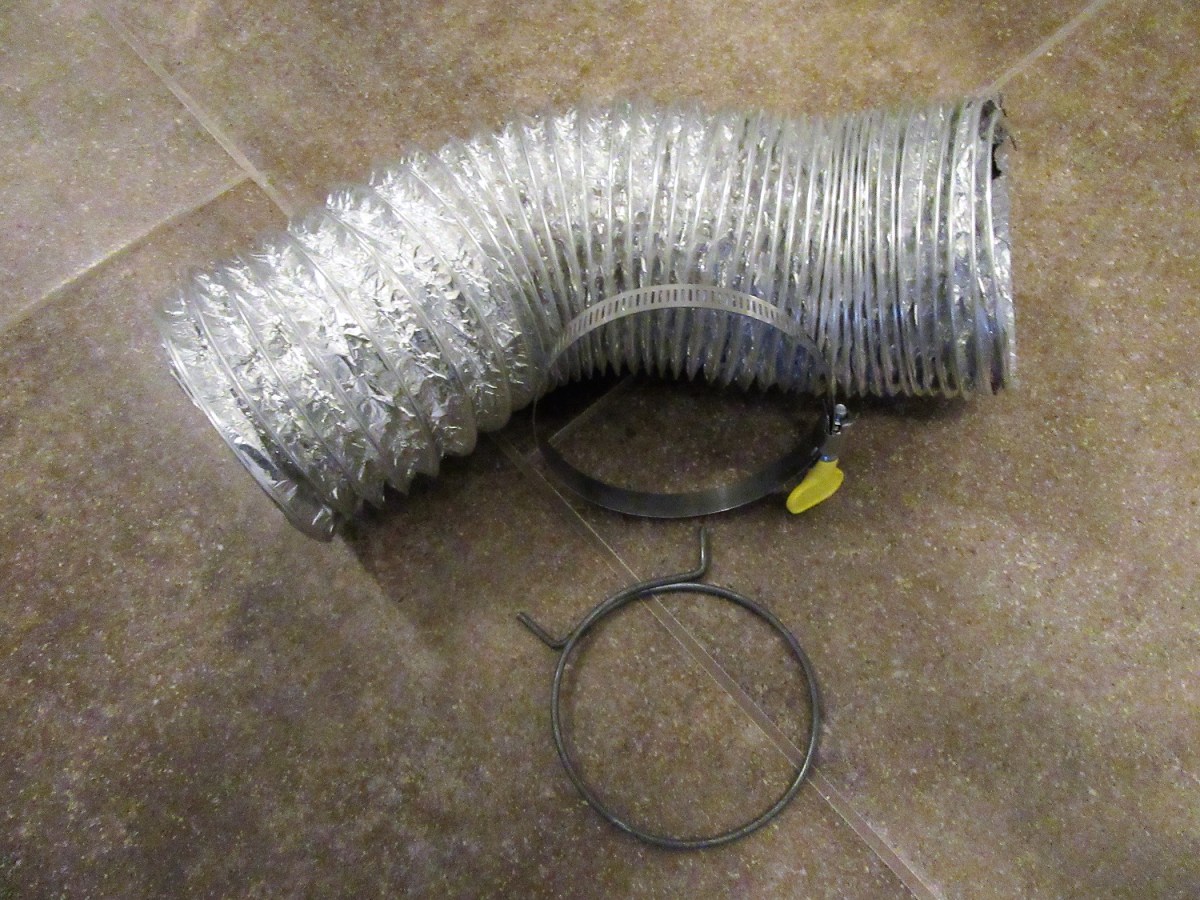
And for the first time, I had to replace a dryer vent duct. I’m the least handy person on the planet. Our washer and dryer pair are both 54 inches tall and I found out that when you have to drag a big dryer away from the wall, you have to do it like you really mean business.
You don’t want to look at what’s behind the dryer. Worse yet is jumping down behind it in a space barely big enough for me to turn around. Getting out of it is even harder. Jump and press to the top of the machines and watch those cords and hoses.
I tried so-called semi-flexible aluminum duct. I switched to flexible foil duct, despite the hardware store guy telling me that it’s illegal. It’s not. You want to wear gloves with either because you’ll cut up your hands if you don’t.
Who’s the genius who thought of oval vent pipe on the wall when the duct is 4-inch round? It’s not illegal but it does make life harder. And how do you attach the duct ends to the pipes? Turn key or screw type worm drive clamps. If you don’t have enough room for a screw driver, the turn key style is the best bet. Good luck finding those wire galvanized squeeze-style full clamps. I think they’re often out of stock because they’re not only older, but easier to use and cheaper.
See what I mean? I would not even have the vocabulary for that kind of job if I were still working as a psychiatrist. I would just hire a handyman to do it—like I do for a lot of other things I still don’t know how to do since I retired. It’s sort of like that Men in Black movie line from Agent K when he tells Agent J what they have to do on their first mission: “Imagine a giant cockroach, with unlimited strength, a massive inferiority complex, and a real short temper, is tear-assing around Manhattan Island in a brand-new Edgar suit. That sound like fun?”
No, it doesn’t and neither does replacing a dryer vent duct or any number of things retired guys get to learn because they have too much time on their hands.
So, I’m really glad to change the subject and talk about other people who are doing things I admire. First is a former student of mine, Dr. Paul Thisayakorn, who is a consultation-liaison (CL) psychiatrist in Bangkok, Thailand. He did his residency at The University of Iowa Hospitals and Clinics. He put together a CL fellowship program in Thailand. The photo below shows from left to right: Paul, Dr. Tippamas, the first CL Psychiatry fellow, and Dr. Yanin. Dr. Tippamas will be the first CL Psychiatry trained graduate in Thailand next year and will work at another new medical school in Bangkok. Dr. Yanin just graduated from the general psychiatry residency program last year. Paul supervised her throughout her CL Psychiatry years. Now she is the junior CL staff helping Paul run the program. Within the next few years, Paul will send her to the United States or the United Kingdom or Canada for clinical/research/observership experience so she can further her CL education. Way to go, Paul and your team!
Dr Paul Thisayakorn and CL Psychiatry grads (see text for details)
By the way, that tie I’m wearing in the Mindfully Retiring from Psychiatry post picture (the one with white elephants; the white elephant is a symbol of royal power and fortune in Thai culture) was a going away gift from Paul upon his graduation.
The other is a heavy-hitter I met years ago, Dr. E. Wes Ely, MD, MPH, a critical care doctor who is publishing a new book,Every Deep-Drawn Breath, which well be coming out September 7, 2021. Our interests converged when it came to delirium, especially when it occurs in the intensive care unit, which is often. I met him in person at an American Delirium Society meeting in Indianapolis. He’s a high-energy guy with a lot of compassion and a genius for humanely practicing critical care medicine. I sort of made fun of one of his first books, Delirium in Critical Care, which he wrote with Dr. Valerie Page and published in 2011, the same year I started a blog called The Practical Psychosomaticist (which I dropped a few years ago as I headed into phased retirement). Shortly after I made fun of how he compared the approaches of consult psychiatrists and critical care specialists managing delirium, he sent me an email suggesting I write a few posts about the ground-breaking research he and others were doing to advance the care of delirious ICU patients—which I gladly did. I think he actually might have remembered me in 2019 when he came to present a grand round in the internal medicine department at University of Iowa Hospitals & Clinics (I wrote 3 posts about that visit: March 28 and April 11 and 12).
In the email Dr. Ely sent to me and many others about the book, he said, “Every penny I receive through sales of this book is being donated into a fund created to help COVID and other ICU survivors and family members lead the fullest lives possible after critical illness. This isn’t purely a COVID book, but stories of COVID and Long COVID are woven throughout. I have also shared instances of social justice issues that pervade our medical system, issues that you and I encounter daily in caring for our community members who are most vulnerable.”
I look up to these and others I had the privilege of working with or meeting back before I was not retired and struggling to come up with a good answer to the dreaded question: What do you do now that you’re retired?
Today the CDC posted the data supporting the change in the mask guidelines for the fully vaccinated. It’s in the July 30, 2021 Morbidity and Mortality Weekly Report (MMWR) describing the outbreak of several hundred new cases of the Delta variant COVID-19 infection in Barnstable County, Massachusetts following July 4th events. Those who were fully vaccinated shed virus as much as the unvaccinated.
Organizers of the Iowa State Fair and those planning to attend, take note.
Brown CM, Vostok J, Johnson H, et al. Outbreak of SARS-CoV-2 Infections, Including COVID-19 Vaccine Breakthrough Infections, Associated with Large Public Gatherings — Barnstable County, Massachusetts, July 2021. MMWR Morb Mortal Wkly Rep. ePub: 30 July 2021. DOI: http://dx.doi.org/10.15585/mmwr.mm7031e2external icon.






 Go Retire Psychiatrist