I know I’d been saying that I probably wouldn’t have time to
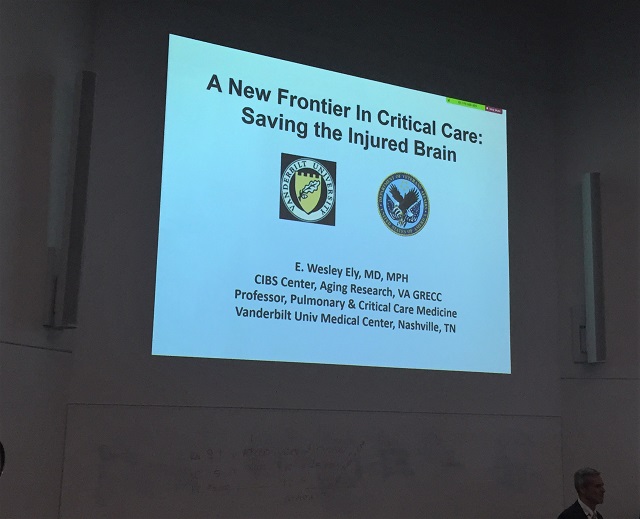
attend Wes Ely’s Grand Rounds presentation yesterday, “A New Frontier in
Critical Care: Saving the Injured Brain.” But against all odds, I
actually got to go, along with some medical students and a Family Medicine resident.
As I expected, Dr. Ely brought the house down. His talk was similar to the one he gave at Emory University in Atlanta, Georgia, but not identical. He described the results of the study “Haloperidol and Ziprasidone for treatment of Delirium in Critical Illness,” published last October in the New England Journal of Medicine. There’s a YouTube video of that in my March 28, 2019 post announcing his visit to Iowa City.
He also discussed in detail the ABCDEF bundle for protecting the brains of patients in the ICU.
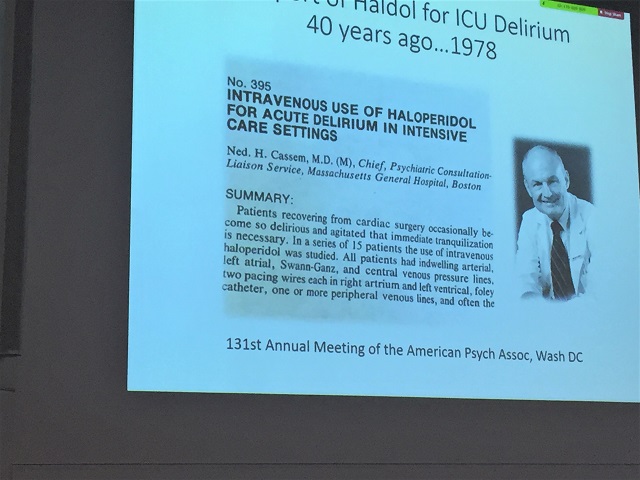
When he outlined the history of intravenous haloperidol for the treatment of delirium in critical care units, I had to cringe because I remembered the continuous IV haloperidol infusion protocol (running at 5-10 mg an hour) developed by Riker and colleagues. I mention it for historical reasons only. I don’t recommend using it.
IV haloperidol for ICU Delirium
Riker, R. R., G. L. Fraser and P. M. Cox (1994). “Continuous infusion of haloperidol controls agitation in critically ill patients.” Critical care medicine 22(3): 433-440.
After his presentation, Dr. Ely asked for questions. I asked him what he thought the role of the psychiatrist is regarding ICU delirium. He actually recognized me; we met very briefly at a meeting of the American Delirium Society in Indianapolis several years ago.
Even better, he knew enough to mention the catatonic variant of delirium and the irony of using a benzodiazepine to treat it, which you would avoid like the plague in delirium (except for alcohol withdrawal, for example). However, benzodiazepines can reverse catatonia. See my post from April 10, 2019 (“Delirium and Catatonia: Medical Emergencies”). He thought psychiatrists would know more about that and would be important collaborators in managing catatonia.
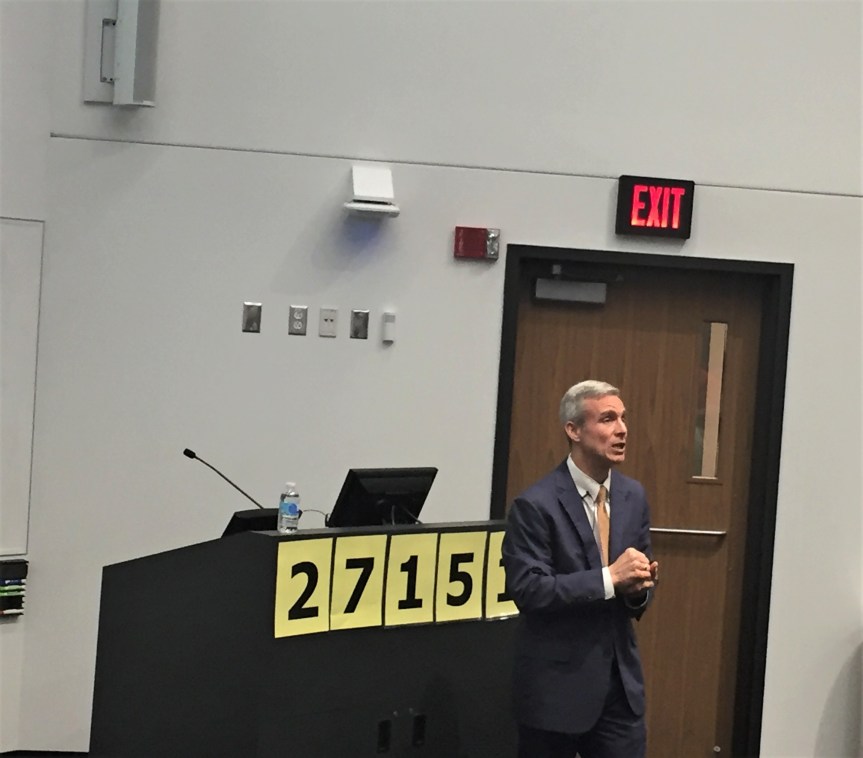
Wes bringing the house down.
It’s difficult not to be excited by the advances in medicine
and psychiatry when an inspirational scientist, humanist, and visionary leader
like Wes comes to town. It makes me wonder how I’m going to get a buzz like
that out of anything I do in retirement.
On the other hand, I get a kick out of making silly videos.
Wes Ely, MD will be giving the Internal Medicine Grand Rounds today at noon at University of Iowa Hospitals and Clinics. The title of his presentation is “A New Frontier in Critical Care: Saving the Injured Brain.”
I’m on duty today in the general hospital as a psychiatric consultant. I’m pretty sure I won’t be able to attend Dr. Ely’s talk, ironically because I’ll be helping colleagues care for delirious patients.
But I found a YouTube video of the talk he gave with the same title. He delivered it in 2017 at a Critical Care Summit meeting at Emory University in Atlanta, Georgia.
I gave a talk to the medical students yesterday about delirium and dementia, which you can view in yesterday’s post. I urged them to try to attend Dr. Ely’s talk today because it would be a stellar, eye-opening, inspirational presentation. I talked about many of the same topics relevant to delirium that he does–but he’s a rock star. He’s a scientist and a humanist. I met him briefly at a meeting of the American Delirium Society several years ago and he’s brilliant.
I was listening to his talk via this YouTube video as I quickly tapped out this post. He’s an intensivist and focuses on delirium in critical care. While the focus of his talk is called “ICU delirium,” I think it’s important to realize that delirium is delirium–anywhere in the hospital or in nursing homes, skilled care facilities, and hospital emergency rooms.
The first-person video that Dr. Ely shows of a patient who developed what is essentially a dementia from prolonged delirium in the ICU is compelling. It’s a stunning revelation from someone who has not recovered from the neurocognitive injury that we call delirium. Some patients have even committed suicide because of the long-term brain injury resulting from delirium.
Dr. Ely makes the point that changing the culture of hospital medicine regarding the approach to assessing and managing delirium is a baby step process. It takes time.
Change happens, especially if we approach it as a team.
It was a very busy day on the consultation psychiatry service today. Besides that, I gave a lecture about delirium and dementia to the medical students. The talk is similar to the one below:
As a reminder, Dr. Wes Ely, MD will be in Iowa City at the University of Iowa Hospitals and Clinics to talk about delirium, “A New Frontier in Critical Care: Saving the Injured Brain.” It will be at noon.
I’m urging medical students and residents to attend. Unfortunately, I’ll probably be too busy in the hospital to go.
I sometimes see what is called a catatonic variant of delirium in patients who are medically very sick.
A condition called catatonia can occur in the setting of
delirium. Most commonly, patients with this condition are mute and immobile.
They may have a fever and muscular rigidity that leads to the release of an
enzyme associated with muscle tissue breakdown called creatine kinase (CK). The
level of CK can be elevated and detectable on a lab test.
Many patients will have a fast heart rate and fluctuating
blood pressure. They may sweat profusely which can lead to a sort of greasy
facial appearance. They may have a reduced eye blink rate or seem not to blink
at all. They may display facial grimacing.
The patient may exhibit the “psychological pillow” (some
call this the “pillow sign”). While lying in bed, the patient holds his head
off the pillow with the neck flexed at what looks like an extremely
uncomfortable angle. The position, like other odd, awkward postures can be held
for hours.
Catatonia can be caused by both psychiatric and medical
disorders. It tends to be more common in bipolar disorder than in schizophrenia
even though catatonia has historically been associated with schizophrenia as a
subtype. You can also see it in encephalitis, liver failure, and in some forms
of epilepsy and other medical conditions.
The patient may perseverate or repeat certain words no
matter what questions you ask. He may simply echo what you say to him and
that’s called “echolalia”.
Although catatonic stupor is what you usually see, less
commonly you can see catatonic excitement, which is constant or intermittent
purposeless motor activity.
The usual way to assess catatonic stupor in order to
distinguish it from hypoactive delirium is to administer Lorazepam
intravenously, usually 1 to 2 milligrams. A positive test for catatonic stupor
is a quick and sometimes miraculous awakening as the patient returns to more
normal animation. The reaction is usually not sustained and the treatment of
choice is electroconvulsive therapy (ECT), which can be life-saving because the
consequence of untreated catatonia can be death due to such causes as
dehydration and pulmonary emboli.
Another less invasive test that doesn’t use medicine is the
“telephone effect” described in the 1980s by a neurologist, C. Miller Fisher.
It was used to temporarily reverse abulia, which in a subset of cases of stupor
is probably the neurologist’s word for catatonia. Sometimes the mute patient
suffering from abulia can be tricked into talking by calling him on the
telephone. It’s pretty impressive when a patient who is mute in person answers
questions by cell phone. I have never tried texting.
The goal is to identify any medical condition left
undiscovered and treat it. Both delirium and catatonia should be thought of as
ominous indicators of a medical emergency.
This transition to retirement has me looking back at times to an earlier transition in my life—college. I wrote a blog post 8 years or so ago about a few of my experiences at Huston-Tillotson College (now Huston-Tillotson University, a private, historically African American school) in Austin, Texas. We called it H-T for short. The post was entitled “Patience is a Virtue.”
You have to remember, this was in the ‘70s. A lot has
changed, including me. The blog post is going to be different now.
I’m not what you’d call a patient person by nature although I’m much older and patience comes easier nowadays. Patience is arguably the physician’s most valuable asset, so it was worthwhile for me to work at cultivating it. We’ve all heard that doctors start yapping almost before patients are through talking.
I’m still learning to be patient. I think I first realized
that people thought I was impatient when I was a freshman at H-T. They were
right; I just didn’t know it then.
I remember a day when I was pretty annoyed about some remarks a peer made during a class in Black History (we were still “black” in those days). After class, I vented about it with the teacher, Dr. Lamar Kirven, who was also a Major in the military. We called him Major Kirven.
We loved Major Kirven. He had a wonderful sense of humor and laughed along with us when we had to tell him we just could not read his indecipherable scrawls on the blackboard. We didn’t have PowerPoint—and I don’t think it would have helped him.
Anyway, Major Kirven listened without saying a word during
my long diatribe. I’ll never remember what that nonsense was all about; it
doesn’t matter now.
He listened deeply and, at the time it didn’t occur to me to
be surprised about that. I was too busy liking the sound of my own opinions. Several
times he could have interrupted and justifiably corrected me.
He didn’t. He waited until I was finished.
And then, very gently he said, “Brother Amos, patience is a virtue”. It suddenly struck me that he had been very
patiently listening to a very impatient young man’s philippic about the
shortcomings of everyone but himself for almost a half hour before he made that
brief observation.
I’ve been trying to be more patient. Along the way, I’ve
discovered and rediscovered the truth of a statement that has often been
attributed to Stephen Covey,
“With people, if you want to save time, don’t be efficient. Slow is fast and fast is slow.”
Stephen Covey
There’s a lot that goes into being an effective psychiatric consultant, not the least of which is the skill of transforming “That’s all I can do” into “I will do all I can.” That’s usually a lot easier if I listen patiently to what my colleagues, my trainees, and my patients want.
As you know, I’m back in the saddle at work, according to the terms of my phased retirement contract. When I’m off service, I feel less pressured. However, when I’m on service, I’m like a fireman, thriving on pressure. I’ve done Consultation-Liaison (C-L) Psychiatry for so many years that, when I stop to think about it, I realize I get a good deal of my sense of meaning and purpose through my job.
I sometimes tell residents and medical students that I “do
it for the juice.” That means I work for the adrenaline: rushing to emergencies,
making quick decisions (some of them far from perfect), teaching on the run,
telling funny stories about how my work as evolved over the years.
When I spent less time on the job during the first two years
of phased retirement, I felt lost. There’s no better word for it. That’s not as
much of a challenge now, but meaning and purpose in retirement can be difficult
for a fireman to define.
I had a blog called The Practical C-L Psychiatrist until I
dropped it last year. There were a couple of reasons. One of them was the
expectation that bloggers write their own Privacy Policies in response to the
European Union’s General Data Protection Regulation (GDPR) going into effect. I
rebelled against it.
Please read my Privacy Policy on this blog. I worked pretty
hard at it. I asked a few attorneys for guidance and only one of them got back
to me, humbly admitting he didn’t know anything about it really, but had a
helpful suggestion nonetheless.
The other reason I dropped The Practical C-L Psychiatrist
was that it was less relevant to my stage of life in that I’m not racing all
over the hospital nearly as much nowadays. I don’t have as much to write about
that life anymore.
But I still love to write and so I swallowed my pride, wrote the Privacy Policy and decided on making a chronicle of my transition into retirement, which is this new blog, Go Retire Psychiatry. So far, I’ve more or less just made jokes about it. I realize that’s a defense. I need to move on and confront the search for meaning and purpose in retirement.
I’ve done a lot of fun things on the job over the years. I used to have mascots for the C-L service, like the one below. You can tell that it was from some time ago. The mascots were usually inflatable animals I bought from the hospital gift shop. The residents, medical students and I gave them silly names. The trouble was that the mascots, being balloons, were always running out of gas.
Winston googling neuroscience.
And that meant that somebody had to take the mascot for a walk all the way across the hospital back to the gift shop to get a healing shot of helium—and walk all the way back. The volunteers there got a big kick out of an old geezer doctor walking the mascot. It was an exercise in humility, which I admit I often needed.
And I took group pictures of trainees and me at the end of rotations by using an app on my old iPad. It’s called CamMe. The way it worked was that I set the iPad up on a stack of books or something; then we all stood for the shot. I would hold up my hand and make a fist to start a 3-2-1 countdown, which gave you just enough time to make a big smile for the automatic group selfies. Everybody got a kick out of it.
I was so proud of those pictures I thought nothing of posting
them on my blog, with nary a thought about their privacy. All of them thought
they were fun.
That’s about enough on meaning and purpose for today.
Good Gahd Amighty, it was busy today! I really had to start my engine. It felt like I logged a lot more than 2.6 miles and 21 floors on the step counter. It’s days like this one that I’m not going to miss when I retire.
I don’t think I could exercise enough to withstand too many hectic days. I need to be a transformer of some kind.
I could use a break, so it’s a good thing I got the weekend off. I think I can feel my age.
The only time I want a wild ride like that is if I’m at an amusement park.
In fact, my wife and I had a great time at the Mall of America in Minnesota a few years ago. See for yourself.
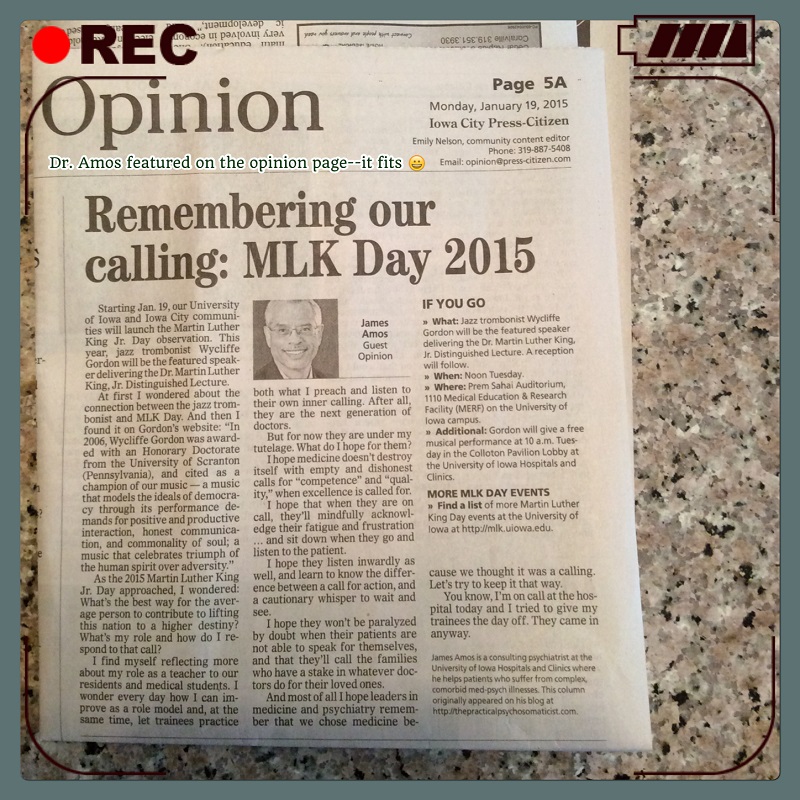
Back when I had the blog The Practical C-L Psychiatrist, I wrote a post about the Martin Luther King Jr. Day observation in 2015. It was published in the Iowa City Press-Citizen on January 19, 2015 under the title “Remembering our calling: MLK Day 2015.”
I have a small legacy as a teacher. As I approach retirement next year, I reflect on that. When I entered medical school, I had no idea what I was in for. I struggled, lost faith–almost quit. I’m glad I didn’t because I’ve been privileged to learn from the next generation of doctors.
“Faith is taking the first step, even when you don’t see the whole staircase.”
Martin Luther King, Jr.
As the 2015 Martin
Luther King Jr. Day approached, I wondered: What’s the best way for the average
person to contribute to lifting this nation to a higher destiny? What’s my role
and how do I respond to that call?
I find myself
reflecting more about my role as a teacher to our residents and medical
students. I wonder every day how I can improve as a role model and, at the same
time, let trainees practice both what I preach and listen to their own inner
calling. After all, they are the next generation of doctors.
But for now they are
under my tutelage. What do I hope for them?
I hope medicine doesn’t
destroy itself with empty and dishonest calls for “competence” and “quality,”
when excellence is called for.
I hope that when they
are on call, they’ll mindfully acknowledge their fatigue and frustration…and
sit down when they go and listen to the patient.
I hope they listen
inwardly as well, and learn to know the difference between a call for action,
and a cautionary whisper to wait and see.
I hope they won’t be
paralyzed by doubt when their patients are not able to speak for themselves,
and that they’ll call the families who have a stake in whatever doctors do for
their loved ones.
And most of all I hope
leaders in medicine and psychiatry remember that we chose medicine because we
thought it was a calling. Let’s try to keep it that way.
You know, I’m on call at the hospital today and I tried to give my trainees the day off. They came in anyway.
Today, a colleague and I compared socks. I noticed he was wearing
a pair of Go Iowa Hawkeye-type socks. They looked pretty good—and then I showed
him my brand-new Taco Avocado Alien socks. He was pretty impressed. They are
the Darn Weird socks of America.
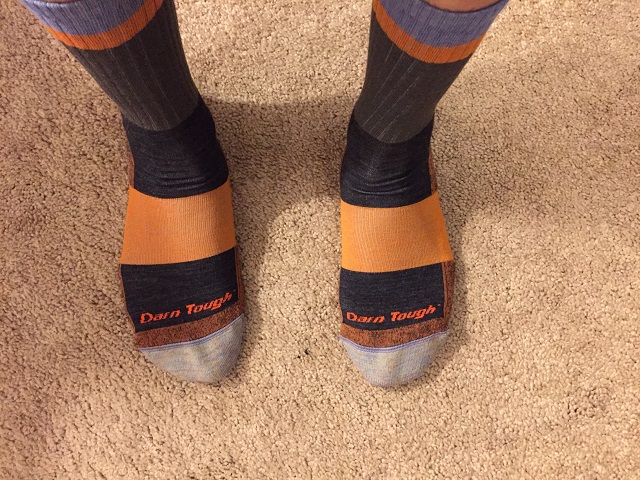
On the other hand, around 3 years ago, I found out about Darn Tough socks and got a couple pairs. They’re still tough, no matter how many stairs I climb.
Darn Tough socks have an unconditional lifetime replacement
guarantee. They’re made in Vermont. They’re not cheap. But hey, if they’re good
enough for dairy farmers in Wisconsin, they got to be good enough for me.
I’m not sure how long my Taco Avocado Alien socks are going to last. I usually get about 2-3 miles and 20 floors and more logged on my step counter as I hoof it around the hospital in my job as a Consultation-Liaison Psychiatrist. Today I logged 2.9 miles and 27 floors. And when I got home, I exercised in them. I wore my geezer Velcro tennis shoes, of course.
That kind of punishment often leads to my wearing out socks in a few weeks. Usually the toes go quick. Maybe my Darn Weird socks won’t last. I Like the Taco Avocado Alien theme anyway. I still haven’t figured out what the connection is between aliens, tacos, and avocados. Sure, you make guacamole from avocado for tacos and so they’re all green. Maybe that’s all there is to it.
Then again, we have to ask ourselves, do aliens like tacos
with guacamole? I guess you’d have to ask the guys on the Ancient Aliens TV show
(it’s on the History Channel), which I watch every Friday. It’s relaxing and often
puts me to sleep. Does Giorgio A. Tsoukalos, a.k.a. the hair guy, wear Taco
Avocado Alien socks? There are so many memes out there about him, it wouldn’t
surprise me if you could find a picture of him wearing them—photo-shopped, of course.
I’ve noticed that I’m getting more garrulous as I age. In fact, I call this anecdotal garrulity and I always warn my trainees that I’m about to tell them yet another war story which usually involves some activities or processes in my job as a Consultation-Liaison (C-L) Psychiatrist that nobody knows about anymore–but should.
My anecdotes tend to grow longer and more woolly as the years pass. I add a detail or nuance to the story that adds extra angles, twists and turns, and bits of hair-raising action. Some of them never happened. No, I ‘m just kidding. I don’t actually lie; I just polish the history a little bit.
One example of anecdotal garrulity in which the tales get hairier with each performance, I mean embellishment, no I mean repetition–involve people I’ve encountered while blogging on WordPress.
One of them is Dr. Igor Galynker, a brilliant psychiatrist at Beth Israel in New York who has done very important research in suicide risk assessment. He has recently published a book about the suicide crisis syndrome, The Suicidal Crisis: Clinical Guide to the Assessment of Imminent Suicide Risk. I purchased a copy and am reading it whenever I get a chance. I wrote a post about a paper he published regarding his suicide risk assessment research in my previous blog, The Practical C-L Psychiatrist, which started off with the name The Practical Psychosomaticist for goodness sakes, what a name! The name Psychosomatic Medicine (PM), by the way, was chosen by the American Board of Psychiatry and Neurology (ABPN) and the American Board of Medical Specialties (ABMS) about 2,000 years ago when this subspecialty got approved by the Accreditation Council on Graduate Medical Education (ACGME).
Come to think of it, I probably ought to call it a supraspecialty instead of a subspecialty and that name originated with another grand beacon of academic C-L Psychiatry (I mean besides me), Dr. Theodore Stern, at an annual meeting of the Academy of Psychosomatic Medicine (that’s what it was called then, if you can believe it; but now, because the members of the academy (including me) howled about it and voted to change it to something that made some darn sense, it is now rightly called the Academy of C-L Psychiatry; we’re finally correctly identified, good gahd’amighty) and you will not find “supraspecialty in Webster’s Dictionary although “supra” comes from the Latin for “above, beyond, earlier”. One of the definitions is “transcending”. I tried to Google “supraspecialty” and came up empty, so it’s a bona fide neologism. Dr. Stern coined the term while talking about the scope of practice of PM. As he went through the long list, it gradually dawned on me why “supraspecialty” as a title probably fits our profession. It’s mainly because it makes us, as psychiatrists, accountable for aspects of general and specialty medical and surgical care above and beyond that of Psychiatry alone. That doesn’t make us deities; just better than most doctors on the planet. Of course not; I’m only kidding. Can’t you take a joke?
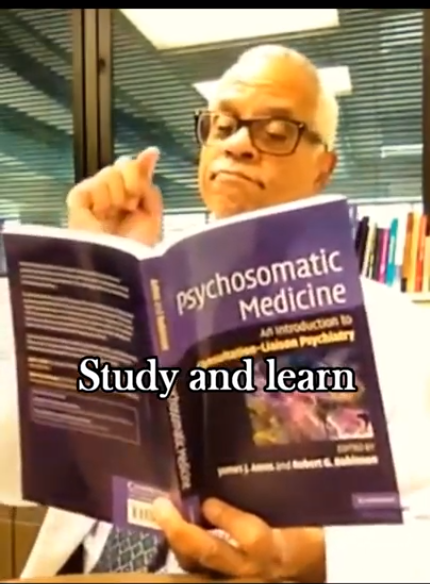
Where was I ? Oh, getting back to Igor Galynker, I wrote a post about one of his papers on the assessment of imminent suicide risk, published in about 2014 I believe, a few years after the book Robert G. Robinson and I edited was published, Psychosomatic Medicine: An Introduction to Consultation-Liaison Psychiatry, a block bluster that you cannot put down and will read cover to cover; the level of interest just climbs, almost the effect you get from my award-winning and wildly popular video on pseudobulbar palsy.
Command Performance by Jim Amos, MD
Anyway, shortly after I posted that, I got a box in the mail with a very strange-looking address for me:
Hey, what do you know, I work for WordPress!
Even more astonishing was what was in the box. It was Bumpy the Bipolar Bear, an item that evidently was a part of his Mood Disorder Division at Beth Israel.
Bumpy is the one with the Fire Chief helmet
I have never really figured out whether he did this tongue-in-cheek or what. We’ve never met and we don’t correspond. It doesn’t look like Bumpy is a thing anymore at Beth Israel.
I’m not a research scientist, but I wonder if anyone would fund a center for the study of Anecdotal Garrulity? More importantly, would a statue of me, sculpted from Play-Doh (originally wallpaper cleaner, something you’d know if you watched the Travel Channel as much as I do now that I’m retiring), be erected in the rotunda?
Retirement takes a back seat today for this announcement: Dr. Wes Ely, Critical Care Specialist and one of the foremost experts in intensive care unit (ICU) delirium at Vanderbilt University will be speaking at The Newman Center in Iowa City on April 11, 2019 at 7:00 PM, “Maximizing Dignity at End of Life: Insights from the ICU.” He’ll also deliver the Internal Medicine Grand Rounds at the University of Iowa at noon, “A New Frontier in Critical Care: Saving the Injured Brain.”
I was notified by one of our critical care specialists, Dr. Gregory A. Schmidt, MD, who co-authored the recently published study showing that antipsychotics are not effective treatment for delirium. Wes talks about the study in the video below:
Dr. Wes Ely
I met Dr. Ely briefly at one of the annual meetings of the American Delirium Society several years ago. He’s enthusiastic, brilliant, and inspiring. He’s published hundreds of articles and book chapters on delirium and taking care of the brain. Along with Dr. Valerie Page (another critical care specialist) he co-authored a book entitled Delirium in Critical Care, originally published in 2011 and I see that there is a 2nd edition available, published in 2015 by Cambridge University Press.
That is the same publisher, incidentally, for the book I co-edited with Dr. Robert G. Robinson, Psychosomatic Medicine: An Introduction to Consultation-Liaison Psychiatry)–shameless plug for my book.
I have a copy of the first edition, which contains a section about the role of the psychiatrist in ICU delirium. It’s very short, which I think is very appropriate. Dr. Alasdair MacLullich, Professor of Geriatric Medicine, Professor of Geriatric Medicine at the University of Edinburgh and past President of the European Delirium Association, wrote the foreword to the 2nd edition and he describes Dr. Ely as “…perhaps the best recognized expert in this field worldwide,” referring to delirium.
Incidentally, about 8 years ago Dr. MacLullich and I corresponded about his research team’s development of the Edinburgh Delirium Test Box (EDTB), an instrument for detecting attentional abnormalities that are a defining feature of delirium. He loaned us the box and I eventually turned it over to a colleague for continuing use of it as part of an ongoing delirium committee project to improve the early detection and prevention of delirium at our hospital. There is now a smartphone application for it.
Where is this thing called an “app”?
Regrettably, I probably won’t get to hear Wes give his presentation—because I’m on duty as the general hospital psychiatric consultant and most likely will be trying to help physicians care for delirious patients.
References:
Girard, T. D., et al. (2018). “Haloperidol and Ziprasidone for Treatment of Delirium in Critical Illness.” N Engl J Med 379(26): 2506-2516.
BACKGROUND: There are conflicting data on the effects of antipsychotic medications on delirium in patients in the intensive care unit (ICU). METHODS: In a randomized, double-blind, placebo-controlled trial, we assigned patients with acute respiratory failure or shock and hypoactive or hyperactive delirium to receive intravenous boluses of haloperidol (maximum dose, 20 mg daily), ziprasidone (maximum dose, 40 mg daily), or placebo. The volume and dose of a trial drug or placebo was halved or doubled at 12-hour intervals on the basis of the presence or absence of delirium, as detected with the use of the Confusion Assessment Method for the ICU, and of side effects of the intervention. The primary end point was the number of days alive without delirium or coma during the 14-day intervention period. Secondary end points included 30-day and 90-day survival, time to freedom from mechanical ventilation, and time to ICU and hospital discharge. Safety end points included extrapyramidal symptoms and excessive sedation. RESULTS: Written informed consent was obtained from 1183 patients or their authorized representatives. Delirium developed in 566 patients (48%), of whom 89% had hypoactive delirium and 11% had hyperactive delirium. Of the 566 patients, 184 were randomly assigned to receive placebo, 192 to receive haloperidol, and 190 to receive ziprasidone. The median duration of exposure to a trial drug or placebo was 4 days (interquartile range, 3 to 7). The median number of days alive without delirium or coma was 8.5 (95% confidence interval [CI], 5.6 to 9.9) in the placebo group, 7.9 (95% CI, 4.4 to 9.6) in the haloperidol group, and 8.7 (95% CI, 5.9 to 10.0) in the ziprasidone group (P=0.26 for overall effect across trial groups). The use of haloperidol or ziprasidone, as compared with placebo, had no significant effect on the primary end point (odds ratios, 0.88 [95% CI, 0.64 to 1.21] and 1.04 [95% CI, 0.73 to 1.48], respectively). There were no significant between-group differences with respect to the secondary end points or the frequency of extrapyramidal symptoms. CONCLUSIONS: The use of haloperidol or ziprasidone, as compared with placebo, in patients with acute respiratory failure or shock and hypoactive or hyperactive delirium in the ICU did not significantly alter the duration of delirium. (Funded by the National Institutes of Health and the VA Geriatric Research Education and Clinical Center; MIND-USA ClinicalTrials.gov number, NCT01211522 .).
Tieges, Z., Stíobhairt, A.,
Scott, K., Suchorab, K., Weir, A., Parks, S., . . . MacLullich, A. (2015).
Development of a smartphone application for the objective detection of attentional
deficits in delirium. International Psychogeriatrics, 27(8),
1251-1262. doi:10.1017/S1041610215000186