
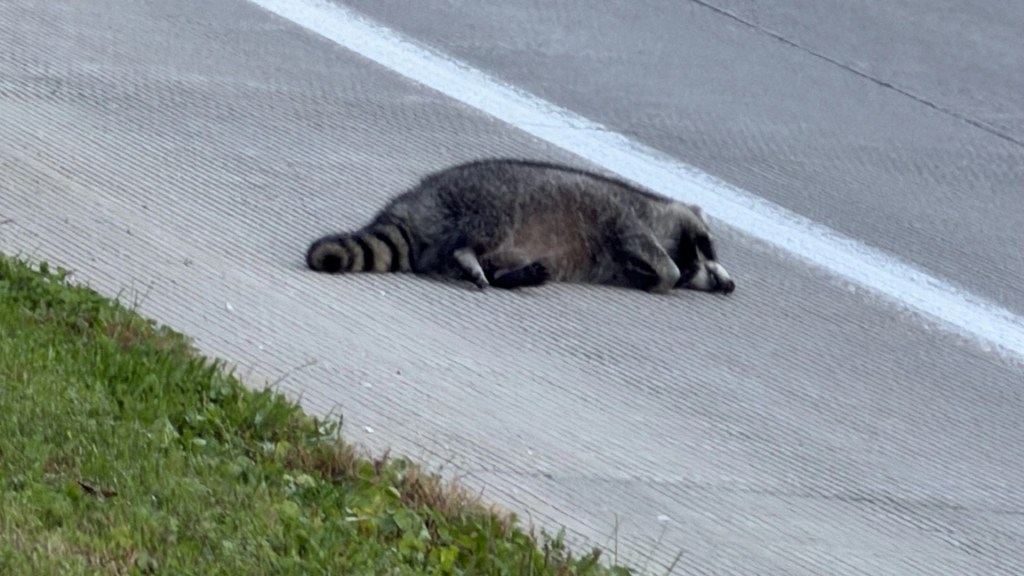
I’ve read the recent news reports about rabid raccoons in California. About two weeks ago while I was out for my usual walk around the block, I found a dead raccoon in the street. It was hard to tell if it was killed by a motor vehicle. There was no blood at the scene.
I called the Iowa City police department’s non-emergency phone number to request removal of the carcass. That’s what I did to get the carcass of an adult deer a month ago that got left on the side of the street next to the sidewalk where I always walk. The deer had obviously been hit by a vehicle.
While there is no animal control agency to contact for help with animal carcass removal per se in Iowa City, you can call the local police to have a carcass removed.
There was a puzzling part of the raccoon removal process. When I called the police, the carcass was in the bicycle lane of the street. When Sena drove by the street on her way home later, she saw the carcass had been moved off the street on to the grass next to the sidewalk.
That raised a question about who moved it. It could have been a driver who thought it would be a good deed to pick it up and move it out of the street. The next day we walked by the area and didn’t see the raccoon carcass. We assumed that the responsible agency had picked it up, but there was no way to know without calling the police. I chose not to do that.
Further, Sena told me that around a week after that she saw a couple of dead raccoons lying dead on a different street she’d been driving on. Later, she found that one of them had been placed in the grass with its head chewed off and the other carcass was still in the street.
That’s a segue into a friendly warning never to touch a dead animal known to catch rabies because the consequences could be deadly. Maybe you should never touch any dead animal, period.
The Iowa Dept of Natural Resources Rabies web page has helpful information for anyone interested in learning more about the disease and how to protect yourself from infection. While the main animal associated with rabies is the bat, raccoons can also carry the deadly virus, which is uniformly fatal without post-exposure rabies prophylaxis (PEP), available through hospital emergency departments. Other guidance includes vaccinating pets against rabies and never handling a wild animal—dead or alive.
Raccoons are beneficial to the environment because they disperse seeds, help control insects, and ironically eat carrion, breaking down the carcass and promoting soil health.
So, it’s probably not true that the only good raccoon is a dead raccoon—because their carcasses could be dangerous if they’re fresh enough to still bear their saliva. There is a document published by the Hudson Community College about Handling Safety Procedures, which specifies one method for disposing of a carcass which could have been rabid. It’s under the Handling Animal Carcasses section. Among the recommendations is to use a specialized shovel (“carcass scoop”) used for roadkills.





Leave a Reply