
I’ve been looking at my old WordPress blog posts from 16 years ago. I found one entitled “The Lantern of Diogenes.” It’s connected to Dr. Jenny Lind Porter, who published her book of poems in 1954, entitled The Lantern of Diogenes.
I guess I can repost the first part of that blog post, in which I talk about her book and the poem in it of the same name. I’m not sure that would count as a reblog, since I originally posted it in 2010 in my first WordPress blog, The Practical Psychosomaticist (which I later renamed The Practical Consultation-Liaison Psychiatrist). I cancelled that blog around 2018. In any case, the second part of that post was about delirium. However, because her book is still under copyright, I can’t copy the poem “The Lantern of Diogenes” itself.
But I did use a picture of Diogenes on the home page of my old blog, The Practical Psychsomaticist.
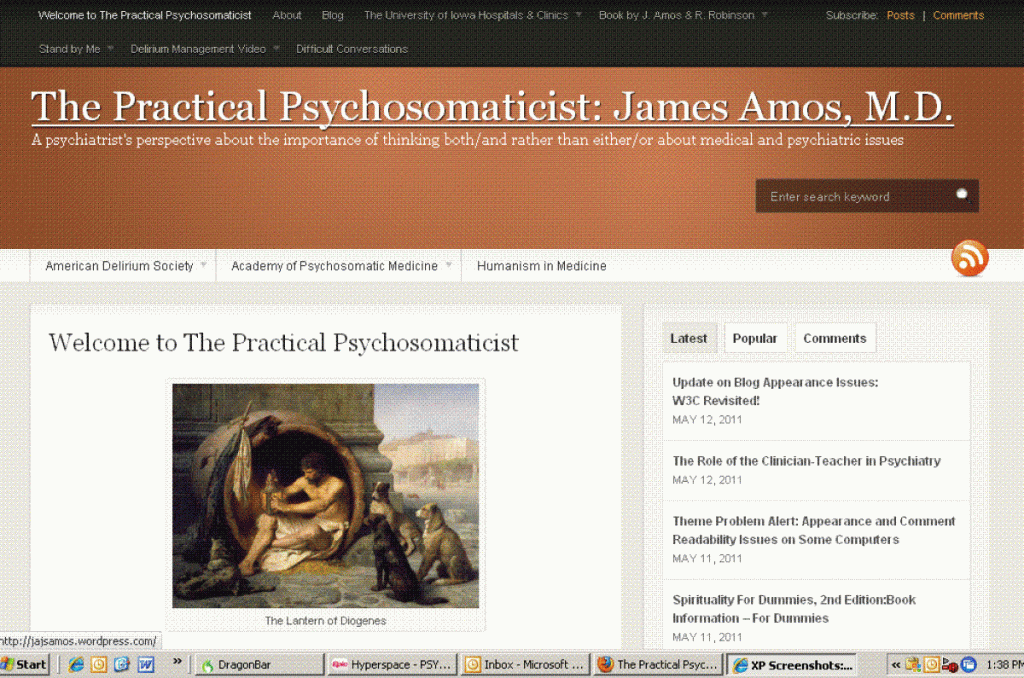
I did discover just the other day something called Diogenes Syndrome (which had been called senior squalor syndrome). I’d never heard of it. It’s not something you’ll find in textbooks of medicine and psychiatry. It is sometimes called “severe domestic squalor.” This is in keeping with the story of Diogenes the Cynic, who was a philosopher who was said to have lived in a large jar and behaved as though he didn’t care about living in squalor.
Diogenes the Cynic was an ancient Greek philosopher who is said to have wandered about Athens with a lit lantern in broad daylight looking either for “an honest man” or simply looking for a man, depending on which version of his life one reads. Despite the story about his search for an honest man, you can find accounts of him being accused of either stealing from the mint in Corinth or defacing its coinage. He taught that man should live by reason and lived a very ascetic life. He was eccentric and provocative. He was reported to have masturbated in public and when censured, remarked that he wished it were as easy to allay hunger by rubbing one’s belly. He’s said to have lived in a tub after an apartment could not be found for him expeditiously.
He has been called a practical philosopher who preferred to live his convictions and principles rather than write about them.
I’m not sure how he came to be a subject for Dr. Porter’s poem. I wonder if the lantern is a symbol of reason. Another association for me was something I recall from Sunday school in my early childhood. It’s a little song called This Little Light of Mine. I gather even Bruce Springsteen has recorded a version. Just to jog your memory, the first few lines go:
This little light of mine,
I’m going to let it shine.
This little light of mine,
I’m going to let it shine.
This little light of mine,
I’m going to let it shine,
Ev’ry day, ev’ry day,
Ev’ry day, ev’ry day,
Gonna let my little light shine.
There’s even a web page that links Diogenes to the mystical, linking him to a search for wisdom, which is plausible because Dr. Porter had an interest in the metaphysical.
I think she connected with a sanitized version of Diogenes and there can be a contemporary message in it for those of us who are trying to teach doctors, nurses, and hospital administrations about delirium and the importance of recognizing and treating this acute syndrome that mimics many primary psychiatric illnesses but is actually a medical emergency that kills and disables many patients, especially the elderly who are frail in some way, such as suffering from dementia.
If I may focus on the dementia part of this essay, I remember a neighbor who lived across the street from us many years ago in Mason City, Iowa who was elderly and eccentric. At odd times during the day or especially in the evening when traffic was pretty loud, she would slam her door at the noise and yell about the racket. She invited us into her house once day and we were appalled to see that there was no place to sit because just about every conceivable space was covered by an uncountable number of newspapers. She evidently collected them and never threw them out. She didn’t seem to notice the clutter.
Diogenes syndrome is sometimes conflated with hoarding, although some authors would make a distinction between them. I was surprised to find a fairly recent news article as well as a case report about Diogenes syndrome.
Proctor C, Rahman S. Diogenes Syndrome: Identification and Distinction from Hoarding Disorder. Case Rep Psychiatry. 2021 Nov 25;2021:2810137. doi: 10.1155/2021/2810137. PMID: 34868693; PMCID: PMC8639269.
I would consider Diogenes Syndrome to be a risk factor for delirium, similar to dementia.







Leave a Reply