
Thoughts on “An Occurrence at Owl Creek Bridge”

Sena and I got to talking about a Twilight Zone show we saw over the holidays. It was a 1964 episode, not the regular program but short film that won a Cannes Film Festival award in the early 1960s, “An Occurrence at Owl Creek Bridge.”

The quick summary is that a Southern plantation owner is being hanged by Union soldiers for trying to set fire to the bridge to prevent the Union Army from attacking Confederate troops. The plantation owner seems to miraculously escape the noose, evades bullets and cannon fire, running all the way back to his plantation in an escape which lasts hours, finally almost rushing into his wife’s arms—but he can’t because at that moment his neck is snapped by the hangman’s rope. All of the action during his escape is a hallucination which happens in the blink of an eye.

It’s based on a short story of the same title by Ambrose Bierce. I vaguely recalled reading it years ago, possibly in a science fiction/fantasy anthology. At that time, I didn’t know the author’s background, which was that he’d been a Union soldier in the Civil War. He fought in a lot of battles and witnessed horrific injuries and death. He disappeared without a trace, and there is no explanation why or how.

As Sena and I talked about it, she wondered more about the details of the Civil War as context, while I thought the main point was about the time compression of a miraculous escape from execution that spoke of the nature and meaning of life and death.

When I searched the web to find out more about the story and the life of Ambrose Bierce, I saw her point.

I read the original story on the Internet Archive. It’s very short. Now, I’m not sure I ever really read it. I’m just a blogger and unworthy to really talk about it other than to acknowledge that it’s a work of genius. How the author’s spare and yet meticulous attention to every terrifying detail of war can be so ugly and yet so mesmerizing is beyond my understanding.
Thoughts on the Russian Invasion of Ukraine

I got up at around 3:30 AM this morning, unable to get back to sleep. It was mainly because of the current crisis in Ukraine. Russia has invaded Ukraine. I wonder if many of us will remember where we were and what we were doing when we found out that Russia invaded Ukraine? For us, it was sometime around 9:30 last night. I was listening to the light classical music channel on TV in our living room when Sena came up from downstairs where she had been watching the news and told me about it.

I switched to the TV news and saw two reporters, one based in the U.S. connected as part of the broadcast with another in Kyiv reporting on the shelling of the city. The reporter in Ukraine kept looking back over her shoulder at the city. She seemed distracted and distressed. The other reporter, based in the U.S., asked irritably, “What do the bombs sound like?” as though he were unhappy with her account of what was going on. She replied, just as irritably, “They’re loud!” I think she wanted to also say (as I did in my mind), “They sound like bombs and they’re scary; what do you think bombs sound like?”

I listend to various reporters talk about the attack. One of them commented that President Biden had said there would be no American soldiers actively engaging in combat in Ukraine. If they did, it would be “World War III.”

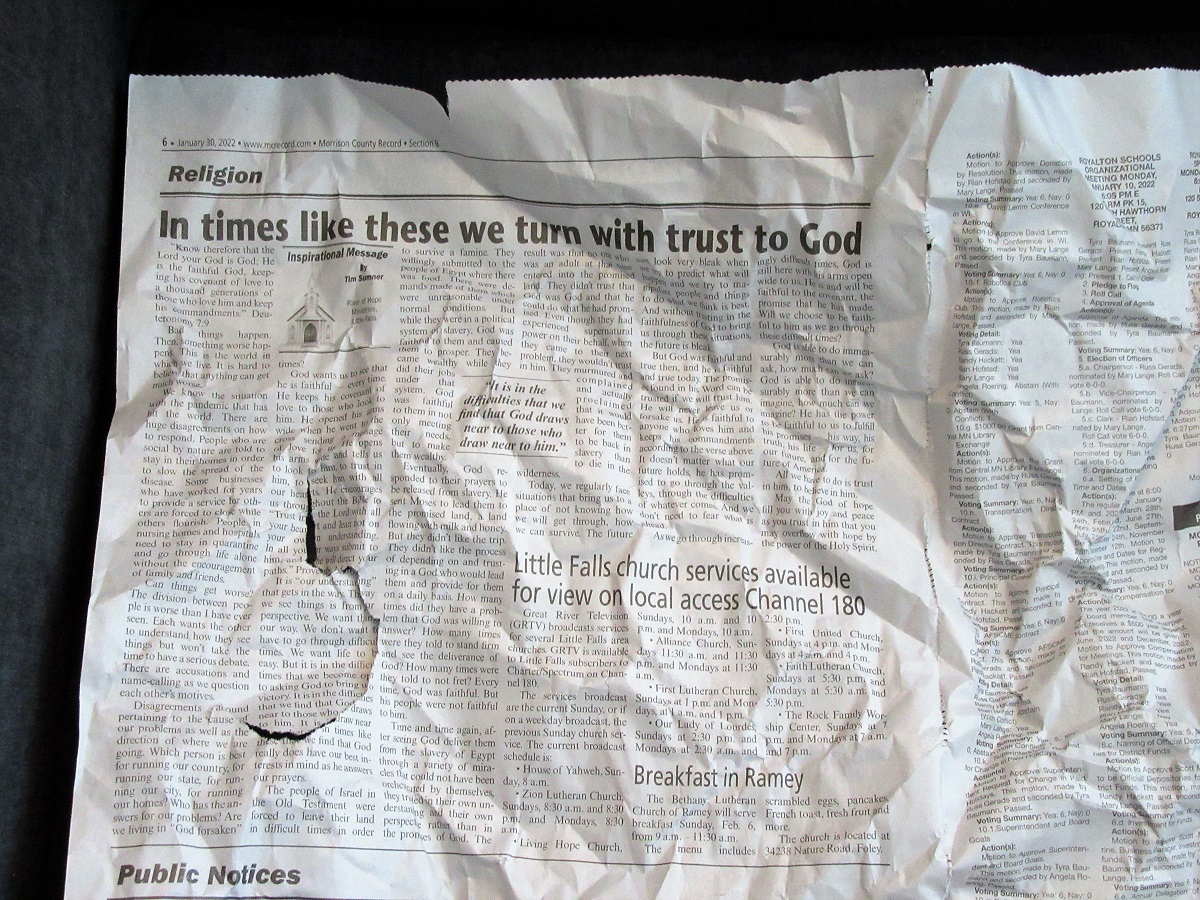
I thought of the other post I’d written for today. It’s just about a cribbage board in the shape of the state of Iowa that we got from Minnesota the day before yesterday. It came wrapped in a newspaper, probably the whole issue published about a month ago by the Morrison County Record in a town called Little Falls.

We just thought it was unusual that the cribbage board was shipped wrapped in newspaper; usually it’s those Styrofoam packing peanuts or bubble wrap. But this was like getting something from a friend or a family member who used the only thing handy to pack a gift.

I didn’t just toss the newspaper wrapping in the garbage, mainly because I enjoy reading actual printed material including books and newspapers. I was curious about it and so I found the article “In times like these” which I also described in the other post today, which is partly about a cribbage board in the shape of the state of Iowa. The article is a sermon, written by a local clergyman, Tim Sumner.

In it he talks about how difficult things are nowadays, that people are more divisive than he has ever seen. He mentioned the pandemic as a major contributor, but it’s easy to see how it could be applied more broadly now that major world powers seem to be moving toward war to feed what seems to be a hunger for empire-building.

Sumner, in accordance with his role as a clergyman, counsels us to turn to God. In view of the talk of World War III, it’s hard to disagree. Sumner asks, “Can things get worse?” It looks like it can.

I could find a lot of cribbage boards in the shape of single states in America. I could even find one of Middle Earth, believe it or not. But I couldn’t find one in the shape of the whole United States of America. Why?

Sumner writes,

It is “our understanding” that gets in the way. The way we see things is from our perspective. We want things our way. We don’t want to have to go through difficult times. We want life to be easy.

Maybe that’s true. He says trusting God is the way to respond to this. We could do that. And while we’re waiting for God to respond to us, what else could we do?

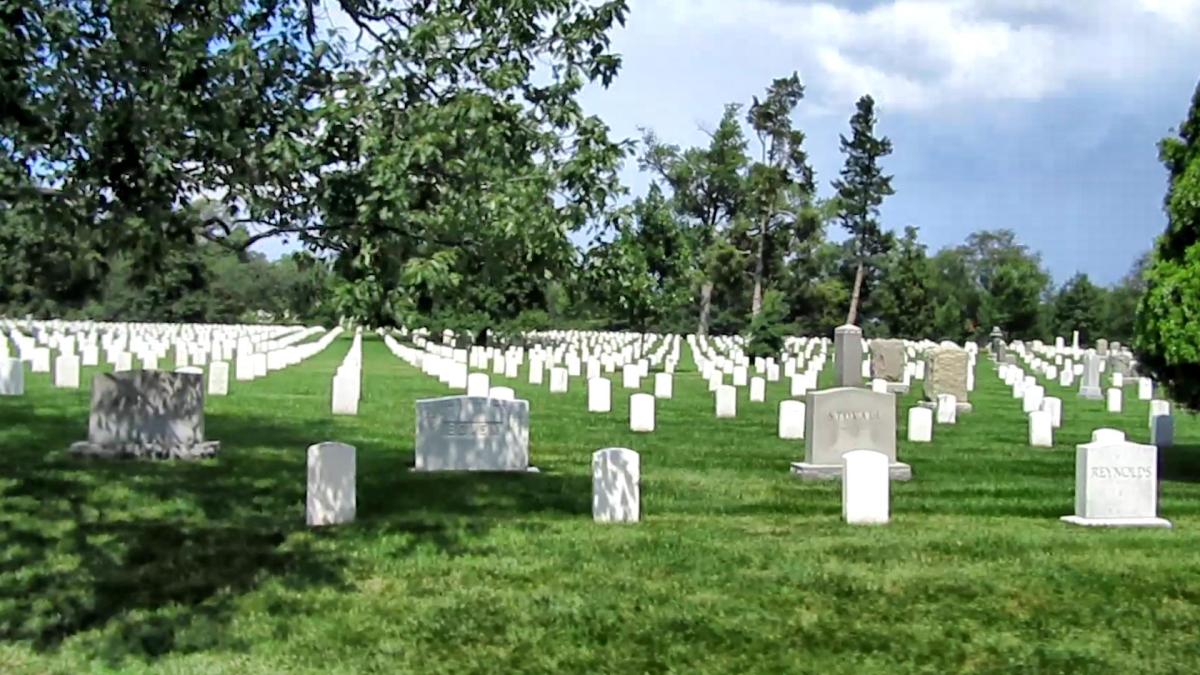
Memorial Day Reflection

It’s a cool, sunny afternoon. The lawn has just been neatly mowed by hard-working, reliable people who use power mowers. We used to mow lawns at previous properties using old-time reel mowers. I should say my wife used to do the lion’s share of that while I was at the hospital, working as a consulting psychiatrist. Now that I’m retired, I sometimes just wonder what I’m good for.

But it’s not hard to remember what Memorial Day is for. I was never a soldier. I never knew anyone who died in war. I only talked with military recruiters in a time so long ago, I barely remember being that young. I think they knew I was not ready to die for my country. They didn’t scorn or openly reject me. They treated me with respect.

Though I know what grief is because I am bereft, I cannot imagine what it’s like to grieve the death of any loved one who perished in war.

All I know is that when I was young and thought I wanted to be in the armed forces, there were recruiters who saw through me and knew I did not want to be a soldier.

They knew I did not want to die thousands of miles from my home in a bloody field. They knew I did not want to be buried forever in a foreign graveyard.

They knew I could not be one of them. Yet they did not treat me like an outsider. Now all I can do is be grateful. Now what I can do is honor them in silence.