
Calpurnia’s Lesson

I finished To Kill a Mockingbird by Harper Lee a couple of days ago. Calpurnia’s line toward the end of Chapter 12:

It’s not necessary to tell all you know. It’s not ladylike—in the second place, folks don’t like to have somebody around knowin’ more than they do. It aggravates ‘em. You’re not gonna change any of them by talkin’ right, they’ve got to want to learn themselves, and when they don’t want to learn there’s nothing you can do but keep your mouth shut or talk their language.

That stuck in my head until the end of the book. It reminds me of my time at an HBCU, Huston-Tillotson University (then Huston-Tillotson College) in Austin, Texas. I was the only black child in my classes in grade school while I was growing up in Iowa. Nobody noticed how I talked because I sounded like everybody else.

But I didn’t have a Texas twang at H-TC. I also tended to talk too much. Finally, one student asked me, “Why do you talk so hard?” Those were her exact words. I don’t remember my reply, or if I even had one. I hope I just shut up.

That doesn’t mean that black students all had a drawl or were terse. One of them I remember called himself Malachi. He didn’t have a drawl or twang. He pronounced it Ma-Lah-Chee, emphasis on the second syllable.  He had an ordinary English name. One of the English professors tried to tell him that, if he was trying to model himself after the Hebrew prophet in the Bible, he should pronounce it Ma-Luh-Kai. He didn’t buy it.

And there was the guy I had to debate in philosophy and logic class. He talked way too much—which is a big part of the reason I lost the debate. I couldn’t get a word in edgewise. My professor hinted that being too polite by not interrupting was unlikely to help me in debates with bombastic opponents.

I have sometimes found myself either staying clammed up or talking too much, often at the wrong times with the wrong people.

I think there must be a happy medium somewhere. If I can’t talk the talk, is there a way to walk the talk? If I respect others, and believe we should all show respect for one another, I don’t have to drone on forever about it. I can hold the door open for them.
Wandering Thoughts on Talents and Traits in “To Kill a Mockingbird”

I’ve been reading To Kill a Mockingbird and thinking over something a character named Miss Maudie said in Chapter 10: “People in their right minds never take pride in their talents.” It seems to run counter to popular opinion. Why wouldn’t you take pride in your talents?

I got a lot of hits on my google search for this quote, by the way.

Miss Maudie’s statement was soon after Atticus shot a rabid dog with a marksman’s skill. Jem and Scout had been grousing about how they couldn’t find anything to be proud of in their old man. Atticus had never told his children about his skill as a marksman. He gave his kids guns but declined to teach them how to shoot.

I try to make sense of Miss Maudie’s comment by thinking about marksmanship as a skill, which is often distinguished from a talent, usually because the latter is thought to be a trait you’re born with. On the other hand, it’s hard to think of modesty (which is what keeps you from bragging or “taking pride”) as a talent. Some might say it’s more like a character trait.

Can you can develop a talent by practice? Can you improve your modesty by working at it and how would you do that, deadlifting your inner barbells? I tend to think you either have it or you don’t. And why does it take being in your right mind to refuse to take pride in or brag about your talent?

I often hear athletes (think Super Bowl) bragging non-stop about their talents. But I stop well short of admiring them for doing it. It’s annoying, but often preferable to the half-time show. Why do they grab their crotches?

Maybe it doesn’t make sense to brag about a talent you’re born with. I’m not sure if modesty is also something you’re born with. Babies seem very immodest, especially when they’re pooping, based on my extensive research of TV commercials and anecdotes.

On the other hand, a talent is also often said to be something which can be honed to perfection. In fact, Miss Maudie said that Atticus’s skill with a gun was a gift from God, a talent—which he perfected by practice. This might contradict the definition of talent as a thing you’re just born with. She goes on to say that Atticus thought this particular gift from God gave him an unfair advantage, so he gave it up. It would be unseemly to take pride in such a thing, and why would it even occur to someone with a talent to minimize it? The religious reference “pride goeth before a fall” is obvious, but religion doesn’t always seem to play a big role.

Maybe both talent and traits like modesty can be honed as well. What if they’re sort of like lifting just one of your eyebrows to make you look haughtily bemused? You can cultivate it, or at least some people say you can. There’s even a WikiHow for it. But it seems like you have to find your dominant eyebrow, which means there’s something inborn that makes it easier.

Can you develop modesty as though it’s a skill, assuming that it’s also a trait which is malleable? Is there a modesty cortex? Then, you could say some people have a talent for modesty. And how about those splinter talents or skills (like suddenly playing the piano like a virtuoso) which can appear abruptly after brain injuries? Can modesty be like that, a nascent itch in the body waiting to be scratched? That kind of makes you want to drop a piano on the guy at the cocktail party who brags about his golf game, doesn’t it?

I suppose some would take pride in being modest, although it sounds paradoxical—until I remember all the people I’ve seen who can feign desirable traits.

So, is there a Gold’s Gym for character traits where we can go and develop talents like modesty, patience, respect, kindness, and mercy?

Not exactly, but we can give ourselves a kick start by checking out some resources that aren’t that hard to find. Those would be different from what you can pick up from “To Kill a Mockingbird,” although it’s obvious that’s how I got steered to this topic in the first place. Remind me again, why is this book be taken off required reading lists?

Thoughts So Far on “To Kill a Mockingbird”

I am just getting started reading “To Kill a Mockingbird” by Harper Lee. As I said in a previous post, I can’t remember ever reading it, but I saw the movie (or most of it). I have seen news reports that some schoolteachers are opposed to keeping the title on required reading lists.

I just finished the 3rd chapter, the one that contains an oft quoted line from Atticus:

“You never really understand a person until you consider things from his point of view…until you climb into his skin and walk around in it.”

 I found dozens of hits on the web about this quote. There are likely a lot more. I don’t have to explain it to anyone, least of all to schoolteachers.

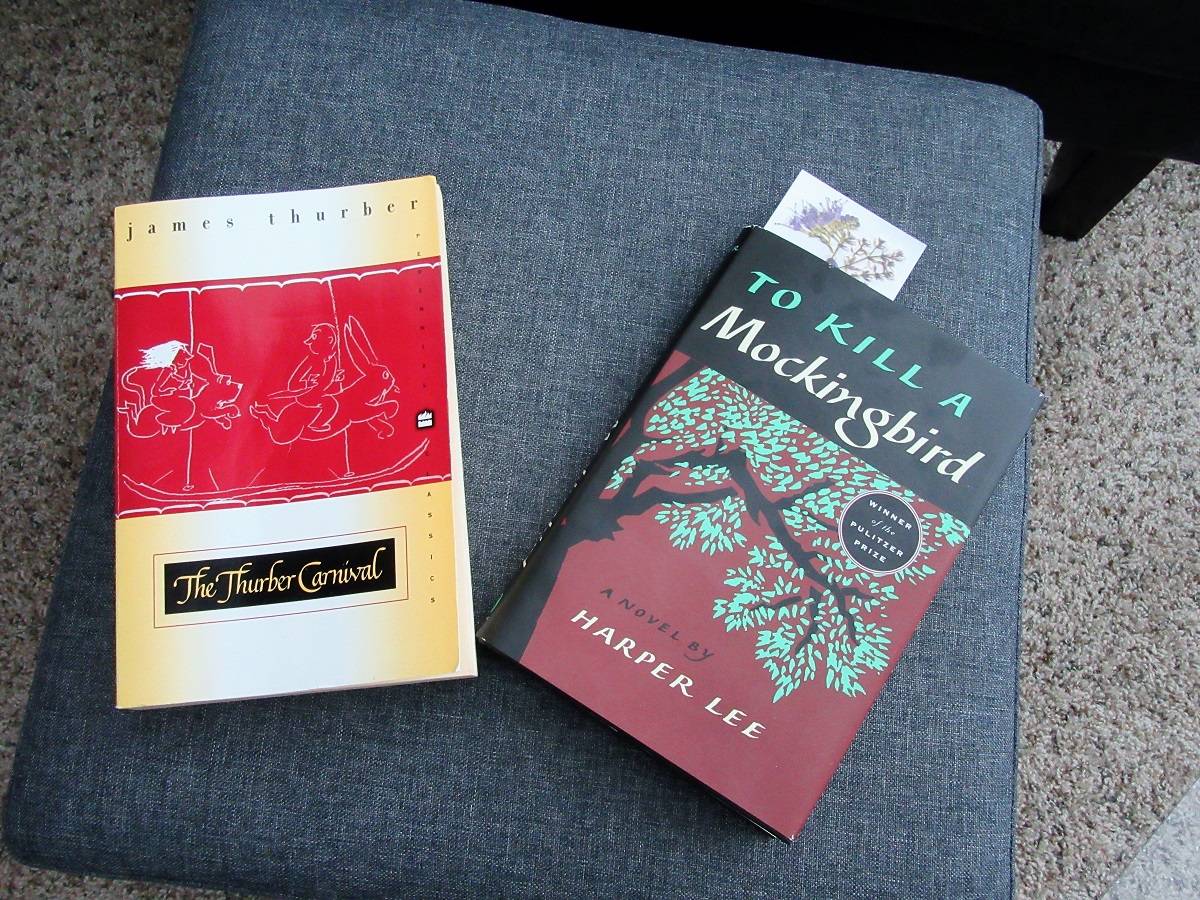
I can see my bookshelf from my chair where I’m reading Lee’s novel. I see my copy of a book by James Thurber, “The Thurber Carnival.” I occasionally re-read a story in it entitled “Bateman Comes Home.” I think it’s hilarious. There’s a short message ahead of the main text:

“Written after reading several recent novels about the deep south and confusing them a little—as the novelists themselves do—with “Tobacco Road” and “God’s Little Acre.”

And then I searched the web and found a web site, The Library dot org, and on a web page entitled Kids Booklists, there was the message, “If you liked ‘To Kill a Mockingbird’,” you might also enjoy…” Beneath it was a list of books, including “God’s Little Acre” by Erskine Caldwell.  

I noticed the resemblance. I’ll keep you posted.

“To Kill a Mockingbird” Dropped from Seattle School Reading List

This is just a brief announcement about the book “To Kill a Mockingbird” by Harper Lee being dropped from the reading list in a Seattle school. We ordered a copy and just got it today. I realized I don’t recall ever reading the book. I did see the movie starring Gregory Peck and Brock Peters, though.

I’ll let you know what I think.