

Sena just told me that it’s National Grammar Day today, which was news to me, but irregardless (whoops, that’s ungrammatical! It’s regardless or off comes your head), I mean regardless, grammar is pretty important.
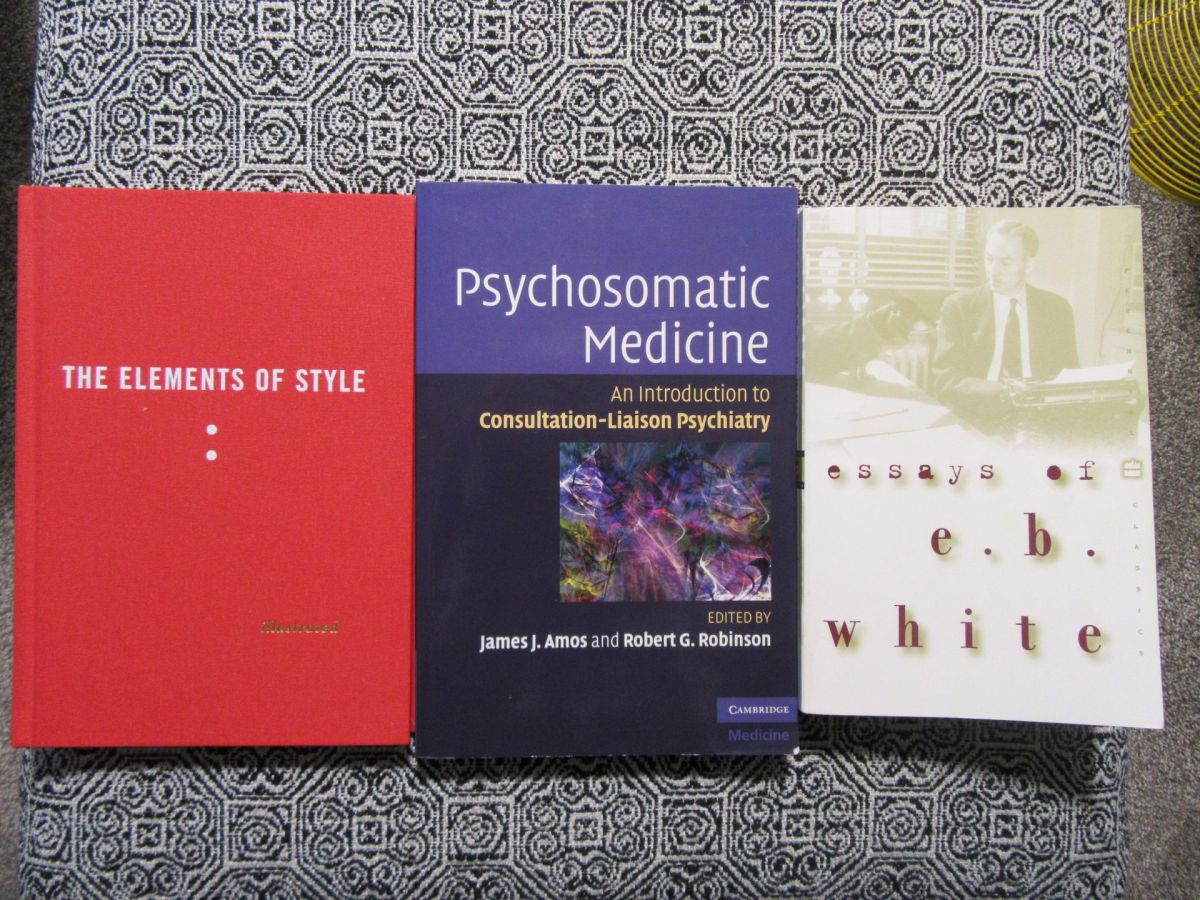
This reminds me of the essayist, E.B. White, who wrote an essay about his former teacher, Will Strunk Jr. White admired Strunk so much, he revived what Strunk wrote about grammar and word usage in what he called “the little book,” his own short guide to grammar.
The title of the book is “The Elements of Style.” White’s introduction quotes Strunk on his opinion of the best prose being short and to the point:
“Vigorous writing is concise. A sentence should contain no unnecessary words, a paragraph no unnecessary sentences, for the same reason that a drawing should have no unnecessary lines and a machine no unnecessary parts. This requires not that the writer make all sentences short or avoid all detail and treat subjects only in outline, but that every word tell.”
I cringe every time I hear somebody on TV say “comprised of.” It’s either “composed of” or “comprises.” Professor Strunk adds a nugget to this in Chapter IV: Words and Expressions Commonly Misused.
“Comprise. Literally, “embrace”: A zoo comprises mammals, reptiles, and birds (because it “embraces” or includes them). But animals do not comprise (“embrace”) a zoo—they constitute a zoo.”
“Irregardless. Should be regardless. The error results from failure to see the negative in -less and from a desire to get it in as a prefix, suggested by such words as irregular, irresponsible, and, perhaps, especially, irrespective.”
“Literal. Literally. Often incorrectly used in support of exaggeration or violent metaphor.
A literal flood of abuse a flood of abuse
Literally dead with fatigue almost dead with fatigue
“Nauseous. Nauseated. The first means “sickening to contemplate.”; the second means “sick at the stomach.” Do not, therefore, say, “I feel nauseous,” unless you are sure you have that effect on others.”
I hear these expressions a lot and always correct them in my mind. Yet I still make a lot of mistakes that would have made Professor Strunk cringe. And even my spell checker made a mistake in Strunk’s text. He has what seem like a lot of rules, but the book is still little. And I mention his influence in part of my introduction to the book I and my former Dept of Psychiatry Chair Robert G. Robinson wrote: Psychosomatic Medicine: An Introduction to Consultation-Liaison Psychiatry:
“The handbook is also a collaborative work. Many of the chapters were co-written by learners and teachers. One of the major goals of the work was to bring them together, sparking the synergy to create new solutions by letting the learner teach and the teacher learn. It is meant to be the portable, dog-eared, coffee-stained companion to any learner who needs pithy guidance on the basics of consultation psychiatry. Accordingly, as we came to call it for short, it’s “the little book” of Psychosomatic Medicine, in honor of E.B. White’s homage to Will Strunk’s “little book”, The Elements of Style, which was a pithy guide to writing. This is not a textbook; it is the little book.”
Happy National Grammar Day!
References:
Essays of E.B. White 1971 HarperCollins Publishers, Inc.
The Elements of Style by William Strunk, Jr. and E.B. White 2005 Penguin Press
Psychosomatic Medicine An Introduction to Consultation-Liaison Psychiatry edited by James J. Amos and Robert G. Robinson 2010 Cambridge Univ Press
 Go Retire Psychiatrist