I don’t know where the saying “silence is golden” came from but I suspect silence is sometimes not golden. I notice that The University of Iowa quote from Martin Luther King, Jr. for MLK Human Rights Week is “We will remember not the words of our enemies, but the silence of our friends.” Although I could not find the exact words, that doesn’t mean it’s not written in one of his books or letters. I found a similar statement in one of his speeches which I think captures the sense of it:
Pertinent here is a presentation given by University of Iowa Health Care psychologist and professor of psychiatry Dr. David Moser, PhD and medical student Destinee Gwee, entitled “Responding to Mistreatment.” One of the first bits of advice is to speak up if you see racism happening.
When I was a first-year resident on rotation in the inpatient psychiatric wards, one of the patients assigned to me roared at me “I don’t want no nigger doctor!” more than once. I discussed the issue with my supervisor. It was a difficult conversation. It was a long time ago and I recall mostly the sense that we both felt awkward. I asked that the patient, who clearly didn’t want anything to do with me, be transferred to the care of another resident. I don’t recall whether he offered to talk with the patient and he deferred on asking another trainee to take over the patient’s care. My recollection is dim about how I handled it. I suspect that’s because it was emotionally painful. Although I had to see him prior to rounds every day, I think I excused myself as soon as he spat the word “nigger” in my face—which was practically every day. I told him I didn’t’ have to tolerate that.
In that situation, the silence was deafening and certainly not golden. This kind of insulting scenario was not common, but it was not the only one.
I wasn’t exactly shocked. I was born and raised in Iowa. While Iowa historically has been more tolerant of African Americans, I grew up hearing the word “nigger” and was called that enough times to become pretty sensitive.
I had plenty of positive experiences over the course of my medical school and residency years. But they never erased the memory of that incident.
Today, Dr. Joan Y. Reede, MD, MPH, MS, MBA delivered the Martin Luther King, Jr Distinguished Lecture. It led to a long discussion between me and Sena, which is a good sign that the presentation was superb.
“We shall overcome because the arc of the moral universe is long, but it bends toward justice.”
Dr. King adapted the phrase from abolitionist Theodore Parker who thought the abolition of slavery would be successful and said:
“I do not pretend to understand the moral universe; the arc is a long one, my eye reaches but little ways; I cannot calculate the curve and complete the figure by the experience of sight; I can divine it by conscience. And from what I see I am sure it bends towards justice.”
Now that is according to a Wikipedia article, which was just edited today. Call it coincidental.
Sena mentioned to a couple of persons yesterday while out picking up groceries that we were planning to observe the MLK holiday by listening to the MLK Distinguished Lecture. Both of them were store employees. One of them was a white woman who said simply that she had to work, evidently meaning she would not be participating. The other was a young Black man who looked like he was in his twenties. He gave the same answer, simply saying that he had to work. Neither gave any indication that they even knew who Dr. King was.
We both think that was astonishing. It’s incredible to think that knowledge about Dr. Martin Luther King, Jr. would belong mainly to those in my generation and older. It’s not like cribbage, a favorite two hander card game Sena and I enjoy, but which I’ve often seen described as being a game popular mainly among older people.
It was with this thought in mind as we listened to Dr. Reede’s presentation. The history of America is full of “firsts” for minorities: first ever to attend a white college, first ever to become a physician, and so on. But from there it seems extremely difficult to trace a clear path to full access to positions of authority, influence, and power in this country for anyone who is different from the mainstream. This is not news to any of us.
But Sena and I wondered at the apparent difficulty in recruiting and retaining leaders from the wider pool of humanity: people of different races, women, the LGBTQ community. There were no pat answers. Dr. Reede wondered aloud about how and where will we get more leaders like Dr. King? Will it be through crafting more well-conceived outreach programs? I wonder about that approach if the twenty-something young Black man Sena spoke with did not even seem aware of who MLK was. And if people like him are too busy working in order to just survive, how will they ever get the time to learn another way to live? And how will they learn how to lead? We’ll need more beacons like Dr. Reede—and maybe you and me.
I remember singing in Sunday School, “This Little Light of Mine.” Leaders like Dr. Reede are beacons who show us how to carry our lights. In fact, the title of an article describing something just like that is “This Little Light.” The subtitle is “2018 Dean’s Community Service Awards celebrate service to others.” Dr. Reede herself presented the awards to the recipients, who she described as people who “don’t only talk the talk, but walk the walk.” Her closing remarks at that ceremony was a reminder:
“Service comes in many forms, and one’s contributions need not be heroic or hugely financial in scope; it is about giving of your time, your talents, making a difference, and having an impact.”
Dr. Joan Y. Reede, MD, MPH, MS, MBA is scheduled to deliver the Human Rights Week 2021: Distinguished Lecture on January 20, 2021 from noon to 1:00 PM. This is by Zoom because of the pandemic, a commonplace method nowadays. I’m registered for it so I hope Sena and I can zoom in.
Dr. Reede has a list of accomplishments as long as my arm. She’s the dean for diversity and community partnership and professor of medicine at Harvard Medical School. She also holds appointments as professor in the Department of Social and Behavioral Sciences at the Harvard T.H. Chan School of Public Health, and she is an assistant in health policy at Massachusetts General Hospital. The title of her lecture is “Bending the Arc Toward Equity and Social Justice: Addressing the Imperative.”
Dr. Reede’s life journey has been fascinating and she has had a lot of thought-provoking and inspiring things to say about how she got to where she is in her career and how to help others succeed. In her 2016 interview “Strictly Business—Women of Influence” she answered a question about how American could improve its standing in providing excellent health care to all people, she broadened the concept of what providing medical care means. In fact, health care doesn’t just happen in a clinician’s office. Many factors influence a person’s health and how they take care of themselves, including whether they are impoverished. Poverty inhibits access to food, education, and jobs and there can be unrealistic expectations about what disadvantaged people can do on their own about this lack. She said: “It’s having expectations of people to ‘pull yourself up by your bootstraps’ but not giving anybody any boots.”
That rang a bell and I found a speech by Dr. Martin Luther King, Jr in which he said almost exactly the same thing in the broader context of addressing racial injustice:
“Now there is another myth that still gets around: it is a kind of over reliance on the bootstrap philosophy. There are those who still feel that if the Negro is to rise out of poverty, if the negro is to rise out of the slum conditions, if he is to rise out of discrimination and segregation, he must do it all by himself. And so, they say the Negro must lift himself by his own bootstraps.”
And again, King said: “It’s all right to tell a man to lift himself by his own bootstraps, but it is a cruel jest to say to a bootless man that he ought to lift himself by his own bootstraps.”
The web says the bootstrapping idiom probably had its beginnings around the mid to late-19th century, in which it was clearly meant to express an absurdity. The image of someone trying to lift himself by the straps on the back of his boots shows it’s laughably impossible. The idea that you could lift yourself up without any outside help was mocked. However, over decades it evolved so that it somehow came to mean that you could succeed without any outside help—although with difficulty.
Bootstrapping
I think one way The University of Iowa College of Medicine tried to address the bootstrapping idea was to create the medical school summer enrichment program for minority students many years ago. I recall being one of a handful of minority students entering the summer enrichment program in 1988 at the University of Iowa. The summer enrichment opportunity was intended to be one way to assist minority students excel in the basic sciences courses that would be coming up in the upcoming regular academic year.
I have always appreciated that boost but not all of my peers saw it that way back then. Nowadays there is a well-established Office of Diversity, Equity, and Inclusion.
Looking forward to Dr. Reede’s presentation tomorrow!
Today is the first day of Martin Luther King, Jr. Human Rights Week and I’m giving a shout-out for acts of kindness as well as the Loving-Kindness meditation. A neighbor with a snowblower helped clear our driveway a couple of weeks ago. A couple of days ago he did the same for his next-door neighbor. I’m going to go out on a limb and speculate the city snowplow driver was kind enough to avoid plugging the driveways on our street. No kidding, we watched the snowplow use what was obviously a different plowing technique which left our driveways relatively clear of snow.
The Loving-Kindness meditation is a mindfulness practice that Dr. King would probably have supported. It’s a way to send love to yourself and others, including those with whom you might be in conflict—even your enemies. King might say, “Now is the time” for something like that.
I’m reestablishing my mindfulness and exercise practice after a several month lapse. I first took the Mindfulness-Based Stress Reduction (MBSR) course several years ago through The University of Iowa Hospitals and Clinics. It made a difference in how I approached problem-solving and conflict. I was on autopilot most of the time and wrote a blog post about my experience before and after my mindfulness training experience, “How I left the walking dead for the walking dead meditation.”
Part of that program included instruction on the Loving-Kindness meditation. I’m still a beginner at mindfulness, although my approach to life is still ironically more like the expert’s in Shunryu Suzuki’s quote:
“In the beginner’s mind, there are many possibilities, in the expert’s mind there are few.”–Shunryu Suzuki
I need to keep working on being more open to different ideas, interpretations, and ways of getting things done—approaching challenges with a beginner’s mind.
One recent challenge is hanging pictures. Sena and I hung a picture yesterday. I wanted to measure everything and she wanted to estimate. She had misgivings about my measurements but went along with it. After the picture was hung, even I had to admit it was not in the right spot. Funny thing, after a short while, she admitted that the misplacement was not that far off and that she was getting used to it. If you’ve ever hung pictures, you know I’m leaving out a lot of the back-and-forth negotiation about how we finally arrived at that middle ground. It involved loving kindness on both sides.
As I struggle to remember to write and say the year “2021” I noticed the University of Iowa Health Care quotation selection by Dr. Martin Luther King, Jr this month pertinent to the upcoming MLK Human Rights Week, starting January 18, 2021:
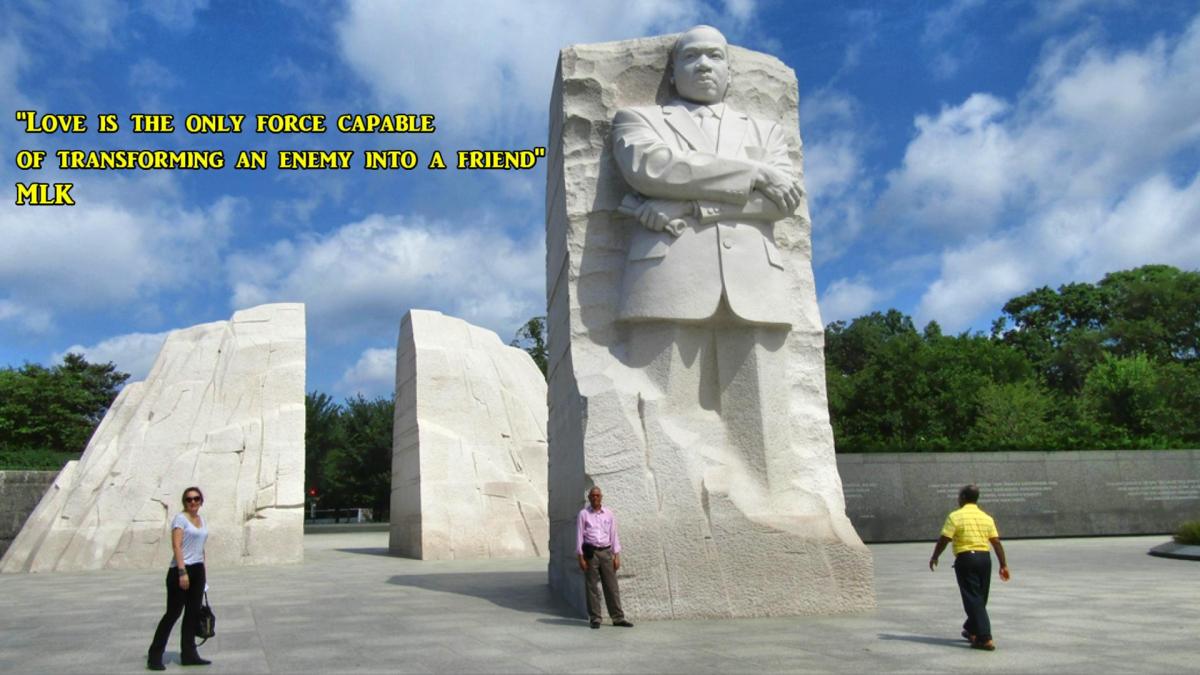
“Love is the only force capable of transforming an enemy into a friend.”
It’s funny because, as usual, the way my sense of humor works, I also recall quotes from the movie Men in Black 3. Agent K asks Agent J, “Do you know the most destructive force in the universe?” Agent J answers with a wisecrack, “Sugar?” Agent K replies, “Regret.”
Then what is the most constructive force in the universe? Dr. King thought it was love.
Since my retirement in July of last year, I’ve had a lot of time on my hands. It leaves me with too much time to reflect on my current life as a retired psychiatrist—and my past life as a consulting psychiatrist. As my thin veneer of authority, responsibility, and other lies I tell myself drop away, I become more aware of my flaws in both roles. I find deep holes in my identity as a person as my identity as a doctor fades. Just being a person who has a lot to learn about life despite being a psychiatrist—is hard. I have regrets and remorse. My sense of humor sometimes helps me get by.
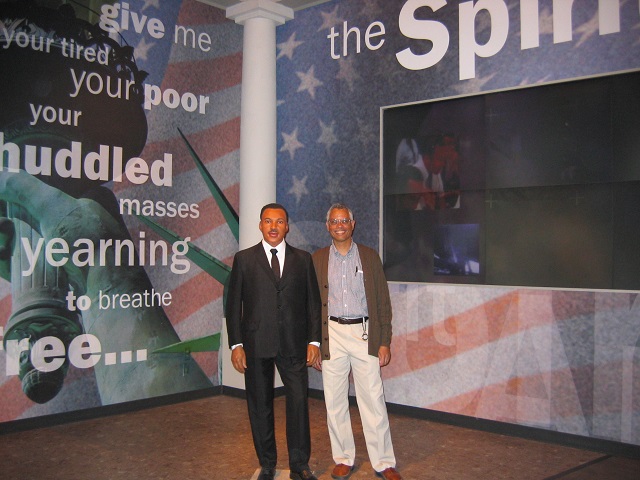
Dr. Martin Luther King, Jr and me in Vegas.
Regret can indeed be a destructive force. Though it’s similar to regret and painful, remorse could help me be a better person. It becomes more and more important that I find something constructive, both to do and to be.
Maybe love is the most constructive force in the universe. Because quotes are sometimes misquoted and inaccurately attributed, I googled the quote “Love is the only force capable of transforming an enemy into a friend.” I found the sermon from which I think the quote is derived on a Stanford University web site. It’s called the “Loving Your Enemies” sermon and it’s published in the book, A knock at midnight: inspiration from the great sermons of Reverend Martin Luther King, Jr.
There are YouTube and Vimeo videos of an audio recording of the sermon as well. The internet being what it is, you apply hyperlinks to these and other works at the risk of the links being broken at some point, which I have found and which might be due to uncertainty about whether the text of the sermon is in the public domain.
As an aside, I’m reminded of a quote variously attributed to Charles Schulz, creator of the Peanuts comic strip, Fyodor Dostoyevsky, and others: “I love mankind; it’s people I can’t stand.” This probably betrays my skepticism about the ability to love your enemies.
You know, it’s funny. I didn’t find the Dr. King quote, word for word, the first couple of times I scanned it in the Stanford University transcript. What I did was the thing most junior medical students do when they discover the vast load of information they have to memorize and digest. I scanned the sermon for the key words and didn’t see them.
Nor did I find it on the third read, in which I finally abandoned the scanning method and actually read the sermon. But I got the point.
If the Stanford version and my reading are accurate, what I found were probably the main ideas I needed to make sense of the sermon. King said that I have to look deep within myself first before attempting to understand anyone else, much less to love my enemies. I also would do well to look for the good in people who I judge are bad. Moreover, I gain nothing by trying to defeat my enemies. He even mentions the theories of psychologists and psychiatrists to support his profound conclusions. As I read them, I was acutely reminded of my shortcomings as a psychiatrist. You would think a psychiatrist would know how to analyze himself (and psychoanalysts do undergo analysis in training). I am not a psychoanalyst. But I am capable of reflection.
The exact quote might not be discoverable (at least to me) in King’s sermon. Nevertheless, the transformative and redemptive power of love is clearly expressed. The quote is distilled from the text of the sermon. That doesn’t mean that there might not be a different version of the sermon which could have contained each and every word. According to one writer, that may be the case. Perhaps it’s in the book, A Knock at Midnight: Inspiration from the Great Sermons of Martin Luther King, Jr.
What is more important for me at this time of my life is to accept that my search for the most constructive force in the universe will proceed in baby steps.
What I need to do is reflect on my own shortcomings and find ways to improve while avoiding making excuses. Stephen Covey said that we often blame our parents or our grandparents for our flaws. This was part of his three theories of determinism to explain man’s nature. Genetic determinism says I inherited my flaws from my grandparents (whom I never met), which implied my mistakes were encoded in my DNA. Psychic determinism supposedly explains what I got from my parents because of their mistakes in rearing me. Hmmm, I was exposed to fruitcake at Christmas. Environmental determinism implicates says that other people in my workplace, my school, my neighborhood or my country (politicians perhaps?) caused my flaws.
Covey disputed these ideas by the example of Viktor Frankl’s personal triumph over his experience as a prisoner in a Nazi death camp. His captors controlled his liberty to move about his environment. They could not control his freedom to choose what he thought and felt. He controlled his self-awareness, imagination, conscience, and independent will to draw meaning from his experience [The Seven Habits of Highly Effective People: By Stephen R. Covey. New York: Simon and Schuster, 1989].
How can I see the good in my enemies, despite their obvious flaws in comparison to my own angelic perfection? And how to avoid acting on the urge to defeat them, despite the reality that there have to be winners and losers at all levels in society, including elections, sports, cribbage (at which my wife regularly beats me)? Something tells me I’m getting off to a shaky start here.
I have to crawl before I can walk; I have to walk before I can run—before I fall flat on my face for the umpteenth time. Now more than any other time in my life, I must keep trying. I must get up and try again.
ADDENDUM January 11, 2021: I tried to access the King Library and Archives (KLA) today at The King Center website. There is a message indicating the KLA page is down indefinitely and redirects the reader to the Stanford University site noted above.





 Go Retire Psychiatrist