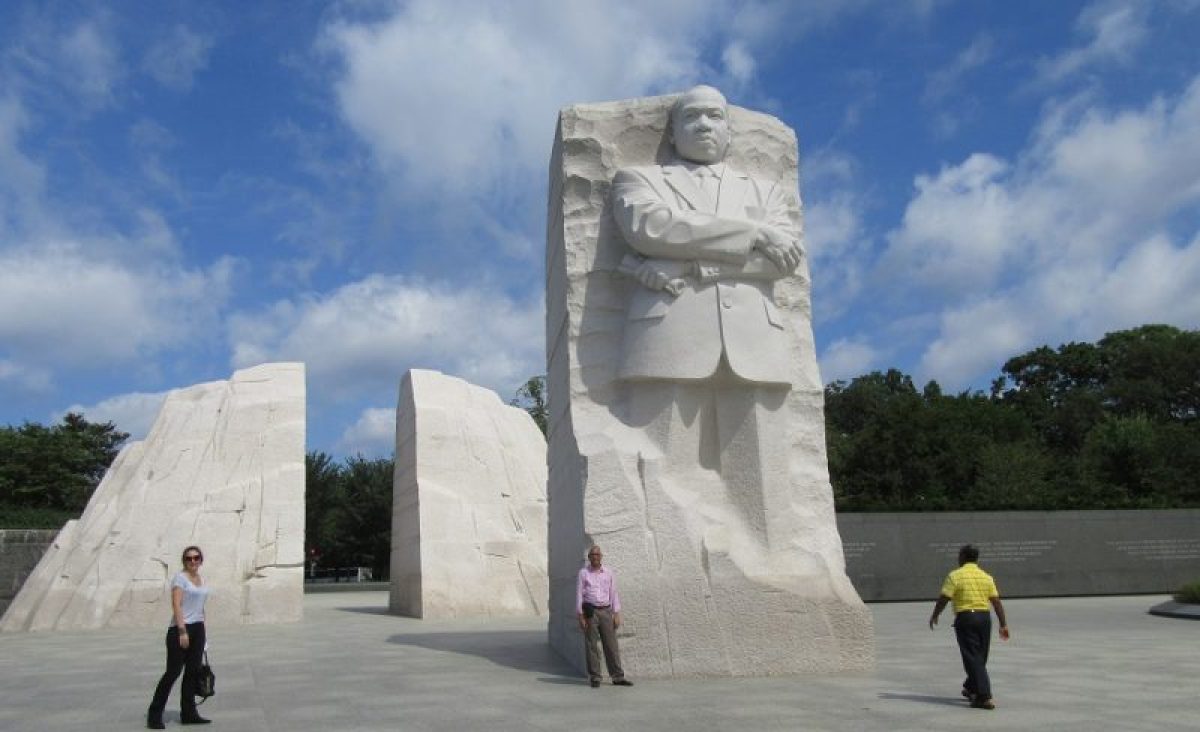
I first saw a photo of the sculpture honoring Dr. Martin Luther King Jr and Coretta Scott King, called “The Embrace” a couple of days ago. I remember my first impression being that it would have been nice to see a full sculpture of the couple rather than disembodied arms.
Sena mentioned it today because it was unveiled at Boston Commons. This was just before my mindfulness meditation, so I just told her that I saw the picture of it and said I would have to think about it some more.
As I sat in meditation, it occurred to me that “The Embrace” expressed what I think is a basic abstract idea, which is the challenge for us to embrace the notion that we’re all humans who ought to accept each other, and be kind and generous to one another.
That’s what I think the Kings did. That’s why Dr. King won the Nobel Peace Prize.
You could make a sculpture of the King as a couple embracing each other after he won the Nobel Prize. It would have been beautiful. On the other hand, you could make a sculpture which tries to do more than that. How difficult would it be to make a representation of what it might look like if all of us embraced our humanity—and each other?
It sounds too difficult. Yet the artist managed to do just that. Anyway, that’s my two cents.
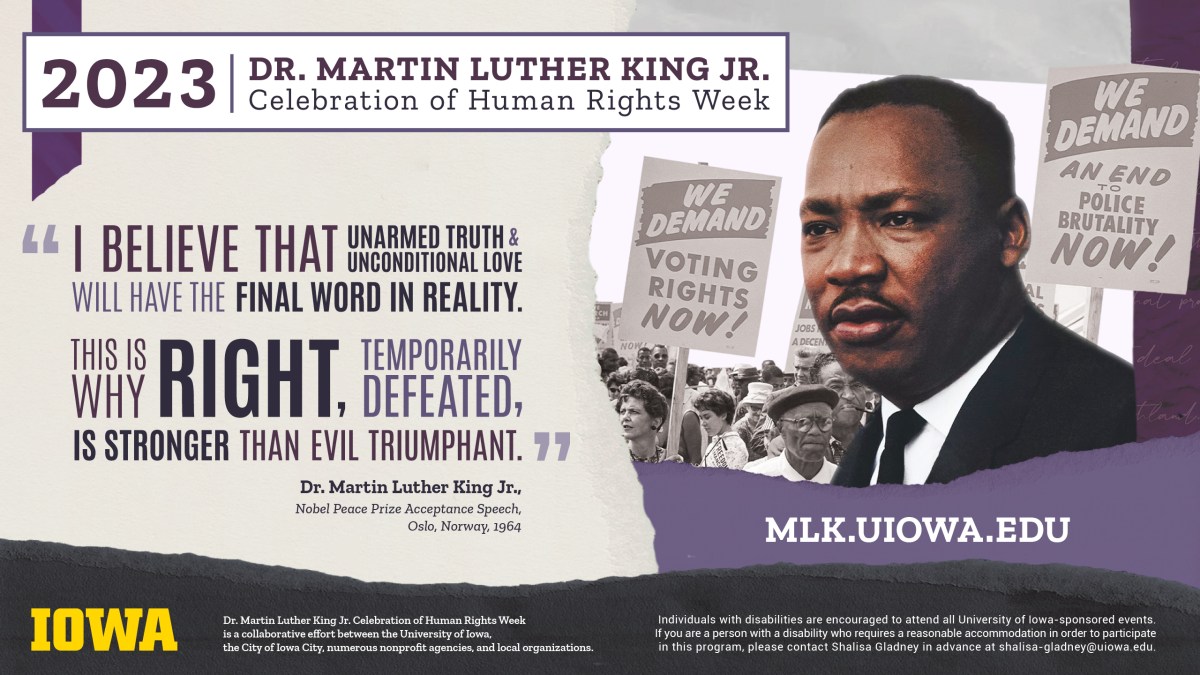
The Martin Luther King, Jr. Celebration of Human Rights Week 2023 begins January 16, 2023. See the University of Iowa Healthcare list of events, which will be updated.
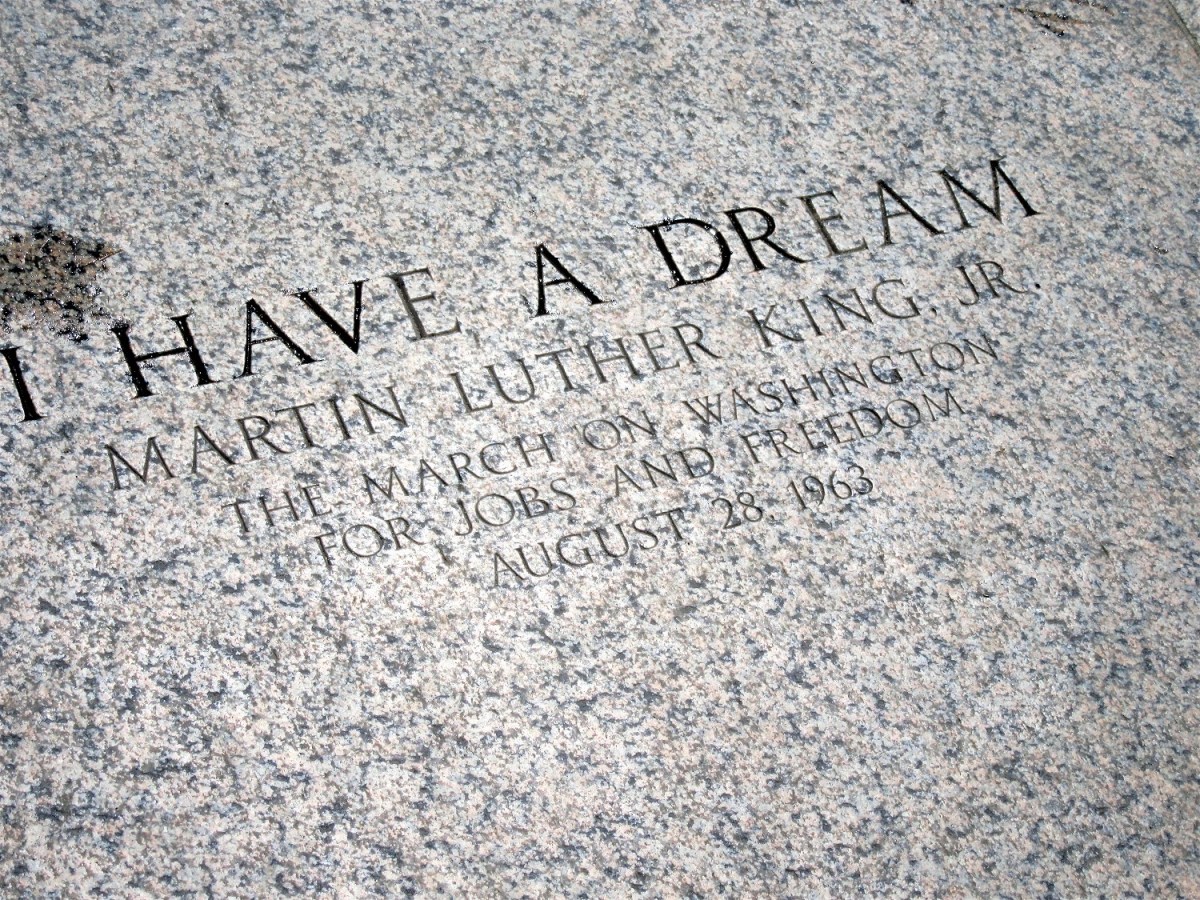
Sena reminded me that today is the 59th Anniversary of Reverend Martin Luther King Jr’s “I Have a Dream” speech in Washington, D.C. After she reminded me about it, I found this anniversary mentioned in only a few headlines on the web.
But that’s no excuse. It doesn’t matter that I was just a small child on August 28, 1963. And when I hear the speech, it still makes the hair on the back of my neck stand up.
Today, Dr. Feranmi Okanlami, MD, MS, director of student accessibility and accommodation services at the University of Michigan, delivered the Martin Luther King Jr. Distinguished Lecture: “Disabusing Disabilities.” It was sponsored by the University of Iowa.
I attended Dr. Okanlami’s lecture by Zoom. I noticed he was wearing a handsomely carved wooden bow tie, which I don’t have an image for, but you can order them on Amazon, if you’re interested. I’m not the only attendee who noticed it. I used to wear cloth bow ties when I was a much younger man. I gave up wearing any cloth ties shortly after the Covid-19 pandemic began because, as everyone knows, fabric neckties of any kind generally almost never get laundered and carry all kinds of germs. The wooden bow tie is easily wiped down with sanitizers.
But this post is not about wooden bow ties. It’s about what Dr. Okanlami called “ableism” which naturally brings to mind other terms like “racism.” He showed a few images on his slides which showed another point he expanded on, which is the difference between equality and equity. The quick way for me to explain this is to quote the Milken Institute School of Public Health definition:
“Equality means each individual or group of people is given the same resources or opportunities. Equity recognizes that each person has different circumstances and allocates the exact resources and opportunities needed to reach an equal outcome.” — MPH@GW, the George Washington University online Master of Public Health program.
Dr. Okanlami impressed me in many ways, but one of them is his ability to give unrehearsed presentations. He hates to “give talks” as he put it, but likes to talk.
I should explain the reason for this post’s featured image, which might seem puzzling. It’s a photo of the curb ramp connected to the sidewalk outside our home. The city requires homeowners to clear the snow from curb ramps, which, ironically, the city plows plug with snow after every snowstorm. These used to be called “handicap ramps.” I suspect Dr. Okanlami would object to the use of this label and in general it’s probably insulting, but that is what they were called for years. They are an accommodation for those who use wheelchairs.
The word accommodation can have a negative connotation, which Dr. Okanlami clarified. Many believe accommodations give an “unfair” advantage to some people. Actually, they provide opportunities for those with a different set of abilities or altered abilities to participate in society in ways that allow them to contribute to society, and even change it—sometimes in major ways.
Our curb ramp is interesting. The short length of sidewalk beyond it leads to a pile of construction rubble because there is no sidewalk extending beyond our property line on that side. I call it the sidewalk to nowhere, which is now a misnomer. There is a new subdivision under development leading north of our neighborhood. There are houses being built and many have moved in. But for now, you have to walk in the street, which is often muddy and blocked. It’s difficult to walk through it because of heavy equipment and trucks parked along the street. But that doesn’t stop people from walking there. I have never seen anyone in a wheelchair attempt to use the curb ramp. But many people use it who don’t have a visible disability. But it’s there if someone needs it, and we keep it clear of snow on principle.
Dr. Okanlami mentioned those with invisible disabilities. There was not enough time to discuss this in detail, but they include those with mental health challenges. As a consulting psychiatrist working in the general hospital, I saw many of them. They deserve a seat at the table, too.
And I remember one of my medical school classmates who did need to use a wheelchair. There was a special ramp made for him that allowed him to participate in gross anatomy class. Dr. Lance Goetz, MD, graduated with our class and has been a practicing physiatrist in Richmond, Virginia for the last 21 years.
Although Dr. Okanlami’s lecture was recorded today and will, I hope, soon be available for public view, I’m including a YouTube recording of a presentation he gave in 2018 which has the same title and very similar content as the talk he delivered today.
I think his talk evolves every time he gives it. The environment in 2018 was very different than it is now because there was no pandemic and there was a live audience which interacts in a very different way than Zoom allows. That said, the slides were essentially the same today on equity and equality, as were his essential points. He shared a lot about himself in 2018, maybe a little less today mainly because of time constraints and the difficulties inherent to virtual lectures. But he has a great sense of humor.
And he does wear very handsomely carved wooden bow ties.
Sena and I thought today’s Zoom presentation “Racial Perspectives on the Institution of Medicine” by Director and Chair of Emergency Medicine Jenice Baker, MD, from Chestnut Hill Hospital in Philadelphia was fascinating. It was an early feature of Martin Luther King Jr. Celebration of Human Rights week. This presentation stimulated a long discussion between us. The theme of this year’s MLK week is “Whatever Affects One Directly, Affects All Indirectly.”
Dr. Baker cautioned that some of the content of her talk would make us feel uncomfortable about the issue of racism in the social realm of our society extending to the medical realm as well. Sena and I were a little surprised about some of the historical facts, such as that white patients always had to be treated first before black people in emergency rooms, regardless of the severity and urgency of the trauma.
This led me to look up the term “implicit bias.” It doesn’t always denote racism per se. It does mean that we’re all prone to making broad generalizations. This accentuates the conflict between political parties, races, and other groups. People on both sides of the color line can overgeneralize, leading to stereotyping.
I told the following anecdote in a blog post from last year’s MLK Human Rights Week:
When I was a first-year resident on rotation in the inpatient psychiatric wards, one of the patients assigned to me roared at me “I don’t want no nigger doctor!” more than once. I discussed the issue with my supervisor. It was a difficult conversation. It was a long time ago and I recall mostly the sense that we both felt awkward. I asked that the patient, who clearly didn’t want anything to do with me, be transferred to the care of another resident. I don’t recall whether he offered to talk with the patient and he deferred on asking another trainee to take over the patient’s care. My recollection is dim about how I handled it. I suspect that’s because it was emotionally painful. Although I had to see him prior to rounds every day, I think I excused myself as soon as he spat the word “nigger” in my face—which was practically every day. I told him I didn’t’ have to tolerate that.
The flip side of this is a conversation I overheard in the distant past between my father (a black man) and his friend (also black, who I’ll call Mark). My father took Mark in, who had just been released from jail and was homeless. He was wearing poorly fitting clothes he probably found because he was penniless and jobless. While he paced the living room floor, he cursed and said angrily, “Man, I will never let this white man do this to me again.” My father just snorted in a way that made me think he didn’t believe that Mark was in his predicament because of any white man—it was probably Mark’s own bad decisions that led to his problems.
As in past years when Sena and I are intellectually stimulated by MLK Celebration of Human Rights week speeches, our discussions get long and spirited and tend to range widely over the spectrum and durability of human weakness, human evil, and the seemingly accidental nature of human wisdom and human kindness.
We talked at length about James Alan McPherson, long time Iowa City resident and nationally renowned writer, the first African American to win the Pulitzer Prize for short fiction, and acting director of the Iowa City Writers Workshop. He died in in the summer of 2016. An Iowa City neighborhood park was recently renamed James Alan McPherson Park in his honor.
But judging from news stories, this didn’t happen until members of the Iowa Freedom Riders suggested that a park be named “Black Lives Matter Park” in the summer of 2020. In response, more than a dozen people recommended that Creekside Park be renamed in McPherson’s honor instead.
Was the suggestion of renaming the park after McPherson simply a maneuver to avoid naming a park after BLM—and possibly to avoid extremist consequences? Why did it take Iowa City so long to honor him after he died? It is puzzling given that his peers called him the heart and soul of the Iowa Writers Workshop and given that McPherson himself called Iowa a place where he felt welcome. He was even in psychotherapy delivered by a white psychiatrist, Dr. Dorothy “Jean” Arnold, the first female psychiatrist to open a private practice in the state of Iowa in 1957. They were both from the racially polarized South. I wonder how they ever connected.
Why should this matter so much to us? Just like Dr. Baker’s presentation, it’s a very uncomfortable discussion. Sena is very good at doing what MLK suggested in his Letter from a Birmingham Jail, where the quote “Whatever Affects One Directly, Affects All Indirectly” comes from—creating “constructive nonviolent tension.” King always advised against violence or anything other than nonviolent methods of protest, saying that what we need is to create a type of constructive nonviolent tension, which he proved can be more effective than violent confrontation.
Some extremists say that King’s nonviolent approach is no longer relevant for our times, but I doubt violence is the answer. Somehow all of us need to learn how to not just tolerate an atmosphere charged with constructive nonviolent tension—but to somehow transform ourselves directly and thereby transform others indirectly into peaceful agents of change.
The 2022 Martin Luther King Jr. Celebration of Human Rights Week gets kicked off on January 12, 2022 with Chair of Emergency Medicine Jenice Baker, MD, from Chestnut Hill Hospital in Philadelphia giving a lecture via Zoom, “Racial Perspectives on the Institution of Medicine.”
And on Wednesday January 19, 2022, Dr. Feranmi Okanlami, MD, MS, director of student accessibility and accommodation services at the University of Michigan, will deliver the Martin Luther King Jr. Distinguished Lecture: “Disabusing Disabilities.” You can register on line for this lecture and see the following link for a full list of events which will be updated.
I don’t know where the saying “silence is golden” came from but I suspect silence is sometimes not golden. I notice that The University of Iowa quote from Martin Luther King, Jr. for MLK Human Rights Week is “We will remember not the words of our enemies, but the silence of our friends.” Although I could not find the exact words, that doesn’t mean it’s not written in one of his books or letters. I found a similar statement in one of his speeches which I think captures the sense of it:
Pertinent here is a presentation given by University of Iowa Health Care psychologist and professor of psychiatry Dr. David Moser, PhD and medical student Destinee Gwee, entitled “Responding to Mistreatment.” One of the first bits of advice is to speak up if you see racism happening.
When I was a first-year resident on rotation in the inpatient psychiatric wards, one of the patients assigned to me roared at me “I don’t want no nigger doctor!” more than once. I discussed the issue with my supervisor. It was a difficult conversation. It was a long time ago and I recall mostly the sense that we both felt awkward. I asked that the patient, who clearly didn’t want anything to do with me, be transferred to the care of another resident. I don’t recall whether he offered to talk with the patient and he deferred on asking another trainee to take over the patient’s care. My recollection is dim about how I handled it. I suspect that’s because it was emotionally painful. Although I had to see him prior to rounds every day, I think I excused myself as soon as he spat the word “nigger” in my face—which was practically every day. I told him I didn’t’ have to tolerate that.
In that situation, the silence was deafening and certainly not golden. This kind of insulting scenario was not common, but it was not the only one.
I wasn’t exactly shocked. I was born and raised in Iowa. While Iowa historically has been more tolerant of African Americans, I grew up hearing the word “nigger” and was called that enough times to become pretty sensitive.
I had plenty of positive experiences over the course of my medical school and residency years. But they never erased the memory of that incident.
Today, Dr. Joan Y. Reede, MD, MPH, MS, MBA delivered the Martin Luther King, Jr Distinguished Lecture. It led to a long discussion between me and Sena, which is a good sign that the presentation was superb.
“We shall overcome because the arc of the moral universe is long, but it bends toward justice.”
Dr. King adapted the phrase from abolitionist Theodore Parker who thought the abolition of slavery would be successful and said:
“I do not pretend to understand the moral universe; the arc is a long one, my eye reaches but little ways; I cannot calculate the curve and complete the figure by the experience of sight; I can divine it by conscience. And from what I see I am sure it bends towards justice.”
Now that is according to a Wikipedia article, which was just edited today. Call it coincidental.
Sena mentioned to a couple of persons yesterday while out picking up groceries that we were planning to observe the MLK holiday by listening to the MLK Distinguished Lecture. Both of them were store employees. One of them was a white woman who said simply that she had to work, evidently meaning she would not be participating. The other was a young Black man who looked like he was in his twenties. He gave the same answer, simply saying that he had to work. Neither gave any indication that they even knew who Dr. King was.
We both think that was astonishing. It’s incredible to think that knowledge about Dr. Martin Luther King, Jr. would belong mainly to those in my generation and older. It’s not like cribbage, a favorite two hander card game Sena and I enjoy, but which I’ve often seen described as being a game popular mainly among older people.
It was with this thought in mind as we listened to Dr. Reede’s presentation. The history of America is full of “firsts” for minorities: first ever to attend a white college, first ever to become a physician, and so on. But from there it seems extremely difficult to trace a clear path to full access to positions of authority, influence, and power in this country for anyone who is different from the mainstream. This is not news to any of us.
But Sena and I wondered at the apparent difficulty in recruiting and retaining leaders from the wider pool of humanity: people of different races, women, the LGBTQ community. There were no pat answers. Dr. Reede wondered aloud about how and where will we get more leaders like Dr. King? Will it be through crafting more well-conceived outreach programs? I wonder about that approach if the twenty-something young Black man Sena spoke with did not even seem aware of who MLK was. And if people like him are too busy working in order to just survive, how will they ever get the time to learn another way to live? And how will they learn how to lead? We’ll need more beacons like Dr. Reede—and maybe you and me.
I remember singing in Sunday School, “This Little Light of Mine.” Leaders like Dr. Reede are beacons who show us how to carry our lights. In fact, the title of an article describing something just like that is “This Little Light.” The subtitle is “2018 Dean’s Community Service Awards celebrate service to others.” Dr. Reede herself presented the awards to the recipients, who she described as people who “don’t only talk the talk, but walk the walk.” Her closing remarks at that ceremony was a reminder:
“Service comes in many forms, and one’s contributions need not be heroic or hugely financial in scope; it is about giving of your time, your talents, making a difference, and having an impact.”
Dr. Joan Y. Reede, MD, MPH, MS, MBA is scheduled to deliver the Human Rights Week 2021: Distinguished Lecture on January 20, 2021 from noon to 1:00 PM. This is by Zoom because of the pandemic, a commonplace method nowadays. I’m registered for it so I hope Sena and I can zoom in.
Dr. Reede has a list of accomplishments as long as my arm. She’s the dean for diversity and community partnership and professor of medicine at Harvard Medical School. She also holds appointments as professor in the Department of Social and Behavioral Sciences at the Harvard T.H. Chan School of Public Health, and she is an assistant in health policy at Massachusetts General Hospital. The title of her lecture is “Bending the Arc Toward Equity and Social Justice: Addressing the Imperative.”
Dr. Reede’s life journey has been fascinating and she has had a lot of thought-provoking and inspiring things to say about how she got to where she is in her career and how to help others succeed. In her 2016 interview “Strictly Business—Women of Influence” she answered a question about how American could improve its standing in providing excellent health care to all people, she broadened the concept of what providing medical care means. In fact, health care doesn’t just happen in a clinician’s office. Many factors influence a person’s health and how they take care of themselves, including whether they are impoverished. Poverty inhibits access to food, education, and jobs and there can be unrealistic expectations about what disadvantaged people can do on their own about this lack. She said: “It’s having expectations of people to ‘pull yourself up by your bootstraps’ but not giving anybody any boots.”
That rang a bell and I found a speech by Dr. Martin Luther King, Jr in which he said almost exactly the same thing in the broader context of addressing racial injustice:
“Now there is another myth that still gets around: it is a kind of over reliance on the bootstrap philosophy. There are those who still feel that if the Negro is to rise out of poverty, if the negro is to rise out of the slum conditions, if he is to rise out of discrimination and segregation, he must do it all by himself. And so, they say the Negro must lift himself by his own bootstraps.”
And again, King said: “It’s all right to tell a man to lift himself by his own bootstraps, but it is a cruel jest to say to a bootless man that he ought to lift himself by his own bootstraps.”
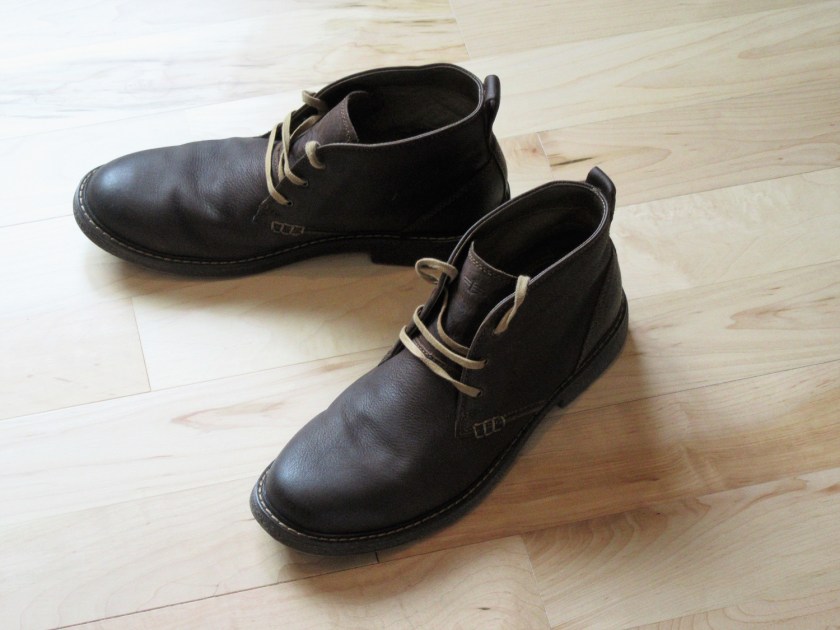
The web says the bootstrapping idiom probably had its beginnings around the mid to late-19th century, in which it was clearly meant to express an absurdity. The image of someone trying to lift himself by the straps on the back of his boots shows it’s laughably impossible. The idea that you could lift yourself up without any outside help was mocked. However, over decades it evolved so that it somehow came to mean that you could succeed without any outside help—although with difficulty.
Bootstrapping
I think one way The University of Iowa College of Medicine tried to address the bootstrapping idea was to create the medical school summer enrichment program for minority students many years ago. I recall being one of a handful of minority students entering the summer enrichment program in 1988 at the University of Iowa. The summer enrichment opportunity was intended to be one way to assist minority students excel in the basic sciences courses that would be coming up in the upcoming regular academic year.
I have always appreciated that boost but not all of my peers saw it that way back then. Nowadays there is a well-established Office of Diversity, Equity, and Inclusion.
Looking forward to Dr. Reede’s presentation tomorrow!








 Go Retire Psychiatrist