


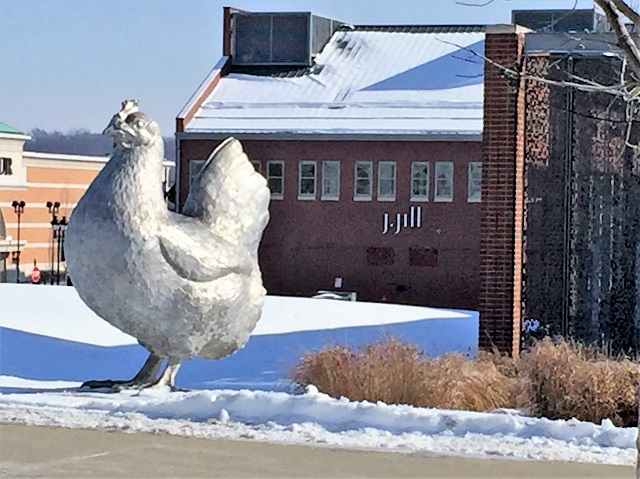
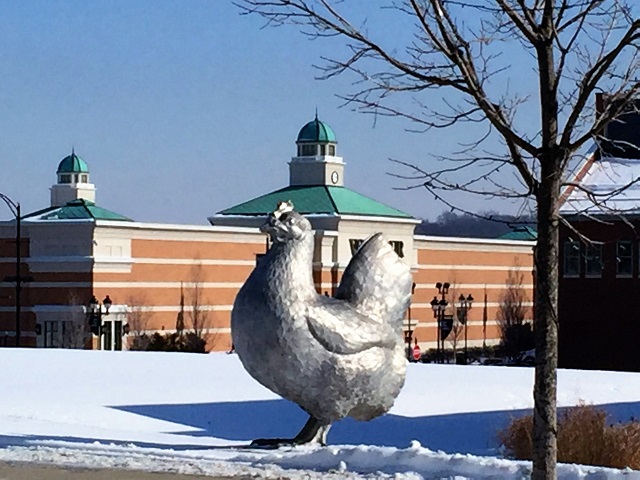
I had so much fun with the giant chicken post on January 25, 2020 that I thought it would be nice to revisit the subject, only this time take a butt-freezing tour of the entire Iowa River Landing (IRL) Sculpture Walk.
We took the walk Tuesday, January 28, 2020. The weather was typical for Iowa in January. The temperature was in the teens and there were brief flurries. My wife, Sena, and I dressed warm and took a meandering journey through the Sculpture Walk, guided by a small map.
It was a little more challenging because snow and ice covered up many of the plaques identifying the works (and parts of the sculptures as well) although this lent even more visual interest to them. They’re three dimensional objects anyway and you really have to walk around them to fully appreciate their complexity. You have to watch out for yellow snow.
What made this adventure even more special was the Iowa Writers’ Library in the lobby of the Coralville Marriott Hotel and Conference Center. It’s maintained by the Coralville Public Library. One of the issues I had was being unfamiliar with the text of the poems and other literary works (all were connected with the Iowa Writers’ Workshop) referenced by the artists. The library was cozy, had a fireplace warming the softly lit room lined by bookshelves and a couple of ladders on wheels to help you reach the books higher up.
I have always felt comforted in libraries, ever since I was a little boy. Every day I got the chance, I would walk to my hometown library (which was about a mile trip), browse the stacks for hours, then tote home piles of books in both arms.
The hotel library had most of the books pertinent to the literary references cited by the artists for their sculptures. I even found David B. Axelrod’s book, The Man Who Fell in Love with a Chicken. It turns out that the title of Axelrod’s poem is “The Man Who Fell in Love with His Chicken.” There, I’ve said enough already about that chicken.
Of course, I couldn’t take the time to find and read every book; we would not have had time to freeze our butts off touring the sculptures.
I didn’t wear my heavy winter boots and had to crunch through the crusty snow nearly up to my ankles to reach certain sculptures. Sena was dressed better for the weather but we both slipped around on the ice and I began to think more and more about things like broken hips.
But we soldiered on because it was necessary to walk completely around the Made of Money sculpture by Aaron Wilson in order to see the message printed, “HOW CAN WE HELP YOU?” It’s funny because that’s what I typically ask patients in the general hospital when I sit down on my little camp stool after I introduce myself to them as a consultation-liaison psychiatrist.
The sculpture To Dorothy, by artist James Anthony Bearden, was in a difficult spot and initially we thought we’d have to either rappel down from the roof of the building it was in front of or climb up the big retaining walls to get a good look at it. We found a way out to it and ignored passersby who gawked at us. They needed to admire us for how unique we are (not how eccentric and possibly a danger to ourselves and others), which is what I think Iowa Poet Laureate Marvin Bell was getting at in his poem of the same title as Bearden’s sculpture.
The sculpture, A Thousand Acres, by artist V. Skip Willits was another piece you really have to walk around to fully appreciate, although you generally have to do that with any sculpture. The book of the same title by Jane Smiley is based on Shakespeare’s King Lear—which I have also never read—but which I got an earful about in my undergraduate days from a fellow student who thought he knew everything there was to know about King Lear. He was garrulous in the extreme and bested me in debating class mainly because he never let me open my mouth.
The sculpture by artist Victoria Ann Reed, called Convergence, was very intriguing and looked more like a human figure who had been through a wormhole than a memory.
The Tipping Point, by artist Sarah Deppe, was a convincing image of persons with holes in their heads (several holes in fact). Bureaucrats come to mind.
We nearly dismissed the sculpture called After Trillium by artist Anthony Castronovo as a broken lamppost with dysfunctional solar panels, only partly because snow and ice covered the panel describing it. On the other hand, the top part does resemble a flower called a Trillium, not to be confused with Trillian, a character in the book by Douglas Adams, The Ultimate Hitchhiker’s Guide to the Galaxy. I’m glad I could clear that up for you.
The Prairie Breeze Bench by artist Bounnak Thammavong is a sculpture you could actually sit on and watch the Bald Eagles. However, it’s made of steel and the seat was covered by snow. After you wipe away the Bald Eagle droppings, you can read the poem by James Hearst, “Landscape Iowa.” You can also hear it set to music and performed by Scott Cawelti, a former University of Northern Iowa educator who taught film, writing, and literature courses. He also edited The Complete Poetry of James Hearst (University of Iowa Press, 2001).
The Alidade sculpture by Dan Perry was the one Sena and I both really liked. I know Perry says the alidade was used by astronomers but I remember it as being a part of an instrument used by land surveyors, also for measuring distance and angles in topographical surveys. I used to work for consulting engineers as a surveyor’s assistance and draftsman many years ago. Perry links it to the poem entitled “1,2,3” from James Galvin’s book of poems, X: Poems. I confess I don’t see the connection yet. The poem for the most part reminds me of spelunking although Galvin describes a hole that he and a friend rappel into as being a planet. Much of the rest seems to be about something very painful. I’m sorry I can’t do better, but that’s why he’s a poet and I’m not.
Next, we encountered Bounnak Thammavong’s second sculpture, a very recognizable fish, a “lowly river carp,” entitled From the River. It’s linked to the poem “Where Water Comes Together with Other Water” by Raymond Carver. When I was a boy, I used to fish for bullhead in my hometown river. I sometimes caught carp and thought that was the poorer catch. It didn’t matter. I always threw both back into the river. My mom would not clean fish and neither would I.
Finally, by a pretty circuitous route, we saw the last sculpture, Gilead, by artist Kristin Garnant. The snow plow had piled up a lot of snow around it. I probably won’t read Gilead, the epistolary novel by Marilynne Robinson.
In fact, I probably won’t read a lot of the literature connected with the sculptures we saw. I did read Margaret Walker’s poem “For My people.” Sorry, Jubilee is way too much for me. She was the first African-American woman to be accepted into the Iowa Writers’ Workshop, of course depending on which story you believe about when the program formally began (Invisible Hawkeyes: African Americans at the University of Iowa during the Long Civil Rights Era, in Chapter Four: Obscured Traditions: Blacks at the Iowa Writers’ Workshop, 1940-1965, by Michael D. Hill, University of Iowa Press, 2016).
In some ways, I identify way with her, one of the reasons being obvious and skin-deep. The other is that she taught school at Jackson State, a historically black college in Jackson, Mississippi.
I wonder if the IRL Sculpture Walk could include another one for her, just to make it an even dozen?
I spent my Freshman and Sophomore college years at a historically black college. It was then called Huston-Tillotson College (now Huston-Tillotson University) in Austin, Texas. That was back in the mid-1970s. I had grown up in largely white neighborhoods and gone to predominantly white schools prior to going to H-TC. It was a culture shock and that’s probably about all I’ll say about it for now, since this post is way too long.
I can say one other thing about H-TC. I submitted a poem for the college’s annual poetry contest. Winners would have their work published in the school’s small anthology called Habari Gani (Swahili for What’s Going On?). Mine didn’t make it but years later I scoured the web looking for a way to get a copy of Habari Gani, finally succeeding only a few years ago after tracking a copy of the Spring 1975 volume down at the H-TU library. I like the short introductory poem:
“Let your hum be the dream
Of an understanding universe…
Let your hum be a perfect
Utopia of Love”
–Patricia Lloyd
 Go Retire Psychiatrist