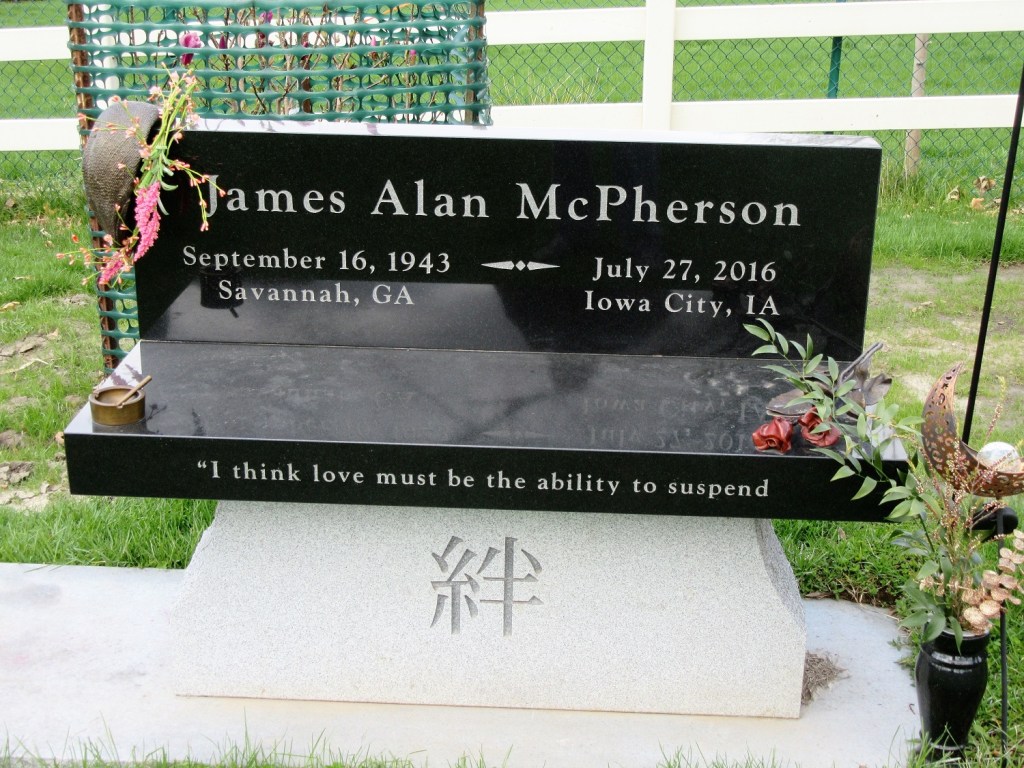
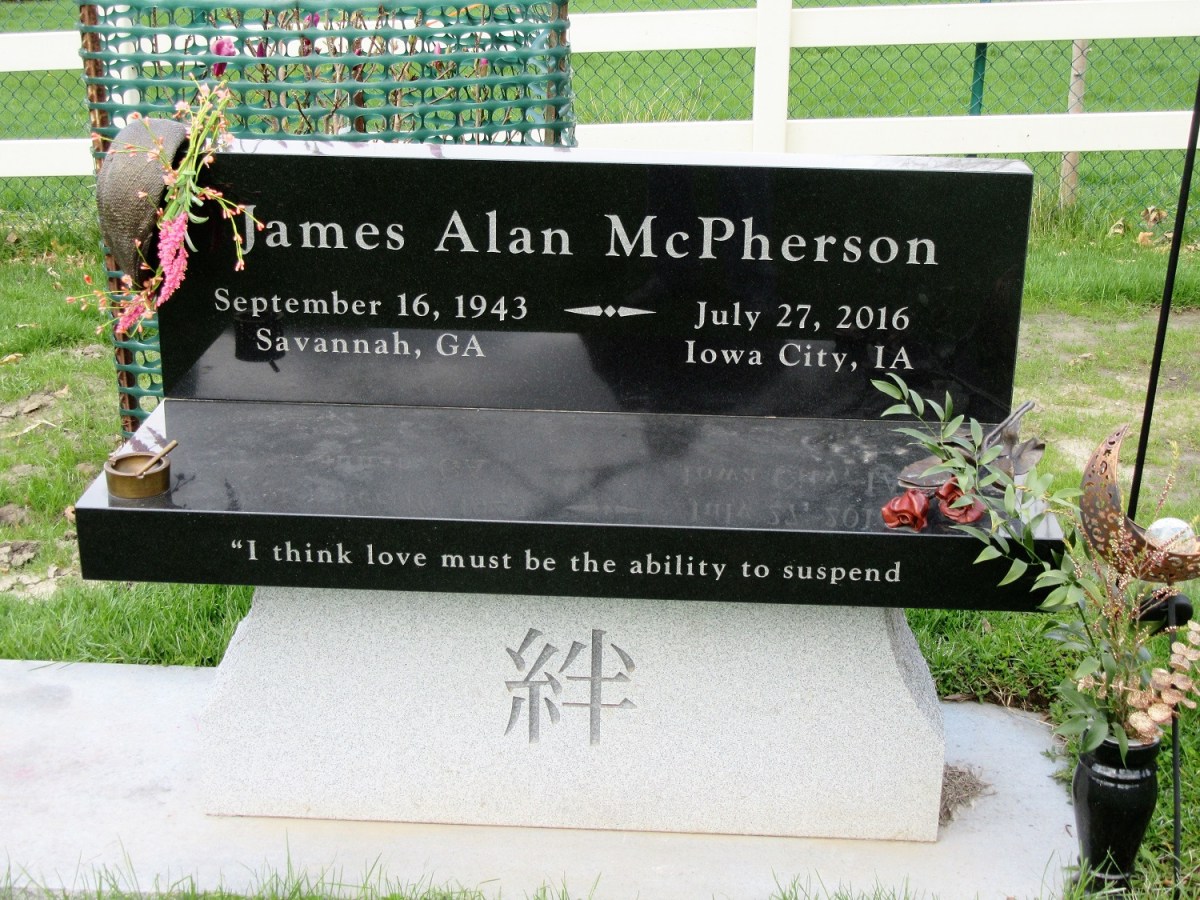
Yesterday, Sena and I visited the James Alan McPherson Park. The Iowa City Council renamed it in his honor last month; it was formerly called Creekside Park. There were compelling reasons for the name change. He was the first African American to win a Pulitzer Prize for fiction for his collection of short stories, Elbow Room in 1978, graduated from Harvard Law School in 1968, was inducted into the American Academy of Arts and Sciences in 1995, and was a permanent faculty member for thirty years at the Iowa Writers’ Workshop at the University of Iowa, among other notable career achievements. He was 72 when he died in 2016 of complications of pneumonia.
McPherson was a longtime resident of Iowa City and was revered by his students. Colleagues described him as the “moral center of the Iowa Writers’ Workshop” and even the “moral center of the world.” Despite his stunning achievements, he was shy and often barely spoke above a whisper in the classroom. He lived in the general neighborhood where the park is located. We never got a chance to meet him.
We are reading his books, though.
The park is located at 1878 Seventh Ave Ct and sits on a little over 2 acres. It was empty except for the occasional walker on the trail. People were friendly. It seems hardly distinguishable from the neighborhood surrounding it and blends into the homes, hugs the meandering creek and adjoining trail, and seems held in a protective embrace by the homes bordering it. A new park sign and a memorial plaque will be installed later this summer.
We saw a rich variety of birds, in fact more than we’ve seen in a while.
We get a sense that everyone is welcome there. There are 6 parking spaces. You can imagine that limited parking makes the place a treasured possession of the immediate neighborhood. But people we encounter there make us feel that it belongs to all of us. Even a sign leaning against a house alongside the trail made that clear. We’ll be back.
I discovered recently from a news item that a local park (formerly Creekside Park) in Iowa City has been renamed James Alan McPherson Park. I realize it’s incredible, but I didn’t know who he was. How did he escape my notice? We’ve lived in the Iowa City and Coralville area for over 30 years and the African American Pulitzer Prize winning fiction writer and Iowa Writers’ Workshop professor had been here the whole time. McPherson died of pneumonia complications in 2016.
We moved in different circles. My wife, Sena, and I moved to Iowa City in 1988 so that I could attend the new summer enrichment medical school program for minority and disadvantaged students. The program owed its start to a leading African American University of Iowa professor, Philip Hubbard. I graduated in 1992, finished my psychiatry residency in 1996, and spent nearly my entire career working as a psychiatric consultant in the University of Iowa general hospital until my retirement last summer.
In contrast, McPherson spent his whole career as a fiction writer. He earned his Master of Fine Arts at the Iowa Writers’ Workshop in 1971. He returned in 1981 to become a faculty member there and lived in Iowa City until his death. He won both the Guggenheim and MacArthur fellowships. In fact, his fame as a writer was established before he ever got to Iowa. McPherson made a substantial contribution to the workshop’s reputation as one of the top creative writing programs in the world.
Last January when I wrote the post about the Iowa River Landing Sculpture Walk, we visited the Iowa Writers Library at the Coralville Marriott Hotel and Conference Center. I mentioned Margaret Walker, the first African American woman accepted to the Iowa Writers’ Workshop. I still think the IRL should have a sculpture honoring her.
But I can’t even recall seeing a book by an African American man in the lowa Writers Library. It’s maintained by the Coralville Public Library, whose website lists several of McPherson’s works, including Elbow Room (which won the Pulitzer in 1978), as being shelved there. I remember thinking that the collection was a bit disorganized and that some books seemed to be missing or shelved in the wrong places. But since I wasn’t even aware of McPherson, I can’t say his books weren’t there.
Even though I have a copy of the book Invisible Hawkeyes: African American at the University of Iowa during the Long Civil Rights Era, edited by Lena M. Hill and Michael D. Hill, I missed any mention of McPherson in the chapter, Obscured Traditions: Blacks at the Iowa Writers’ Workshop, 1940-1965. One reason might be the time frame, which preceded McPherson’s matriculation. However, that’s no excuse because the very last page of the chapter mentions him.
The conclusion chapter of Invisible Hawkeyes (An Indivisible Legacy: Iowa and the Conscience of Democracy by Michael D. Hill in Invisible Hawkeyes: African Americans at the University of Iowa during the Long Civil Rights Era, in Chapter Four: Obscured Traditions: Blacks at the Iowa Writers’ Workshop, 1940-1965, by Michael D. Hill, University of Iowa Press, 2016). does devote a lot of attention to McPherson’s role at the Iowa Writers’ Workshop. While Hill acknowledges that McPherson described his experience at Iowa as “humanizing,” this was in the context of the struggle against racism endured by most other African American students who preceded him decades before. Interestingly, Hill suggests that it’s ironic for an alumnus of a historically black college or university (HBCU), (which was Morris Brown College in Atlanta, Georgia) to express a fondness for Iowa, a place where racism was keenly felt by his predecessors and which Hill suspects McPherson might not have understood in detail and which he discussed only in the abstract with his mentor, Ralph Ellison (author of Invisible Man).
Well, I’m in way over my head there—and I think it’s better for Michael Hill himself to comment on how irony seemed a part of McPherson. He’s also in the best position to describe McPherson as a person as well as a writer. In the video, Hill’s initial comments are about McPherson’s reaction to being the recipient of the Pulitzer Price for Elbow Room, his book of short stories.
We just ordered a copy of Elbow Room. I read a few of the stories from it on the web. It’s funny how chapters from some books find their way out there, often through university web sites, it seems. He was a genius at storytelling. Just from a psychiatric clinician’s standpoint, “The Story of a Dead Man” is a perfect description of someone with Antisocial Personality Disorder, something a colleague wrote about: Bad Boys, Bad Men: Confronting Antisocial Personality Disorder (Sociopathy) by Donald W. Black, MD, 2013 Oxford University Press. It’s an autographed copy. Incidentally, whenever I google black psychiatrists in Iowa, Dr. Black’s always near the top of the page. His name is Black but black he is not.
Which brings up a sense of humor, something which many people say McPherson had. He used a sense of humor several times during a fascinating 1983 interview with Bob Shacochis for the Iowa Journal of Literary Studies. It seems to me that they got a bit annoyed with each other a few times. One of the more striking comments from McPherson was his quote of an old Negro saying, “You may be my color, but you ain’t my kind.” The context was a question from Shacochis about McPherson’s thoughts about the Third World. I was puzzled by his reply that he thought the Third World was a “fiction.” McPherson said if the Third World has any power, then it might be politically advantageous for African Americans to identify themselves with it. He wasn’t after power, he just wanted to find his kind—and that didn’t have anything to do with color.
McPherson was very evocative in his writing and his speech. That old Negro saying evoked a memory in me of my short time at Huston-Tillotson College (another HBCU, in Austin, Texas) in the mid-1970s. I had grown up in Iowa in what were basically all white schools where I was the only African American kid in the classroom. When I finally went to H-TC, I felt very out of place. Even my Northern accent got me into trouble. One student asked me, “Why do you talk so hard?” There was this one time when I tried to play in a pickup basketball game with a group of other students. I was a very clumsy player. For the briefest of moments while struggling underneath the basket, I got murmurs of encouragement from several of them, even members of the opposite team. I will never forget how good that made me feel, especially when I contrast it with a memory from my hometown when I tried to play with a bunch of white guys. When one of them called out, “Don’t worry about the nigger!” I went and sat down on the bench.
The point is that nobody at H-TC ever said to me “You may be my color, but you ain’t my kind.” I said that to myself. Now, somebody else sent me a similar message to me in Iowa, shortly before I left for H-TC. It was a white woman who thought she meant well; she knew I was going there. She showed me a picture of a young black woman with the clear intention of trying to get me interested in females closer to my own color. The message was more like “You may be in my back yard, but you ain’t my color.”
Speaking of back yards, when I was in elementary school, a couple of white bullies a few grades ahead of me found me at my house and started beating the crap out of me in my own back yard. Somehow, they knew that I wrote little stories and brought them to school to read. I began doing that for my mother at home. I promised them I would put them in my stories if they would quit beating on me. They believed me and stopped. It didn’t occur to me how dumb they were for a long time after.
Those little anecdotes are nothing like the jewels that McPherson fashioned. My stories here are true biography of pain. James Alan McPherson’s stories were true fiction, something magical and evocative enough to foster healing of pain. I hope he found his kind.
James Alan McPherson did more than enough to get his name on a sign and dedication plaque for a small park.
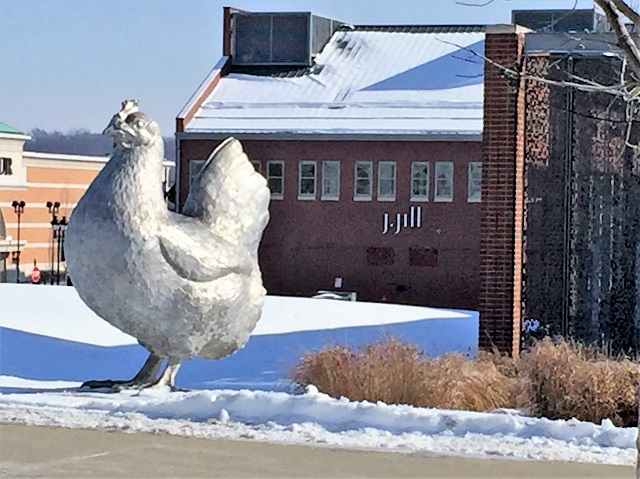
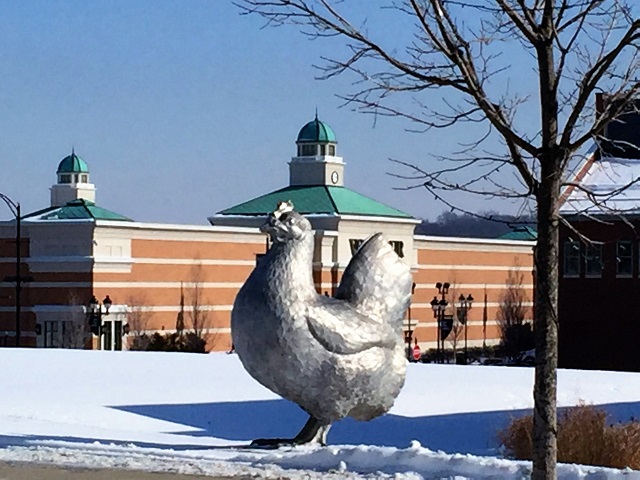
Last week, we were out at the Iowa River Landing (IRL) and saw a giant chicken. It’s actually a metal sculpture entitled Iowa Blue: The Urbane Chicken, 2013, one of 11 such works (all installed in 2013) of art making up the Iowa River Landing Sculpture Walk, located in the Coralville Marriott Hotel and Conference Center.
All of them are linked to literary works by authors associated with the Iowa Writers’ Workshop at the University of Iowa. The artist is Amber O’Harrow’s and her statement about the chicken is:
“I have created a sculpture of the noble chicken, as described in the poem by David B. Axelrod. The Iowa Blue Chicken is the only breed of chicken that was created in the state of Iowa and bred to survive Iowa’s harsh winters and its hot summers.”
The literary reference is to David B. Axelrod’s poem, The Man Who Fell in Love with a Chicken.
The chicken is made from cast aluminum and is taller than I am.
This set me off on an internet journey to find out more about the Iowa Blue chicken breed and Axelrod’s poem. It took a while, because there’s a lot to know.
If you’re a poultry enthusiast and an Iowan, then you know the story about the Iowa Blue Chicken Club (IBCC), not to be confused with the sandwich of the same name which doesn’t yet exist but should. The IBCC is an organization dedicated to making sure that the public at large realizes that the sculpture’s name is Betsy and that there is a big effort to get the breed recognized officially by the American Poultry Association (APA). So far, the APA has deferred, but the IBCC is not giving up.
The story of the origin of the Iowa Blue is somewhat apocryphal in that the breed was said to arise from the union of a White Leghorn (or Red depending on what you’ve been drinking) and a pheasant, which serves to explain the chestnut to striped colors of the feathers and certain behaviors of the chicks, which includes antics like crouching, fast fleeing, and something called “popping” which apparently means a kind of hopping which resembles popcorn popping. I gather this is typical for pheasant chicks.
Iowa Blue roosters will fight hawks, even slapping them with their wings and crowing challenges like “Have some of that!” or “You got something on your face, dude!” They’ll fight just about any critter: opossums, raccoons, snakes, rats, cats, congressmen.
Iowa Blue chickens are bred to thrive in Iowa’s harsh winters and oppressive summers. When the barnyard gets snowed in, they just grab little ergonomic shovels and scoop their way out—they just flip the bird at snow blowers.
Visit the IBCC web site to see photos of these beautiful birds.
Turning to Axelrod’s poem, The Man Who Fell in Love with a Chicken, the web search got a little complicated. For the longest time, I couldn’t find it. All I wanted to do was read it. Heck, you can look up Robert Frost’s The Road Not Taken in half a second at the Poetry Foundation web site.
I finally stumbled on it at a web site (the poetrydoctor) the owner of which I eventually found out was Axelrod himself! I found the chicken poem but the title was The Man Who Fell in Love with His Chicken. Now, I realize that even he says there are typos in the extremely long list of his works which you cannot search by the way, even though the author says there is a search box. The book of his poetry of the same name is 16 pages long and the title is The Man Who Fell in Love with a Chicken, which you can order through Amazon.
Interestingly, one publisher, Cross-Cultural Communications, says the book is “humorous poetry playing on poultry puns.”
This makes me wonder about O’Harrow’s description above including the phrase “…the noble chicken as described in the poem by David B. Axelrod.”
I can’t copy the poem here because that would be copyright violation (despite Axelrod’s making it available on his website—I guess he can do anything he wants with his own work). On the other hand, I think I can say that the poem does, in fact, contain several chicken puns and the man eventually does something to the chicken which is something less than noble and could involve lettuce, tomato, and possibly secret sauce.
The poem is dedicated to someone named Russell Edson, who I learned was called the “grandfather of the prose poem in America.” Edson wrote a few whimsical poems which could have been very much like Axelrod’s poem about the love affair with a chicken. One of them, Let Us Consider, was about a “farmer who makes his straw hat his sweetheart” and “an old woman who makes a floor lamp her son.” See the entry about him at the web site Poetry Foundation—where Axelrod entries can’t be found.
Well, that was my journey through the web about the Iowa Blue chicken sculpture. I’m next to clueless about chickens, unless their roasted, barbecued, fried, or what have you and I’m a terrible poet, as you can see from my video, Pseudobulbar Affect Top Ten—which somehow gets more views than almost anything else on my YouTube Channel.