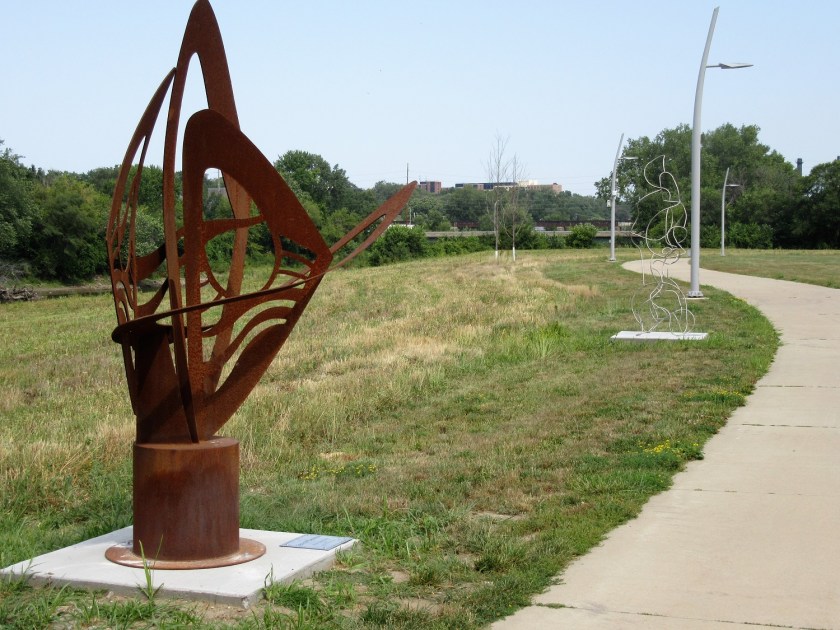
Right on time, the Iowa City Sculptors Showcase is out in the parks. The featured pieces all have a plate on the showcase pad with a QR Code you can scan to learn more about the works. They’ll be up for two years.
Tim Adams: “Exuberance” at Mercer Park, Bradford Dr; “Poppy” at Scott Park on Scott Blvd
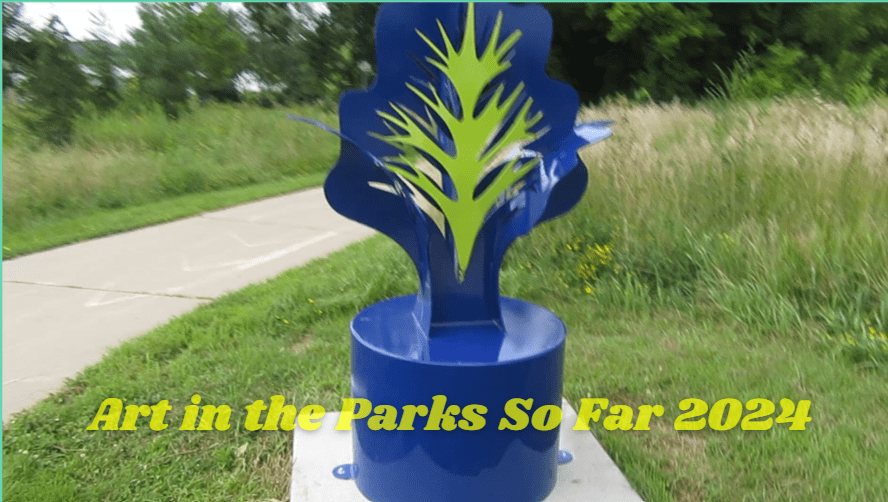
Hilde DeBruyne: “Gaia” and “Life Leaf” at Terry Trueblood Recreation Area, McCollister Blvd
V. Skip Willits: “Writing Figure” at Iowa River Trail; “Flight of Butterflies” at Riverfront Crossings Park
Kristin Garnant: “Mechanics of Grace” at Riverfront Crossings Park
Johnathan Goupell: “Pillars [1]” at Riverfront Crossings Park
We were driving by the Terry Trueblood Trail on July 28th and Sena noticed there was a new sculpture. We’ve been on the lookout for the new Art in the Parks collection since the announcement in May.
The anticipated opening date is August 7, 2024, but it looks like the artists are already getting started. Not all the new pieces we saw had title plaques yet, but there were 6 of them and they are very interesting.
We visited the parks earmarked in previous years: Terry Trueblood Recreational Area, Riverfront Crossings Park, Iowa River Corridor Trail, Mercer Park, and Scott Park.
So far, Tim Adams’s work, “Exuberance,” at Mercer Park is Sena’s favorite, although I think the sculpture of me and Herky is pretty good.
It was wicked hot, in the 90s and we saw a kid out at Mercer Park selling lemonade! Can you believe it? I peddled papers but I never sold lemonade. I figured he would charge a buck, but it was only 50 cents. He got a tip, believe me!
Sena and I took a walk down Scott Boulevard today. The weather was practically balmy, compared to how cold it has been. Forty degrees above zero compared to 9 degrees below feels miraculous.
We walked past the Harvest Preserve entry. Across the street is what we’ve just learned is an old building that is known as the “Haunted Barn” (photo taken in August 2021).
We passed the 20-foot-tall, 110-ton Sitting Man sculpture, now on the west side of Scott Boulevard after it was moved from the east side of the road in July, 2020.
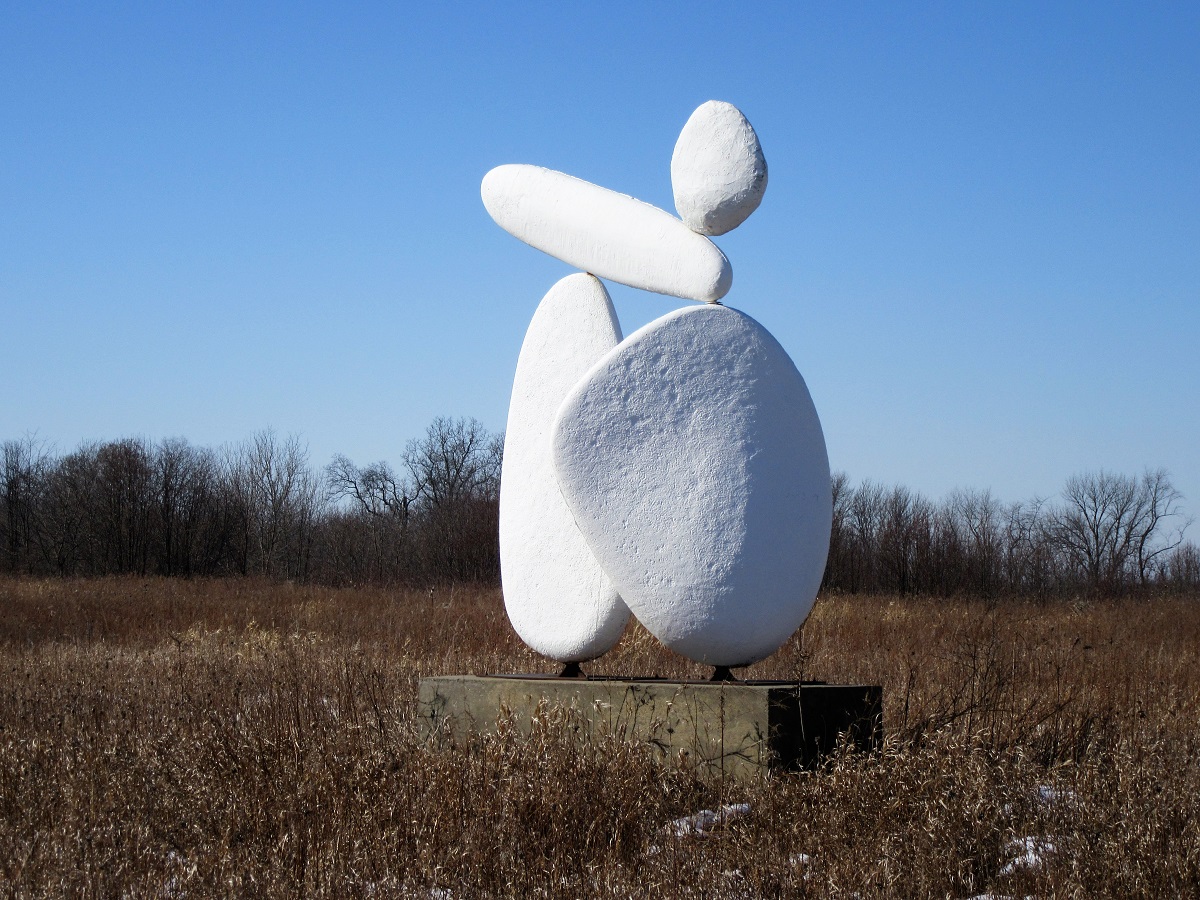
Today was the first time we trekked past the Sitting Man to Rochester Avenue and beyond. If we hadn’t, we would not have noticed a fascinating, blindingly white abstract sculpture mounted on a concrete block which we initially believed was on the Harvest Preserve property at the northwest corner of the intersection. Sena said it looked like a person, noting the head, arms, and body. I didn’t notice that.
After we got back home, I couldn’t find out anything about it on the web, no matter how much I connected the search terms to Harvest Preserve, the Sitting Man and so on. I found only one item with a photo and it was an announcement about a tour on Harvest Preserve in 2018. The impression is that the sculpture is on the property.
I sent an email inquiry to Executive Director of the Harvest Preserve Foundation, Inc., Julie Decker, whose email address is available on the website.
Ms. Decker informed me that the sculpture is technically not on Harvest Preserve property. She knew the sculpture is entitled “Family,” and the artist’s name was Eugene Anderson, who died in 2008. That’s all she knew.
It turns out that what little she knew led to an astonishing story that was even deeper and more engaging than we imagined. You can read the obituary of the Iowa City artist Eugene Anderson on legacy dot com. The highlights are that he started his career in architecture, was the University of Iowa Hospital and Clinics (UIHC) architect for 25 years, and then began creating original art work to display in the hospital to comfort patients. He later became a full-time sculptor, and was on the board of directors for “Arts Iowa City.”
I was a medical student, resident, faculty member and a consulting psychiatrist at UIHC, a career starting in 1988 and ending with my retirement in June of 2020. It’s possible I saw some of Anderson’s work while I was galloping around the hospital.
In 1994 he created the “Family Group” series of sculpture which have been displayed at Chait Galleries in Iowa City, Des Moines Art Center, and the Brunnier Art Museum in Ames, Iowa. The piece we saw might have been one of those. Unfortunately, I couldn’t find anything on the web about the series.
And what is more intriguing, Anderson also traveled extensively, even to Egypt where he cruised on the Nile and took a sunrise balloon ride over the pyramids.
How is it possible that so little of Eugene Anderson’s life and work are not better known? Come to think of it, I guess time can erase the memory of our accomplishments.
This little story reminded me of the poem “Ozymandias” by Percy Bysshe Shelley. I’ve forgotten all of my college freshman English Literature but a web search indicates that Ozymandias was based on Ramesses II, a king of ancient Egypt. Ozymandias was a great ruler of a vast empire. His sculptor built a huge monument in the desert and gave it the oft-quoted inscription, “Look on my works, ye Mighty, and despair!”
Ozymandias
Percy Bysshe Shelley-1792-1822
I met a traveller from an antique land Who said: “Two vast and trunkless legs of stone Stand in the desert . . . Near them, on the sand, Half sunk, a shattered visage lies, whose frown, And wrinkled lip, and sneer of cold command, Tell that its sculptor well those passions read Which yet survive, stamped on these lifeless things, The hand that mocked them, and the heart that fed: And on the pedestal these words appear: ‘My name is Ozymandias, king of kings: Look on my works, ye Mighty, and despair!’ Nothing beside remains. Round the decay Of that colossal wreck, boundless and bare The lone and level sands stretch far away.”
Today we searched for links on the web to find out more about a mysterious sculpture. We found links of a different kind, links to a stranger and to the near and the ancient past. Anderson’s sculpture, “Family,” is still standing, tall, clean, and bright for all to see.
Since the weather took a break yesterday from the triple digit temperatures, we took a little getaway to a few of the city parks to see the new public art. This is connected with the Iowa City Public Art Program. Five sculptures were installed about a week ago at Terry Trueblood Recreation Area, Riverfront Crossings Park, and Mercer Park.
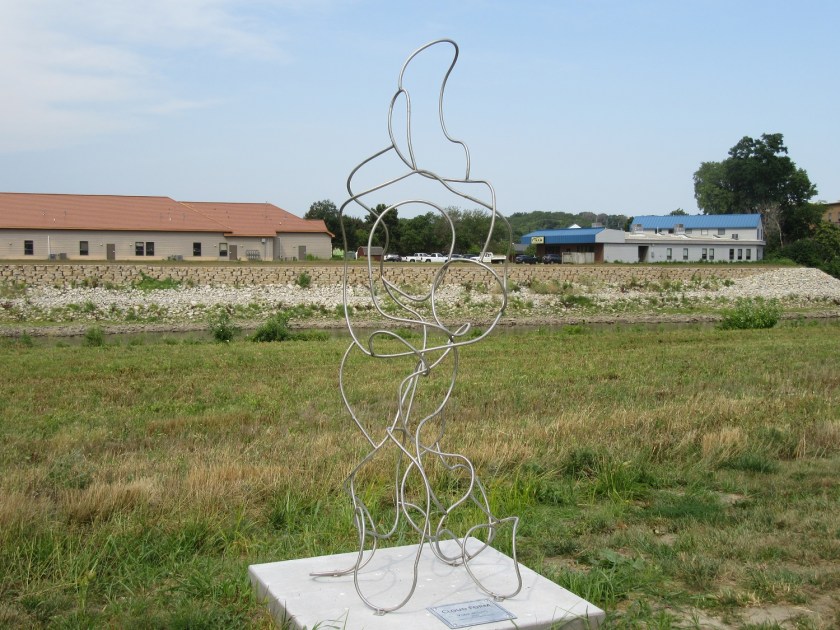
Three sculptures are at Riverfront Crossings. Two are by V. Skip Willits: Palimpsest and Cloud Form. The third is by Hilde DeBruyn: Sea of Change. Sena knows that Sea of Change looks like a sailboat when you look at it from the right angle. We could see clouds through Cloud Form.
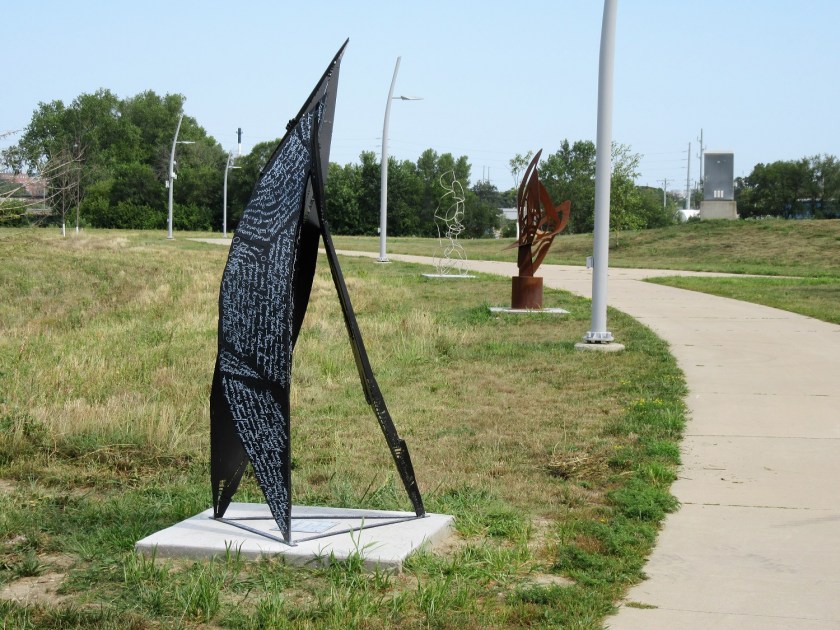
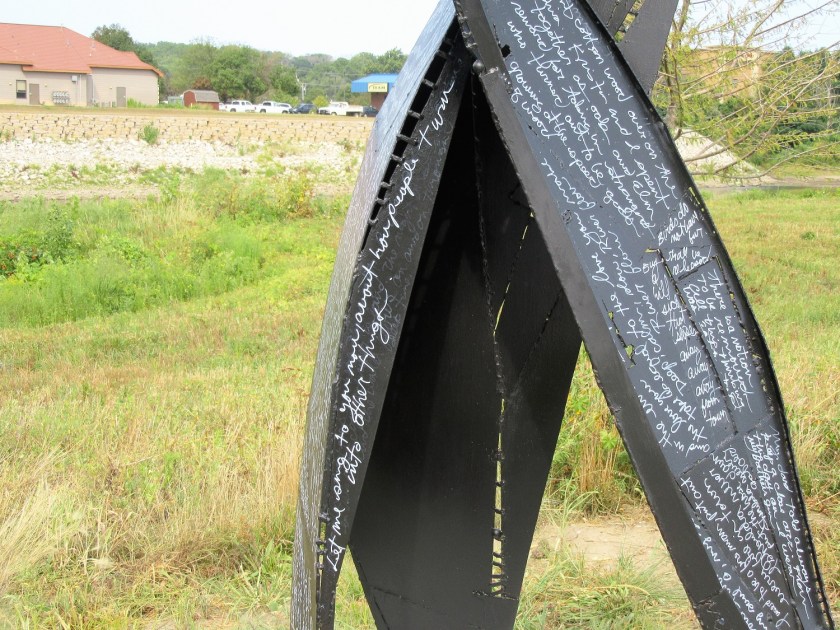
I noticed that V. Skip Willits’s name could be spelled wrong (Willets vs Willits?) on the artist’s nameplate below the sculpture, Palimpsest (also on Cloud Form). I also discovered a 2013 news story of a similar sculpture at the Ames Annual Outdoor Sculpture Exhibition although it was given a different title: Prayer Torso. His sculpture Swans on the Marsh featured in a 2015 image on Sculpture Walk Peoria in Illinois and another fashioned out of corrugated iron in Effingham, Illinois resemble Palimpsest as well. A news story in the March 26, 2021 Effingham Daily News quotes Willits as identifying the sculpture’s title as Cipher. He and probably a few passersby had written on the piece. There are also variant spellings of his name, including V.skip Willits, lower case “s” for “skip.” He’s not the same person as Skip Willits, who is a photographer selling wall art. In any case, Palimpsest is a pretty good example of a palimpsest.
According to the dictionary, a palimpsest is a “piece of writing on which the original writing has been effaced to make room for later writing but of which traces remain.” More generally, it’s something that’s been reused or altered but still has traces of its earlier form. You might want to snap a picture of the sculpture and rotate it in order to see all that’s written there; for example:
“Let me sing to you now, about how people turn into other things.”
I think it could be evocative of what many have noticed and remarked on, only using different words in different languages in different circumstances over millennia. We’re all turning into other things in the turbulent sea of change, sort of like clouds which are the ultimate shape-shifters.
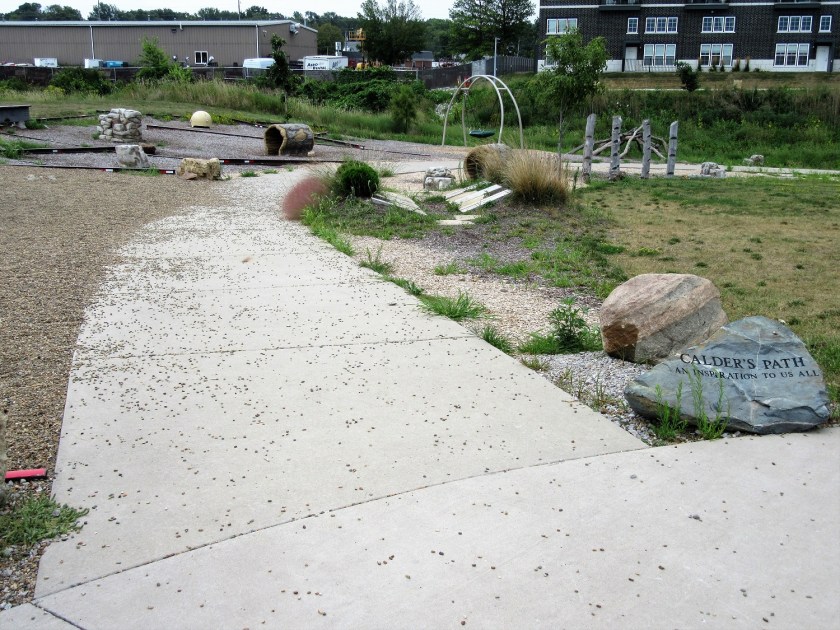
This was the first time we had ever visited Riverfront Crossings Park and we found something familiar there—a stone inscribed with the words Calder’s Path: An Inspiration to Us All. Pebbles were strewn all over the path. After all, no path is without stones. We frequently drive by a small and neatly kept neighborhood park called Calder Park many blocks away. It’s a memorial to a boy named Calder Wills, who passed away of leukemia several years ago. We never knew him or his family. Based on what I’ve gleaned on the web, Calder had big dreams. He was strong. He was a person who turned into a light.
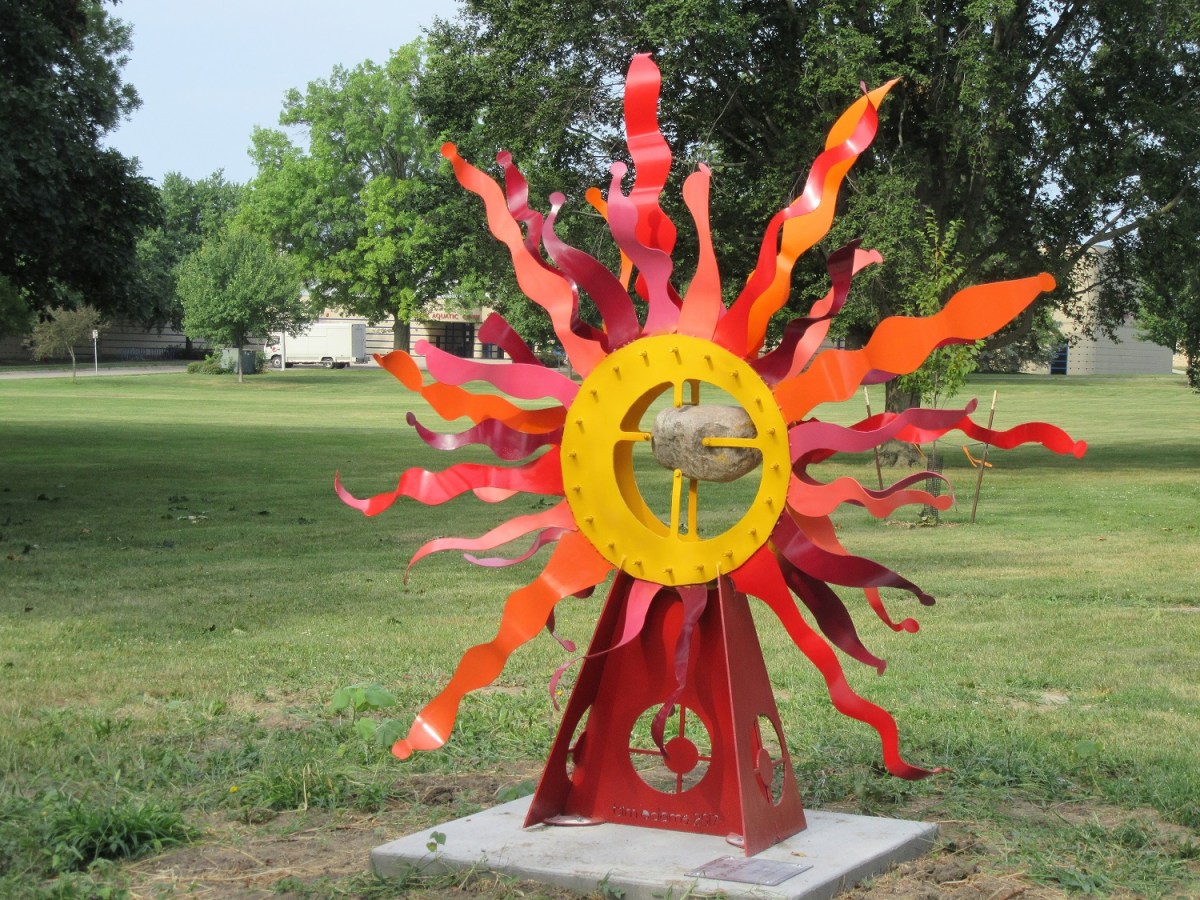
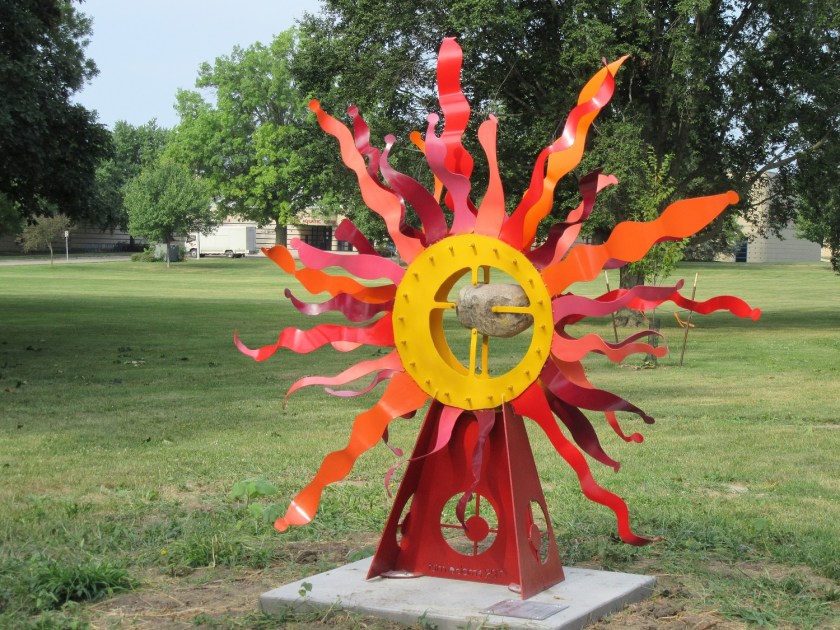
We also enjoyed Mercer Park where we saw the sculpture The Other Extreme, by Tim Adams. Mercer Park and Aquatic Center is named in honor of Leroy S. Mercer who distinguished himself as Iowa City Mayor, state representative and state senator as well as a successful businessman and banker. The sculpture is the sun with a rock at the center. According to Adams, it’s utterly simple; a clear vision of how everything started. There was only the earth and the sun. That was it. And then change took over. Things changing into other things. People turning into other things. Tim Adams art has been influenced by his career as a Registered Landscape Architect. His subjects are influenced by the rugged Iowa weather, which his creations are designed to withstand with little need for maintenance.
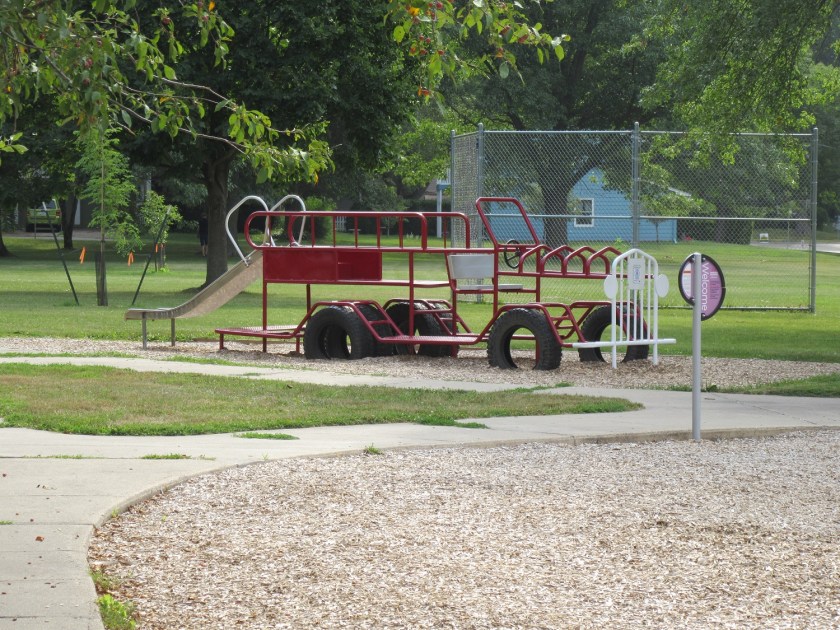
Sena and I both got a kick of the automobile jungle gym.
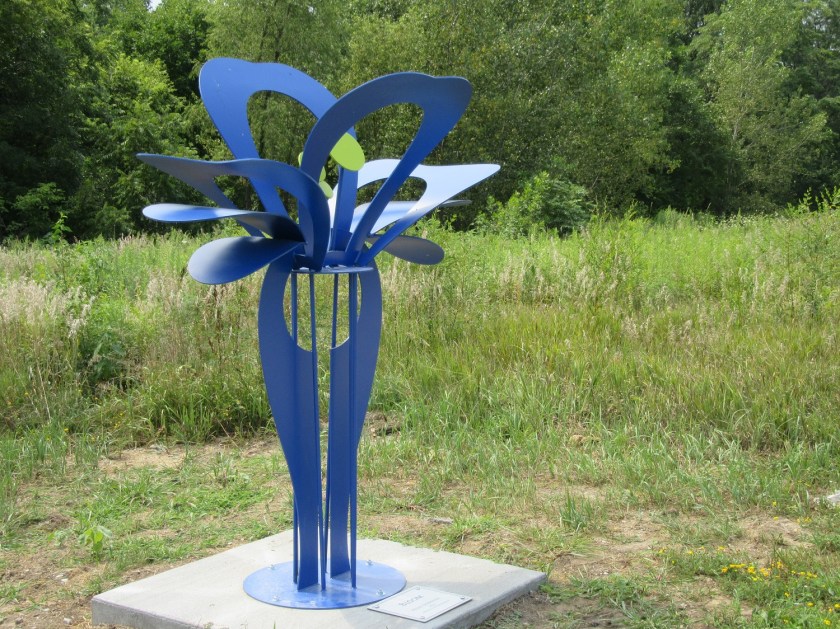
We had already visited the 5th sculpture last week. It is called Bloom by Hilde DeBruyn. Again, the theme of change because it’s a flower and flowers start from seeds in the earth, and burst up to the sun. Because this is where it all begins. DeBruyn is another gifted Iowa artist who has said in an interview with Iowa Artisans Gallery that her work often involves the “natural cycle of growth and decay.”
We begin with one extreme, the raw and wild. Eventually, we reach the other extreme, the ultra-refined and wildly complex. In the middle, we erase and then reconstruct many things from the relics of ancient wisdom or folly, forgetful of bygone grandeur or catastrophe, rarely startled by déjà vu.








 Go Retire Psychiatrist