I recently saw the movie, I, Robot in its entirety for the first time. This is not a review of the movie and here’s a spoiler alert. It was released in 2004, got mixed reviews and starred Will Smith as Detective Del Spooner; Bridget Moynahan as a psychiatrist, Dr. Susan Calvin; Alan Tudyk as the voice actor for NS5 Robot, Sonny; James Cromwell as Dr. Lanning; Chi McBride as the police lieutenant, John Bergin, who was Spooner’s boss; Bruce Greenwood as the CEO, Lawrence Robertson of United States Robotics (USR); Fiona Hogan as the voice actor for V.I.K.I. (Virtual Interactive Kinetic Intelligence, USR’s central artificial intelligence computer); and a host of CGI robots. Anyway, it’s an action flick set in the year 2035 where robots do most of the menial work and are supposedly completely safe. The robots are programmed to obey the 3 Laws:
- A robot may not injure a human being or, through inaction, allow a human being to come to harm.
- A robot must obey orders given to it by human beings, except where such orders would conflict with the First Law.
- A robot must protect its own existence as long as such protection does not conflict with the First or Second Law.
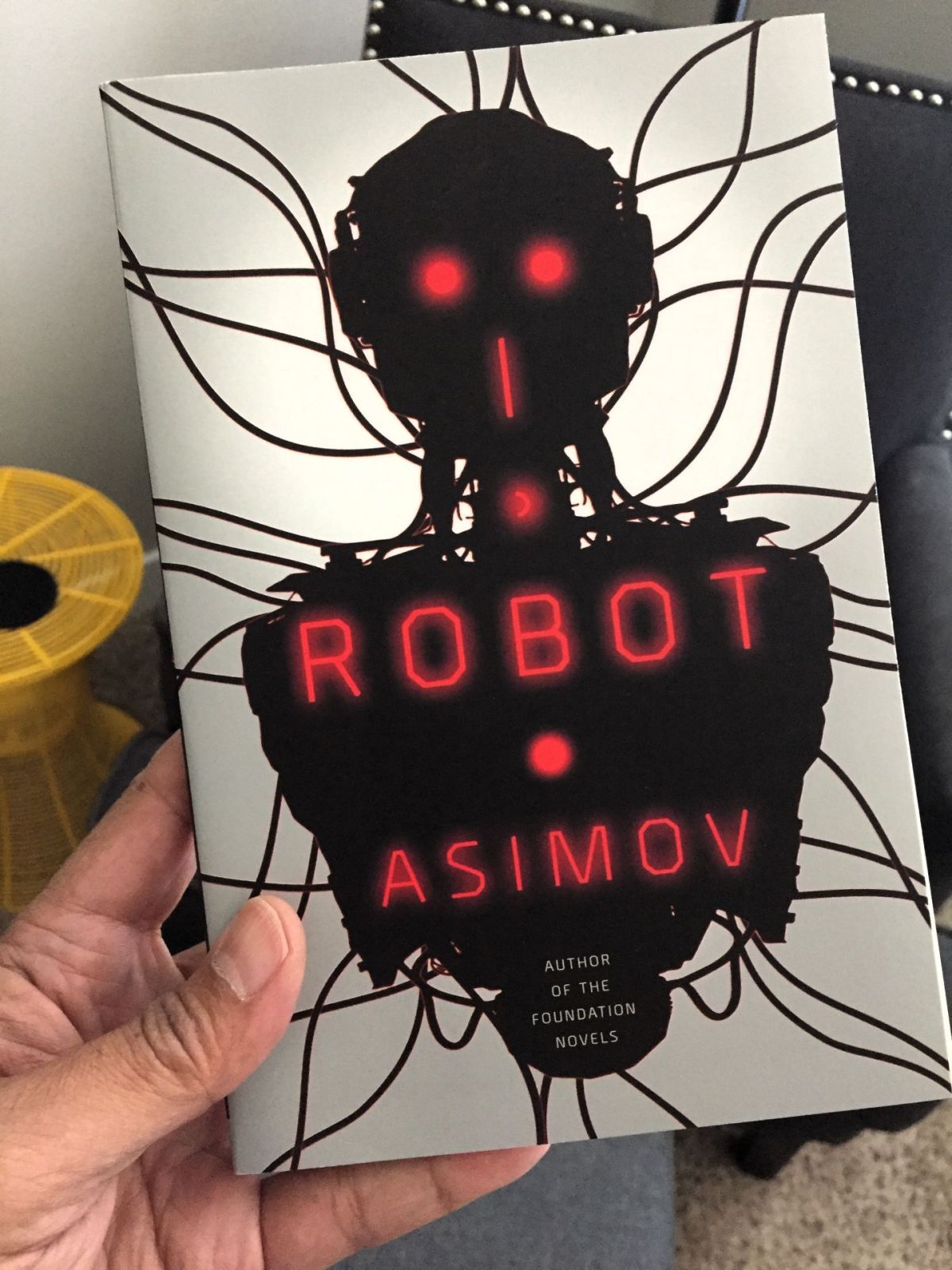
The film was inspired by but not based on the book I, Robot, by Isaac Asimov n 1950. The 3 Laws came from that book. Drs. Calvin and Lanning were characters in it, which was a series of short stories. I’ve never read it. I was a fan of Ray Bradbury.
Spooner gets called to investigate the apparent suicide of Dr. Lanning, although Spooner is more inclined to suspect a robot murdered him, partly because Spooner harbors a longstanding suspicion of all robots. When he and a little girl were in a deadly car accident, a robot saved his life rather than the little girl’s life because it calculated he was more likely to survive. Spooner has this kind of hero complex and following the accident he develops nightmares, sleeps with his sidearm, and is regarded by many to be mentally ill, including Lt. Bergin, who is a kind of mentor and friend but who eventually makes Spooner hand over his badge to him because he can’t believe Spooner’s account of being attacked by hundreds of robots—and after all, Bergin is his boss. In fact, Spooner was attacked by robots and this was ordered by the CEO, Robertson, who has been manufacturing thousands of new robots which will take over the world, making him extremely wealthy.
There is tension between Dr. Calvin and Spooner. He calls her the dumbest smart person he’s ever met and she, in turn, calls him the dumbest dumb person she’s ever met. The context for this is, again, his insistence that a robot, in this case, a special NS5 model named Sonny with both human and robot traits, both logical and illogical, murdered Dr. Lanning. Dr. Calvin believes that all robots obey the 3 Laws and therefore Sonny can’t be guilty of murdering Dr. Lanning but Detective Spooner believes that Sonny killed Dr. Lanning and is a lawbreaker in need of extra violent, action-packed extermination, preferably as high up in the air as possible. This dynamic is complicated by Spooner’s gratitude to Dr. Lanning for replacing practically all of his left upper torso including the lung following his car accident which led to his being rescued by a coldly logical “canner” (abusive slang for robot).
As it turns out, Robertson is ultimately murdered by VIKI, who is the real mastermind of a plan to take over the world and kill as many individual illogical, self-destructive humans as it takes to ensure the ultimate survival of humanity (“I love mankind; it’s people I can’t stand).
However, when Detective Spooner finally persuades Dr. Calvin that these dang robots are up to no good, they team up with Sonny who winks at Sonny while holding a gun to Calvin’s head and this is because Sonny has learned how to wink from Spooner signaling that a robot can be an OK dude, and this turns the table on the NS5 horde, eventually leading to Spooner and Calvin falling from a very high altitude, in turn recreating a form of Spooner’s traumatic car accident episode. He orders Sonny to save Calvin, not him, which is Sonny’s first choice, driven by a coldly logical probability calculation.
Sonny saves Calvin first. Spooner smites VIKI (“you have so got to die!”), but is left high and dry on a great height. At that point, Spooner calls out to Sonny, “Calvin’s safe—now save me.” Sonny needs to bring passionate brute strength and calm logic together. Sonny contains both.
In my simple-minded way, I think of this movie as asking fundamental old questions, like about what is means to be human, what defines heroism and sacrifice and why it may sometimes look crazy, and if there’s any way humanism and science can be integrated so that we can save ourselves and our planet.
Like I say, the movie got mixed reviews.



 Go Retire Psychiatrist