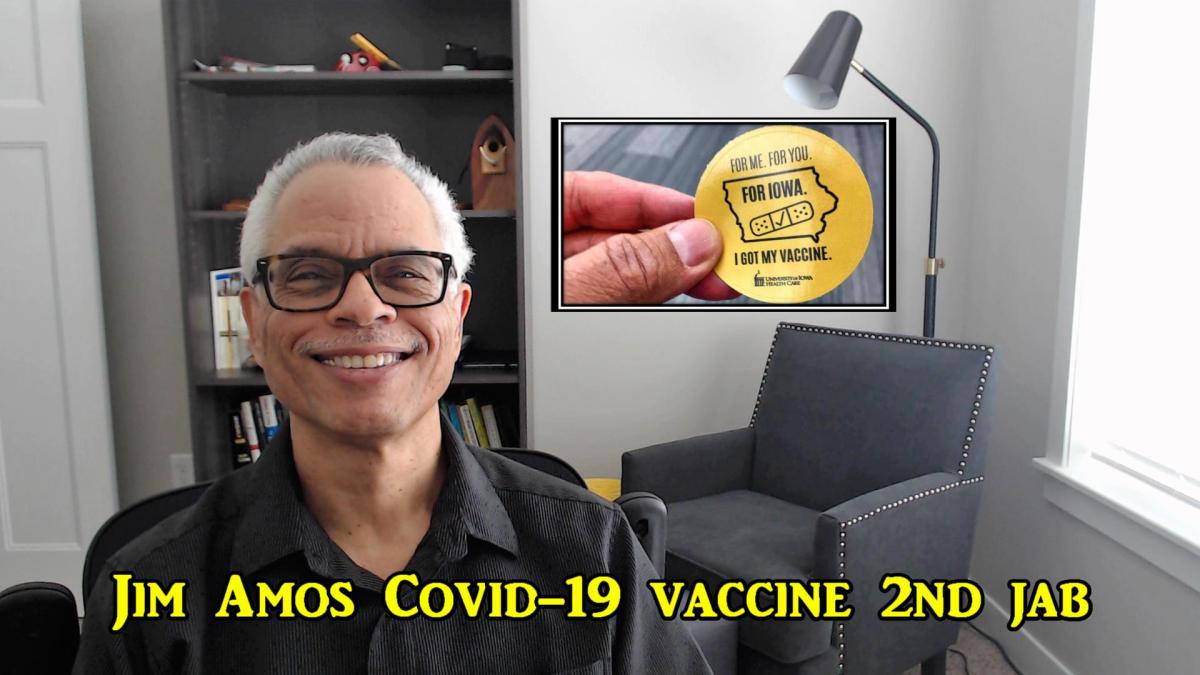
It has been a couple of days since my second COVID-19 vaccine shot a couple of days ago. Consistent with what is known about the side effect profile of the second jab, I had one day of the well-described generalized aches and fatigue besides the sore arm, which didn’t limit my activities. It’s working.
I want to thank the University of Iowa Health Care Support Services Building (HSSB) personnel for a kind, well-organized approach to the vaccine administration process for so many people. This was a way for HSSB to shine a light. It was also an opportunity for many to shine their lights—protecting others as well as themselves.
Dr. Patricia Winokur, MD, Executive Dean and Infectious Diseases specialist at the University of Iowa Hospitals and Clinics, deserves special mention for her superb educational video presentations on the COVID-19 vaccines. Now there’s a big light—more like a beacon.
Her father was George Winokur, MD, who was a very influential psychiatrist and a past chairman of the University of Iowa Department of Psychiatry. He had a great sense of humor and was fond of reminding trainees that we had a lot to learn. He came up with a set of 10 commandments for residents:
Winokur’s 10 Commandments
Thou shalt not sleep with any UI Psychiatry Hospital patient unless it be thy spouse.
Thou shalt not accept recompense for patient care in this center outside thy salary.
Thou shalt be on time for conferences and meetings.
Thou shalt act toward the staff attending with courtesy.
Thou shalt write progress notes even if no progress has been made.
Thou shalt be prompt and on time with thy letters, admissions and discharge notes.
Thou shalt not moonlight without permission under threat of excommunication.
Data is thy God. No graven images will be accepted in its place.
Thou shalt speak thy mind.
Thou shalt comport thyself with modesty, not omniscience.
I got a shout-out to the University on Match Day today. A special congratulations to the Psychiatry Department and the new incoming first year residents. I know they’re going to let their lights shine, especially if they commit Winokur’s 10 Commandments to memory.
I’m reminded of Dr. Joan Y. Reede, MD, MPH, MS, MBA, who delivered the Martin Luther King, Jr. Distinguished Lecture in January. Her light glowed. By the way, she delivered the 2018 Harvard Deans Community Service Awards to medical students whose lights shone brightly.
I also remember my former English Literature professor at Huston-Tillotson College in Austin, Texas ages ago, Dr. Jenny Lind Porter-Scott, who carried her lantern high. I have a copy of one of her books of poetry, The Lantern of Diogenes and Other Poems. The lead poem fits the theme today:
This morning I got my 2nd COVID-19 vaccine shot at the Health Care Support Services Building (HSSB)—just in time for St. Patrick’s Day, as luck would have it. Sena got her first shot yesterday and is scheduled for her second next month. I forgot to wear green, which worried me a little while I was waiting in line when the lady ahead of me poked a lot of fun at a guide for the same sin. He pointed to something bright green on the sole of his shoe, which I didn’t inspect too closely, and which didn’t pass the lady’s inspection.
After my first shot last month, I had some swelling, soreness, redness, and itching in my left arm which didn’t limit my activities. Today, the nurse affirmed that my symptoms after the first shot were not uncommon and that I might have more symptoms after my second shot—or none at all. Like my first experience, the process was very smooth and fast.
I didn’t pay much attention to the type of vaccine I got. I felt lucky to get it. All three, Johnson and Johnson, Moderna, and Pfizer are effective. According to a recent news report, about 88% of Americans who got the first dose of the Pfizer or Moderna vaccine completed the 2-shot series, based on a CDC study of 12 million people.
In other important news, just this past Sunday I spread crab grass preventer and fertilizer on our lawn. On Monday, I shoveled snow from our driveway. Sena assured me that the snow would not hinder the lawn treatment. In fact, things are greening up nicely for St. Patrick’s Day.
The robins have probably been around for about a week. I noticed a robin standing in the street Monday while the snow was coming down. It was mesmerized and seemed to be thinking like me, “Just my luck. Now what?” But the robin didn’t have to shovel a driveway. Luck comes and goes.
I nearly got a 29-hand playing cribbage with Sena last night. She nearly always wins. The odds of getting a 29-hand are 1 in 216,580. In my hand I had the jack of spades and 3 of the four 5 cards. All I needed was a spade 5 cut card, which I did not get. Some players think cribbage is 2/3 luck and 1/3 skill. You need both.
Me and the robin keep looking for the warmer spring sun, and any other good fortune which is coming—and not dependent just on luck.
Today I got my first COVID-19 vaccine shot and I’m scheduled for the second one. This was through the University of Iowa Hospitals & Clinics (UIHC). It was a slick operation and a lot of people like me (in the 1b class) were getting vaccinated. There were very kind and efficient persons guiding me everywhere I needed to go, starting in the parking lot, all the way in the building, leading to the person who administered the vaccine. And from there, I was never at a loss for where to go next, which was to the waiting room for observation for 15-30 minutes. I got jabbed. I stuck around for at least 15 minutes as required and had no worrisome reaction symptoms. I was in and out in a half hour.
I requested the vaccine through MyChart about a week ago. I got notified to schedule yesterday through MyChart. I kept getting a message that there were no available openings. I was just going to check back periodically, but was pleasantly surprised this morning when they telephoned me inviting me to come in today.
I also found out from a news item this morning that the Iowa COVID vaccine provider portal may have a glitch in it. Some of the counties were not able to post accurate data. Some are listed as not having available vaccine providers when, in fact, they do. The list varies from day to day. For now, I removed the web link from the menu on my blog until they get it worked out, which I hope will be soon.
But UIHC definitely did not have a problem getting the vaccine into arms today. There are two ways to request the vaccine: through MyChart or a web-based request form. Hang in there and keep trying.
The UIHC COVID-19 Vaccine Clinic gets the Triple Whammy Shout-Out for kindness, safety, and a great job.
As I struggle to remember to write and say the year “2021” I noticed the University of Iowa Health Care quotation selection by Dr. Martin Luther King, Jr this month pertinent to the upcoming MLK Human Rights Week, starting January 18, 2021:
“Love is the only force capable of transforming an enemy into a friend.”
It’s funny because, as usual, the way my sense of humor works, I also recall quotes from the movie Men in Black 3. Agent K asks Agent J, “Do you know the most destructive force in the universe?” Agent J answers with a wisecrack, “Sugar?” Agent K replies, “Regret.”
Then what is the most constructive force in the universe? Dr. King thought it was love.
Since my retirement in July of last year, I’ve had a lot of time on my hands. It leaves me with too much time to reflect on my current life as a retired psychiatrist—and my past life as a consulting psychiatrist. As my thin veneer of authority, responsibility, and other lies I tell myself drop away, I become more aware of my flaws in both roles. I find deep holes in my identity as a person as my identity as a doctor fades. Just being a person who has a lot to learn about life despite being a psychiatrist—is hard. I have regrets and remorse. My sense of humor sometimes helps me get by.
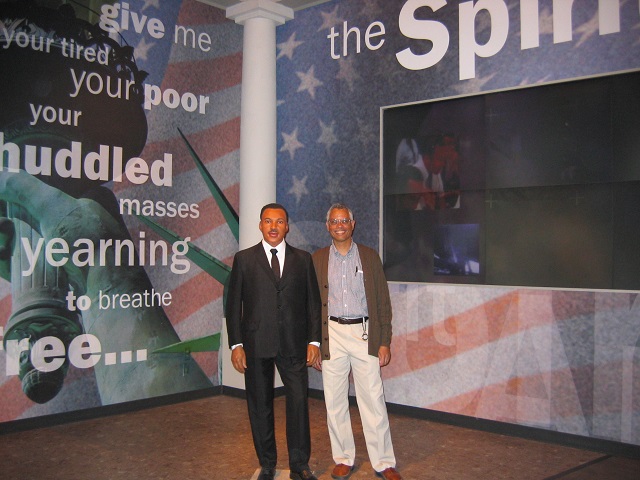
Dr. Martin Luther King, Jr and me in Vegas.
Regret can indeed be a destructive force. Though it’s similar to regret and painful, remorse could help me be a better person. It becomes more and more important that I find something constructive, both to do and to be.
Maybe love is the most constructive force in the universe. Because quotes are sometimes misquoted and inaccurately attributed, I googled the quote “Love is the only force capable of transforming an enemy into a friend.” I found the sermon from which I think the quote is derived on a Stanford University web site. It’s called the “Loving Your Enemies” sermon and it’s published in the book, A knock at midnight: inspiration from the great sermons of Reverend Martin Luther King, Jr.
There are YouTube and Vimeo videos of an audio recording of the sermon as well. The internet being what it is, you apply hyperlinks to these and other works at the risk of the links being broken at some point, which I have found and which might be due to uncertainty about whether the text of the sermon is in the public domain.
As an aside, I’m reminded of a quote variously attributed to Charles Schulz, creator of the Peanuts comic strip, Fyodor Dostoyevsky, and others: “I love mankind; it’s people I can’t stand.” This probably betrays my skepticism about the ability to love your enemies.
You know, it’s funny. I didn’t find the Dr. King quote, word for word, the first couple of times I scanned it in the Stanford University transcript. What I did was the thing most junior medical students do when they discover the vast load of information they have to memorize and digest. I scanned the sermon for the key words and didn’t see them.
Nor did I find it on the third read, in which I finally abandoned the scanning method and actually read the sermon. But I got the point.
If the Stanford version and my reading are accurate, what I found were probably the main ideas I needed to make sense of the sermon. King said that I have to look deep within myself first before attempting to understand anyone else, much less to love my enemies. I also would do well to look for the good in people who I judge are bad. Moreover, I gain nothing by trying to defeat my enemies. He even mentions the theories of psychologists and psychiatrists to support his profound conclusions. As I read them, I was acutely reminded of my shortcomings as a psychiatrist. You would think a psychiatrist would know how to analyze himself (and psychoanalysts do undergo analysis in training). I am not a psychoanalyst. But I am capable of reflection.
The exact quote might not be discoverable (at least to me) in King’s sermon. Nevertheless, the transformative and redemptive power of love is clearly expressed. The quote is distilled from the text of the sermon. That doesn’t mean that there might not be a different version of the sermon which could have contained each and every word. According to one writer, that may be the case. Perhaps it’s in the book, A Knock at Midnight: Inspiration from the Great Sermons of Martin Luther King, Jr.
What is more important for me at this time of my life is to accept that my search for the most constructive force in the universe will proceed in baby steps.
What I need to do is reflect on my own shortcomings and find ways to improve while avoiding making excuses. Stephen Covey said that we often blame our parents or our grandparents for our flaws. This was part of his three theories of determinism to explain man’s nature. Genetic determinism says I inherited my flaws from my grandparents (whom I never met), which implied my mistakes were encoded in my DNA. Psychic determinism supposedly explains what I got from my parents because of their mistakes in rearing me. Hmmm, I was exposed to fruitcake at Christmas. Environmental determinism implicates says that other people in my workplace, my school, my neighborhood or my country (politicians perhaps?) caused my flaws.
Covey disputed these ideas by the example of Viktor Frankl’s personal triumph over his experience as a prisoner in a Nazi death camp. His captors controlled his liberty to move about his environment. They could not control his freedom to choose what he thought and felt. He controlled his self-awareness, imagination, conscience, and independent will to draw meaning from his experience [The Seven Habits of Highly Effective People: By Stephen R. Covey. New York: Simon and Schuster, 1989].
How can I see the good in my enemies, despite their obvious flaws in comparison to my own angelic perfection? And how to avoid acting on the urge to defeat them, despite the reality that there have to be winners and losers at all levels in society, including elections, sports, cribbage (at which my wife regularly beats me)? Something tells me I’m getting off to a shaky start here.
I have to crawl before I can walk; I have to walk before I can run—before I fall flat on my face for the umpteenth time. Now more than any other time in my life, I must keep trying. I must get up and try again.
ADDENDUM January 11, 2021: I tried to access the King Library and Archives (KLA) today at The King Center website. There is a message indicating the KLA page is down indefinitely and redirects the reader to the Stanford University site noted above.
After a lot of encouragement from Sena, we got the 29-cribbage board. It’s a novelty board shaped like the very rare perfect 29 cribbage hand. You’re more likely to spot aliens in your back yard than to get a 29 hand—the odds are 1 in 216,580. See our 29 cribbage board antics in our YouTube video.
This is a follow up cribbage post, the most recent one being “Kitchen Table Cribbage” featuring our other new board, which was a v-tournament model.
We have a lot of fun playing cribbage and making the videos are a challenge, given that we’re still learning how to play. If we wait for the perfect video (meaning one without mistakes), it would be similar to waiting for the perfect 29 hand to show up.
On the cribbagecorner web site, there are interesting facts about the 29 hand probabilities. According to them, given the assumption that there’s a cribbage tournament somewhere in the United States almost daily, you should expect to see one 29 hand a year during tournament play.
One the other hand, there are many cribbage games, including kitchen table versions, occurring daily between commoners like us. Who knows how many 29 hands show up in all those unofficial competitions?
We’re not shy about comments from cribbage players helping us develop our skills. I suppose another way to do that would be to join a cribbage club. The American Cribbage Congress (ACC) sponsors the ACC Grass Roots organizations which has about 200 such clubs across North America.
Players in the ACC Grass Roots clubs compete to earn points for awards including being crowned champion and for getting 29 hand. There is one ACC Grass Roots club in Iowa and it’s in Ankeny. It’s called the Capital City 9-game club (given that most club members get together to play 9 games about once a week or so).
Just for the record, the capital city of Iowa is Des Moines. Ankeny is about 13 miles north of there. If we were to join the Capital City club, that would mean about a 2-hour drive from Iowa City. Since the season runs from September to May, we’d be driving in winter weather conditions sometimes.
If you earn enough lifetime milestone points in the ACC Grass Roots club, you can earn a trip to big tournaments such as the annual ACC Tournament of Champions, usually held in Reno, Nevada. However, the ACC announcement says the 2020 Grand National tournament XXXIX will be in Sacramento from September 22-27, 2020. The first-place trophy is a gold pan. The last time anybody from Iowa won it was in 1990. He was from Des Moines.
The obvious question is why isn’t there an ACC Grass Roots club in Iowa City? I don’t know if there is enough interest, frankly. I did see a small 29 cribbage board at a local hobby shop here. It fit in the palm of my hand. The one we just got works out better for us.
I just found out that National Cribbage Day is celebrated annually on February 10, which is just around the corner! February 10 happens to be the birthday of Sir John Suckling, the creator of cribbage in the early 17th century. He was also a poet. According to the Poetry Foundation web page for him, his poetry showed him to be a cynical party animal, womanizer, and gambler. He invented cribbage from an earlier game called Noddy and it was gambling game. I gather it’s still the only game that can be play in an English pub for money. Cribbage came to American with the first English settlers.
Can you tell we really like playing cribbage? Please, no wagering.
I had so much fun with the giant chicken post on January 25, 2020 that I thought it would be nice to revisit the subject, only this time take a butt-freezing tour of the entire Iowa River Landing (IRL) Sculpture Walk.
We took the walk Tuesday, January 28, 2020. The weather was typical for Iowa in January. The temperature was in the teens and there were brief flurries. My wife, Sena, and I dressed warm and took a meandering journey through the Sculpture Walk, guided by a small map.
It was a little more challenging because snow and ice covered up many of the plaques identifying the works (and parts of the sculptures as well) although this lent even more visual interest to them. They’re three dimensional objects anyway and you really have to walk around them to fully appreciate their complexity. You have to watch out for yellow snow.
What made this adventure even more special was the Iowa Writers’ Library in the lobby of the Coralville Marriott Hotel and Conference Center. It’s maintained by the Coralville Public Library. One of the issues I had was being unfamiliar with the text of the poems and other literary works (all were connected with the Iowa Writers’ Workshop) referenced by the artists. The library was cozy, had a fireplace warming the softly lit room lined by bookshelves and a couple of ladders on wheels to help you reach the books higher up.
I have always felt comforted in libraries, ever since I was a little boy. Every day I got the chance, I would walk to my hometown library (which was about a mile trip), browse the stacks for hours, then tote home piles of books in both arms.
The hotel library had most of the books pertinent to the literary references cited by the artists for their sculptures. I even found David B. Axelrod’s book, The Man Who Fell in Love with a Chicken. It turns out that the title of Axelrod’s poem is “The Man Who Fell in Love with His Chicken.” There, I’ve said enough already about that chicken.
Of course, I couldn’t take the time to find and read every book; we would not have had time to freeze our butts off touring the sculptures.
I didn’t wear my heavy winter boots and had to crunch through the crusty snow nearly up to my ankles to reach certain sculptures. Sena was dressed better for the weather but we both slipped around on the ice and I began to think more and more about things like broken hips.
But we soldiered on because it was necessary to walk completely around the Made of Money sculpture by Aaron Wilson in order to see the message printed, “HOW CAN WE HELP YOU?” It’s funny because that’s what I typically ask patients in the general hospital when I sit down on my little camp stool after I introduce myself to them as a consultation-liaison psychiatrist.
The sculpture To Dorothy, by artist James Anthony Bearden, was in a difficult spot and initially we thought we’d have to either rappel down from the roof of the building it was in front of or climb up the big retaining walls to get a good look at it. We found a way out to it and ignored passersby who gawked at us. They needed to admire us for how unique we are (not how eccentric and possibly a danger to ourselves and others), which is what I think Iowa Poet Laureate Marvin Bell was getting at in his poem of the same title as Bearden’s sculpture.
The sculpture, A Thousand Acres, by artist V. Skip Willits was another piece you really have to walk around to fully appreciate, although you generally have to do that with any sculpture. The book of the same title by Jane Smiley is based on Shakespeare’s King Lear—which I have also never read—but which I got an earful about in my undergraduate days from a fellow student who thought he knew everything there was to know about King Lear. He was garrulous in the extreme and bested me in debating class mainly because he never let me open my mouth.
The sculpture by artist Victoria Ann Reed, called Convergence, was very intriguing and looked more like a human figure who had been through a wormhole than a memory.
The Tipping Point, by artist Sarah Deppe, was a convincing image of persons with holes in their heads (several holes in fact). Bureaucrats come to mind.
We nearly dismissed the sculpture called After Trillium by artist Anthony Castronovo as a broken lamppost with dysfunctional solar panels, only partly because snow and ice covered the panel describing it. On the other hand, the top part does resemble a flower called a Trillium, not to be confused with Trillian, a character in the book by Douglas Adams, The Ultimate Hitchhiker’s Guide to the Galaxy. I’m glad I could clear that up for you.
The Prairie Breeze Bench by artist Bounnak Thammavong is a sculpture you could actually sit on and watch the Bald Eagles. However, it’s made of steel and the seat was covered by snow. After you wipe away the Bald Eagle droppings, you can read the poem by James Hearst, “Landscape Iowa.” You can also hear it set to music and performed by Scott Cawelti, a former University of Northern Iowa educator who taught film, writing, and literature courses. He also edited The Complete Poetry of James Hearst (University of Iowa Press, 2001).
The Alidade sculpture by Dan Perry was the one Sena and I both really liked. I know Perry says the alidade was used by astronomers but I remember it as being a part of an instrument used by land surveyors, also for measuring distance and angles in topographical surveys. I used to work for consulting engineers as a surveyor’s assistance and draftsman many years ago. Perry links it to the poem entitled “1,2,3” from James Galvin’s book of poems, X: Poems. I confess I don’t see the connection yet. The poem for the most part reminds me of spelunking although Galvin describes a hole that he and a friend rappel into as being a planet. Much of the rest seems to be about something very painful. I’m sorry I can’t do better, but that’s why he’s a poet and I’m not.
Next, we encountered Bounnak Thammavong’s second sculpture, a very recognizable fish, a “lowly river carp,” entitled From the River. It’s linked to the poem “Where Water Comes Together with Other Water” by Raymond Carver. When I was a boy, I used to fish for bullhead in my hometown river. I sometimes caught carp and thought that was the poorer catch. It didn’t matter. I always threw both back into the river. My mom would not clean fish and neither would I.
Finally, by a pretty circuitous route, we saw the last sculpture, Gilead, by artist Kristin Garnant. The snow plow had piled up a lot of snow around it. I probably won’t read Gilead, the epistolary novel by Marilynne Robinson.
In fact, I probably won’t read a lot of the literature connected with the sculptures we saw. I did read Margaret Walker’s poem “For My people.” Sorry, Jubilee is way too much for me. She was the first African-American woman to be accepted into the Iowa Writers’ Workshop, of course depending on which story you believe about when the program formally began (Invisible Hawkeyes: African Americans at the University of Iowa during the Long Civil Rights Era, in Chapter Four: Obscured Traditions: Blacks at the Iowa Writers’ Workshop, 1940-1965, by Michael D. Hill, University of Iowa Press, 2016).
In some ways, I identify way with her, one of the reasons being obvious and skin-deep. The other is that she taught school at Jackson State, a historically black college in Jackson, Mississippi.
I wonder if the IRL Sculpture Walk could include another one for her, just to make it an even dozen?
I spent my Freshman and Sophomore college years at a historically black college. It was then called Huston-Tillotson College (now Huston-Tillotson University) in Austin, Texas. That was back in the mid-1970s. I had grown up in largely white neighborhoods and gone to predominantly white schools prior to going to H-TC. It was a culture shock and that’s probably about all I’ll say about it for now, since this post is way too long.
I can say one other thing about H-TC. I submitted a poem for the college’s annual poetry contest. Winners would have their work published in the school’s small anthology called Habari Gani (Swahili for What’s Going On?). Mine didn’t make it but years later I scoured the web looking for a way to get a copy of Habari Gani, finally succeeding only a few years ago after tracking a copy of the Spring 1975 volume down at the H-TU library. I like the short introductory poem:
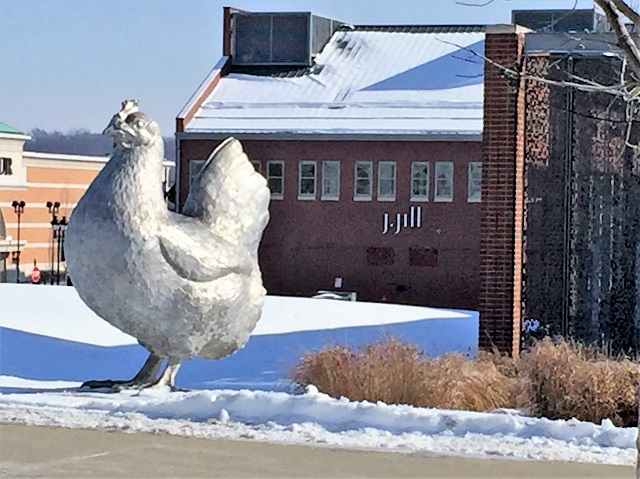
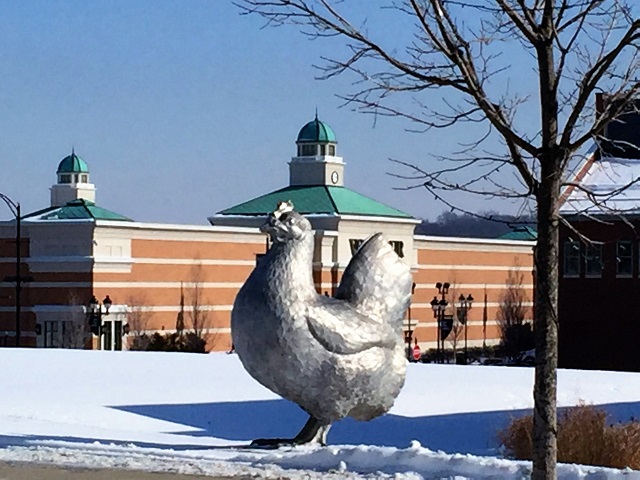
Last week, we were out at the Iowa River Landing (IRL) and saw a giant chicken. It’s actually a metal sculpture entitled Iowa Blue: The Urbane Chicken, 2013, one of 11 such works (all installed in 2013) of art making up the Iowa River Landing Sculpture Walk, located in the Coralville Marriott Hotel and Conference Center.
All of them are linked to literary works by authors associated with the Iowa Writers’ Workshop at the University of Iowa. The artist is Amber O’Harrow’s and her statement about the chicken is:
“I have created a sculpture of the noble chicken, as described in the poem by David B. Axelrod. The Iowa Blue Chicken is the only breed of chicken that was created in the state of Iowa and bred to survive Iowa’s harsh winters and its hot summers.”
The literary reference is to David B. Axelrod’s poem, The Man Who Fell in Love with a Chicken.
The chicken is made from cast aluminum and is taller than I am.
This set me off on an internet journey to find out more about the Iowa Blue chicken breed and Axelrod’s poem. It took a while, because there’s a lot to know.
If you’re a poultry enthusiast and an Iowan, then you know the story about the Iowa Blue Chicken Club (IBCC), not to be confused with the sandwich of the same name which doesn’t yet exist but should. The IBCC is an organization dedicated to making sure that the public at large realizes that the sculpture’s name is Betsy and that there is a big effort to get the breed recognized officially by the American Poultry Association (APA). So far, the APA has deferred, but the IBCC is not giving up.
The story of the origin of the Iowa Blue is somewhat apocryphal in that the breed was said to arise from the union of a White Leghorn (or Red depending on what you’ve been drinking) and a pheasant, which serves to explain the chestnut to striped colors of the feathers and certain behaviors of the chicks, which includes antics like crouching, fast fleeing, and something called “popping” which apparently means a kind of hopping which resembles popcorn popping. I gather this is typical for pheasant chicks.
Iowa Blue roosters will fight hawks, even slapping them with their wings and crowing challenges like “Have some of that!” or “You got something on your face, dude!” They’ll fight just about any critter: opossums, raccoons, snakes, rats, cats, congressmen.
Iowa Blue chickens are bred to thrive in Iowa’s harsh winters and oppressive summers. When the barnyard gets snowed in, they just grab little ergonomic shovels and scoop their way out—they just flip the bird at snow blowers.
Visit the IBCC web site to see photos of these beautiful birds.
Turning to Axelrod’s poem, The Man Who Fell in Love with a Chicken, the web search got a little complicated. For the longest time, I couldn’t find it. All I wanted to do was read it. Heck, you can look up Robert Frost’s The Road Not Taken in half a second at the Poetry Foundation web site.
I finally stumbled on it at a web site (the poetrydoctor) the owner of which I eventually found out was Axelrod himself! I found the chicken poem but the title was The Man Who Fell in Love with His Chicken. Now, I realize that even he says there are typos in the extremely long list of his works which you cannot search by the way, even though the author says there is a search box. The book of his poetry of the same name is 16 pages long and the title is The Man Who Fell in Love with a Chicken, which you can order through Amazon.
Interestingly, one publisher, Cross-Cultural Communications, says the book is “humorous poetry playing on poultry puns.”
This makes me wonder about O’Harrow’s description above including the phrase “…the noble chicken as described in the poem by David B. Axelrod.”
I can’t copy the poem here because that would be copyright violation (despite Axelrod’s making it available on his website—I guess he can do anything he wants with his own work). On the other hand, I think I can say that the poem does, in fact, contain several chicken puns and the man eventually does something to the chicken which is something less than noble and could involve lettuce, tomato, and possibly secret sauce.
The poem is dedicated to someone named Russell Edson, who I learned was called the “grandfather of the prose poem in America.” Edson wrote a few whimsical poems which could have been very much like Axelrod’s poem about the love affair with a chicken. One of them, Let Us Consider, was about a “farmer who makes his straw hat his sweetheart” and “an old woman who makes a floor lamp her son.” See the entry about him at the web site Poetry Foundation—where Axelrod entries can’t be found.
Well, that was my journey through the web about the Iowa Blue chicken sculpture. I’m next to clueless about chickens, unless their roasted, barbecued, fried, or what have you and I’m a terrible poet, as you can see from my video, Pseudobulbar Affect Top Ten—which somehow gets more views than almost anything else on my YouTube Channel.
The Martin Luther King Jr. Day of Service is today and the University of Iowa has taken a quote from King to set the tone each year for this event. This year it is:
“Let us build bridges rather than barriers, openness rather than walls. Rather than borders, let us look at distant horizons together in a spirit of acceptance, helpfulness, cooperation, peace, kindness and especially love.”—Dr. Martin Luther King, Jr.
Dr. Martin Luther King, Jr.
As I look back on my career in medicine, it’s only natural for me to think of my role as a consultation-liaison psychiatrist as a sort of bridge between medicine and psychiatry. I’m pretty sure most would agree that as I chased around the hospital up and down the stairs doing the 3 and 30 (3 miles and 30 floors; I never take the elevator), I was doing my level best to bring psychiatric care to the patients in the general hospital who were suffering from medical illness as well.
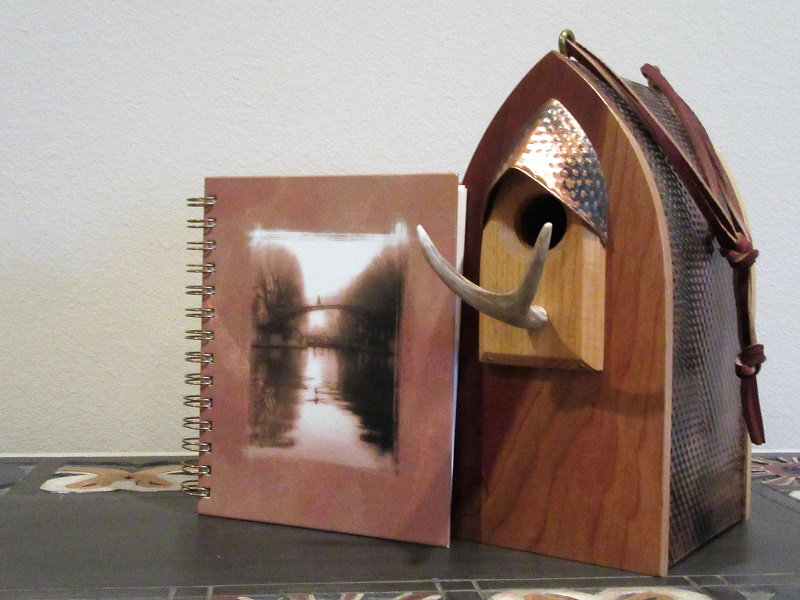
The featured image shows the cover of a little book of kind remembrances I received from colleagues and trainees when, during one of my two such lapses in good judgment, I left the University of Iowa to have a try at private practice. The book has an image of a bridge on it. At the time, I thought of it as a depiction of my path between academia and community psychiatry. We need bridges there too, although one person let me know that someone has to teach new doctors.
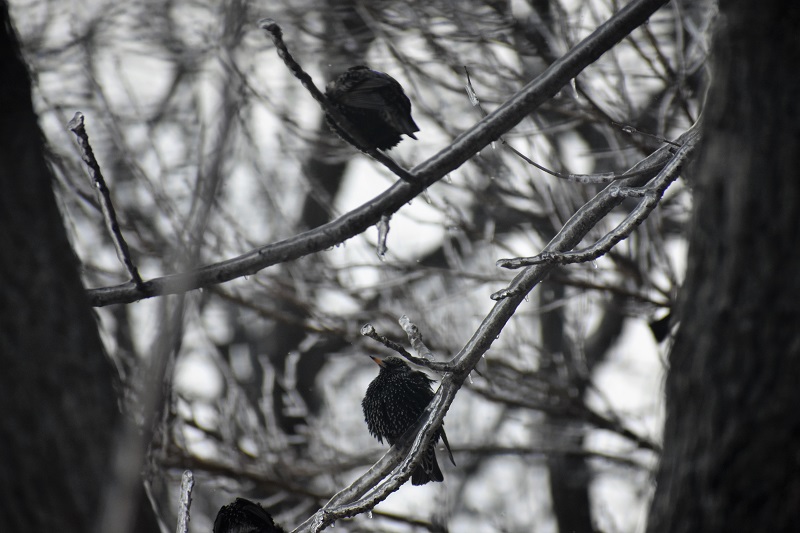
I also got a fancy birdhouse as a going-away gift. I still do some bird-watching.
Starlings on ice
As I head into retirement, I hope that I’ve been a bridge of sorts between the old ways and the new to the next generation of doctors. After all, I’m the institutional memory of psychiatry on the medical and surgical units, in a manner of speaking.
The Medical-Psychiatry Unit (MPU) at University of Iowa Hospitals & Clinics was where I learned how this ward of patients with both medical and psychiatric illness served as a bridge between the departments of psychiatry and medicine. My teachers were doctors who were and still are great leaders. I still recall Dr. Roger Kathol, MD, an internist who also trained in psychiatry, and who designed and started the MPU decades ago, gave readings during sit-down rounds in the unit conference room. He read passages from the works of Galen, the Greek physician, surgeon, and philosopher in the Roman Empire.
Dr. Kathol assigned to me a task one day, which was to give a short presentation the following day on hyponatremia and how to distinguish psychogenic polydipsia from the Syndrome of Inappropriate Antidiuretic Hormone (SIADH). That night I was on call and got 4 admissions on the unit, which was chaotic. One patient actually broke a bed. I didn’t get any sleep. I was up running around until we all sat down to discuss patients.
I struggled through presentations of the 4 patients I had admitted the night before. I could barely talk. I had actually looked up a little information for my assigned presentation on hyponatremia but I was sweating it because I could barely stay awake. I was not the first resident to have episodes of microsleep on rounds and I knew Dr. Kathol saw it happening to me. That was in the days of 32 hours of call. They don’t make trainees do that now.
Dr. Kathol gave me sort of a sidelong glance as we finished discussing patients, which was usually when trainees were expected to give short educational talks. That day, he skipped me.
I should mention that he thought the proper name for the MPU was the Complexity Intervention Unit (CIU), owing to not just the medical and psychiatric complexity of our patients, but also to their social environments and the U.S. payer system which often led to many having inadequate, dis-integrated health care, meaning that there was no bridge between psychiatric and medical illness treatment and split health insurance coverage even though research showed that mental illness definitely lessened quality of life and increased health care costs. He has his own company, aptly named Cartesian Solutions, and it’s a major organization dedicated to helping hospitals and clinics set up collaborative ways to bridge the needs of patients with comorbid psychiatric and medical illness.
The University of Iowa model for the MPU has been disseminated to a number of other hospitals in the country, one of them in Pennsylvania, which I mentioned in a previous post, “Brief News Item,” on May 23, 2019. I’ve just received word a couple of days ago from Dr. Kolin Good that the unit, called the Medical Complexity Unit (MCU), a name which bridges the underlying intent of MPU and CIU, has saved the hospital a great deal of money, has drastically cut the use of sitters doing one to one observation (an extremely expensive intervention), is treasured by patients, and popular with trainees. They are very proud of it and have every right to be so. They are bridge builders too.
Dr. Louis Kirchhoff has been one the most notable internal medicine co-attendings on the MPU. He’s an infectious disease specialist, but has a knack for communicating effectively with patients who are mentally and medically ill, even speaking fluent Spanish with some of them. He and I shared triage call to the MPU every other night before the triage system was changed to a more humane schedule. He was a bridge between internal medicine and psychiatry trainees rotating on the ward. He could explain psychiatry to the medicine residents as well as I could.
I have had a penchant for finding a chair to sit down when I interview patients in their hospital rooms. There are usually not enough chairs in the rooms. A few years ago, Dr. Tim Thomsen, a surgeon and Palliative Care Medicine specialist as well, lent me a camp stool which I carry around with me so that I’m never at a loss for a chair. Everyone likes it. I think the camp stool helps build an emotional bridge with patients.
The little chair
There are special combined specialty residencies at the University of Iowa Hospitals and Clinics which bridge Internal Medicine and Psychiatry and Family medicine and Psychiatry. Slowly but surely the siloed departments of academic medical centers are broadening their curricula and training regimens to rebuild the bridge between mind and body.
It’s been evolving for years. I’m proud to have played a small role in it. This is a place where teachers, researchers, and clinicians build bridges in many ways, foster openness, and search the “distant horizons in a spirit of acceptance, helpfulness, cooperation, peace, kindness and especially love.”
We were out working hard in the garden today–or at least Sena was. She was very busy planting Black-Eyed Susan and other things the names of which I can never remember.
I usually just take pictures and make videos of her garden. It’s a lot of fun watching her. But that’s not all I do. Sometimes I carry bags of mulch.
She has been devoted to gardening for over 17 years. It began with cultivating our back yard. I labored cutting out weeds by the dozens–until I found out it was Vinca. I think another name for it is creeping myrtle.
She gave me permission to film her usual planting posture. You’re welcome.
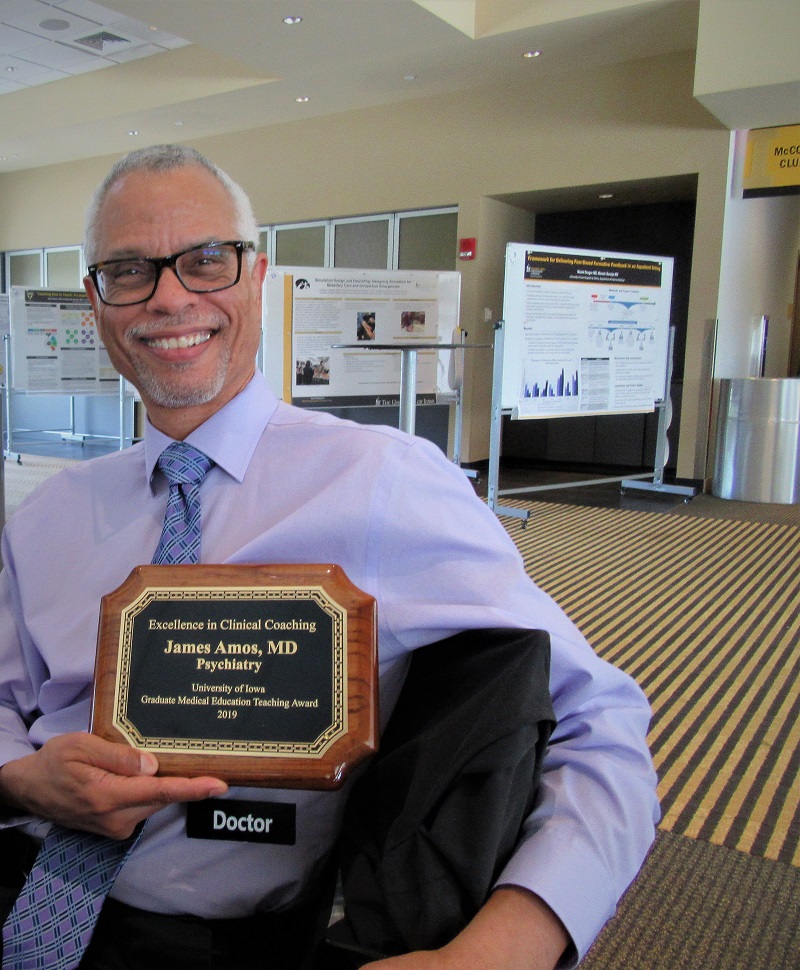
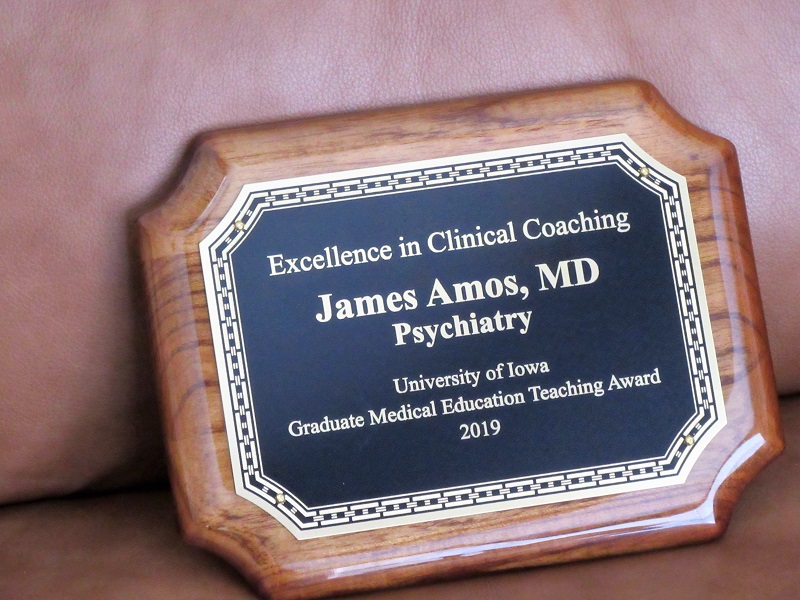
Today I want to thank everyone in my department for nominating me for the Excellence in Clinical Coaching Award . I accepted it during the Graduate Medical Education Leadership Symposium this afternoon.
For some reason, I almost wrote “Excellence in Clinical Clowning Award ” above. I guess maybe one of the reasons is that I was given an award (tongue in cheek) by the residents a few years ago when I made a pretty funny mistake giving a Grand Rounds presentation.
Much to my embarrassment, I somehow mixed up my slides so badly that many of them were out of order. I had to ad lib around that–a lot. Little wonder the residents whipped up the Improviser of the Year Award for outstanding improvisation during a Grand Rounds.
Improviser of the Year Award
Another honor I received about 8 years ago was a Feather in My Cap award after making the rank of Clinical Professor. The awardees had to come up with a favorite quote which guided them, and which was printed on the certificate. At the time, my favorite quote was:
“Vitality shows in not only the ability to persist but the ability to start over.”
F. Scott Gitzgerald
Another feather in my cap
I think I chose that because I have sort of reinvented myself over the years, including going to medical school later in adulthood, trying private practice in psychiatry, and most recently transitioning to retirement.
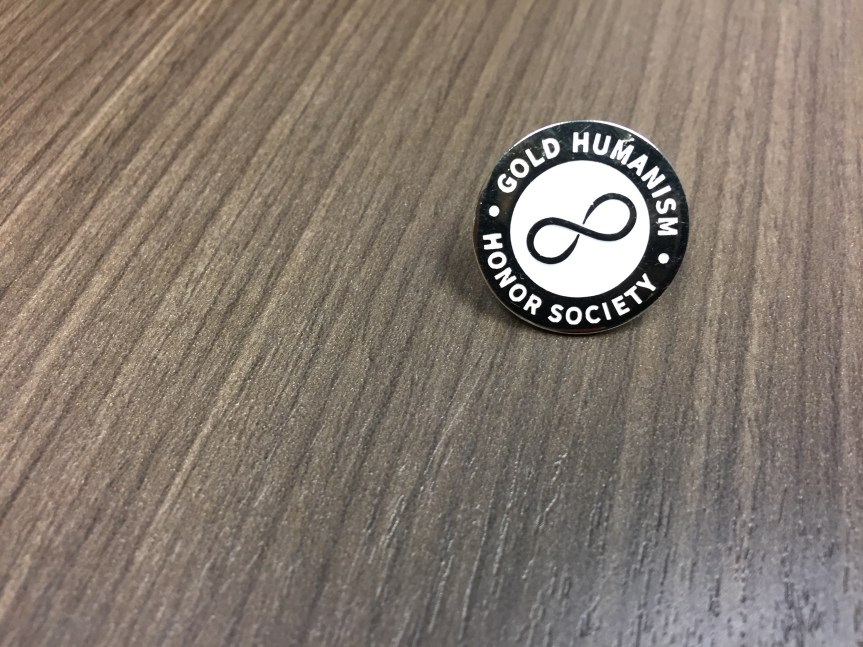
I’m also very fond of the Leonard Tow Humanism in Medicine Award about twelve years ago.
These days, other quotes are more important to me, like the one by Stephen Covey,
“Leadership is a choice, not a position.”
Stephen Covey
The comments praising today’s honorees, written in the the program by trainees and department colleagues, were heart warming for everyone. They brought back memories for all of us, I’m sure.
I struck up a conversation with an attendee about comparing coaches and mentors. I mentioned that in a previous post, “Spring,” on May 4, 2019. Many people tend to conflate the two roles, although I still favor the view that coaches tend to have shorter relationships that are more focused on skill building while mentors have longer term relationship more focused on career building.
However, both mentors and coaches serve as role models, something all teachers do. I have a short coaching video below for a skill I have often role-modeled for trainees–sitting with patients and listening to them for understanding.
In honor of Excellence in Clinical Coaching–and Clowning.
I’m also a big fan of a sense of humor on the Consultation-Liaison Psychiatry service, as anyone knows who has worked with me. My work-related anecdotes get more colorful, less accurate, and longer the older I get. I know when to cut them short, though–the trainees snore loudly. My hearing is still pretty good. I briefly considered getting a coach’s whistle—but thought better of it.
Dr. Amos, clowning again–and thanks for all the produce!

















 Go Retire Psychiatrist