Sena and I got our annual flu shots last week, and I also got a pneumonia vaccine. We’ve been fully vaccinated against COVID-19 since earlier in the year. Now we’re waiting for the word on whether we’ll need COVID-19 vaccine boosters. We’ll probably know more about that by the end of the week after the FDA Advisory Committee meeting on the matter.
We’re part of the vaccinated, which is increasingly distinguished from the unvaccinated in various ways. The controversy about the unvaccinated almost amounts to them being discriminated against, according to some news headlines. The COVID-19 pandemic is now being called a pandemic of the unvaccinated, although some are able to resist the trend by seeing through it and realize we’re all in this together.
It reminds me of an old Cold War era episode of The Twilight Zone, “The Monsters Are Due on Maple Street,” which originally aired in 1960. The gist is that aliens seeking to conquer earthlings create paranoia and violent conflict amongst neighbors on a quiet cul-de-sac simply by manipulating the electrical power to cars and other devices. At first, the electrical malfunctions are only puzzling until a boy named Tommy tells everyone that the trouble is being perpetrated by aliens who are indistinguishable from humans, a notion he got from a comic book.
And after that, everyone on the street begins accusing each other of being malevolent aliens disguised as humans, often on the basis of interpreting benign behaviors like insomnia or tinkering with a ham radio as evidence for dangerous plots. One character even shoots his neighbor dead, believing he’s a dangerous alien.
There was a 2003 remake of this in which the government, instead of aliens, is doing the manipulating. No doubt both of these will be re-broadcast as part of Twilight Zone marathons next month as part of the usual October Halloween TV program lineup.
Sena thought of another Twilight Zone show, “The Shelter,” first broadcast in 1961, which also might fit the current pandemic context. A doctor builds a bomb shelter to protect just him and his family in case of a disaster. The unthinkable happens with UFOs being sighted and the friends and neighbors who threw a party for him all want to beg, bargain, or threaten their way into the doctor’s bomb shelter because they didn’t build their own. He refuses to allow them in. The neighbors turn on each other, showing the worst selfishness, hatred, and racism. They finally break into the doctor’s shelter with a battering ram (which, of course, negates the safety it might have provided)—only to find out in that moment that the UFOs were just satellites. They had become monsters and could not see how it happened.
Depending on what news media outlet you prefer to read, the vaccinated or the unvaccinated will be cast as bad guys or good guys. As the rhetoric heats up based on divisions between political parties, religious groups, scientists, races, and nations, the antipathy has fostered escalating tensions over whether vaccine and mask mandates should or should not prevail. The unvaccinated have their own battering ram—fake vaccination passports, which negate the safety assurance. The unvaccinated can’t get in to see their doctors in person, poison themselves with unproven medicines, or accuse the government of trying to poison them with vaccines. The wealthy vaccinated buy their booster shots at the expense of those who can’t afford them and before the medical experts can approve their safety and necessity. People are resorting to violence.
I always had a little trouble with the title of the Twilight Zone episode, “The Monsters Are Due on Maple Street.” The monsters are not just due—we have arrived. Why is it so hard for me to recall an episode showing exactly how to recover our humanity?
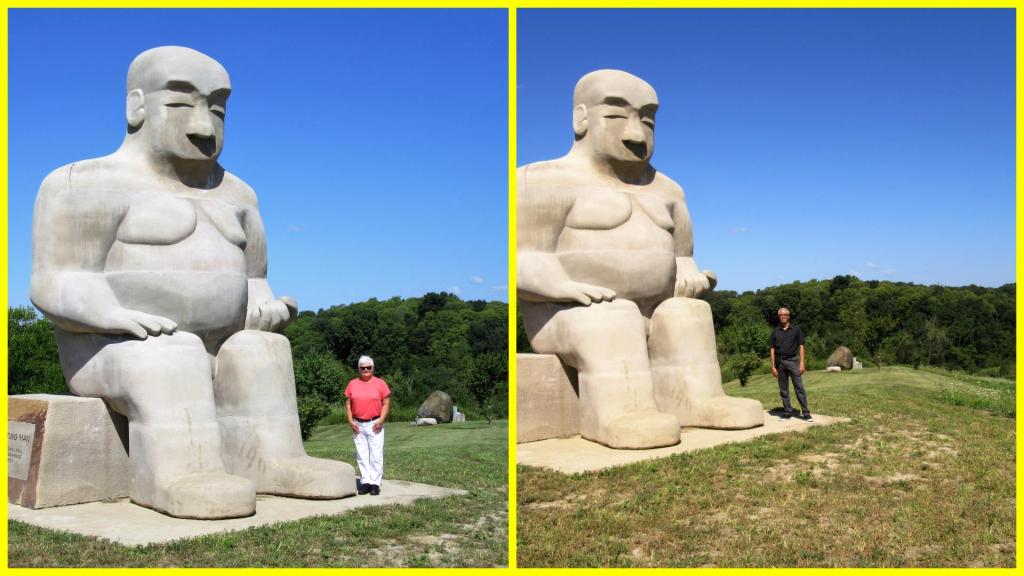
After 33 years living in Iowa City, Iowa, Sena and I finally trekked up Scott Boulevard to see Sitting Man, or Man on a Bench, or the Buddha of Iowa City. Whatever you call him, he’s steady as a rock, which is what he is—110 tons of limestone and 20 feet tall. He was carved by Douglas J. Paul and J.B. Barnhouse and finished in 2013. It was a monumental challenge to move him from the east side of Scott Boulevard to the west side in the summer of 2020 after a change in property ownership. He sits on land owned by Harvest Preserve.
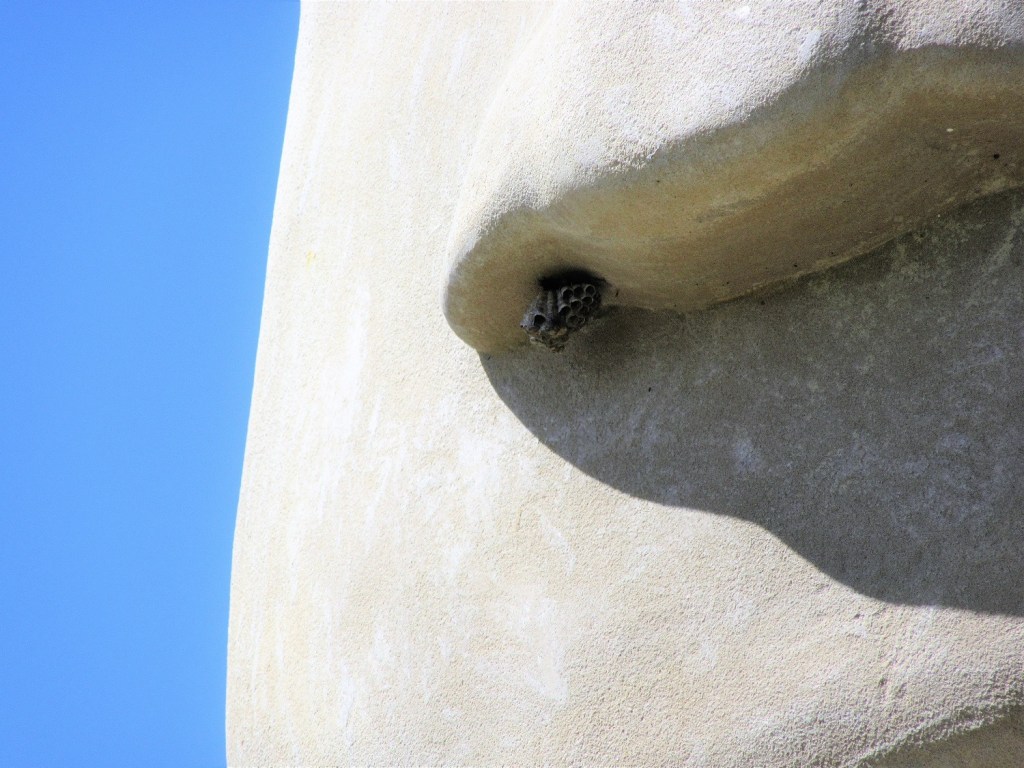
He had an old hornet’s nest booger up his nose, which actually tends to support the idea of him being some kind of Buddha. You have to be pretty serene to put up with that.
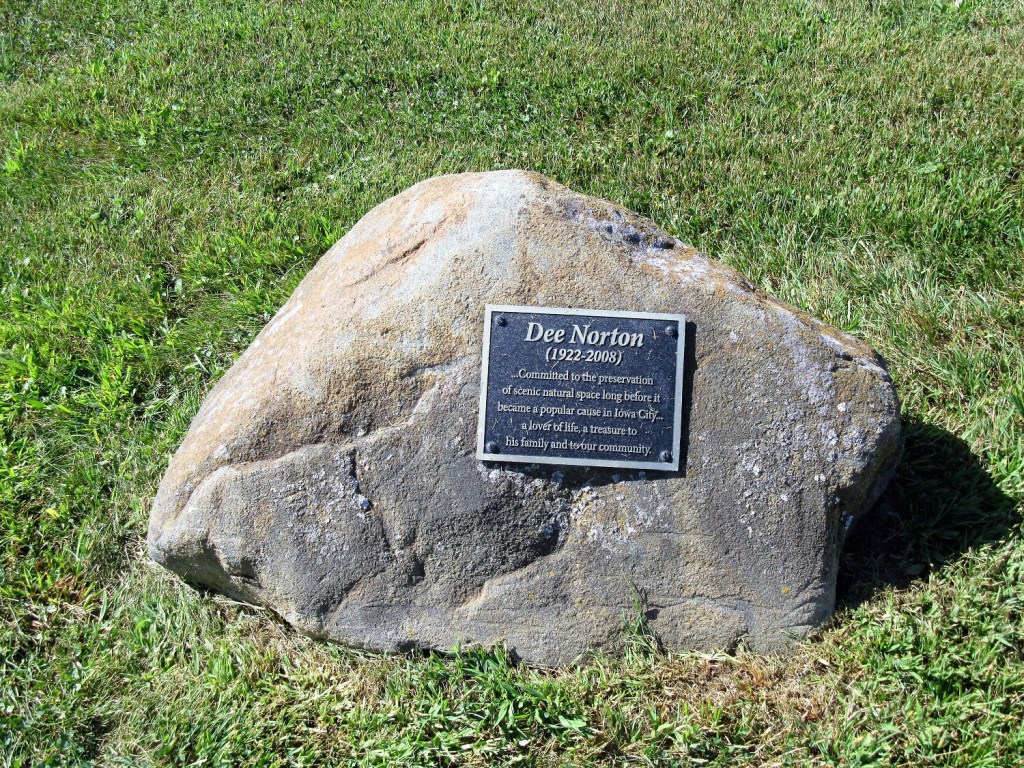
Before you get to the Sitting Man, you reach a contemplative space called the Visionary Stone. The inscription on it is about Dee Norton. According to his obituary on the web, Dee W. Norton was Associate Professor of Psychology and former chair of the Department of Psychology at The University of Iowa. In 1991, he received the Michael J. Brody Award for Faculty Excellence in service to The University of Iowa. He was a longtime member of the Unitarian Universalist Society. He made numerous contributions to education and the community. He had a pretty good sense of humor, too.
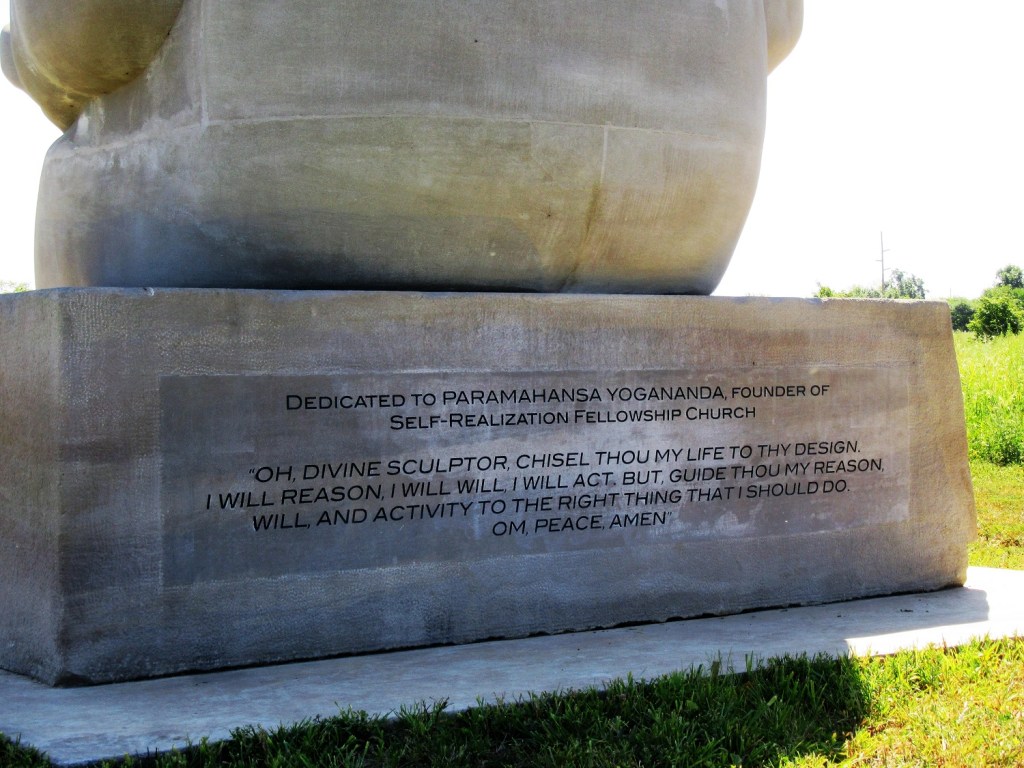
I learned more than I thought I would on the journey to the Sitting Man. On the back of the sculpture is an inscription of a prayer, which is dedicated to Paramahansa Yogananda, founder of the Self-Realization Fellowship Church, which I had never heard of or read about when I scanned the web trying to learn more about the Sitting Man. I briefly looked at the website and there seems to be an Iowa City Meditation Circle here, although only an email address is listed (iowacity.srf@gmail.com) and I don’t know what the fellowship is all about in any detail.
There may be more than meets the eye when it comes to a limestone giant with an old hornet’s nest up his nose and a hand open in what is probably a gesture of welcome and acceptance. We could sure use some of this now—minus the hornet’s nest.
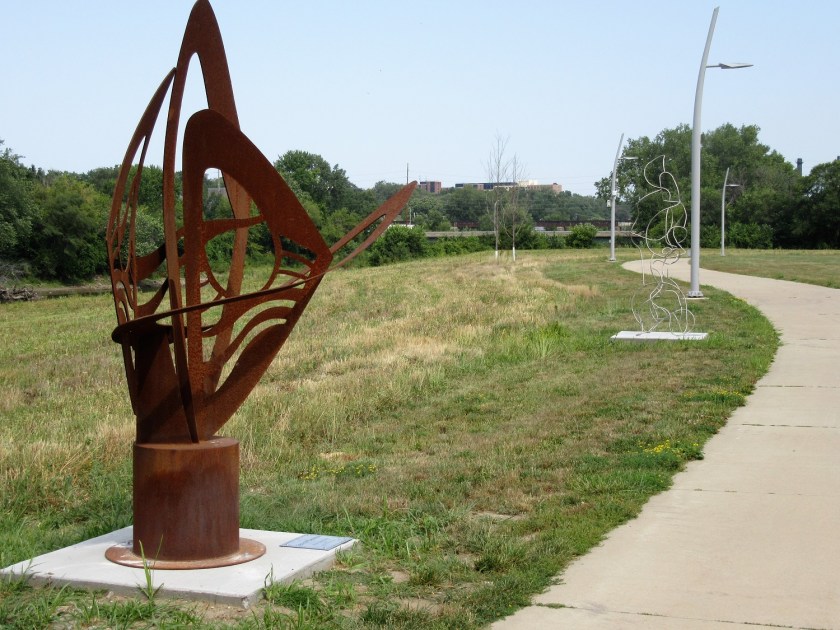
Since the weather took a break yesterday from the triple digit temperatures, we took a little getaway to a few of the city parks to see the new public art. This is connected with the Iowa City Public Art Program. Five sculptures were installed about a week ago at Terry Trueblood Recreation Area, Riverfront Crossings Park, and Mercer Park.
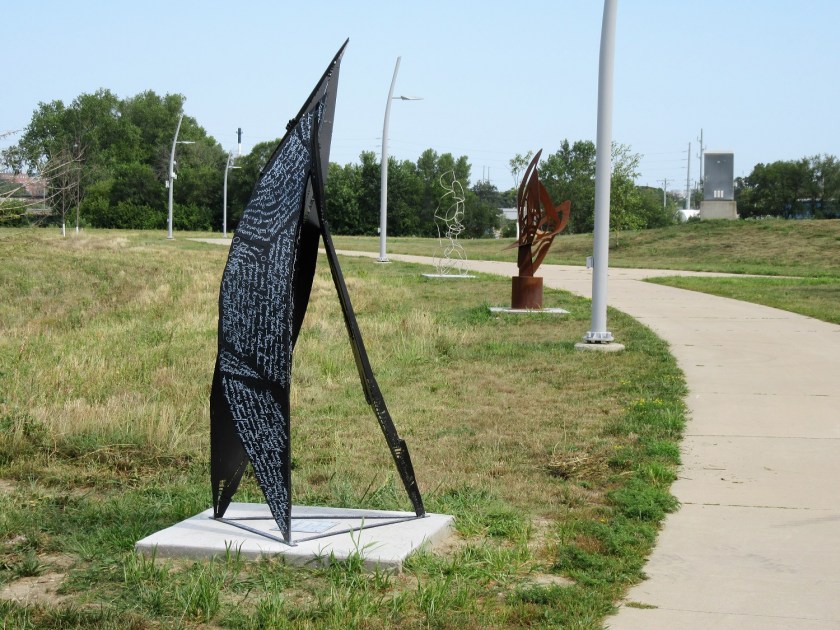
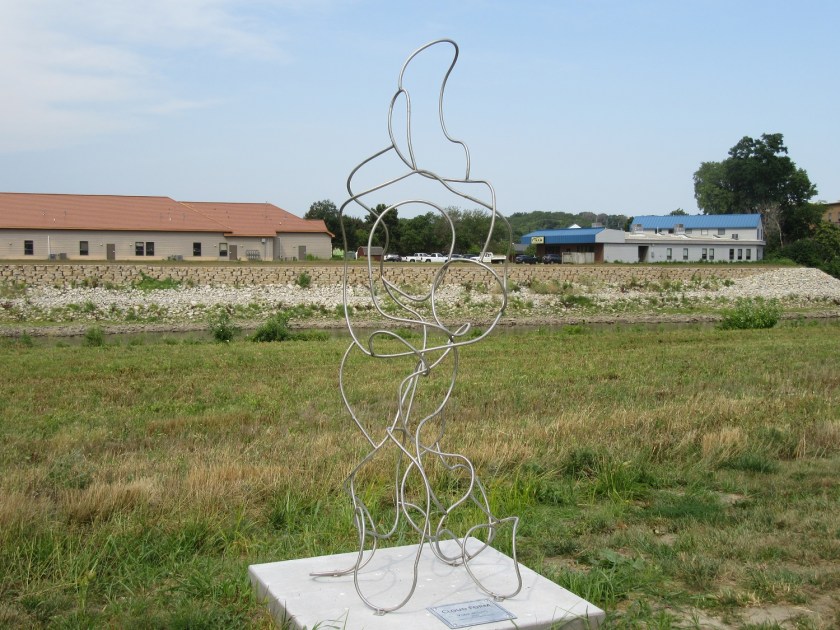
Three sculptures are at Riverfront Crossings. Two are by V. Skip Willits: Palimpsest and Cloud Form. The third is by Hilde DeBruyn: Sea of Change. Sena knows that Sea of Change looks like a sailboat when you look at it from the right angle. We could see clouds through Cloud Form.
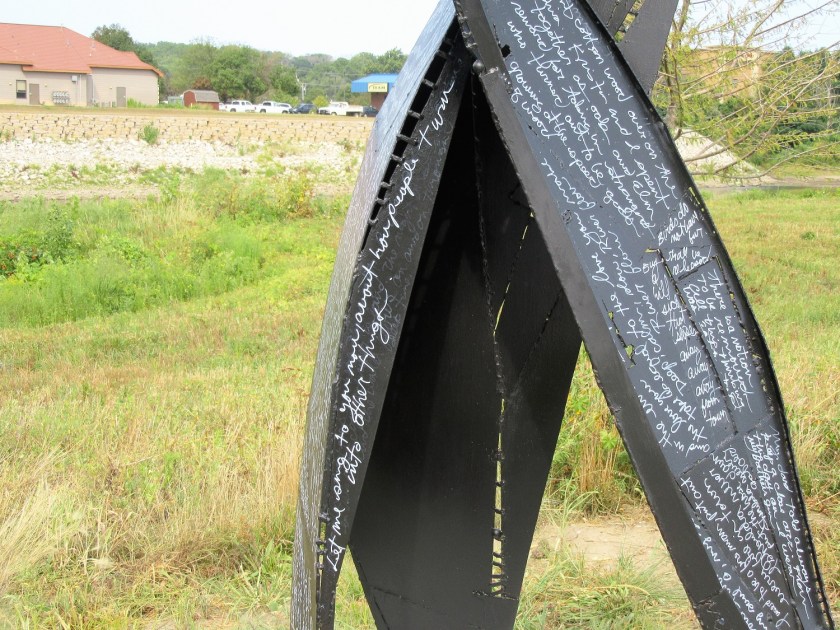
I noticed that V. Skip Willits’s name could be spelled wrong (Willets vs Willits?) on the artist’s nameplate below the sculpture, Palimpsest (also on Cloud Form). I also discovered a 2013 news story of a similar sculpture at the Ames Annual Outdoor Sculpture Exhibition although it was given a different title: Prayer Torso. His sculpture Swans on the Marsh featured in a 2015 image on Sculpture Walk Peoria in Illinois and another fashioned out of corrugated iron in Effingham, Illinois resemble Palimpsest as well. A news story in the March 26, 2021 Effingham Daily News quotes Willits as identifying the sculpture’s title as Cipher. He and probably a few passersby had written on the piece. There are also variant spellings of his name, including V.skip Willits, lower case “s” for “skip.” He’s not the same person as Skip Willits, who is a photographer selling wall art. In any case, Palimpsest is a pretty good example of a palimpsest.
According to the dictionary, a palimpsest is a “piece of writing on which the original writing has been effaced to make room for later writing but of which traces remain.” More generally, it’s something that’s been reused or altered but still has traces of its earlier form. You might want to snap a picture of the sculpture and rotate it in order to see all that’s written there; for example:
“Let me sing to you now, about how people turn into other things.”
I think it could be evocative of what many have noticed and remarked on, only using different words in different languages in different circumstances over millennia. We’re all turning into other things in the turbulent sea of change, sort of like clouds which are the ultimate shape-shifters.
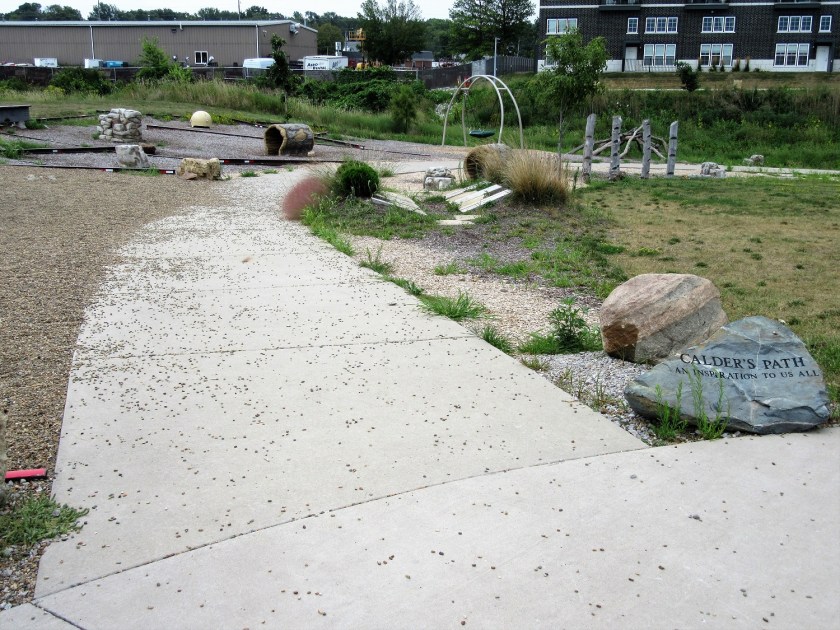
This was the first time we had ever visited Riverfront Crossings Park and we found something familiar there—a stone inscribed with the words Calder’s Path: An Inspiration to Us All. Pebbles were strewn all over the path. After all, no path is without stones. We frequently drive by a small and neatly kept neighborhood park called Calder Park many blocks away. It’s a memorial to a boy named Calder Wills, who passed away of leukemia several years ago. We never knew him or his family. Based on what I’ve gleaned on the web, Calder had big dreams. He was strong. He was a person who turned into a light.
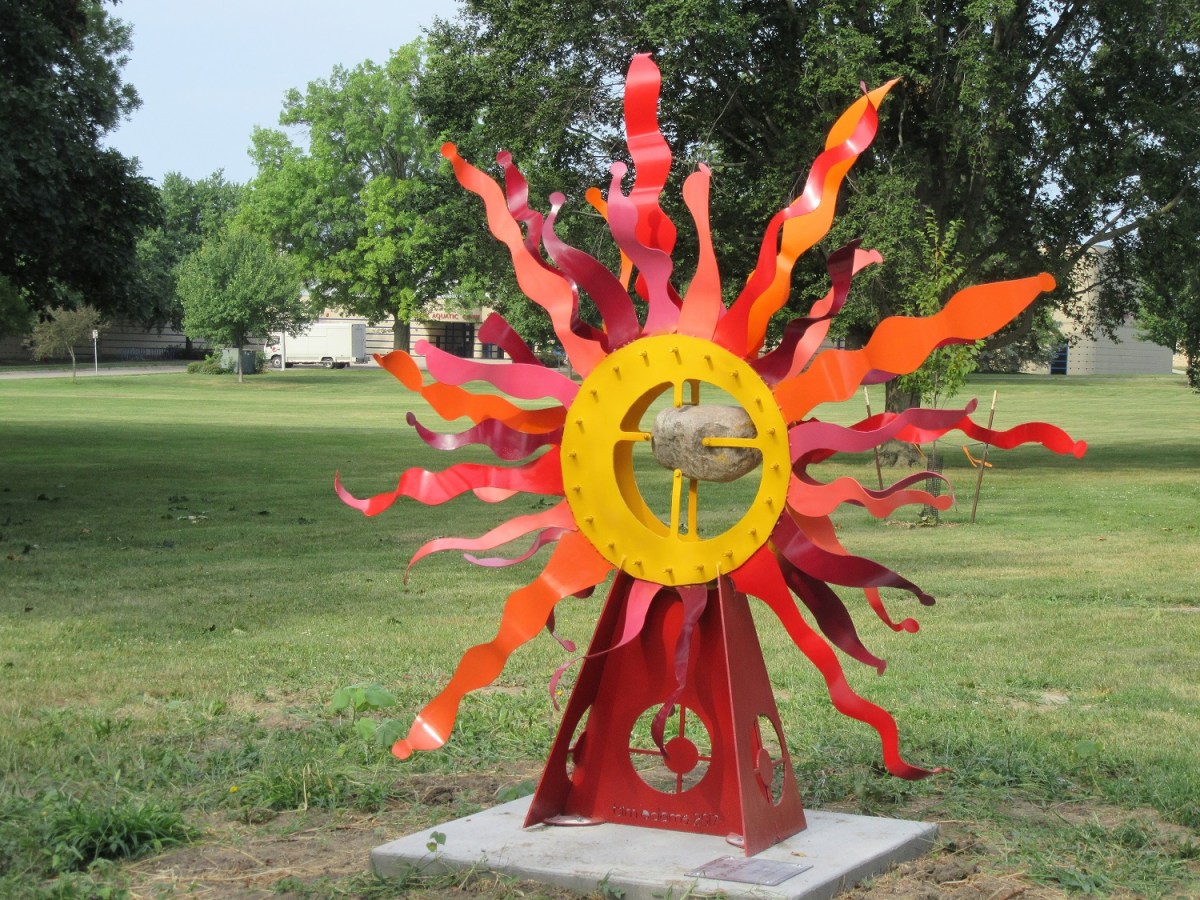
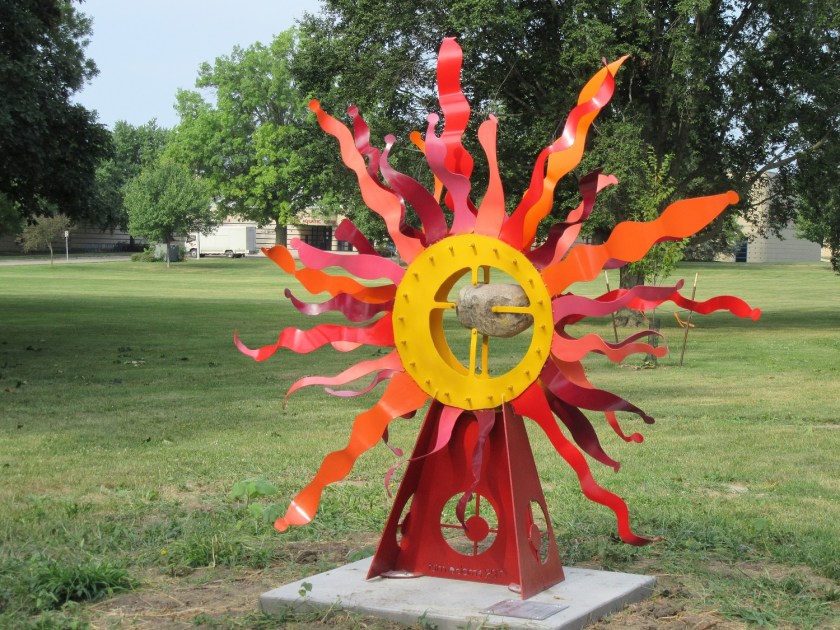
We also enjoyed Mercer Park where we saw the sculpture The Other Extreme, by Tim Adams. Mercer Park and Aquatic Center is named in honor of Leroy S. Mercer who distinguished himself as Iowa City Mayor, state representative and state senator as well as a successful businessman and banker. The sculpture is the sun with a rock at the center. According to Adams, it’s utterly simple; a clear vision of how everything started. There was only the earth and the sun. That was it. And then change took over. Things changing into other things. People turning into other things. Tim Adams art has been influenced by his career as a Registered Landscape Architect. His subjects are influenced by the rugged Iowa weather, which his creations are designed to withstand with little need for maintenance.
Sena and I both got a kick of the automobile jungle gym.
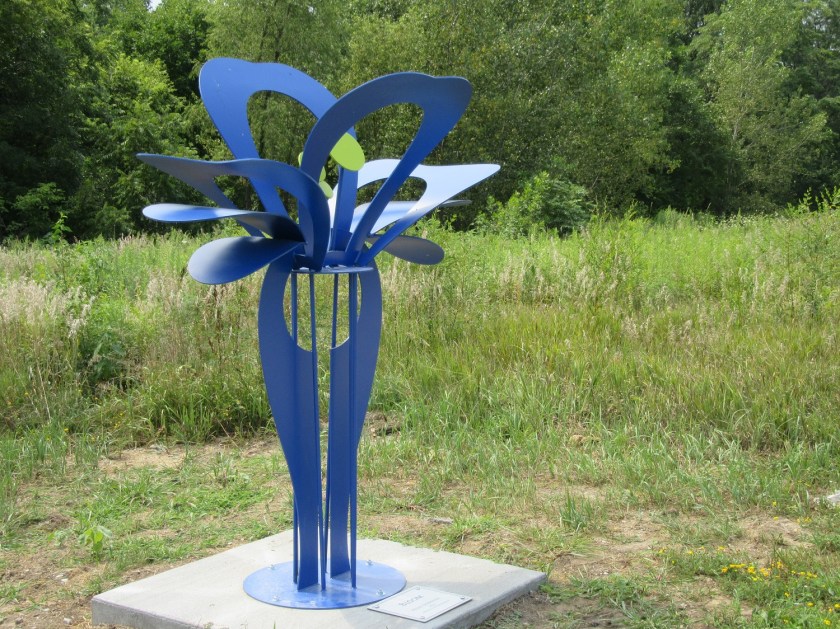
We had already visited the 5th sculpture last week. It is called Bloom by Hilde DeBruyn. Again, the theme of change because it’s a flower and flowers start from seeds in the earth, and burst up to the sun. Because this is where it all begins. DeBruyn is another gifted Iowa artist who has said in an interview with Iowa Artisans Gallery that her work often involves the “natural cycle of growth and decay.”
We begin with one extreme, the raw and wild. Eventually, we reach the other extreme, the ultra-refined and wildly complex. In the middle, we erase and then reconstruct many things from the relics of ancient wisdom or folly, forgetful of bygone grandeur or catastrophe, rarely startled by déjà vu.
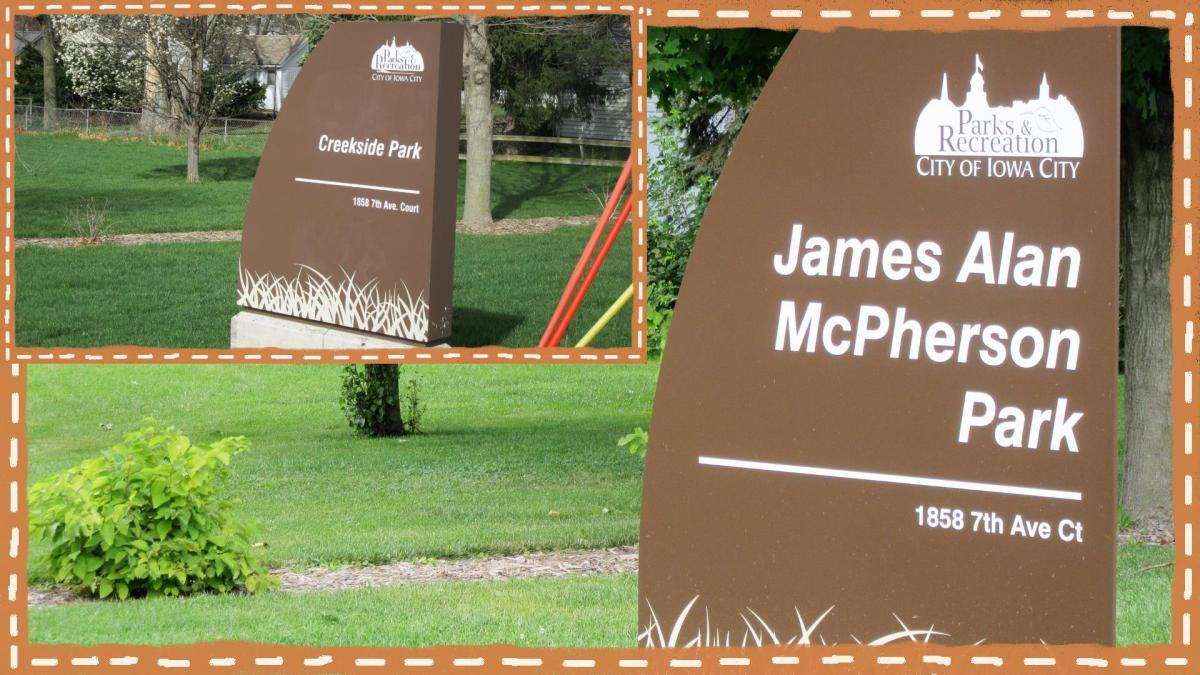
Yesterday evening the new sign reveal of James Alan McPherson Park made the new name of the park official. The weather was balmy and a big crowd showed up for the event, including Iowa City Mayor Bruce Teague. He joined McPherson’s daughter, Rachel McPherson; Director of Parks and Recreation Juli Seydell Johnson, and Iowa City Council member, Pauline Taylor for the ribbon-cutting ceremony.
This was immediately followed by a sing-along of a few bars of “You are My Sunshine,” led by Mayor Teague—who was in fine voice.
And even more music was provided by Cedar County Cobras. They were in a blues mood that evening—very popular with the crowd.
Prior to the ribbon-cutting, there were remarks from Mayor Teague, Rachel McPherson, and Juli Seydell Johnson. They shed personal stories highlighting McPherson’s gifts as a writer, intellectual, and humanist. They seemed to echo poet James Galvin’s perception of McPherson as not just the moral center of the Iowa Writers Workshop, but as the moral center of the universe.
You couldn’t miss the speakers’ impression of McPherson’s sense of humor, which tended to be ironic. Rachel shared an incredible anecdote about his tendency to write to far right-wing organizations (including the KKK) for more information about them, evidently giving them the impression that he was interested in becoming a member—to which they replied with enthusiastic offers to do so! This was not a one-time gag, but a running insider joke for years. Rachel is still getting mail from these groups. She also brought enough memorabilia to fill a table, and it included several “business cards” which deftly deflated the pomposity, posturing, racism, and outright villainy in society. I had to run to the web to get some of the jokes:
Guslar: traditional Bosnian-Croatian-Serbian name for an epic singer who performs long narrative tales (some detailing ancient battles and other historical events) while accompanying himself on a one-or-two stringed instrument called a gusle.
Ebonics: According to the Linguistics Society of America, this means literally “black speech” and refers to English spoken by African-Americans.
Enron was a company which perpetrated one of the largest accounting scandals and bankruptcy in recent history.
We welcomed a member of the Iowa City Police, who set up a table offering many useful free items including a generous helping of good will.
Another part of the presentation was a discussion between consultants and interested community members about future enhancements to the park, which include a plan for a memorial plaque in honor of McPherson.
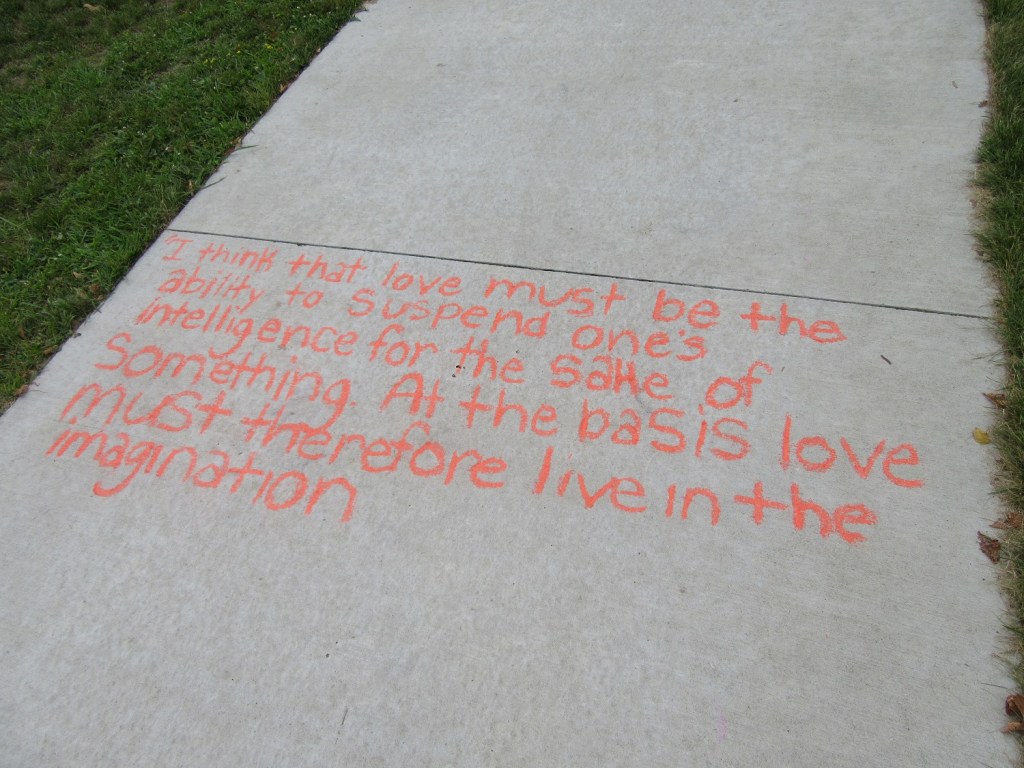
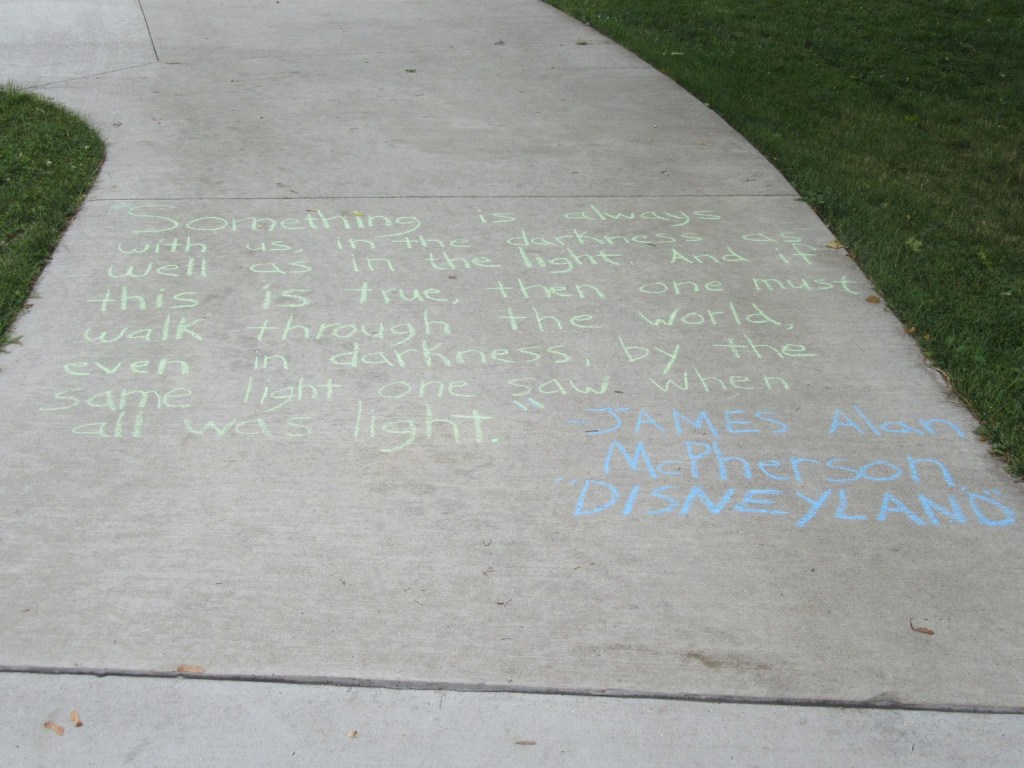
Many quotes from McPherson were written in colorful chalk on the walkways around the park, including one that is also inscribed on his monument in Oakland Cemetery:
“I think that love must be the ability to suspend one’s intelligence for the sake of something. At the basis love must therefore live in the imagination.”
We headed over to James Alan McPherson Park today because we saw a news item about the new sign being up and an upcoming ribbon-cutting ceremony this coming Thursday, August 5, 2021. The party starts at 6:30 PM and goes ‘til 8 PM. There will be live music from the group Cedar County Cobras.
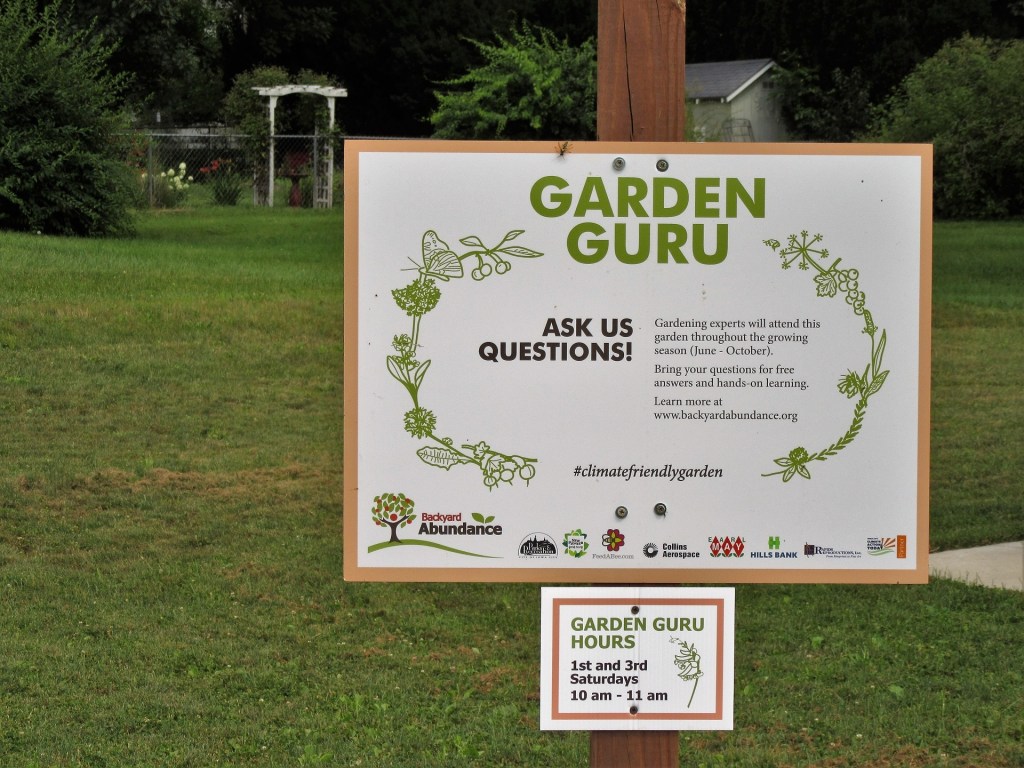
The gardeners have been busy since we first visited in April. White Cloud Catmint, Allium, Black-Eyed Susan, Karl Foerster ornamental grasses and more were thriving. Many of these are reputed to improve your health in various ways. Obviously knowledgeable, those cultivating this communal garden also posted a sign, “Garden Guru” and are eager to teach.
White catmint on the left and allium on the right
Sena cooked a delicious soup, using Gumbo File, in honor of McPherson. While you couldn’t call it gumbo, it was hearty and file is tasty. By the way, despite what you may read on the web, file is not illegal and does not cause cancer. File is produced from sassafras leaves which don’t contain safrole, a carcinogen banned by the FDA since 1960.
There is a story told by the head of the University of Iowa literature professor Ed Folsom that McPherson, apparently an excellent cook, helped sooth the tension between the Iowa Writers Workshop and the English Department. When it got to an intense pitch, McPherson said softly, “I think we need to have some gumbo.” He invited members from both organizations to his house for gumbo. And he explained how the roux held all of the wide diversity of tastes together. It may have been his metaphor for how a house divided could blend together better and be more harmonious. Ed asked him if that was the case—and McPherson said he was just talking about gumbo. Anyway, things got easier between the two departments.
Folsom summarized what McPherson did, which was to find a way to bind the soul and the body together.
It’s a little like the Men in Black movies in which eating pie (“We need pie”) was a way to solve particularly difficult crimes involving aliens and humans. You did it by doing something completely at odds, apparently, with the usual kind of problem-solving skills and strategies. You did it by introducing a diversity of approaches by a diversity of persons, baking in a sense of humor, and patiently allowing the non-logical eureka moment to evolve.
Maybe we need something like McPherson’s gumbo moment here and now in our planet’s present madness.
I never knew until today that Johnson County; Iowa had originally been named for a slaveholder. That has changed since the Johnson County Board of Supervisors voted to rename the county for distinguished African American scholar, Dr. Lulu Merle Johnson on June 24, 2021. Read the Iowa Now story for the details. The drive to rename the county for Dr. Johnson, an accomplished University of Iowa alumna, began last year with an on-line petition that gathered 1,000 signatures, led by David McCartney, an archivist in UI Libraries’ Special Collections.
According to the Iowa Now story, the drive to rename the county for Dr. Johnson was also in the context of the deaths of several African Americans by police officers earlier this year. It reminds me of another famous African American, James Alan McPherson, a long-time faculty member at the Iowa Writers Workshop, for whom a local neighborhood park was recently renamed. Part of the drive for that came from members of Black Lives Matter.
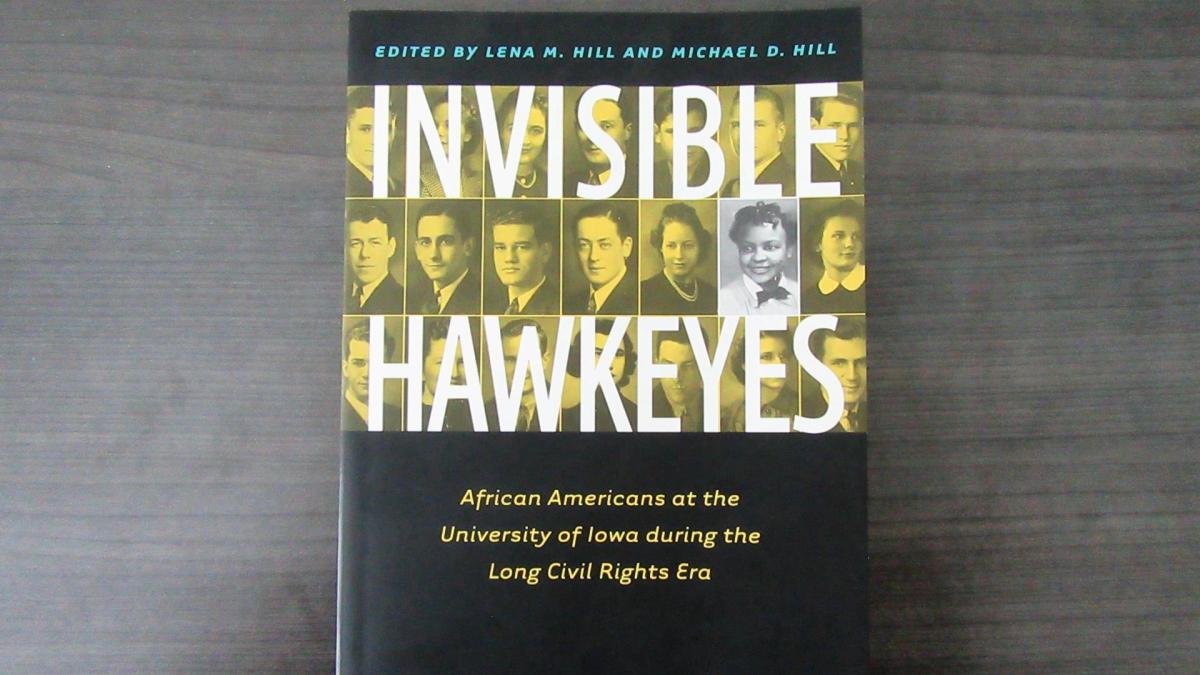
McPherson was written about in the book Invisible Hawkeyes: African Americans at the University of Iowa during the Long Civil Rights Era, edited by former UI faculty, Lena and Michael Hill. Although Dr. Johnson was not mentioned in their book, she certainly could have been because of her towering status as an educator, historian, and activist.
Support for the change also came from Leslie Schwalm, professor of gender, women’s and sexuality studies, and members of Dr. Johnson’s family.
My wife and I have been immunized against COVID-19 and we recognize that people can be hesitant about getting vaccinated. However, I’m remembering my last few months prior to my retirement a year ago working as a general hospital psychiatric consultant and I saw one or two cases of catatonia in the context of COVID-19 infections.
Catatonia is a complex, potentially lethal neuropsychiatric complication of many medical disorders including COVID-19. It can make a person mute and immobile, often making health care professionals mistake it for primary psychiatric illness (for example, catatonic schizophrenia). You can access a fascinating educational module on the National Neuroscience Curriculum Initiative (NNCI) website about catatonia and how it can be associated with COVID-19.
Catatonia can kill people, rendering them unable to move or eat, leading to blood clots and dehydration among a host of other complications. You’ve seen the news stories about blood clots being an extremely rare but deadly side effect of the Johnson & Johnson COVID-19 vaccine. The risk for blood clots is actually higher from COVID-19 infection itself compared with the very low risk from the vaccine.
I made a YouTube video about catatonia and other neuropsychiatric emergencies and that presentation continues to be viewed fairly often. You’ll want to crank up the volume.
I wrote a blog post about catatonia in the setting of delirium a couple of years ago and the information in it is still relevant below.
Catatonic patients may have a fever and muscular rigidity that leads to the release of an enzyme associated with muscle tissue breakdown called creatine kinase (CK). The level of CK can be elevated and detectable on a lab test.
Many patients will have a fast heart rate and fluctuating blood pressure. They may sweat profusely which can lead to a sort of greasy facial appearance. They may have a reduced eye blink rate or seem not to blink at all. They may display facial grimacing.
The patient may exhibit the “psychological pillow” (some call this the “pillow sign”). While lying in bed, the patient holds his head off the pillow with the neck flexed at what looks like an extremely uncomfortable angle. The position, like other odd, awkward postures can be held for hours.
Catatonia can be caused by both psychiatric and medical disorders. It tends to be more common in bipolar disorder than in schizophrenia even though catatonia has historically been associated with schizophrenia as a subtype. You can also see it in encephalitis, liver failure, and in some forms of epilepsy and other medical conditions—to which we can now add COVID-19 infection.
The patient may perseverate or repeat certain words no matter what questions you ask. He may simply echo what you say to him and that’s called “echolalia”.
Although catatonic stupor is what you usually see, less commonly you can see catatonic excitement, which is constant or intermittent purposeless motor activity.
The usual way to assess catatonic stupor in order to distinguish it from hypoactive delirium is to administer Lorazepam intravenously, usually 1 to 2 milligrams. A positive test for catatonic stupor is a quick and sometimes miraculous awakening as the patient returns to more normal animation. The reaction is usually not sustained and the treatment of choice is electroconvulsive therapy (ECT), which can be life-saving because the consequence of untreated catatonia can be death due to such causes as dehydration and pulmonary emboli.
Another less invasive test that doesn’t use medicine is the “telephone effect” described in the 1980s by a neurologist, C. Miller Fisher. It was used to temporarily reverse abulia or akinetic mutism, which in a subset of cases of stupor are probably the neurologist’s terms for catatonia. Sometimes the mute patient suffering from abulia can be tricked into talking by calling him on the telephone. It’s pretty impressive when a patient who is mute in person answers questions by simply calling him up on the telephone just outside his hospital room.
So that, in my opinion, is yet another reason to get the COVID-19 vaccine.
Yesterday, Sena and I visited the James Alan McPherson Park. The Iowa City Council renamed it in his honor last month; it was formerly called Creekside Park. There were compelling reasons for the name change. He was the first African American to win a Pulitzer Prize for fiction for his collection of short stories, Elbow Room in 1978, graduated from Harvard Law School in 1968, was inducted into the American Academy of Arts and Sciences in 1995, and was a permanent faculty member for thirty years at the Iowa Writers’ Workshop at the University of Iowa, among other notable career achievements. He was 72 when he died in 2016 of complications of pneumonia.
McPherson was a longtime resident of Iowa City and was revered by his students. Colleagues described him as the “moral center of the Iowa Writers’ Workshop” and even the “moral center of the world.” Despite his stunning achievements, he was shy and often barely spoke above a whisper in the classroom. He lived in the general neighborhood where the park is located. We never got a chance to meet him.
We are reading his books, though.
The park is located at 1878 Seventh Ave Ct and sits on a little over 2 acres. It was empty except for the occasional walker on the trail. People were friendly. It seems hardly distinguishable from the neighborhood surrounding it and blends into the homes, hugs the meandering creek and adjoining trail, and seems held in a protective embrace by the homes bordering it. A new park sign and a memorial plaque will be installed later this summer.
We saw a rich variety of birds, in fact more than we’ve seen in a while.
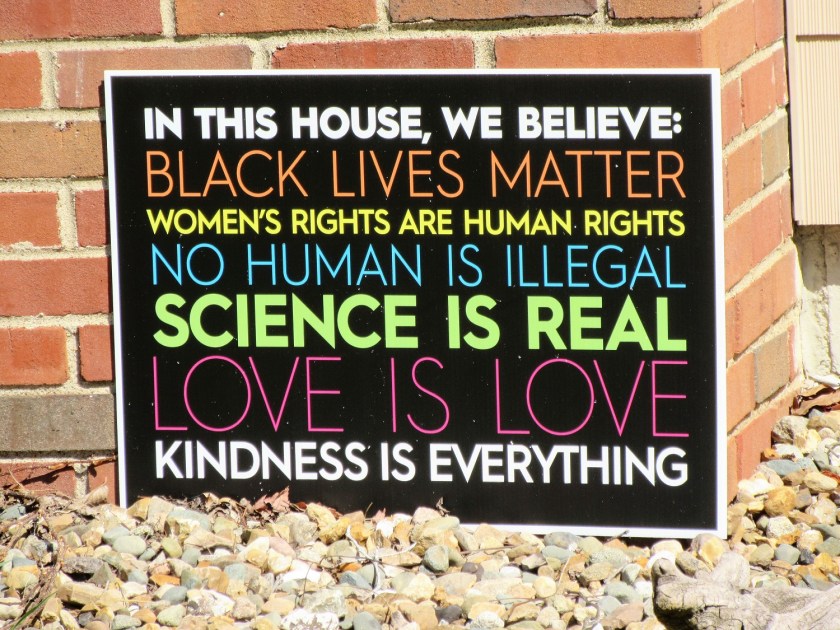
We get a sense that everyone is welcome there. There are 6 parking spaces. You can imagine that limited parking makes the place a treasured possession of the immediate neighborhood. But people we encounter there make us feel that it belongs to all of us. Even a sign leaning against a house alongside the trail made that clear. We’ll be back.
I discovered recently from a news item that a local park (formerly Creekside Park) in Iowa City has been renamed James Alan McPherson Park. I realize it’s incredible, but I didn’t know who he was. How did he escape my notice? We’ve lived in the Iowa City and Coralville area for over 30 years and the African American Pulitzer Prize winning fiction writer and Iowa Writers’ Workshop professor had been here the whole time. McPherson died of pneumonia complications in 2016.
We moved in different circles. My wife, Sena, and I moved to Iowa City in 1988 so that I could attend the new summer enrichment medical school program for minority and disadvantaged students. The program owed its start to a leading African American University of Iowa professor, Philip Hubbard. I graduated in 1992, finished my psychiatry residency in 1996, and spent nearly my entire career working as a psychiatric consultant in the University of Iowa general hospital until my retirement last summer.
In contrast, McPherson spent his whole career as a fiction writer. He earned his Master of Fine Arts at the Iowa Writers’ Workshop in 1971. He returned in 1981 to become a faculty member there and lived in Iowa City until his death. He won both the Guggenheim and MacArthur fellowships. In fact, his fame as a writer was established before he ever got to Iowa. McPherson made a substantial contribution to the workshop’s reputation as one of the top creative writing programs in the world.
Last January when I wrote the post about the Iowa River Landing Sculpture Walk, we visited the Iowa Writers Library at the Coralville Marriott Hotel and Conference Center. I mentioned Margaret Walker, the first African American woman accepted to the Iowa Writers’ Workshop. I still think the IRL should have a sculpture honoring her.
But I can’t even recall seeing a book by an African American man in the lowa Writers Library. It’s maintained by the Coralville Public Library, whose website lists several of McPherson’s works, including Elbow Room (which won the Pulitzer in 1978), as being shelved there. I remember thinking that the collection was a bit disorganized and that some books seemed to be missing or shelved in the wrong places. But since I wasn’t even aware of McPherson, I can’t say his books weren’t there.
Even though I have a copy of the book Invisible Hawkeyes: African American at the University of Iowa during the Long Civil Rights Era, edited by Lena M. Hill and Michael D. Hill, I missed any mention of McPherson in the chapter, Obscured Traditions: Blacks at the Iowa Writers’ Workshop, 1940-1965. One reason might be the time frame, which preceded McPherson’s matriculation. However, that’s no excuse because the very last page of the chapter mentions him.
The conclusion chapter of Invisible Hawkeyes (An Indivisible Legacy: Iowa and the Conscience of Democracy by Michael D. Hill in Invisible Hawkeyes: African Americans at the University of Iowa during the Long Civil Rights Era, in Chapter Four: Obscured Traditions: Blacks at the Iowa Writers’ Workshop, 1940-1965, by Michael D. Hill, University of Iowa Press, 2016). does devote a lot of attention to McPherson’s role at the Iowa Writers’ Workshop. While Hill acknowledges that McPherson described his experience at Iowa as “humanizing,” this was in the context of the struggle against racism endured by most other African American students who preceded him decades before. Interestingly, Hill suggests that it’s ironic for an alumnus of a historically black college or university (HBCU), (which was Morris Brown College in Atlanta, Georgia) to express a fondness for Iowa, a place where racism was keenly felt by his predecessors and which Hill suspects McPherson might not have understood in detail and which he discussed only in the abstract with his mentor, Ralph Ellison (author of Invisible Man).
Well, I’m in way over my head there—and I think it’s better for Michael Hill himself to comment on how irony seemed a part of McPherson. He’s also in the best position to describe McPherson as a person as well as a writer. In the video, Hill’s initial comments are about McPherson’s reaction to being the recipient of the Pulitzer Price for Elbow Room, his book of short stories.
We just ordered a copy of Elbow Room. I read a few of the stories from it on the web. It’s funny how chapters from some books find their way out there, often through university web sites, it seems. He was a genius at storytelling. Just from a psychiatric clinician’s standpoint, “The Story of a Dead Man” is a perfect description of someone with Antisocial Personality Disorder, something a colleague wrote about: Bad Boys, Bad Men: Confronting Antisocial Personality Disorder (Sociopathy) by Donald W. Black, MD, 2013 Oxford University Press. It’s an autographed copy. Incidentally, whenever I google black psychiatrists in Iowa, Dr. Black’s always near the top of the page. His name is Black but black he is not.
Which brings up a sense of humor, something which many people say McPherson had. He used a sense of humor several times during a fascinating 1983 interview with Bob Shacochis for the Iowa Journal of Literary Studies. It seems to me that they got a bit annoyed with each other a few times. One of the more striking comments from McPherson was his quote of an old Negro saying, “You may be my color, but you ain’t my kind.” The context was a question from Shacochis about McPherson’s thoughts about the Third World. I was puzzled by his reply that he thought the Third World was a “fiction.” McPherson said if the Third World has any power, then it might be politically advantageous for African Americans to identify themselves with it. He wasn’t after power, he just wanted to find his kind—and that didn’t have anything to do with color.
McPherson was very evocative in his writing and his speech. That old Negro saying evoked a memory in me of my short time at Huston-Tillotson College (another HBCU, in Austin, Texas) in the mid-1970s. I had grown up in Iowa in what were basically all white schools where I was the only African American kid in the classroom. When I finally went to H-TC, I felt very out of place. Even my Northern accent got me into trouble. One student asked me, “Why do you talk so hard?” There was this one time when I tried to play in a pickup basketball game with a group of other students. I was a very clumsy player. For the briefest of moments while struggling underneath the basket, I got murmurs of encouragement from several of them, even members of the opposite team. I will never forget how good that made me feel, especially when I contrast it with a memory from my hometown when I tried to play with a bunch of white guys. When one of them called out, “Don’t worry about the nigger!” I went and sat down on the bench.
The point is that nobody at H-TC ever said to me “You may be my color, but you ain’t my kind.” I said that to myself. Now, somebody else sent me a similar message to me in Iowa, shortly before I left for H-TC. It was a white woman who thought she meant well; she knew I was going there. She showed me a picture of a young black woman with the clear intention of trying to get me interested in females closer to my own color. The message was more like “You may be in my back yard, but you ain’t my color.”
Speaking of back yards, when I was in elementary school, a couple of white bullies a few grades ahead of me found me at my house and started beating the crap out of me in my own back yard. Somehow, they knew that I wrote little stories and brought them to school to read. I began doing that for my mother at home. I promised them I would put them in my stories if they would quit beating on me. They believed me and stopped. It didn’t occur to me how dumb they were for a long time after.
Those little anecdotes are nothing like the jewels that McPherson fashioned. My stories here are true biography of pain. James Alan McPherson’s stories were true fiction, something magical and evocative enough to foster healing of pain. I hope he found his kind.
James Alan McPherson did more than enough to get his name on a sign and dedication plaque for a small park.

















 Go Retire Psychiatrist