
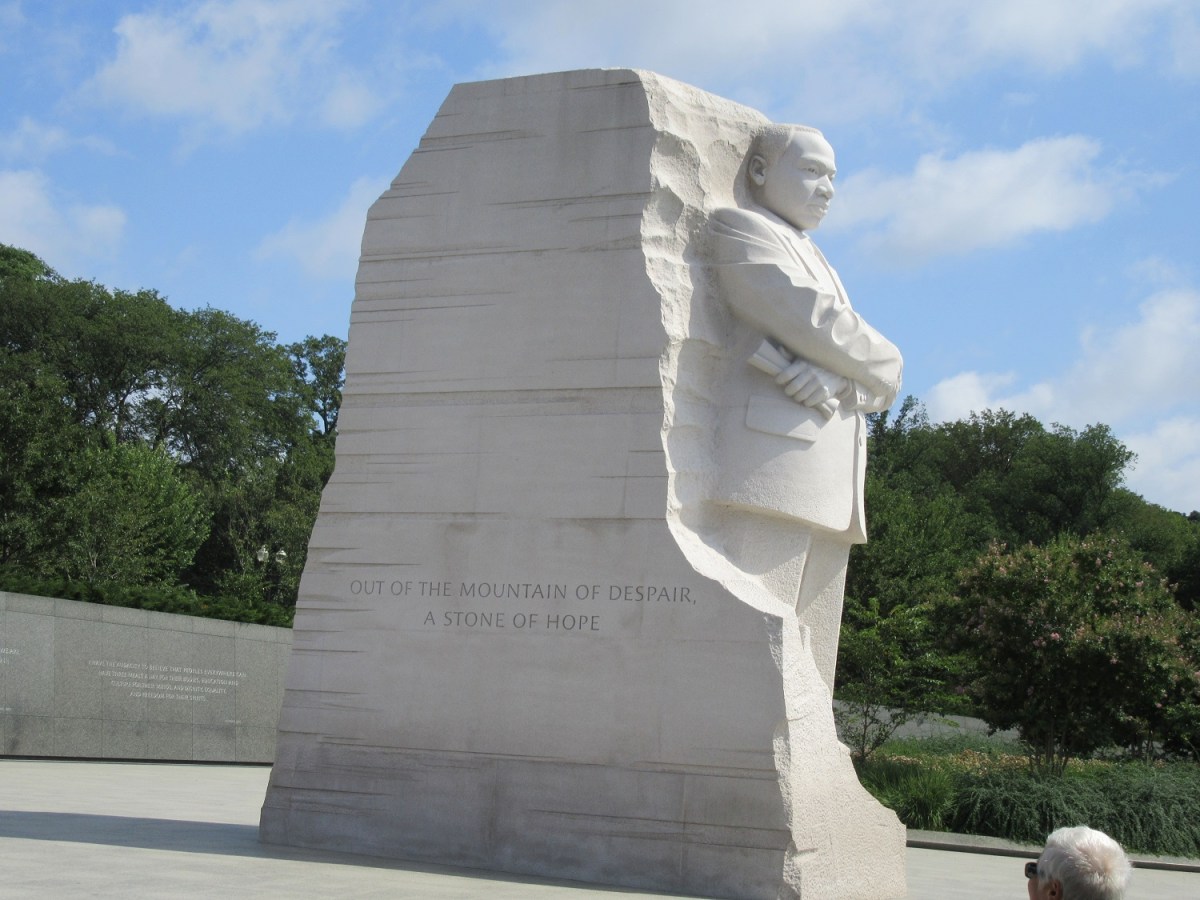
“Bending the Arc Toward Equity and Social Justice”: MLK Lecture by Dr. Joan Y. Reede, MD, MPH, MS, MBA

Today, Dr. Joan Y. Reede, MD, MPH, MS, MBA delivered the Martin Luther King, Jr Distinguished Lecture. It led to a long discussion between me and Sena, which is a good sign that the presentation was superb.

I noticed that the title of the lecture sounded familiar. Dr. King said something very much like it in his speech, “Remaining Awake Through a Great Revolution”:

“We shall overcome because the arc of the moral universe is long, but it bends toward justice.”

Dr. King adapted the phrase from abolitionist Theodore Parker who thought the abolition of slavery would be successful and said:

“I do not pretend to understand the moral universe; the arc is a long one, my eye reaches but little ways; I cannot calculate the curve and complete the figure by the experience of sight; I can divine it by conscience. And from what I see I am sure it bends towards justice.”

Now that is according to a Wikipedia article, which was just edited today. Call it coincidental.

Sena mentioned to a couple of persons yesterday while out picking up groceries that we were planning to observe the MLK holiday by listening to the MLK Distinguished Lecture. Both of them were store employees. One of them was a white woman who said simply that she had to work, evidently meaning she would not be participating. The other was a young Black man who looked like he was in his twenties. He gave the same answer, simply saying that he had to work. Neither gave any indication that they even knew who Dr. King was.

We both think that was astonishing. It’s incredible to think that knowledge about Dr. Martin Luther King, Jr. would belong mainly to those in my generation and older. It’s not like cribbage, a favorite two hander card game Sena and I enjoy, but which I’ve often seen described as being a game popular mainly among older people.

It was with this thought in mind as we listened to Dr. Reede’s presentation. The history of America is full of “firsts” for minorities: first ever to attend a white college, first ever to become a physician, and so on. But from there it seems extremely difficult to trace a clear path to full access to positions of authority, influence, and power in this country for anyone who is different from the mainstream. This is not news to any of us.

But Sena and I wondered at the apparent difficulty in recruiting and retaining leaders from the wider pool of humanity: people of different races, women, the LGBTQ community. There were no pat answers. Dr. Reede wondered aloud about how and where will we get more leaders like Dr. King? Will it be through crafting more well-conceived outreach programs? I wonder about that approach if the twenty-something young Black man Sena spoke with did not even seem aware of who MLK was. And if people like him are too busy working in order to just survive, how will they ever get the time to learn another way to live? And how will they learn how to lead? We’ll need more beacons like Dr. Reede—and maybe you and me.

I remember singing in Sunday School, “This Little Light of Mine.” Leaders like Dr. Reede are beacons who show us how to carry our lights. In fact, the title of an article describing something just like that is “This Little Light.” The subtitle is “2018 Dean’s Community Service Awards celebrate service to others.” Dr. Reede herself presented the awards to the recipients, who she described as people who “don’t only talk the talk, but walk the walk.” Her closing remarks at that ceremony was a reminder:

“Service comes in many forms, and one’s contributions need not be heroic or hugely financial in scope; it is about giving of your time, your talents, making a difference, and having an impact.”


MLK Human Rights Week Distinguished Lecture Jan 20, 2021: Dr. Joan Y. Reede, MD, MPH, MS, MBA

Dr. Joan Y. Reede, MD, MPH, MS, MBA is scheduled to deliver the Human Rights Week 2021: Distinguished Lecture on January 20, 2021 from noon to 1:00 PM. This is by Zoom because of the pandemic, a commonplace method nowadays. I’m registered for it so I hope Sena and I can zoom in.

Dr. Reede has a list of accomplishments as long as my arm. She’s the dean for diversity and community partnership and professor of medicine at Harvard Medical School. She also holds appointments as professor in the Department of Social and Behavioral Sciences at the Harvard T.H. Chan School of Public Health, and she is an assistant in health policy at Massachusetts General Hospital. The title of her lecture is “Bending the Arc Toward Equity and Social Justice: Addressing the Imperative.”

Dr. Reede’s life journey has been fascinating and she has had a lot of thought-provoking and inspiring things to say about how she got to where she is in her career and how to help others succeed. In her 2016 interview “Strictly Business—Women of Influence” she answered a question about how American could improve its standing in providing excellent health care to all people, she broadened the concept of what providing medical care means. In fact, health care doesn’t just happen in a clinician’s office. Many factors influence a person’s health and how they take care of themselves, including whether they are impoverished. Poverty inhibits access to food, education, and jobs and there can be unrealistic expectations about what disadvantaged people can do on their own about this lack. She said: “It’s having expectations of people to ‘pull yourself up by your bootstraps’ but not giving anybody any boots.”

That rang a bell and I found a speech by Dr. Martin Luther King, Jr in which he said almost exactly the same thing in the broader context of addressing racial injustice:

“Now there is another myth that still gets around: it is a kind of over reliance on the bootstrap philosophy. There are those who still feel that if the Negro is to rise out of poverty, if the negro is to rise out of the slum conditions, if he is to rise out of discrimination and segregation, he must do it all by himself. And so, they say the Negro must lift himself by his own bootstraps.”

And again, King said: “It’s all right to tell a man to lift himself by his own bootstraps, but it is a cruel jest to say to a bootless man that he ought to lift himself by his own bootstraps.”

Both quotes are from “Remaining Awake Through a Great Revolution” published in A Knock at Midnight: Inspiration from the Great Sermons of Reverend Martin Luther King, Jr.

The web says the bootstrapping idiom probably had its beginnings around the mid to late-19th century, in which it was clearly meant to express an absurdity. The image of someone trying to lift himself by the straps on the back of his boots shows it’s laughably impossible. The idea that you could lift yourself up without any outside help was mocked. However, over decades it evolved so that it somehow came to mean that you could succeed without any outside help—although with difficulty.

Bootstrapping

I think one way The University of Iowa College of Medicine tried to address the bootstrapping idea was to create the medical school summer enrichment program for minority students many years ago. I recall being one of a handful of minority students entering the summer enrichment program in 1988 at the University of Iowa. The summer enrichment opportunity was intended to be one way to assist minority students excel in the basic sciences courses that would be coming up in the upcoming regular academic year.

I have always appreciated that boost but not all of my peers saw it that way back then. Nowadays there is a well-established Office of Diversity, Equity, and Inclusion.

Looking forward to Dr. Reede’s presentation tomorrow!