
Wild, Flying Tree Warriors

A couple of days ago, Country Arborists cleaned up the debris left behind in our back yard from the derecho that smacked Iowa in August 2020. They are wild, flying tree warriors. That was a scary storm and if the straight-line winds had blown in a slightly different direction, our house would have been all but demolished.

Like a lot of other people in the state, we’ve been clearing tree limbs. But the massive oak was beyond any tool we owned.

The view from our window was a constant reminder of the derecho. The fallen oak was broken but not separated high up and we had to leave that kind of work for the professionals. Many of the tree removal pros have been extremely busy. Some are scheduling out to a couple of years from now. Country Arborists are just as busy, but made time for us anyway.

We had no idea what was involved in tree removal jobs of this magnitude. When they arrived last Friday, one of the first things they noticed about our back-yard trees was one which they identified as possibly a Native American Trail Marker Tree. This summer, Sena noticed this odd, old tree which was bent at right angles.
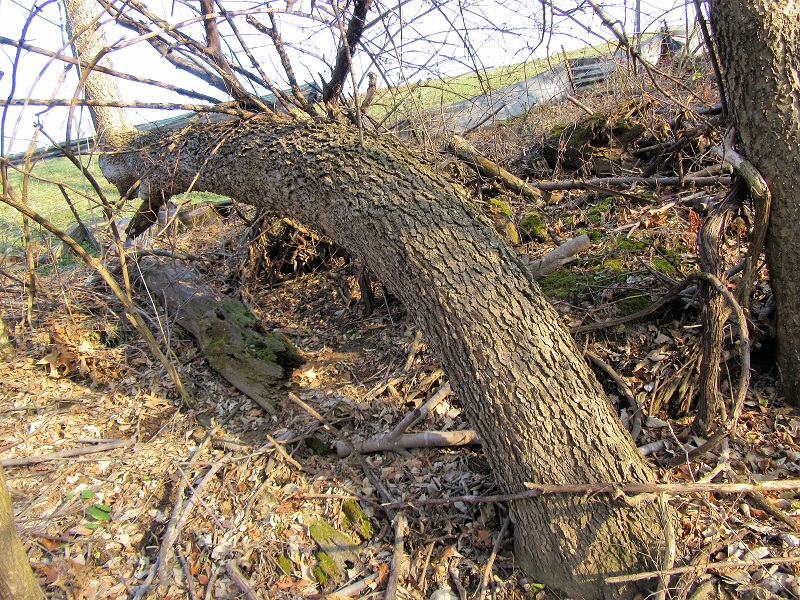
Native American Trail Marker Tree

Anyway, I filmed the work they did, which was spectacular. They rigged a rope system which allowed one of them to cut the trees at the top, above the difficult terrain. He was like a trapeze artist, swinging from the branches. He carried all the tools he needed on his belt, leg holster, and harness as he flipped his little chain saw (which didn’t look big enough to cut the biggest tree but did) behind his back from hand to hand as needed to get the best angle of attack.

It was cold outside and I had trouble keeping the video camera still because I was shivering. I missed the shots of the biggest trees as they were in the act of falling because of that and a flashing red light on the viewfinder, which I was afraid was signaling either low battery or nearly full memory card. This is something Sena will be reminding me of for years to come.

I will never forget my dismay at missing the moment when the airborne arborist finished off the huge broken oak by kicking it, sending it to the ground with a biblical crash. I had to contain my urge to shout, “Hey, can we get another take on that?”

The big job is done—sort of. A wooded lot is a mixed blessing. Parts of the back yard are almost mesmerizing when the foliage is thick and the birds are flying all over the place. The forest is alive, but it doesn’t live forever. We have to learn how to live together somehow.
Stumped

Ever since the derecho last month, we’ve been stumped by stumps—tree stumps. It has been a lesson in the value of persistence. The tree in our front yard got knocked over almost right at ground level. I cut it up with a 20-inch hand saw. But the stump has me stumped so far. You can google “stump removal” and get an idea of what your options are.

One method is to use chemicals, involving drilling holes into the stump, into which the chemical is poured along with water and waiting patiently a few years. One guy’s review of a product revealed what appeared to be a basic misunderstanding of the procedure. It involved mixing the chemical with peanut butter, applying it to the stump which he then set on fire to make a smoke signal which could allow lost hikers to be more easily rescued. And by the way, it also hastened the rotting of a tree. The reviewer even included a photo of the heavily smoking concoction. I suspect the manufacturer published the review mainly for entertainment.

We took a half-hearted stab at chemical rotting. I mainly used a bow saw, believe it or not. That didn’t get the stump low enough below ground level to assure grass would grow above it.

Manual labor methods usually include recommendations for using a chain, a truck with 4-wheel drive, a wrecking bar, shovel, mattock, axe, and a few sticks of dynamite.

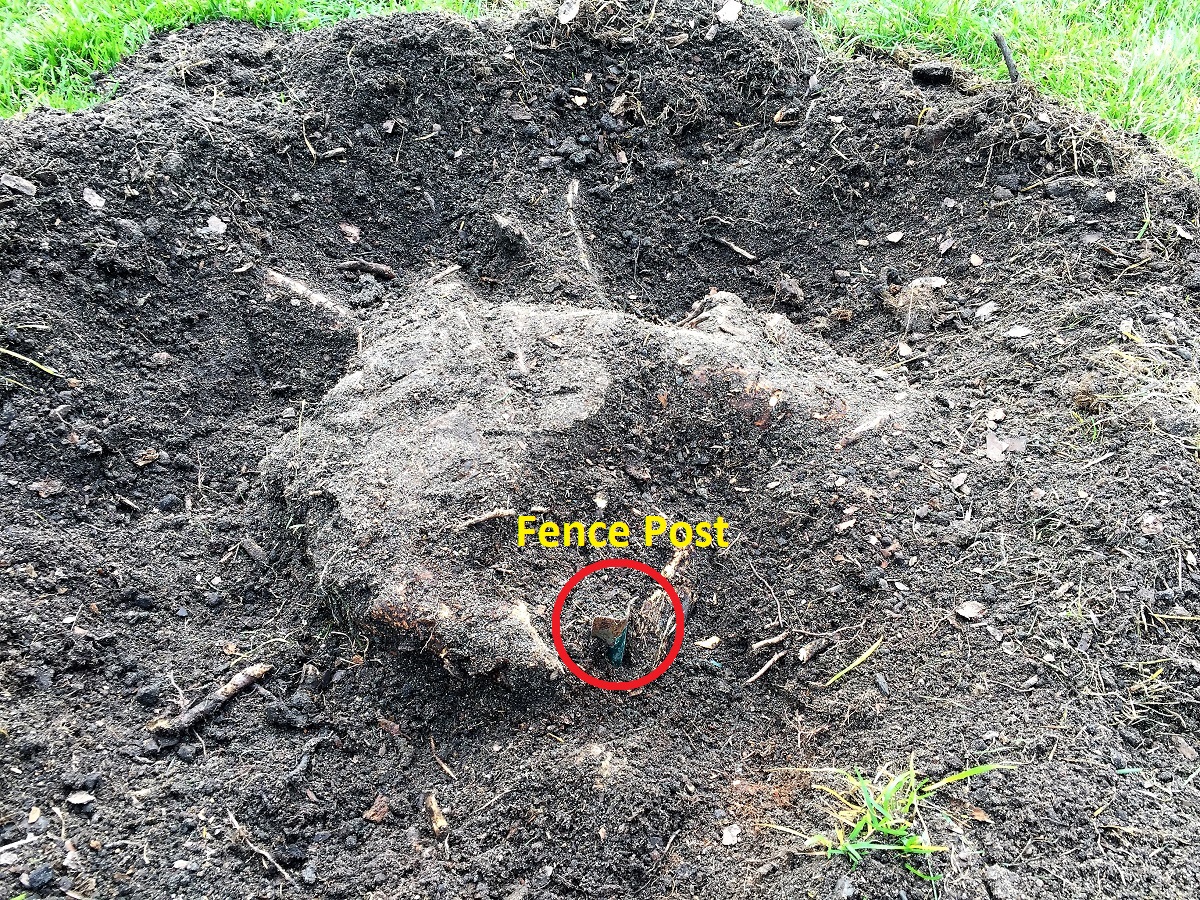
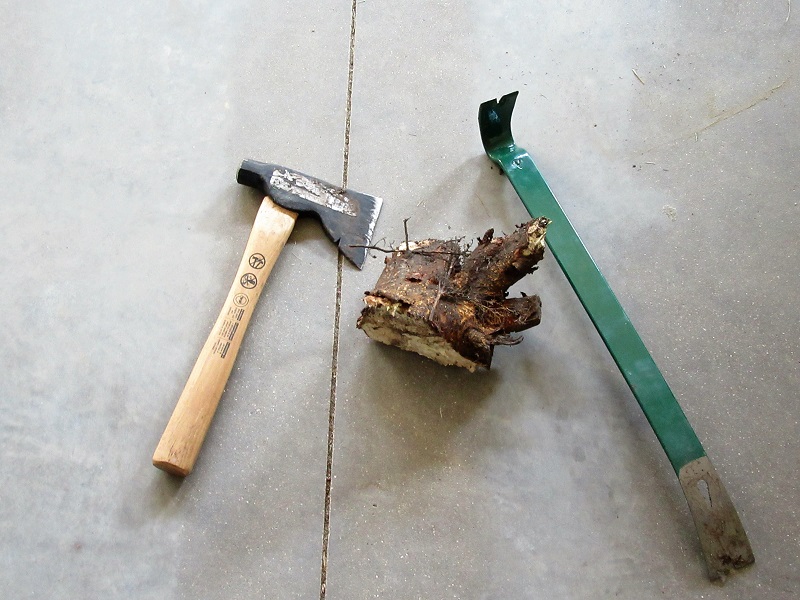
Manual labor has been the main method so far. There was a wire wrapped around the stump and three steel T-bar fence posts, which were probably placed when the tree was first planted several years ago. We got two of the T-bars out but couldn’t get the last one loose (only breaking it in half) until I got a hatchet and a pry bar. Thick roots were wrapped every which way around it and meandered off in all directions. I chopped and pried for hours until I could finally yank it out with vise grips. We hacked a softball-sized chunk of root out of the tangle, and managed to amputate several others away from the main stump. That is why I’m not a big fan of the manual labor method.

And then there’s a guy named Frank, half of a duo owning a stump grinding service. I called him and he came over the following day, shortly after I had removed the T-bar—which probably would not be the best thing for the 21-inch blade on his giant stump remover. He plans to grind it sometime in the next week.

I knew I could rent a stump grinder, but I would never do a thing like that. I’m not the handiest guy in the world, putting it mildly. I’m lucky I didn’t amputate a digit (along with a root) with the hatchet.

We talked with Frank in the front yard as he examined the stump. He said, “Oh, that’s nothing.” He quoted a fair price, which was far less than how much I would have had to pay to rent a stump grinder—and to cover the costs of emergency room charges, damage to the machine, the house and the neighborhood from a runaway grinder.

Frank is pretty busy and we speculated about what the main reasons might be, naturally one being the derecho. Frank thought the coronavirus pandemic might be another one. People sit at home either in self-isolation or quarantine and they have more time to stare at longstanding problems around the house and in the yard.

Having time on your hands can lead to boredom and brooding, which can happen to retirees like me. There are times when I would rather hack at a tree stump than read the daily news. I have to keep focused on where I’m aiming the hatchet or how I’m holding the power pole saw, which occupies me, makes time go by faster, and makes me tired and sore at the end of the day. I feel like I accomplished something. Frank retired several years ago and only later set up the stump grinding business.

We’ll see what happens next week with the stump. Frank’s business card has a picture of his giant machine. He can operate it by remote control. You can see what that looks like in a couple of videos at the website which markets the grinder he uses.

Derecho: Straight Line to Iowa

As the yard waste collection worker approached our small, neat bundles of small tree branches tied up with twine, he just shook his head. He and his partner picked them up by the twine and tossed them in the truck. For a moment, I was afraid they would refuse to collect these relatively tiny remnants of the most devastating inland hurricane to smash Iowa in over a decade. It’s known as a derecho, which is Spanish for “straight line.” It refers to the straight-line winds which were clocked at well over 100 miles per hour on August 10, 2020.

The governor has requested federal aid. People died, many were injured, left homeless, and without power or means of communication for days which is extending to over a week now. Crops were ruined.

Trees and homes were ripped apart and scattered over the land. We knew when it ended that the cleanup job would be unimaginably hard. So that made the requirement to make tidy bundles of twigs festooned with twine all the more surreal. We and neighbors stacked the tree debris as neatly as we could in separate piles, never doubting that the city would understand that we were caught short. We just didn’t have time to stock up on twine in anticipation of a derecho.

The piles were left and so we thought, that’s understandable. The city was caught short as well. Then we heard that the reason they were left was that the bundles were not gift-wrapped.

So, we wrapped them up. It turns out it made the difference between allowing the piles of twigs to sit there and rot the grass underneath—or getting them collected.

It reminds me of a line from the movie Men in Black 2 in which the neurolyzed Agent K as the punctilious postmaster gently scolds a customer for failing to submit a “properly wrapped” parcel— “Brown paper and triple twist twine are the preferred media; thank you for your time.”

On August 10, 2020, the wind screamed like I’ve never heard it before. I made several trips to the basement in anticipation of a tornado, but we got something just as terrifying—the derecho. The power was off for a little over a couple of days. It took about a week before I got cell phone and internet access back. Thankfully, we were not injured and we had a roof over our heads.

Later in the week, we saw a long line of cars outside of a local hardware store—people waiting to buy $700 generators. Later that same afternoon, the power came back on. They’ll be ready next time.

Right after the storm stopped, I went out to get our mail (yes, the post person was out, believe it or not!). My jaw dropped when I noticed the fallen Maple tree in our front yard. We were lucky it didn’t fall on our house. I didn’t have a chainsaw. I cut it up with a 20-inch handsaw. My wife and I trimmed and stacked the remnants in our driveway. I didn’t think of triple twist twine at the time.

The last derecho I remember in Iowa was the Corn Belt derecho in 1998. I was an Assistant Professor in the University of Iowa Hospitals & Clinics Psychiatry Department. I remember pulling a tree branch off the roof of the house my wife and I had recently purchased. The streets were full of downed trees and in some cases were impassable. One of my colleagues called it a straight-line windstorm, the first time I’d ever heard of such a thing. I hoped I would never see such devastation again.

On the other hand, Iowans will make a straight-line comeback.