Let’s Rumble in Cribbage!

Well, by some miracle we got through a Cribbage Rumble game yesterday and we recorded the whole 75-minute event for posterity. We reviewed it several times and it looked pretty good this morning although we were so delirious by the time we finished the marathon, there might be a few bloopers. I also reviewed our house rules and the updated version is below.

This took much longer to play than our first two cribbage wars games we played on the Ebonwood board and which are on my YouTube channel (@JamesAmosMD). We finished those in an hour. This one took 75 minutes.

One question that arose was what does a player in the Blue Time Trap do if his opponent lands in the Blue Penalty Box? I think AI was the only one who explicitly states what happens and it’s below:

According to AI which is the only source for guidance. Although it gives the Crib Wars rules as a reference, I couldn’t find it in the actual pdf source on the web. Anyway, what AI says happens if your opponent lands in the Blue Penalty Box while you’re in the Blue Time Trap:

“Yes, if you are in a blue time trap, you can absolutely use the 20-point forward movement gained from your opponent landing in a blue penalty zone to move forward and potentially exit the trap faster. The rules state that the opponent of the player landing in the penalty box moves 20 holes forward, which takes precedence over your current trapped status.

Key Rules for this Scenario:

  • Opponent Penalty: In a two-player game, when your opponent lands in a blue penalty box, you, as the opponent, advance 20 holes.
  • Time Trap Escape: When in a blue time trap, you must follow the blue path. Advancing 20 holes via your opponent’s penalty helps you reach the end of that blue path faster.
  • Interaction: The forward movement from the penalty is added to your current position, allowing you to move through or past the time trap’s designated path.”

Note: According to Ebonwood rules, an award of 20 points cannot place a player into a new penalty box or time trap; if it would, you skip to the first hole beyond it.

But since neither one of us ever hit the penalty box, that scenario never happened.

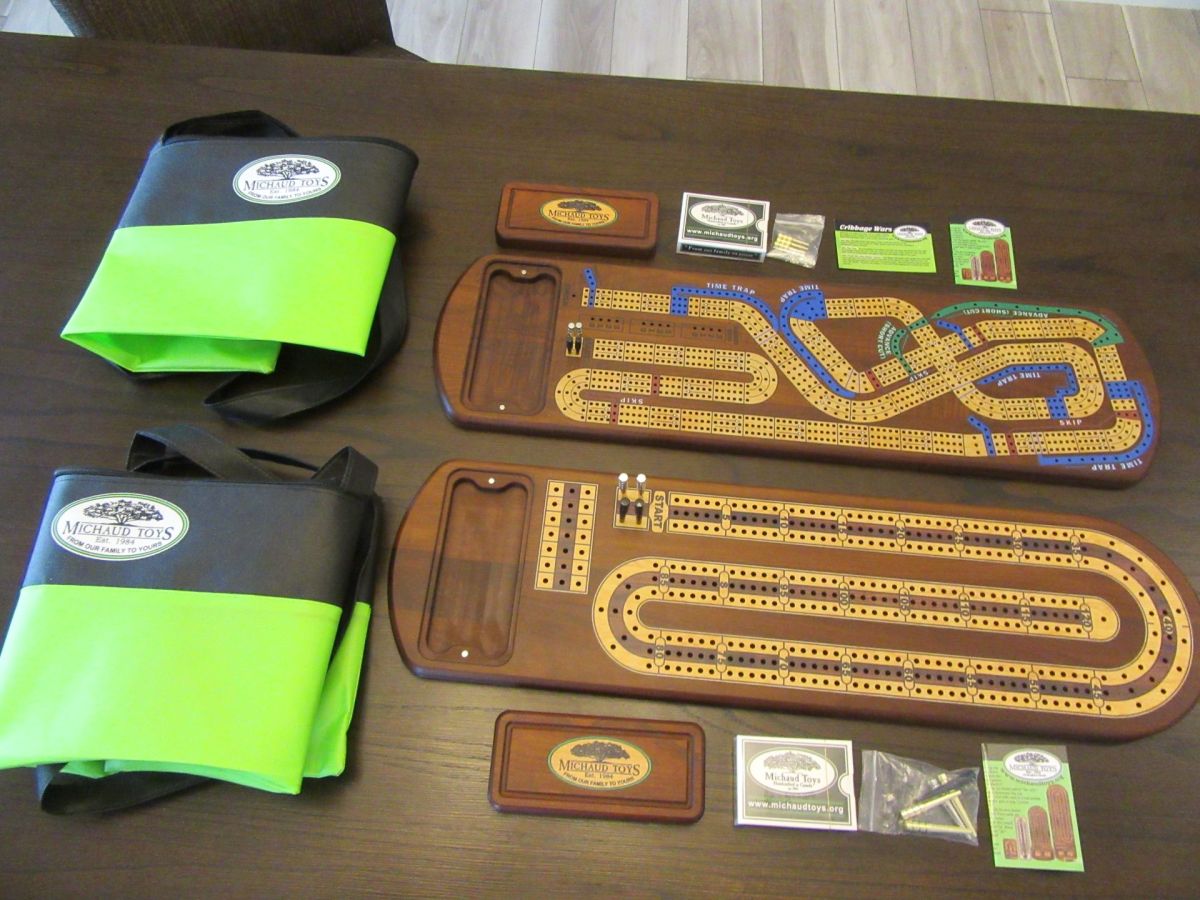
A few words about our new Cribbage Rumble game are in order. First of all, the handsome Cribbage Rumble board is made by Michaud Toys in Ontario, Canada. It’s a slimmer design than our handsome Ebonwood cribbage board, but the basic zones are the same. It’s interesting that Michaud originally called the game Cribbage Wars about a year ago and later changed the name to Cribbage Rumble. On the other hand, when we got the board, it came with a special card with a set of rules for “Cribbage Wars.” The Ebonwood board (made in Wisconsin) cost $210 when we bought it in 2025. The Michaud Toys board cost about $90.

Interesting historical notes: Crib Wars was first invented by a couple of guys from Ontario, Canada. Norm Ackland and Robert J. Prettie patented Crib Wars in 2000. Norm was also an Elvis Tribute Artist (ETA). The terminology for the name of the game is a little confusing. Ackland and Prettie made the first Crib Wars game. There’s also Cribbage Wars, marketed by Ebonwood. They are the same game with the same rules. Cribbage Rumble is also the same game as the first two.

Our updated House Rules for Cribbage Rumble (same as Crib Wars and Cribbage Wars):

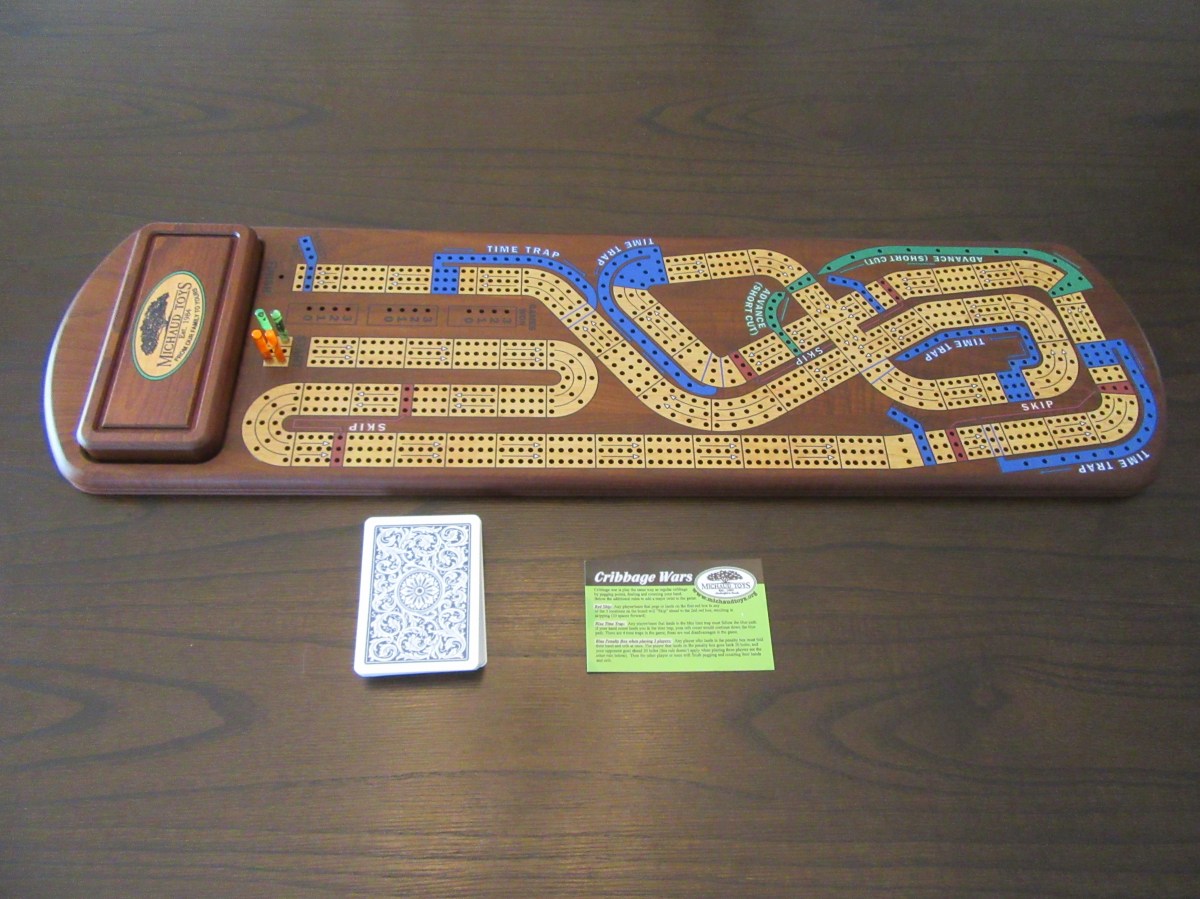
There’s no Muggers Alley on either the Ebonwood board or the Michaud Toys board and we never play muggins. Below are my updated descriptions of the colored zones, which we discuss and demonstrate during the video.

Red Skips: There are 3 of these. The rule says if you land on the first red box you should slide to the next red box which gets you 20 holes further along the board. The red box just means the set of 3 holes highlighted with a red color. You get from the first one to the next one by just moving the peg 20 holes. You’ll land in the 2nd set of holes marked in red. This is a boon in the first Red Skip area. However, if you pay attention to the directional arrows in the path guiding you, it looks like they accelerate you toward two of the Blue Time Traps.

Blue Time Traps: There are 4 of these and there will be three blue lines, meaning the blue color covers all three holes and all three peg tracks (3 holes along the track and 3 holes across the track). If you land in a set of three holes highlighted in blue, you end up moving to a blue area of holes that actually set you behind several holes. You have to play your way out of them. Players note that you can end up in repetitious cycling back to the traps largely because of how often you can get one or two points at a time while scoring. In fact, some say that if their opponent gets close to a Blue Time Trap they may purposely lead with a five card (something you would rarely if ever do in a standard cribbage game). That could trap the opponent into playing a ten card or a 5 card, which might risk them moving only a couple of holes right back into the Blue Time Trap. The same thing could happen with falling into the Blue Penalty Boxes. If you land in a Blue Time Trap and your opponent lands in a Blue Penalty Box, you can get out of the trap by moving forward 20 holes, which gets you out of the trap faster.

Blue Penalty Boxes: There are three of them. You fall into one of these by moving your peg into one of the single blue hole lines, meaning one blue track across the three peg tracks. This is a disaster because you immediately have to move back 20 holes and fold your hand and your crib while your opponent moves forward 20 holes, finishes pegging and counts their hand and crib (if they have the crib). Asking AI is the only way I could find out how to learn how to peg moving back and forward 20 holes. The player who lands in the penalty box moves their front peg back 20 holes starting from the penalty box. You don’t move the rear peg. If your front peg lands behind the rear peg, it becomes the new rear peg. The player who doesn’t land in the penalty box moves their front peg forward 20 holes. The player who lands in the penalty box immediately folds their hand and crib.

Green Advances: There are two of them. If you land in a green hole, you take short cut path. The long one saves you from moving toward the Blue Time Trap in the left lower quadrant. You don’t avoid the potential other trap above. If you take the normal track instead you end up moving toward the lower left quadrant Blue Time Trap—but you have a chance at getting into the short Green Advance track before you get there which loops back away from it and you end up going in the direction of the upper Blue Time Trap.

You think you’re in the clear after that? You’re not because there is a sadistically placed Blue Penalty Box in the next to the last hole before the Finish Line!
Sena Got an Invisible 29 Hand!

Invisible to us anyway. We’ve been excited about filming our first Cribbage Rumble game and we thought the first video we got on March 25, 2026 was too disorganized and chaotic to accept.

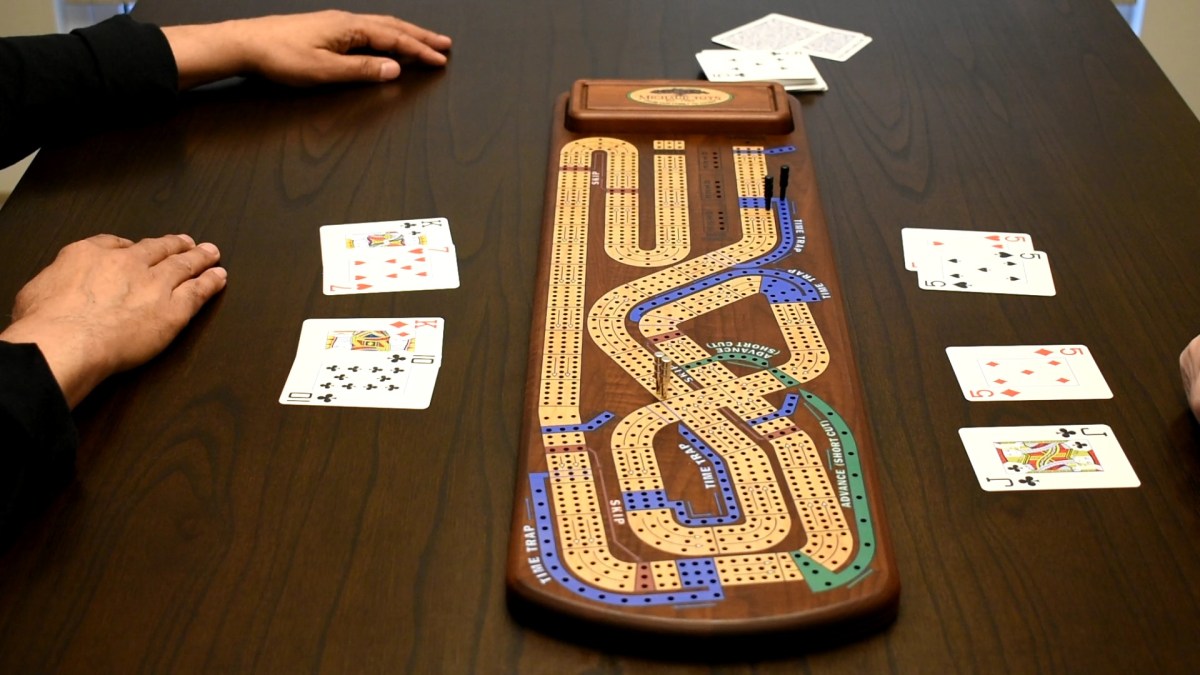
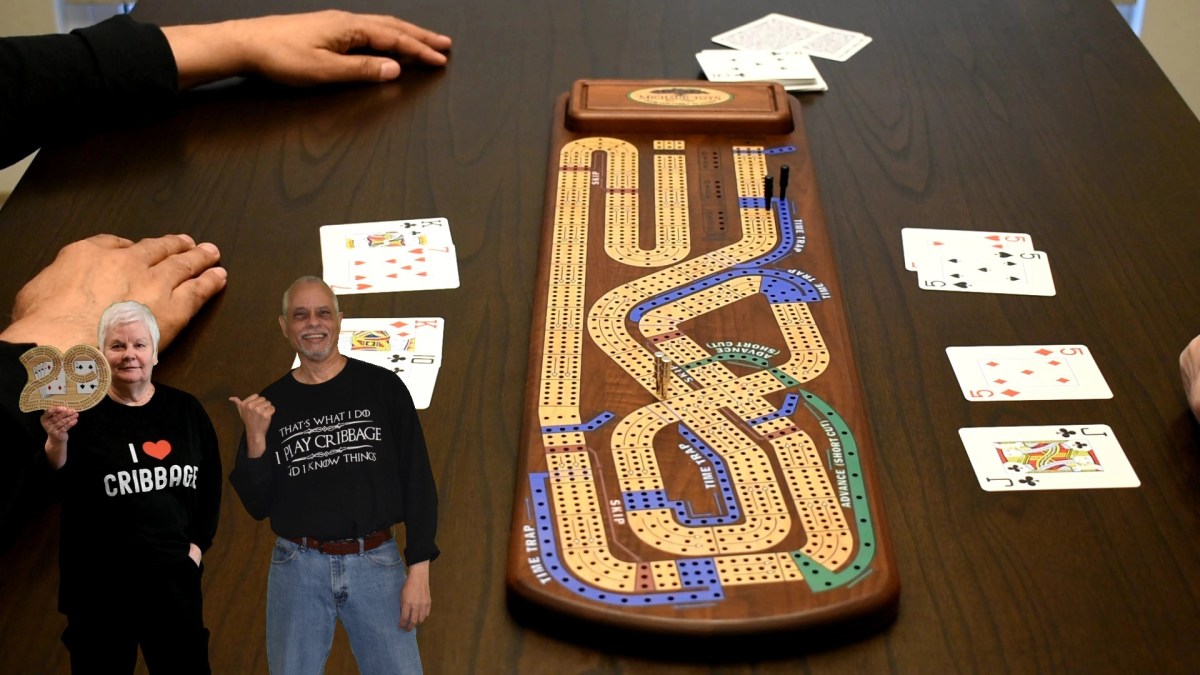
It’s a good thing I didn’t discard the clips—because Sena got a 29 hand. The trouble was we both failed to notice it! We have video evidence of the whole thing. It’s funny and spooky to watch.

OK, it’s time to start making excuses for why we didn’t see the 29 hand. We were playing Cribbage Rumble on our new board from Michaud Toys, so we were focused on the many zones and traps rather than thinking about anything so rare as the 29 hand showing up.

There’s no reason not to expect that a 29 score could happen in a 6-card cribbage game, but our focus was not on that. It was on avoiding things like Blue Time Traps and Blue Penalty Boxes.

Despite our focus on trying to score Sena’s hand, I think we failed to notice the obvious because the context was on Cribbage Rumble, not the rare 29 hand, the odds of which are 1 in 216,580 against getting.

I think that’s why our attention was on the four 5 cards and trying to count the 15s for 2 (which make 8 points) and the other 15s for 2 with the Jack (which is also 8 points). I knew that the four 5s is 4 of a kind which makes 12. In fact, when I said near the end of the video that I remembered seeing something “maybe once before in my life,” all I meant was that I’d seen 4 of a kind. That would have got us to 28 but we didn’t process that. We could see only parts of the elephant.

I think the other reason we didn’t react to it was that we’d played Cribbage Rumble all afternoon and into the early evening. We were tired.

It wasn’t until the next day that I used the skunkeddotclub scorer (just out of curiosity) to see what the total score was. It was 28. Then I added the 1 point because of the nob Jack (same suit as the club 5 card) and came up with 29. The scorer doesn’t deal with suits.

It still didn’t click. I told Sena that her hand’s total score was 29, in a totally offhand way. She didn’t really react to it, either.

Early this morning right after I first woke up, I began to wonder whether the score was an “alternate” way to score the famous and elusive 29 hand in 6 card cribbage. Over a few minutes, it finally dawned on me that thinking of it as “alternate” didn’t make any sense. It just was the 29 hand.

That’s when I got excited and told Sena about it. I said something confusing at the end of the video when I said something about seeing the hand “maybe once before in my life” but all I meant was that I’d seen 4 of a kind (scores 12 points). I still didn’t see that 29 hand at the time.

Marathon Cribbage Rumble Game Today!

We just finished a train wreck, hilarious, Cribbage Rumble game with our brand new board from Michaud Toys this afternoon (it must have been 3 hrs!). We’ll put something together tomorrow on video if we can manage it!

Crib Wars: The King of Calvinball Crib!

Sena asked me the other day if I had checked back on the price of a fancy Canadian cribbage board, Cribbage Rumble. I had not, so of course since that was my assignment, I looked on the Michaud Toys website and found that the high tariff price had disappeared, apparently. There were no alarming notes in red type with multiple exclamation points. And the price was $89.95.

However, as I noted yesterday, they replaced the message that U.S. orders are subject to a 35% tariff and a 25% UPS brokerage fee paid before delivery!

That is too high.

This led to a search for more information about Cribbage Rumble, which sounds a lot like Crib Wars (or Cribbage Wars, if you prefer since I think these games are all the same animal). In fact, it didn’t surprise me very much to find a Facebook post from Michaud Toys enthusiastically advertising “Cribbage Wars” 7 months ago for the low, low price of $89.95.

That’s right; they called it Cribbage Wars just 7 months ago although they call it Cribbage Rumble nowadays. Why is that? I’m glad you asked.

I began to wonder just what exactly is Crib Wars, is that different from Cribbage Wars, and why in blazes does the sight of the game board always prompt people to exclaim that it reminds them of Snakes and Ladders or Chutes and Ladders?

There’s this convoluted and confusing story about Chutes and Ladders and Snakes and Ladders. I think it’s partly because the Crib Wars board layout sort of reminds people in my age group of the layout of Chutes and Ladders. There’s this convoluted and sometimes contradictory history of the name of Snakes and Ladders being changed to Chutes and Ladders (some writers reverse them) to make it less scary for kids.

I think the story of the origin of the game has something to do with teaching morals to children in India. Some web articles say the original game from India was called Snakes and Ladders. Some people make things even worse by calling the game “Shoots and Ladders.” In modern times, the way you played the Chutes and Ladders was to spin a dial and move up a ladder or down a chute and you were supposed to try to be the first to reach the final goal. The morality theme was abandoned and—you know where that left all of us.

Milton-Bradley changed the name from Snakes and Ladders to Chutes and Ladders in 1943 because they thought snakes scared kids.

Where was I? Oh, the Crib Wars and Cribbage Wars game are probably the same, as I said earlier. When I try to search the term http://www.cribwars.com (a suggested search term), I just get an error message. When I search for “cribbage wars” I end up at a game supply store called Ebonwood and they’re located in Appleton, Wisconsin—which is a very nice place. I interviewed for a position in a private practice psychiatry clinic there years ago.

Ebonwood sells the Crib Wars game for $210. You can find the rules on their web site. The board they sell doesn’t put much in the way of markings on it, not even numbers. A reviewer on BoardGameGeek site reviews it and shows a very nice photo of the board. All of them look pretty much like that.

I think the origin of Crib Wars is fascinating. Recall that Michaud Toys in Ontario, Canada has produced and is marketing a Cribbage Rumble board (which is really just another Crib Wars board). It turns out that the two inventors of Crib Wars are from Ontario, Canada as well. One of them is Norm Ackland, an Elvis Tribute Artist, and Robert J. Prettie. They patented the game in the late 1990s.

On the other hand, you can buy a copy of the game for about $30 at Amazon or Walmart and be cursing your luck for hours over a game which many people play only once or twice. It can take hours to play.

That pretty much makes it just another Calvinball crib game, thanks to the Calvinball Cribbage Crowd (CCC). I’m on to their tricks—and they know it.