The CDC and FDA released a Joint Statement today indicating COVID-19 vaccine booster doses for all Americans possibly beginning as soon as September 2021. An excerpt is below:
“We have developed a plan to begin offering these booster shots this fall subject to FDA conducting an independent evaluation and determination of the safety and effectiveness of a third dose of the Pfizer and Moderna mRNA vaccines and CDC’s Advisory Committee on Immunization Practices (ACIP) issuing booster dose recommendations based on a thorough review of the evidence. We are prepared to offer booster shots for all Americans beginning the week of September 20 and starting 8 months after an individual’s second dose. At that time, the individuals who were fully vaccinated earliest in the vaccination rollout, including many health care providers, nursing home residents, and other seniors, will likely be eligible for a booster. We would also begin efforts to deliver booster shots directly to residents of long-term care facilities at that time, given the distribution of vaccines to this population early in the vaccine rollout and the continued increased risk that COVID-19 poses to them.”
Yesterday somebody asked me “So what do you do now that you’re retired?” I have come to dread the question. I told him I write this blog. That seemed to surprise him a little. It sounded a little lame to me as I said it. I’m not sure it’s the right answer to this question that I still don’t know how to answer, even though I’ve been retired for a little over a year.
I remember the blog post I wrote a couple of years or so ago, “Mindfully Retiring from Psychiatry.” It sounded good. It still sounds good even as I re-read it today. Others were reading it too, judging from my blog stats. I wondered if one of them was the guy who asked me the dreaded question.
I still exercise and do mindfulness meditation, although for several months after I retired, I dropped those habits. A lot was going on. We moved. I didn’t weather that process well at all. I was bored. In fact, I still struggle with boredom. The derecho hit Iowa pretty hard. It knocked over a tree in our front yard, which I had to cut up with a hand saw. The COVID-19 pandemic and social upheaval is an ongoing burden for everyone and seems to be directly related to making everyone very angry all the time. Sena and I are fully vaccinated but I’m pretty sure that more vaccinations are on the way in the form of boosters.
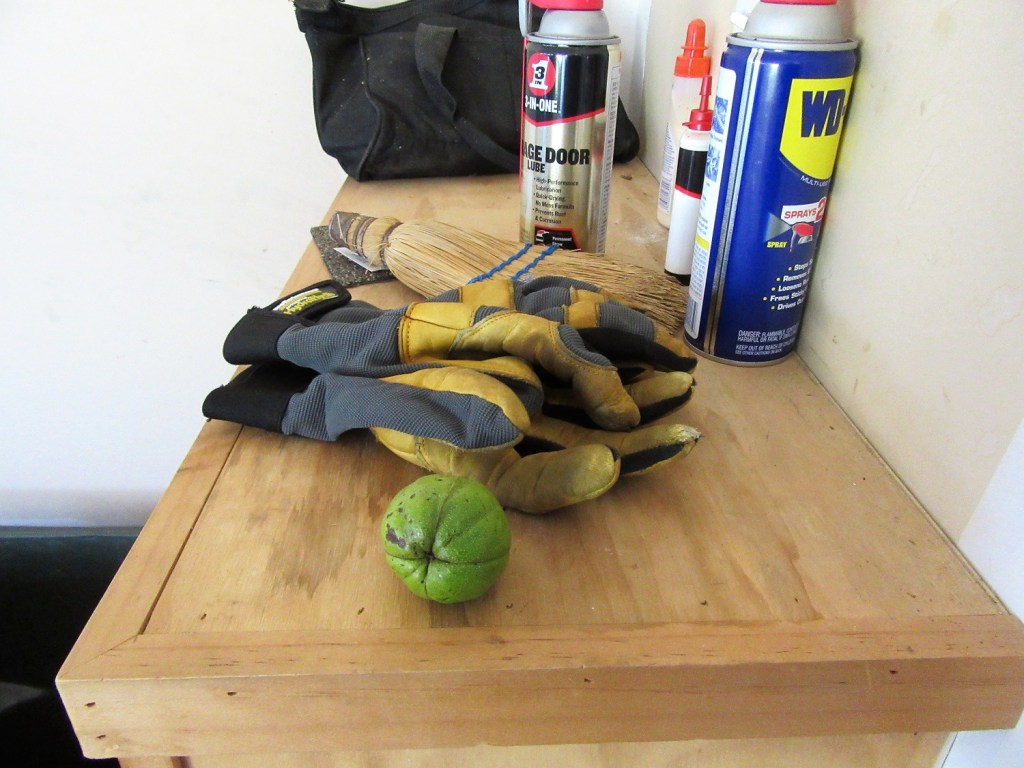
I’ve had to do things I really never wanted to learn how to do. Sena handed me a hickory nut she found in the yard this morning, reminding me of walnut storms we had at a previous home. I picked up scores (maybe hundreds) of walnuts there. I don’t want to do that again. I remember being jarred awake each time a walnut hit the deck.
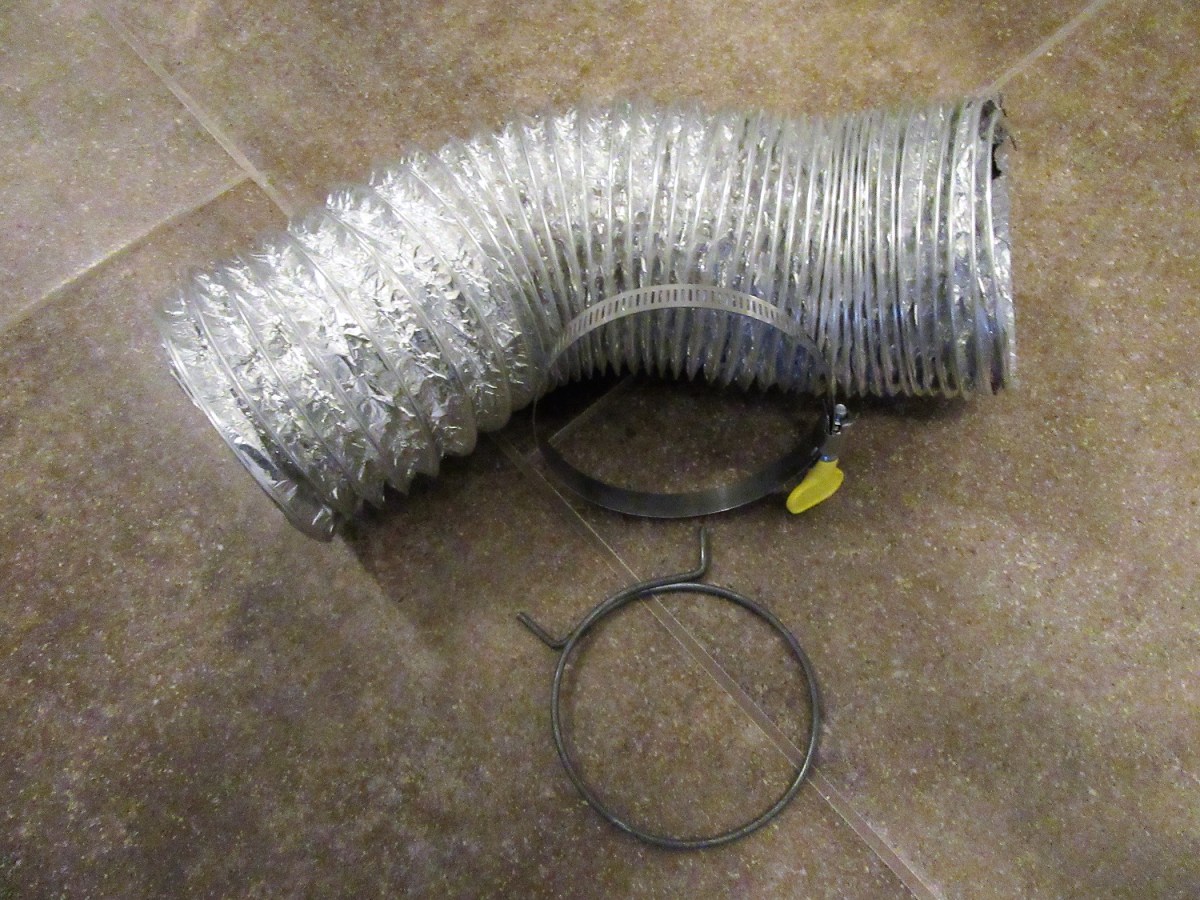
And for the first time, I had to replace a dryer vent duct. I’m the least handy person on the planet. Our washer and dryer pair are both 54 inches tall and I found out that when you have to drag a big dryer away from the wall, you have to do it like you really mean business.
You don’t want to look at what’s behind the dryer. Worse yet is jumping down behind it in a space barely big enough for me to turn around. Getting out of it is even harder. Jump and press to the top of the machines and watch those cords and hoses.
I tried so-called semi-flexible aluminum duct. I switched to flexible foil duct, despite the hardware store guy telling me that it’s illegal. It’s not. You want to wear gloves with either because you’ll cut up your hands if you don’t.
Who’s the genius who thought of oval vent pipe on the wall when the duct is 4-inch round? It’s not illegal but it does make life harder. And how do you attach the duct ends to the pipes? Turn key or screw type worm drive clamps. If you don’t have enough room for a screw driver, the turn key style is the best bet. Good luck finding those wire galvanized squeeze-style full clamps. I think they’re often out of stock because they’re not only older, but easier to use and cheaper.
See what I mean? I would not even have the vocabulary for that kind of job if I were still working as a psychiatrist. I would just hire a handyman to do it—like I do for a lot of other things I still don’t know how to do since I retired. It’s sort of like that Men in Black movie line from Agent K when he tells Agent J what they have to do on their first mission: “Imagine a giant cockroach, with unlimited strength, a massive inferiority complex, and a real short temper, is tear-assing around Manhattan Island in a brand-new Edgar suit. That sound like fun?”
No, it doesn’t and neither does replacing a dryer vent duct or any number of things retired guys get to learn because they have too much time on their hands.
So, I’m really glad to change the subject and talk about other people who are doing things I admire. First is a former student of mine, Dr. Paul Thisayakorn, who is a consultation-liaison (CL) psychiatrist in Bangkok, Thailand. He did his residency at The University of Iowa Hospitals and Clinics. He put together a CL fellowship program in Thailand. The photo below shows from left to right: Paul, Dr. Tippamas, the first CL Psychiatry fellow, and Dr. Yanin. Dr. Tippamas will be the first CL Psychiatry trained graduate in Thailand next year and will work at another new medical school in Bangkok. Dr. Yanin just graduated from the general psychiatry residency program last year. Paul supervised her throughout her CL Psychiatry years. Now she is the junior CL staff helping Paul run the program. Within the next few years, Paul will send her to the United States or the United Kingdom or Canada for clinical/research/observership experience so she can further her CL education. Way to go, Paul and your team!
Dr Paul Thisayakorn and CL Psychiatry grads (see text for details)
By the way, that tie I’m wearing in the Mindfully Retiring from Psychiatry post picture (the one with white elephants; the white elephant is a symbol of royal power and fortune in Thai culture) was a going away gift from Paul upon his graduation.
The other is a heavy-hitter I met years ago, Dr. E. Wes Ely, MD, MPH, a critical care doctor who is publishing a new book,Every Deep-Drawn Breath, which well be coming out September 7, 2021. Our interests converged when it came to delirium, especially when it occurs in the intensive care unit, which is often. I met him in person at an American Delirium Society meeting in Indianapolis. He’s a high-energy guy with a lot of compassion and a genius for humanely practicing critical care medicine. I sort of made fun of one of his first books, Delirium in Critical Care, which he wrote with Dr. Valerie Page and published in 2011, the same year I started a blog called The Practical Psychosomaticist (which I dropped a few years ago as I headed into phased retirement). Shortly after I made fun of how he compared the approaches of consult psychiatrists and critical care specialists managing delirium, he sent me an email suggesting I write a few posts about the ground-breaking research he and others were doing to advance the care of delirious ICU patients—which I gladly did. I think he actually might have remembered me in 2019 when he came to present a grand round in the internal medicine department at University of Iowa Hospitals & Clinics (I wrote 3 posts about that visit: March 28 and April 11 and 12).
In the email Dr. Ely sent to me and many others about the book, he said, “Every penny I receive through sales of this book is being donated into a fund created to help COVID and other ICU survivors and family members lead the fullest lives possible after critical illness. This isn’t purely a COVID book, but stories of COVID and Long COVID are woven throughout. I have also shared instances of social justice issues that pervade our medical system, issues that you and I encounter daily in caring for our community members who are most vulnerable.”
I look up to these and others I had the privilege of working with or meeting back before I was not retired and struggling to come up with a good answer to the dreaded question: What do you do now that you’re retired?
Today the CDC posted the data supporting the change in the mask guidelines for the fully vaccinated. It’s in the July 30, 2021 Morbidity and Mortality Weekly Report (MMWR) describing the outbreak of several hundred new cases of the Delta variant COVID-19 infection in Barnstable County, Massachusetts following July 4th events. Those who were fully vaccinated shed virus as much as the unvaccinated.
Organizers of the Iowa State Fair and those planning to attend, take note.
Brown CM, Vostok J, Johnson H, et al. Outbreak of SARS-CoV-2 Infections, Including COVID-19 Vaccine Breakthrough Infections, Associated with Large Public Gatherings — Barnstable County, Massachusetts, July 2021. MMWR Morb Mortal Wkly Rep. ePub: 30 July 2021. DOI: http://dx.doi.org/10.15585/mmwr.mm7031e2external icon.
This is just a post from a retired psychiatrist who barely passed the statistics course in medical school, so take it with a big grain of salt. I found an article written by Rocco J. Perla about something called Shewhart control charts to monitor the course of pandemic fluctuations. I noticed it because of what Perla commented on, which is the tendency of the press to make sensational headlines about every squeak in the turning wheel of COVID-19, including CDC making changes in masking guidelines leading to congressmen calling for investigations of the CDC for making the changes. It makes it look as though we don’t know what we’re doing.
I don’t know if Shewhart charts can help us make better decisions about what to advise us to do at the community level to help monitor and predict outbreaks. But it looks like we need to try something better soon. Because I can’t stand the pop-up ads at the U.S. News & World Report web site and limitations on how many articles I can view for free where I first saw Perla’s story, I looked up his original article published in the Int J Qual Health Care.
This led to my discovering the web site ISQua (International Society for Quality in Health Care). There I found a Shewchart for my state of Iowa, which shows what happened here this month. I don’t know if the Iowa Department of Public Health (IDPH) is already using it and I’m not qualified to tell them what to do. By the way, I think that mindset of “Don’t tell me what to do” crankiness might be an epiphenomenon of the COVID-19 pandemic. Nobody wants to be told to wear masks or to get a vaccine. It just leads to a pandemic of backlashes. I don’t know if Rocco is right about the Shewhart chart method not being in use by public health officials. But I want to go on record as not telling anybody what to do.
The Shewhart charts look labor intensive and maybe that’s why some public health departments don’t use them. They’re understaffed and overworked. Iowa has been scaling back the collection and reporting of COVID-19 data, partly because things appeared to be so rosy early in July. I’m not so sure how rosy they’ll be after the Iowa State Fair in August, which is expected to draw about a million visitors.
But I’m not telling anyone not to go to the state fair and I’m not telling anyone to wear a mask and I’m not telling anyone to get vaccinated. I’m not even telling anyone to pay any attention to Perla’s article on the Shewhart chart. I am telling you that I’m too old and cranky to be getting backlashes about any of this business.
Have fun at the fair.
Perla RJ, Provost SM, Parry GJ, Little K, Provost LP. Understanding variation in reported covid-19 deaths with a novel Shewhart chart application. Int J Qual Health Care. 2021;33(1): mzaa069. doi:10.1093/intqhc/mzaa069
Inkelas M, Blair C, Furukawa D, Manuel VG, Malenfant JH, Martin E, et al. (2021) Using control charts to understand community variation in COVID-19. PLoS ONE 16(4): e0248500. https://doi.org/10.1371/journal.pone.0248500
Like everyone else, I groaned aloud about the revised CDC mask guidelines yesterday. I still trust the CDC guidance, and I’m sure many might disagree with me. I think some headlines overstate the CDC mask change. I don’t believe it’s a “reversal” per se. I think it’s common sense to wear a mask if you’re inside somewhere with a lot of people whose vaccination status you know nothing about.
I think it’s worthwhile to actually read the CDC web site’s mask guidance in the section entitled “When You’ve Been Fully Vaccinated.” What it says is:
“To maximize protection from the Delta variant and prevent possibly spreading it to others, wear a mask indoor in public if you are in an area of substantial transmission.”
It’s a good idea to check your geographical area (COVID-19 Integrated County View) to see what the transmission situation is. It’s moderate where we live in Iowa. That’s enough for me to go back to wearing a mask in tight quarters with people I don’t know.
I was dismayed to read an opinion piece entitled “Stop listening to the CDC,” in which the author said that “the vaccinated are not responsible for the unvaccinated, and vice versa.”
That made me remember my former pastor, Reverend Glen Bandel, who is now in his 90s. When my mother was very sick, he spent a long night sitting up with her. My brother and I were too little to manage the crisis by ourselves. She was unable to keep any food or fluid down and he made many trips from her room to the bathroom, to empty her bucket of vomit in the toilet. You could have made a case for hospitalizing her, but we somehow got by without it.
If we all believed that we are not responsible for each other, we would have been extinct long ago, let alone getting through this pandemic in the last 18 months. Not all of us who got the COVID-19 vaccine did it just for ourselves. I think a great many also did it for those they loved and for whom they felt responsible. This is called altruism and I think humans are still capable of it, despite what you read in the news.
Presentation slides for the ACIP meeting today are available here. Updates to clinical communication indicate that, while patients with a history of Guillain-Barre Syndrome (GBS) are eligible for any of the authorized vaccines, they should discuss with their clinical teams the availability of mRNA vaccines given the association of GBS with the J&J vaccine.
For the summary of the issues regarding giving booster vaccine doses to immunocompromised patients, see data from slide 15 onwards.
This morning I put on my shirt and noticed the pocket flap puckers for the umpteenth time. I also got a reminder about how difficult it is to keep fingernail clippings from zinging all over the bathroom. I did a quick web search and saw that both problems are perennial with no great solutions. There’s an eerie resemblance to the COVID-19 vaccine hesitancy challenges.
One author says the shirt pocket flap pucker problem (say that three times quickly right now!) is caused by shirt manufacturers who fail to hem correctly and by shirt wearers who fail to properly launder them. Various solutions to the nail clipping problem involves innovative modifications to clipper design and other ingenious suggestions you can try yourself, including clipping with your digits inside a sandwich bag to catch the flying parings.
In other words, there are system changes and user changes, which seems to apply to the vaccines as well. For example, there are some researchers investigating the use of intranasal immunization. This has a few advantages, including maybe helping those who are afraid of needles, which is a population probably bigger than we think.
There are systems advantages as well as challenges to the intranasal route. It capitalizes on the IgA immunity cells in the nasal mucosa, which could help prevent travel of the virus to the lungs. The University of Iowa Hospitals & Clinics research team has found that this works in mice. On the other hand, other researchers are abandoning the approach because they haven’t had success in early human trials. And the vaccine injections are highly effective by comparison. Side effects of the intranasal might include more than just wanting to make you sneeze. Although you could cover your nose with a sandwich bag or maybe pinch your nostrils shut with a pair of nail clippers (but what to do with the nostril parings?). Some raise concerns about how close you get to the brain. There was a reported case of Bell’s Palsy after an intranasal influenza vaccination in 2002. Incidentally, the likelihood of getting Bell’s Palsy after the COVID-19 jab is less than getting it from the virus infection itself (MedPage Today report June 2021).
Congress could pass laws preventing shirt manufacturers from making them with pocket flaps in the first place. After all, what pickpocket would be bold enough to try to pick your shirt pocket, assuming you buttoned it? Or the President could write an executive order mandating the owners of shirts with pocket flaps launder them properly, or at least iron them. There could be a door-to-door campaign to distribute innovative nail clippers, or offer free pedicure and manicure services (only after full licensing, of course).
Well, anytime you need my innovative suggestions you can always choose to opt out.
The ACIP presentation slide sets available for June 23, 2021 regarding safety of COVID-19 vaccine including myocarditis and pericarditis and booster doses are here. Updated CDC recommendations for myocarditis and pericarditis following mRNA COVID-19 vaccination are here. Data does not support recommending booster doses currently although monitoring will continue.
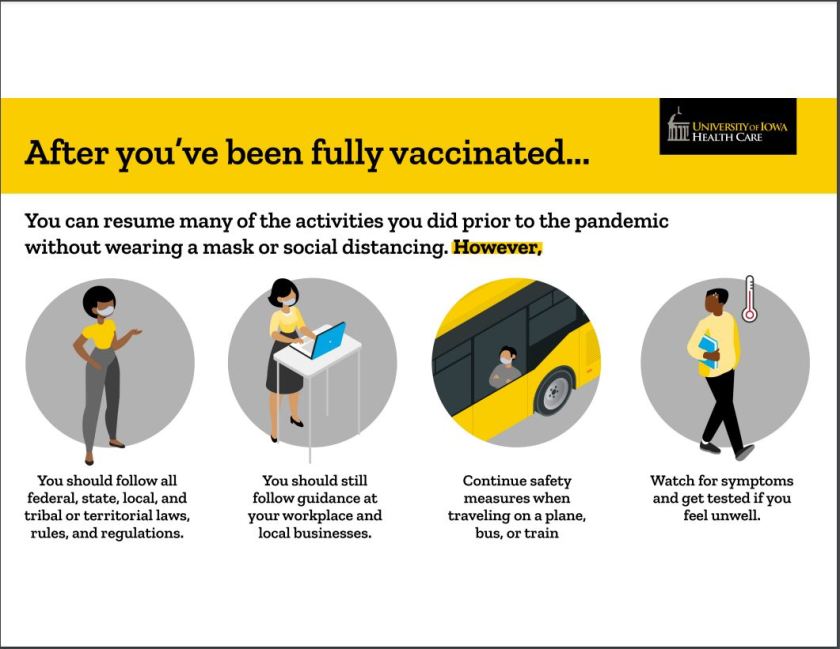
The graphic below is from University of Iowa Health Care. It’s a reminder of what you can do after you’ve been fully vaccinated for COVID-19. You can review CDC guidance here.








 Go Retire Psychiatrist