FDA Removes N95 Respirators from Shortage List

I think it’s ironic that about the same time a PLOs One study and news articles came out announcing a new method using 8-inch rubber bands for improving the fit of the surgical mask to approximate that of the N95 respirator, the FDA removed the N95 respirator from the medical device shortage list. This is relevant to help protect people from infection with Covid-19 because even vaccinated older people are getting hospitalized with the Omicron variant of the virus.

I’m not saying that the new rubber band method to tighten the fit of the surgical mask is not an improvement. It might come in handy when there is another shortage of N95 respirators.

The method mainly targets health care professionals. It would be difficult to persuade everyone in the community to adopt the technique. It’s tough enough to get people to wear masks even in crowded buildings in high transmission areas.

This is despite the CDC study showing that the elderly population continue to be at high risk for hospitalization from Covid-19 despite being vaccinated with the initial series and one or more boosters.

I think it’s hard to achieve a good fit even with the N95 respirators. The free ones distributed by the Federal government early this year were not widely available and fit poorly because the straps were elastic (similar to rubber bands, only flimsier) and loosened quickly, even after using only 2 or 3 times. At least the ones I got did. Prior to retiring, I was never able to pass a Fit test at the hospital using that type of mask.

I think my surgical masks fit better than the N95 respirators, especially after using the knot and tuck method to get a tighter seal.

Now the newer rubber band method to get a better seal uses two large 8-inch rubber bands to make the mid-face portion of the mask fit closer to your face. It looks a little easier to do than the earlier 3 rubber band technique developed a couple of years ago. That one was even tested at the University of Iowa Hospitals and Clinics by emergency room health care professionals, resulting in a small published study (the “double eights mask brace”).

All of the rubber band mask braces techniques were a response to the shortage of N95 respirators. What’s interesting to me is that, as the authors of the PLOs One study point out, there is a fair amount of variability in how well the N95 mask fits. Differences in the shape of a person’s face can account for some of this.

And there’s no shortage of N95 respirators—for now, at least according to the FDA.

If a non-health care professional wanted to use a rubber band brace, it would take some practice to get a good seal. There’s a bit of a learning curve even for a pro.

I think it would be difficult to persuade the average person to get the rubber bands and the surgical mask out of a pocket or a purse and fiddle around to achieve a good fit if you’re just going to run into Wal Mart—where I could not find that the big 8-inch rubber bands are even in stock. They’re pretty much a “3-day shipping” kind of item and could cost as much as $20 a bag.

Covid-19 Vaccine Immune Response to Omicron Wanes According to NIH

According to the National Institute of Health (NIH) the current Covid-19 vaccine booster elicits a robust immune response, it wanes quickly against the Omicron variant.

University of Iowa Participating in COVAIL Trial on Covid-19 Vaccine Boosters

University of Iowa Health Care is participating in a multi-center Phase 2 clinical trial evaluating various additional COVID-19 vaccine boosters. It’s the COVID-19 Variant Immunologic Landscape (COVAIL) trial, sponsored by the National Institute of Allery and Infectious Disease (NIAID). The trial “will test new and existing booster vaccines in various combinations to see which ones provide immune responses that cover existing and emerging COVID-19 variants.”

ACIP Meeting on Covid-19 Vaccines and Boosters Held on April 20, 2022

I got to listen to some of the presentations yesterday during the ACIP meeting on Covid-19 vaccines and boosters. My impression is that there seems to still be some discussion about what the most important goals of the vaccination program. Is it to prevent severe disease, hospitalization, and death? Or is it to prevent infection altogether?

It’s not lost on me that even mild infection with Covid-19 can lead to a chronic (“long haul”) syndrome. On the other hand, it doesn’t sound plausible that a vaccine to prevent infection would even be possible, given that so many people remain unvaccinated. That’s part of the context for the rise of variants that can lead to vaccine-resistant strains. That can lead to boosters and what some ACIP committee members are now afraid might lead to a new vogue term-“booster fatigue.”

Sena and I are now immunized as far as we can go, with 4 doses. We’re hoping for a new vaccine that is safe, effective against variants, and doesn’t involve boosting every few months.

We focus a lot on vaccines. But the other side of the risk of getting infected and sick are a part of host immunity. It gets weaker as we get older. It’s weak in those who are immunocompromised for other reasons, including things like underlying diseases and organ transplantation.

Looking at other ways to prevent disease with Covid-19, such as new medications that might counter the decline of the immune system as we age, and any other innovations are also important.

Second Covid-19 Booster Jab Done

Yesterday I got the second Covid-19 booster jab. Sena got hers shortly before I did. The pharmacy was practically deserted. Nobody is waiting in line to get this one, evidently. Sena and I are now 4 for 4 jabs with no end in sight unless somebody comes up with a new vaccine that’ll last longer than a couple of months.

No pharmacy employees wore masks. I think I was the only one in the store who wore one. I’m not sure what to think of that. We’re still wearing masks out in public.

Some infectious disease specialists are recommending you get the 2nd booster if you’re over 60, even if you don’t have serious medical comorbidities.

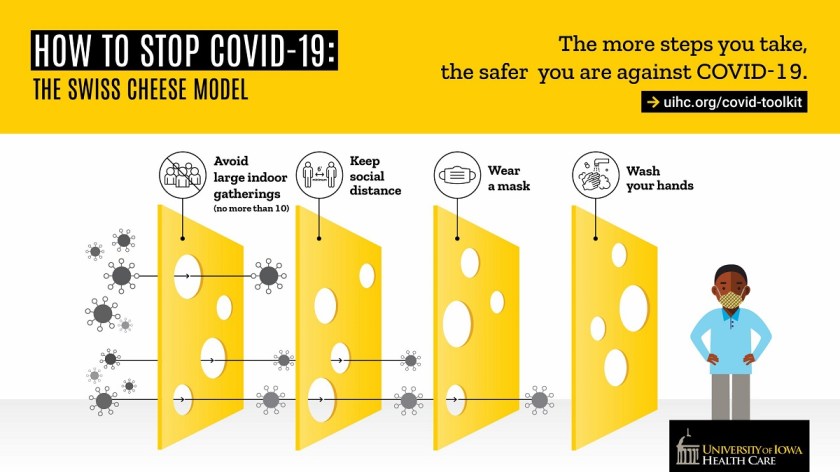
Keeping a watchful eye on transmission levels in the areas where you live is also important. Right now, it’s low in ours. But that could change, especially if we ignore the Swiss cheese method for protecting ourselves from Covid-19.

To Boost or Not to Boost?

To boost or not to boost? That is the question. I’m still thinking about whether or not it’s important for me to get the second booster for the COVID vaccine. What might help me decide is a little bit more information from University of Iowa Hospital epidemiologist Dr. Daniel Diekema, MD.

The Omicron subvariant, BA.2, is much more transmissible than most past variants. According to Dr. Diekema, it’s responsible for more than half of all Covid-19 cases in Iowa. On the one hand, it doesn’t cause more severe disease than the other variants, and it’s just as responsive to the current vaccines.

On the other hand, just because I’m older makes me more susceptible to severe disease and less responsive to vaccines. That’s according to studies done by Stanley Perlman. MD, PhD at the University of Iowa.

So even if the first booster dose is effective against severe COVID-19 disease, I may be better off getting the second booster sooner rather than later.

It’s also important to continue wearing a mask and practicing social distancing as well as good hand hygiene.

My Opinion So Far of the 2nd Covid-19 Booster

My title for this post indicates my opinion of the Covid-19 vaccine 2nd booster. I missed nearly all of the FDA Advisory Committee meeting last Wednesday but got the last hour of the discussion of the questions:

“Following the scheduled presentations and open public hearing, the VRBPAC will be asked to discuss and provide input on the following topics (no voting questions):


• What considerations should inform strain composition decisions to ensure that available COVID-19 vaccines continue to meet public health needs, e.g.:
-Role of VRBPAC and FDA in coordinating strain composition decisions
-Timelines needed to implement strain composition updates
-Harmonization of strain composition across available vaccines


• How often should the adequacy of strain composition for available vaccines be assessed?


• What conditions would indicate a need for updated COVID-19 vaccine strain composition, and what data would be needed to support a decision on a strain composition update?


• What considerations should guide the timing and populations for use of additional COVID-19 vaccine booster doses?”

I think the Stat News summary is helpful. There is a link to the recorded meeting. Sorry, it was over 8 hours long and I don’t think I can sit through that much technical difficulty—which was reportedly more of a problem than usual.

I’m a little disappointed that the duration of the protection from the 2nd booster might be only about 8 weeks, according to the Israeli presentation. Then what? FDA Director Peter Marks frankly calls the 2nd booster a “stopgap” measure. We need a new vaccine, not a series of boosters of the same old, same old.

Can the drug companies coordinate their efforts to come up with a new vaccine that will target the most prevalent variants of concern? Frankly, I doubt it, especially if they have to get going on the production in June and there doesn’t seem to be consensus on what variants would be important by the time the new vaccine would be needed, which is this fall. The virus mutates quickly and not in predictable ways.

I think we’re well past the idea of getting a vaccine that will lead to a sterilizing immunity, especially since it sounds like a product that stimulates nasal mucosa IgA antibodies would be necessary—if you can keep from sneezing the product back out on your sleeve. If the vaccines keep me out of the hospital, I guess I’d be happy with that. It looks like immunity will wane no matter what you do and there doesn’t seem to be a correlate of protection nor any guarantees on durability.

Counting hospitalizations for Covid as a way of tracking infections might be misleading since many hospitals are now not counting them if they’re not the primary reason for admission.

While I think getting the 2nd booster is fine as a stopgap measure for now, and I’ll likely get it, I’m hoping for a new vaccine in the coming months.

Reminder: FDA Advisory Committee Meeting Today on Covid-19 Vaccine Boosters

Just a reminder; today the FDA Advisory Committee will meet from 8:30 AM to 5:00 PM, ET today to discuss Covid-19 vaccine boosters. I’ll be unable to post a “play by play” as I have in the past because I have something else on my schedule.

Especially noteworthy is the Briefing Document in the meeting materials, entitled:

“Considerations for COVID-19 Vaccine Booster Doses and Process for COVID-19 Vaccine Strain Selection to Address Current and Emerging Variants.”

Section 7 starts on page 17, “Topics for VRBPAC Discussion.” The important issue is determining strain composition of Covid-19 vaccines and what goes into consideration for the optimal use of additional booster doses.

April 6, 2022 Update:

“Topics for VRBPAC Discussion


Following the scheduled presentations and open public hearing, the VRBPAC will be asked to discuss and provide input on the following topics (no voting questions):


• What considerations should inform strain composition decisions to ensure that available COVID-19 vaccines continue to meet public health needs, e.g.:
-Role of VRBPAC and FDA in coordinating strain composition decisions
-Timelines needed to implement strain composition updates
-Harmonization of strain composition across available vaccines


• How often should the adequacy of strain composition for available vaccines be assessed?


• What conditions would indicate a need for updated COVID-19 vaccine strain composition, and what data would be needed to support a decision on a strain composition update?


• What considerations should guide the timing and populations for use of additional COVID-19 vaccine booster doses?”

Quick Announcement on Covid-19 2nd Vaccine Booster

According to a University of Iowa Hospitals & Clinics announcement on The Loop, 2nd booster doses were available to employees, volunteers, and patients starting April 4, 2022.