Anecdotal Garrulity

I’ve noticed that I’m getting more garrulous as I age. In fact, I call this anecdotal garrulity and I always warn my trainees that I’m about to tell them yet another war story which usually involves some activities or processes in my job as a Consultation-Liaison (C-L) Psychiatrist that nobody knows about anymore–but should.

My anecdotes tend to grow longer and more woolly as the years pass. I add a detail or nuance to the story that adds extra angles, twists and turns, and bits of hair-raising action. Some of them never happened. No, I ‘m just kidding. I don’t actually lie; I just polish the history a little bit.

One example of anecdotal garrulity in which the tales get hairier with each performance, I mean embellishment, no I mean repetition–involve people I’ve encountered while blogging on WordPress.

One of them is Dr. Igor Galynker, a brilliant psychiatrist at Beth Israel in New York who has done very important research in suicide risk assessment. He has recently published a book about the suicide crisis syndrome, The Suicidal Crisis: Clinical Guide to the Assessment of Imminent Suicide Risk. I purchased a copy and am reading it whenever I get a chance. I wrote a post about a paper he published regarding his suicide risk assessment research in my previous blog, The Practical C-L Psychiatrist, which started off with the name The Practical Psychosomaticist for goodness sakes, what a name! The name Psychosomatic Medicine (PM), by the way, was chosen by the American Board of Psychiatry and Neurology (ABPN) and the American Board of Medical Specialties (ABMS) about 2,000 years ago when this subspecialty got approved by the Accreditation Council on Graduate Medical Education (ACGME).

Come to think of it, I probably ought to call it a supraspecialty instead of a subspecialty and that name originated with another grand beacon of academic C-L Psychiatry (I mean besides me), Dr. Theodore Stern, at an annual meeting of the Academy of Psychosomatic Medicine (that’s what it was called then, if you can believe it; but now, because the members of the academy (including me) howled about it and voted to change it to something that made some darn sense, it is now rightly called the Academy of C-L Psychiatry; we’re finally correctly identified, good gahd’amighty) and you will not find “supraspecialty in Webster’s Dictionary although “supra” comes from the Latin for “above, beyond, earlier”. One of the definitions is “transcending”.  I tried to Google “supraspecialty” and came up empty, so it’s a bona fide neologism. Dr. Stern coined the term while talking about the scope of practice of PM. As he went through the long list, it gradually dawned on me why “supraspecialty” as a title probably fits our profession. It’s mainly because it makes us, as psychiatrists, accountable for aspects of general and specialty medical and surgical care above and beyond that of Psychiatry alone. That doesn’t make us deities; just better than most doctors on the planet. Of course not; I’m only kidding. Can’t you take a joke?
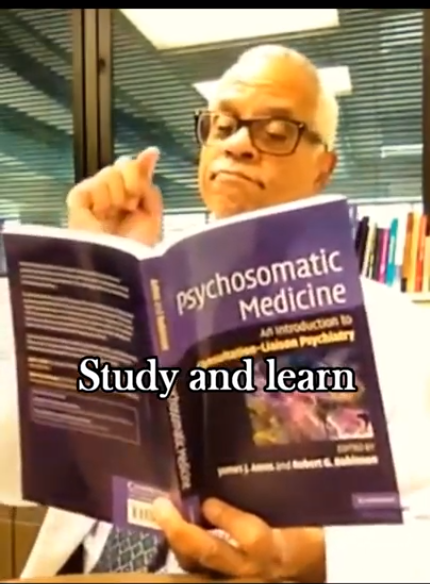
Where was I ? Oh, getting back to Igor Galynker, I wrote a post about one of his papers on the assessment of imminent suicide risk, published in about 2014 I believe, a few years after the book Robert G. Robinson and I edited was published, Psychosomatic Medicine: An Introduction to Consultation-Liaison Psychiatry, a block bluster that you cannot put down and will read cover to cover; the level of interest just climbs, almost the effect you get from my award-winning and wildly popular video on pseudobulbar palsy.

Command Performance by Jim Amos, MD

Anyway, shortly after I posted that, I got a box in the mail with a very strange-looking address for me:

Hey, what do you know, I work for WordPress!

Even more astonishing was what was in the box. It was Bumpy the Bipolar Bear, an item that evidently was a part of his Mood Disorder Division at Beth Israel.

Bumpy is the one with the Fire Chief helmet

I have never really figured out whether he did this tongue-in-cheek or what. We’ve never met and we don’t correspond. It doesn’t look like Bumpy is a thing anymore at Beth Israel.

I’m not a research scientist, but I wonder if anyone would fund a center for the study of Anecdotal Garrulity? More importantly, would a statue of me, sculpted from Play-Doh (originally wallpaper cleaner, something you’d know if you watched the Travel Channel as much as I do now that I’m retiring), be erected in the rotunda?
Mindfully Retiring from Psychiatry

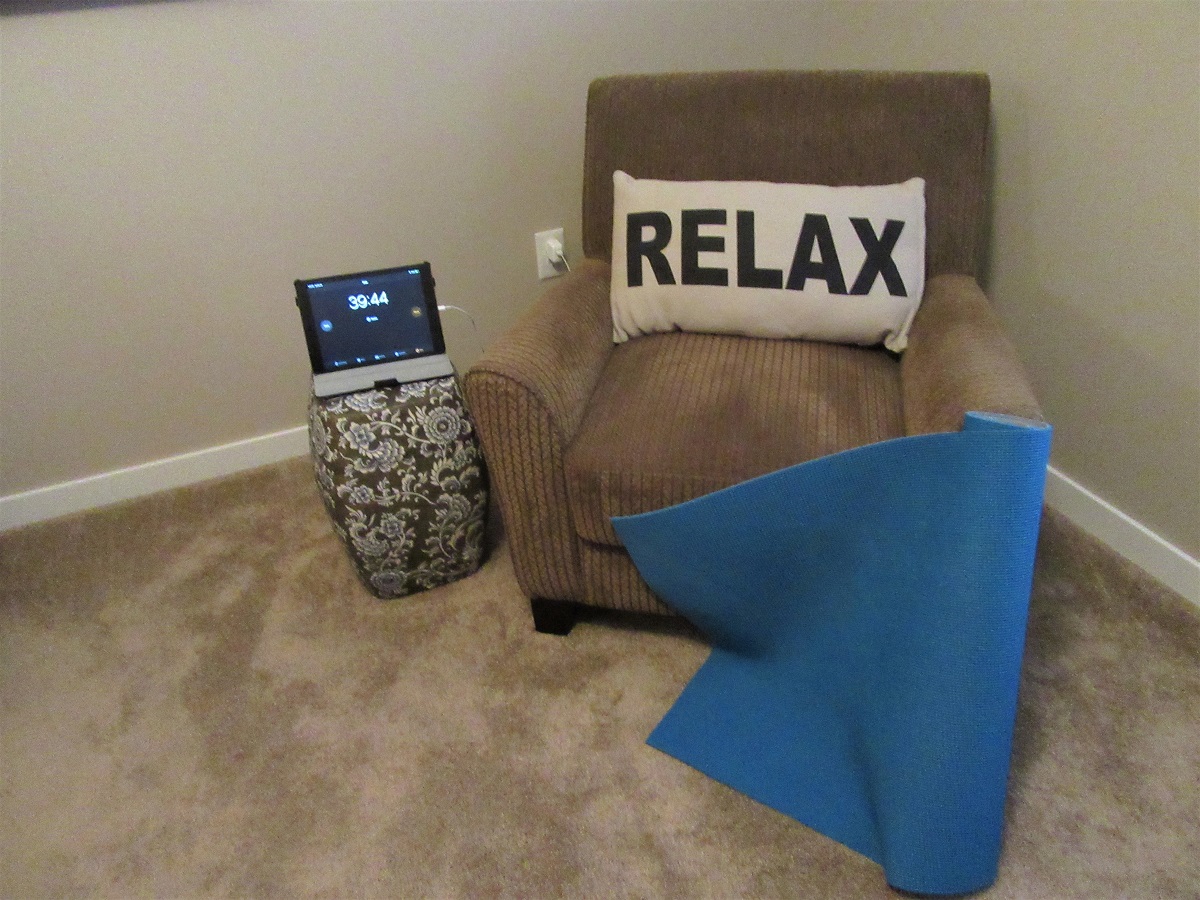
I’ve been off service for months and I’ll return to staff the general hospital psychiatry consultation service on Monday. It can be a stressful role and I’m “mindful” of how helpful mindfulness meditation has been. The featured image above shows my yoga mat and some might say a much too comfortable chair for sitting meditation. And of course, mindfulness is not really about relaxation; that’s just an old pillow.

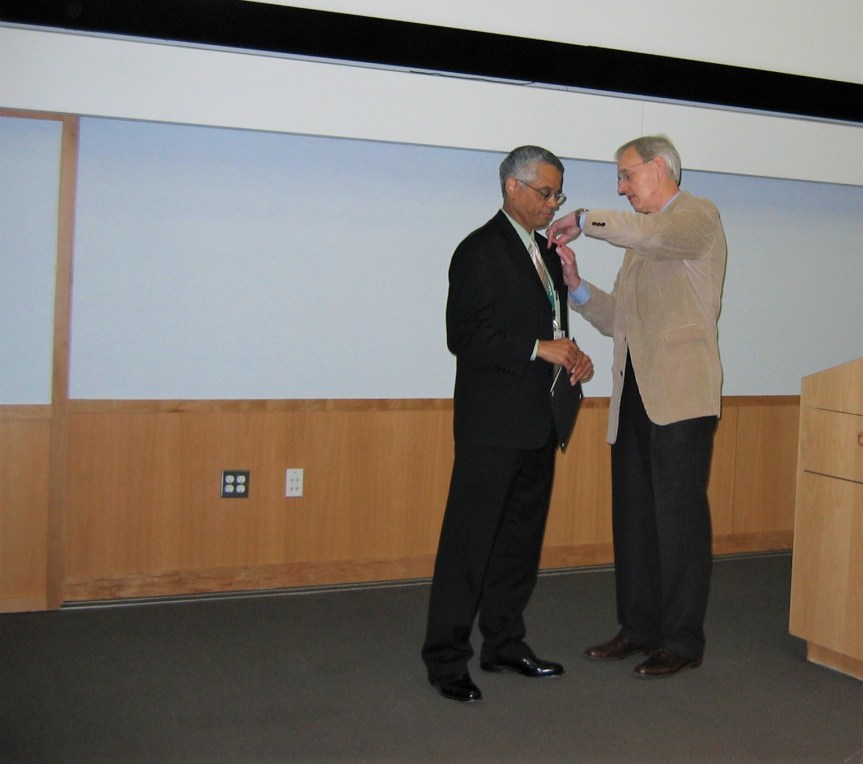
 About 5 years ago the editors of the Arnold P. Gold Foundation Humanism in Medicine Blog saw one of my blog posts (from a previous blog) describing my path to mindfulness practice, which included burnout, a problem for nearly half of all physicians, the causes of which include the health care system itself as well as physician vulnerabilities. It was posted under the title “How I left the walking dead for the walking dead meditation.” I was also the recipient of what was called in 2007 the Leonard Tow Humanism in Medicine Award, sponsored by the Gold Foundation.

Leonard Tow Humanism in Medicine pin
Getting the Humanism in Medicine Pin

This has me thinking about my motivations for retiring and what I’m going to do after I’m fully retired. Interestingly, the phased retirement program I’ve been in has given me a strong sense of how difficult this transition from full-time doctor to retired doctor entails. The meaning and purpose gap require more than a bridge made of recreational pastimes. The breath of relief after the great escape from work can soon become the sigh of boredom. On the other hand, my work as a psychiatric consultant has also been an enormous source of personal satisfaction. The video below gives a sort of Pecha Kucha account of what a Consultation-Liaison Psychiatrist does.

What C-L Psychiatry is about

It can get pretty hectic. Over the last two years of the phased retirement schedule, I’ve struggled to craft a daily routine at home that replaces the sense of accomplishment my work schedule provided—despite the pressures it exerted on my sense of well-being. Only now, in my third and final year am I starting to wonder the opposite.

For example, I’ve been exercising daily as well as practicing my mindfulness meditation. I’ve actually lost a little weight and my wife has noticed my shrinking paunch. I’m not laboring on my workouts by any means; my quads are not flopping over my knees. But I used to think that by climbing all those stairs and running all over the hospital I was staying in pretty good shape. It looked pretty impressive that my smartphone step counter logged around 20 floors and 2-3 miles a day. However, the consult service work demand can run hot and cold. It just doesn’t beat daily exercise.

How do I keep my daily exercise routine? I can hear myself saying that I won’t have time for it. I think my mindfulness teacher would probably remind me that my response could be to make time for it—just as I learned how to make time for mindfulness.

I’m looking for guidance in the literature on retiring psychiatrists, especially C-L specialists, and it’s pretty scant. So far, the best summary of it I’ve found were a couple of blog posts by H. Steven Moffic, MD on the Psychiatric Times web site. You can easily view them for free. In the first one, “Mental Bootcamp: Today is the First Day of Your Retirement,” published in 2012, he highlights the difficulty of psychological adjustment to retirement for psychiatrists. He advises, “Plan how to replace financial, personal, social, and generative needs that work has fulfilled.” There is no doubt I could do a better planning job.

In the second one, “Reviewing Retirement,” which was posted in 2014 (two years after he retired), he advises “Retire, even if you are not retired. Take enough time off periodically, and completely, with no connections to work, so that you can feel emotionally free from concerns about patients and practice.”

That speaks to me. In fact, the title of my blog site, Go Retire Psychiatrist, actually echoes this suggestion, although I never made the title with that connection in mind. I wish it were that easy to follow. You would be very lucky in today’s work environment to pull that off, even in academia. Phased retirement programs are one approach to preparing for retirement and could be effective for preventing burnout.

Go retire, psychiatrist.

The Retiring Consultation-Liaison Psychiatrist

I’m a retiring Consultation-Liaison (C-L) Psychiatrist and this blog is a chronicle about my transition from being a physician to–what? I’m not exactly sure, but I’ll find out. I won’t be offering financial advice about how to prepare for retirement. There are plenty of experts out there for that; I’m not one of them. I’m just evolving like anyone else.

I’ve been a doctor for long enough that I’m a bit rusty about doing much of anything else. Just ask my wife. No, wait; don’t do that. I know a lot about being a C-L psychiatrist. In fact, I’m not done with it. I’m in a phased retirement contract with my employer. This is my final year. I’ll be fully retired as of June 30, 2020. For the next year, my days will be a lot like what they’ve been for years. After that–who knows?

That’s really what my days are like in the hospital, believe it or not. It has some good points. I get pretty regular exercise, running all over the hospital, climbing the stairs and whatnot. I see a lot of interesting people and I have loved teaching medical students and residents.

There may be some out there who remember that I used to have another WordPress blog called The Practical C-L Psychiatrist. It’s gone. It didn’t fit my life anymore since retirement is coming up fast on the horizon.

Anyway, I’ll be posting about my changing life for the next year. I’m still not sure if I’ll keep the site after I fully retire. I’m just hoping that, for now, this public journal will help me adjust to the life change and that some of you come along for the ride.