CDC Advisory Committee Meeting November 2nd on Pfizer Covid-19 Vaccine for Children Ages 5-11

The Advisory Committee on Immunization Practices (ACIP) have scheduled a meeting for November 2, 2021 from 10 AM-5 PM, ET to discuss the Covid-19 vaccine for children ages 5-11.

This follows the FDA authorization for the vaccine in this age group, which was announced today on their web site.

Two Way Street Between Medicine and Psychiatry in Covid-19

I just found out that, as of the middle of this month, a new category, mental health disorders, has been added to the CDC list of medical conditions associated with higher risk for severe Covid-19 disease and thus, qualifies those in the category for receiving the COVID-19 vaccines . It makes sense. Mood, anxiety, and other neuropsychiatric disorders are known to be connected to a variety of medical conditions, such as diabetes mellitus, thyroid disease, and heart disease. Substance use disorders was already on the list previously. There are medical literature references supporting this:

Fond G, Nemani K, Etchecopar-Etchart D, Loundou A, Goff DC, Lee SW, Lancon C, Auquier P, Baumstarck K, Llorca PM, Yon DK, Boyer L. Association Between Mental Health Disorders and Mortality Among Patients With COVID-19 in 7 Countries: A Systematic Review and Meta-analysis. JAMA Psychiatry. 2021 Jul 27:e212274. doi: 10.1001/jamapsychiatry.2021.2274. Epub ahead of print. PMID: 34313711; PMCID: PMC8317055. https://pubmed.ncbi.nlm.nih.gov/34313711/

Ceban F, Nogo D, Carvalho IP, Lee Y, Nasri F, Xiong J, Lui LMW, Subramaniapillai M, Gill H, Liu RN, Joseph P, Teopiz KM, Cao B, Mansur RB, Lin K, Rosenblat JD, Ho RC, McIntyre RS. Association Between Mood Disorders and Risk of COVID-19 Infection, Hospitalization, and Death: A Systematic Review and Meta-analysis. JAMA Psychiatry. 2021 Oct 1;78(10):1079-1091. doi: 10.1001/jamapsychiatry.2021.1818. PMID: 34319365; PMCID: PMC8319830. https://pubmed.ncbi.nlm.nih.gov/34319365/

It’s also interesting that a large randomized controlled trial of the antidepressant fluvoxamine showed that the agent reduced the need for hospitalization in high-risk outpatients diagnosed with early Covid-19:

Gilmar Reis, Eduardo Augusto dos Santos Moreira-Silva, Daniela Carla Medeiros Silva, Lehana Thabane, Aline Cruz Milagres, Thiago Santiago Ferreira, Castilho Vitor Quirino dos Santos, Vitoria Helena de Souza Campos, Ana Maria Ribeiro Nogueira, Ana Paula Figueiredo Guimaraes de Almeida, Eduardo Diniz Callegari, Adhemar Dias de Figueiredo Neto, Leonardo Cançado Monteiro Savassi, Maria Izabel Campos Simplicio, Luciene Barra Ribeiro, Rosemary Oliveira, Ofir Harari, Jamie I Forrest, Hinda Ruton, Sheila Sprague, Paula McKay, Alla V Glushchenko, Craig R Rayner, Eric J Lenze, Angela M Reiersen, Gordon H Guyatt, Edward J Mills,

Effect of early treatment with fluvoxamine on risk of emergency care and hospitalisation among patients with COVID-19: the TOGETHER randomised, platform clinical trial,

The Lancet Global Health, 202, ISSN 2214-109X, https://doi.org/10.1016/S2214-109X(21)00448-4.

(https://www.sciencedirect.com/science/article/pii/S2214109X21004484)

Abstract: Summary

Background

Recent evidence indicates a potential therapeutic role of fluvoxamine for COVID-19. In the TOGETHER trial for acutely symptomatic patients with COVID-19, we aimed to assess the efficacy of fluvoxamine versus placebo in preventing hospitalisation defined as either retention in a COVID-19 emergency setting or transfer to a tertiary hospital due to COVID-19.

Methods

This placebo-controlled, randomised, adaptive platform trial done among high-risk symptomatic Brazilian adults confirmed positive for SARS-CoV-2 included eligible patients from 11 clinical sites in Brazil with a known risk factor for progression to severe disease. Patients were randomly assigned (1:1) to either fluvoxamine (100 mg twice daily for 10 days) or placebo (or other treatment groups not reported here). The trial team, site staff, and patients were masked to treatment allocation. Our primary outcome was a composite endpoint of hospitalisation defined as either retention in a COVID-19 emergency setting or transfer to tertiary hospital due to COVID-19 up to 28 days post-random assignment on the basis of intention to treat. Modified intention to treat explored patients receiving at least 24 h of treatment before a primary outcome event and per-protocol analysis explored patients with a high level adherence (>80%). We used a Bayesian analytic framework to establish the effects along with probability of success of intervention compared with placebo. The trial is registered at ClinicalTrials.gov (NCT04727424) and is ongoing.

Findings

The study team screened 9803 potential participants for this trial. The trial was initiated on June 2, 2020, with the current protocol reporting randomisation to fluvoxamine from Jan 20 to Aug 5, 2021, when the trial arms were stopped for superiority. 741 patients were allocated to fluvoxamine and 756 to placebo. The average age of participants was 50 years (range 18–102 years); 58% were female. The proportion of patients observed in a COVID-19 emergency setting for more than 6 h or transferred to a teritary hospital due to COVID-19 was lower for the fluvoxamine group compared with placebo (79 [11%] of 741 vs 119 [16%] of 756); relative risk [RR] 0·68; 95% Bayesian credible interval [95% BCI]: 0·52–0·88), with a probability of superiority of 99·8% surpassing the prespecified superiority threshold of 97·6% (risk difference 5·0%). Of the composite primary outcome events, 87% were hospitalisations. Findings for the primary outcome were similar for the modified intention-to-treat analysis (RR 0·69, 95% BCI 0·53–0·90) and larger in the per-protocol analysis (RR 0·34, 95% BCI, 0·21–0·54). There were 17 deaths in the fluvoxamine group and 25 deaths in the placebo group in the primary intention-to-treat analysis (odds ratio [OR] 0·68, 95% CI: 0·36–1·27). There was one death in the fluvoxamine group and 12 in the placebo group for the per-protocol population (OR 0·09; 95% CI 0·01–0·47). We found no significant differences in number of treatment emergent adverse events among patients in the fluvoxamine and placebo groups.

Interpretation

Treatment with fluvoxamine (100 mg twice daily for 10 days) among high-risk outpatients with early diagnosed COVID-19 reduced the need for hospitalisation defined as retention in a COVID-19 emergency setting or transfer to a tertiary hospital.

Funding

FastGrants and The Rainwater Charitable Foundation.

Translation

For the Portuguese translation of the abstract see Supplementary Materials section.

Covid-19 pneumonia affects the brain by causing hypoxia and inflammatory reactions, leading to neurologic dysfunction. Mental health disorders may be partly caused by inflammation. Depressed persons may not protect themselves from Covid-19 because they’re apathetic and hopeless. It’s a two-way street. It’s like Dr. Wes Ely, MD, MPH says:

The lung bone is connected to the brain bone

E. Wesley Ely, MD, MPH

Public Notice of Gratitude to FDA & CDC Advisory Committees

I have watched a few YouTube presentations by the CDC and FDA Advisory Committees in the last few weeks. I’m very impressed with the professionalism, sincerity, civility, and dedication of the members of both organizations. The most recent FDA meeting on the extension of the EUA for the Pfizer COVID-19 vaccine to children ages 5-11 was a great example of the best of the best. It’s a tough job. I appreciate them. They also have a pretty good sense of humor, especially when they forget to unmute their microphones.

FDA Advisory Committee Meeting Today on Pfizer COVID-19 Vaccine for Children Ages 5-11

The meeting will go from 7:30 AM-5:00 PM, ET, and the Voting Question will be:

“Based on the totality of scientific evidence available, do the benefits of the Pfizer BioNTech COVID-19 Vaccine when administered as a 2-dose series (10 µg each dose, 3 weeks apart) outweigh its risks for use in children 5-11 years of age.” Please vote yes or no.

This is about extending the EUA for the Pfizer vaccine for this age group. It would be administered as a 2-dose vaccine, 10 micrograms each, 3 weeks apart. COVID-19 causes substantial morbidity and mortality in this age group.

Unlike the other recent FDA presentations I’ve seen, today there was a reminder that, in view of the polarized opinions pro and con about this question, all participants should do their best to observe the utmost civility at all times during the proceedings.

Dr. Fiona Havers presented the epidemiology of COVID-19 in this age group. It showed increasing infections and severe disease and hospitalization rates, which were higher among African American and other minority children than among white. Secondary transmission can and does occur among children and adults. See the slides.

Dr. Matthew Oster’s presentation on mRNA vaccine associated myocarditis showed that myocarditis is a rare but important adverse event following COVID-19 vaccination. See the slides.

Break.

The Pfizer presentation highlighted safety and efficacy data for the vaccine. See Dr. Gruber’s briefing document and slides. The FDA presentation by Dr. Leslie Ball, MD, summarized the immunogenicity and safety data (see summary slides 34 and 35). The supplemental descriptive efficacy analysis showed 90.7% vaccine effectiveness against symptomatic COVID-19 after the second dose. There were no cases of myocarditis/pericarditis after the data cutoff time.

FDA presenter Dr. Hong Yang, PhD presented the Benefit-Risk Analysis. Slide 22 summary:

“• For Scenarios 1 (Base), 2 (Recent COVID-19 Peak Incidence), 4 (Higher Vaccine Efficacy), 5 (Higher COVID-19 Death Rate), and 6 (Lower Excess Myocarditis Rate) the model predicts that benefits of the Pfizer-BioNTech COVID-19 Vaccine 2-dose primary series clearly outweigh the risks for ages 5-11 years.

• For Scenario 3 (The Lowest COVID-19 Incidence), the model predicts more excess hospitalizations and ICU stays due to vaccine-related myocarditis/pericarditis compared to prevented hospitalizations and ICU stays due to COVID-19 in males and in both sexes combined.

• Considering the different implications and length of stay for COVID-19 hospitalization versus hospitalization for vaccine-associated myocarditis/pericarditis, and benefits related to prevention of cases of COVID-19 with significant morbidity, the overall benefits of the vaccine may still outweigh the risks under this lowest incidence scenario.

• If the myocarditis/pericarditis risk in this age group is lower than the conservative assumption used in the model, the benefit-risk balance would be even more favorable.”

“Major Limitations of the Benefit/Risk Model:

• Model assumption about constant incidence rate generates great uncertainty on the estimate of benefits.

• Vaccine efficacy may change due to new emerging variants of virus

• Hospitalizations and ICU stays from COVID-19 and myocarditis are not equivalent and cannot directly compared

• The benefit of reducing COVID related multisystem inflammatory syndrome in children may not be fully captured by preventable hospitalizations, ICU stays and deaths due to COVID-19

• This BR risk assessment does not consider potential long-term adverse effects due to either COVID-19 or myocarditis

• This BR assessment does not include secondary benefits (reducing COVID-19 disease transmission) and risks”

Break.

There were complicated questions about the applicability of the Benefit/Risk model assumptions, partly because it can be influenced by a low incidence of disease-readily acknowledged by the presenter, Dr. Yang. After extensive discussion, including the about the number of doses (One or Two?), concern for the difficult decisions this presents to parents (not just related to side effects), concern about the FDA approval being interpreted as a mandate, discomfort with the binary choice-type question.

A representative from the CDC Advisory Committee (ACIP) expressed that it seems the benefits outweigh the risks. The ACIP representative summarized the safety monitoring and reporting systems available, including but not limited to Vaccine Adverse Effects Reporting System (VAERS). The FDA can make a broad authorization; the ACIP (which may meet on this issue as soon as next week) can make implementation recommendations that could be more restrictive but could not be broader. University of Iowa representative, coronavirus expert with over 40 years’ experience and temporary voting member Dr. Stanley Perlman, indicated, in light of the thorough discussion, that he would vote in favor of the question.

“Based on the totality of scientific evidence available, do the benefits of the Pfizer BioNTech COVID-19 Vaccine when administered as a 2-dose series (10 µg each dose, 3 weeks apart) outweigh its risks for use in children 5-11 years of age.” Please vote yes or no.

The Vote: The votes were 94% (17) Yes, and there was one abstention, out of 18 votes.

The meeting was formally adjourned at 4:35 PM, ET.

Moderna Booster Jab Today and Mindful Zombies

I got my Moderna Covid-19 booster jab this morning. That was quick. A guy (probably about my age, I’m not sure) waiting for his booster behind me chuckled and asked, “Did she even let you sit down for it?” I was in and out that fast. It’s the same as the primary series, only half-dose. Sena and I are now both fully vaccinated and boosted.

According to the FDA and CDC guidelines, I could have gotten a heterologous booster, but I stuck with what I got for my primary series. There was no problem with vaccine supply; it was already on the shelf, so the only thing different was the smaller dose. Since there’s not much else to say about it, we’ll move on to other more exciting news.

Sena ordered the Zombie cribbage game I just had to have. It won’t get here by Halloween, but that’s OK. I know the board is a folding plastic affair and there’s only enough peg holes for what would be half a full game (61 instead of 121). The pegs are zombie figures—which may or may not fit in the holes.

But it’s zombies! This is what happens to you in retirement, people. My gratitude to Sena for getting Zombie cribbage will be to play Scrabble with her.

That reminds me of a cribbage story I read on the web about a game between a couple of old guys in a senior community in Minnesota. One of them, Harry, was 108 years old and the other, Don, was 105. They were long time cribbage players, but they’d never played each other. The young guy won. As soon as he did, he got back on his walker, saying, “Just another game,” and left. In fact, neither player got as excited about the affair as everyone else including spectators, family, and staff, talking it up like it was a championship boxing match. Don’s family said that his attitude about the win was probably part of the reason for his longevity.

I liked Don’s reaction to winning the game. I don’t know if Don’s approach to cribbage is the same as it is to life in general. Maybe it’s about living in the present. When something is over, it’s in the past and it’s time to move on. There’s probably no point in worrying about the future either, especially when you get pretty old. There’s not much of it left.

Maybe this mean that retirees should be more like zombies—we should just play cribbage, eat brains mindfully, and forget about tomorrow. You’re welcome.

FDA Advisory Committee Reminder: Meeting October 26, 2021 to Discuss COVID-19 Vaccine for Children Ages 5-11

This is just a reminder of the FDA Advisory Committee meeting scheduled for tomorrow, October 26, 2021, 8:30 AM-5:00 PM, ET, to discuss the Pfizer COVID-19 vaccine for children, ages 5-11. Some documents are available to preview, including the FDA briefing document. Section 8 is the Benefit-Risk Assessment summary, beginning on page 32.

Congratulations to 2021 UI Physicians Clinical Awards Winners

I was so happy to see the winners of the 2021 University of Iowa Physicians Clinical Awards winners. I have a special bias for a couple of them because I worked with them for years in my capacity as psychiatric consultant in the general hospital prior to my retirement in June of 2020.

Dr. Kevin Doerschug, MD, the winner of the Excellence in Our Workplace Award, actually rotated on the psychiatry consult service when he was a trainee. He and I saw each other frequently in the Medical Intensive Care Unit (MICU). He is one of the kindest doctors I have ever met. Dr. Dilek Ince, MD, the winner of the Best Consulting Provider Award, is a thorough and tireless clinician. As consultants, our paths often crossed in the hospital.

I congratulate all the winners. Iowa is so fortunate to have you.

FDA Advisory Committee to Discuss Pfizer COVID-19 Vaccine for Children 5 Through 11 Years of Age

On October 26, 2021 the FDA Vaccines and Related Biological Products Advisory Committee will meet to discuss the extension of the Pfizer EUA for the COVID-19 vaccine for children 5 through 11 years of age. Some event materials are already available. The meeting is scheduled for at 8:30 AM-5:00 PM, ET.

Can Cribbage Cultivate Congeniality?

Sena and I have been playing cribbage since late 2019. It’s a two-hander card game played on a board with pegs for keeping score. It’s been around for about 400 years and some have asked whether it’s a dying game, played mainly by codgers in retirement homes. The question is whether it can promote positive attributes like congeniality.

Actually, it’s a pretty popular game, especially for, some reason, in California where there are over 40 local cribbage clubs according to the American Cribbage Congress (ACC), the big boss organization in North America, established in 1980. Most states in the U.S. have only a few. Iowa has one in Ankeny.

If you look at the ACC website, you’ll find a section called the ACC Cribbage Club Code of Congeniality. It’s under the Clubs section. The wording is in some ways a bit ambiguous, probably because many of the members are very competitive. There are a lot of tournaments, including an annual Grand National. The most recent one was held in Sacramento in late September, just last month. Even though it’s a pretty big deal, attracting players from just about everywhere on the planet and possibly beyond, I can’t find out who the winner was from the website. Maybe that person is too congenial to brag.

Anyway, the ACC Code of Congeniality has a tone, for lack of a better word. For example, take this item:

“We pledge to not force new players to play a game in fifteen minutes. (We will, instead, be tolerant and not complain, remembering that we too, started slow.”)

Sena and I never can finish a game in 15 minutes, and we’ve been playing for going on a couple of years. That pledge as well as the others have an almost Mark Twain-like ring to them. It’s as though whoever wrote it was snickering behind her hand. Or maybe the ACC leadership got wind of a few complaints from new members who got horsewhipped for dragging the games out to 17 minutes or even longer. Actually, it’s the subtle sense of humor expressed in the Code of Congeniality that I appreciate.

The ACC also has a Code of Ethics which extols “true sportsmanship and respect for others, without rancor, animosity, or overwhelming self-interest during competition.”

The ACC publishes its tournament rules and it is to be contrasted with something called kitchen table cribbage. Except on my blog and YouTube video, you’re unlikely to find the term Kitchen Table Cribbage anywhere on the web.

There was a man named Peter Worden who traveled around the world, teaching people how to play cribbage, love it, and make new friends. His short documentary about his travels and adventures is called the Cribsionary. A photograph shows him hiding his face with his cards—I don’t know why. He says cribbage is 50% luck and 50% skill. There are those who have different opinions about that. He also says he likes the quotation:

It’s easy to agonize over such situations but quite profitless; sometimes one is faced with a scattered collection, at other times there’s an embarrassment of riches.

Peter Worden?

I could not find this quotation in its entirety anywhere on the web. Well, I found the “embarrassment of riches” part, the authorship of which seems to be in some doubt. This seems to capture how one feels about the hand one is dealt in a cribbage game—and perhaps in life. He doesn’t take credit for the quote, but I’m going to take a chance and give it to him.

Cribbage is a lot of fun and there are variety of handsome and even whimsical boards on which to score your points. The ACC prefers a special board for tournaments which makes it easier to avoid pegging mistakes.

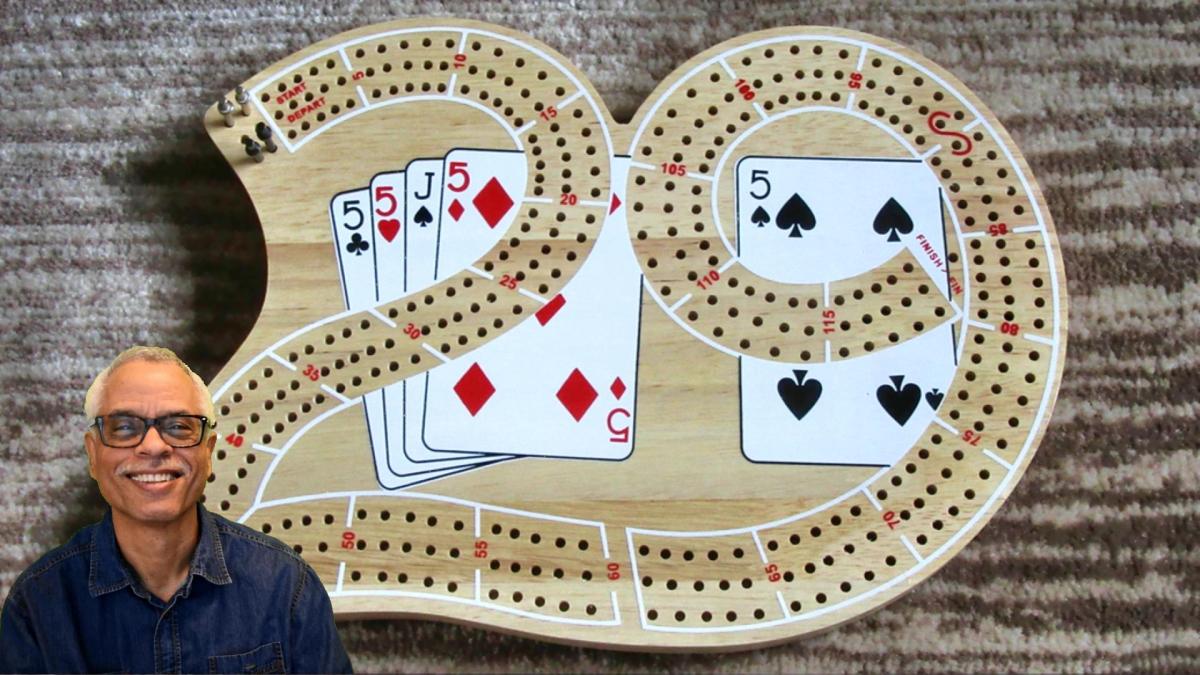
We prefer a jumbo board (bigger numbers and pegs), but have played on one shaped like the number 29, the highest score you can make. The odds of getting that hand score are 1 in 216,580. You want to keep playing just to see if you ever get it. You’ll have a lot of fun on the quest.

It might also be a way to foster congeniality in society. We sure need it.