Balancing Act

I read the CDC web page on what kind of exercises are best for those over the age of 65. It mentioned that the one leg balance should be part of the routine.

I also read the article about what it means if you flunk the one leg balance test. If you can’t balance for 10 seconds, it means there’s a chance your mortality might be significantly higher. According to the recent study about it, it doesn’t prove cause and effect, but it’s a marker about our overall health we should pay attention to.

I exercise most days and I was reasonably confident I could ace the one leg balance test.

Much to my surprise, I was pretty unsteady and even after several tries, I often came close to falling over. I was a little embarrassed and wondered if I had one foot in the grave. Sena tried and fell over.

But then I searched the web and found a number of articles suggesting that having trouble with the one leg balance task might be due to weak ankles.

In fact, my ankles wobble quite a bit when I try to balance on one leg. My wobble is worse on my left ankle. That can happen, according to one writer. Just like you can be right-handed and clumsy with your left and vice versa, that can happen with your legs.

There are all sorts of web articles with advice on helping you strengthen feet and ankles. I saw one on a site called Eldergym in which the author made a suggestion that rang a bell. Try sticking a post it note on the wall in front of you and focus your gaze on it while standing on one leg.

And that reminded me of a Judo class I took when I was a boy. Warm-up exercises included balancing on one leg while grabbing your other foot and rolling it around to work some flexibility into your ankle. Many of us in the class fell over a lot while trying to do this. That improved after the instructor told us to fix our gaze on a single point while balancing. It magically got a lot easier to do.

I can still put on a sock while balancing on one leg, just by focusing on one spot on the floor. I didn’t think I would find anything on the web about that, but there is a web page about it. The language gets a little technical about the explanation on how this trick works, but it has a lot to do with things like the vestibulo-ocular reflex.

I notice I can stand on one leg a little longer when I stare fixedly at a clock’s sweep second hand. But I still wobble. I guess I’ll be adding the one leg balance to my exercise regimen.

I think the argument that the inability to stand on one leg can mean more than one problem might be causing it. It’s associated with a number of issues including brain, heart, and other systemic diseases, and even higher mortality. But it can also mean that you have weak ankles from making a habit of sitting at a desk writing blog posts over a long period of time.

Maybe that gives us a more balanced view of the one leg balancing act.

This video plays pretty well with Sly and the Family Stone song “Stand!”

Factual or Fictional or Felgercarb

I’ve been watching a couple of shows about Alaska that are pretty much Bigfoot tales. One of them is The Alaska Triangle and the other is Alaska Killer Bigfoot.

And when I looked on the web to find out more about the TV shows, I learned a new word, “Felgercarb” (alternate spelling “felgercarb”). It means “crap” and I read that it originated from a 1978 Battlestar Galactica episode. The word was used by a reviewer of The Alaska Triangle. He called the show felgercarb and it obviously means he had a low opinion of it.

Incidentally, I never watched Battlestar Galactica.

I remember an English professor in Texas who made it clear that fact and fiction were not distinguished from each other by simply saying that fiction is anything that is not true. After all, fiction can be about the truth in various contexts, such as science (as in science fiction), and social and economic forces. And facts are mathematical and scientific data including formulas and historically verifiable events.

On the other hand, felgercarb is distinguished from facts and fiction by being notable for being non-satirical, non-parodical writing or performances—and by being unconvincing, amateurish, and—crappy.

Just to clarify, the Bigfoot show Mountain Monsters, which I think is a parody of all the Bigfoot shows, would not be classified as felgercarb, mainly because they obviously are making fun of the Bigfoot sagas.

Anyway, both of the Alaska shows have been labelled as felgercarb (whether they use that name or not) by a significant number of viewers. I acknowledge that a lot of people like them.

One reviewer of The Alaska Triangle who identified himself as living in Alaska all his life said he had never even heard of the Alaska Triangle.

Supposedly, a lot of people have disappeared in the Alaska Triangle, the borders of which connect Anchorage, Juneau, and Utqiagvik (formerly Barrow). Bigfoot is not the only cryptid people claim to see. One bus driver says he saw a dinosaur cross a road, specifically a velociraptor, that scientists say has been extinct for about 75 million years. No tourists on the bus saw it.

This prompts the question, why did the dinosaur cross the road? Because chickens didn’t exist yet.

Actually, the question is why didn’t the bus driver snap a cell phone picture of it? Because he didn’t want to get cited for distracted driving.

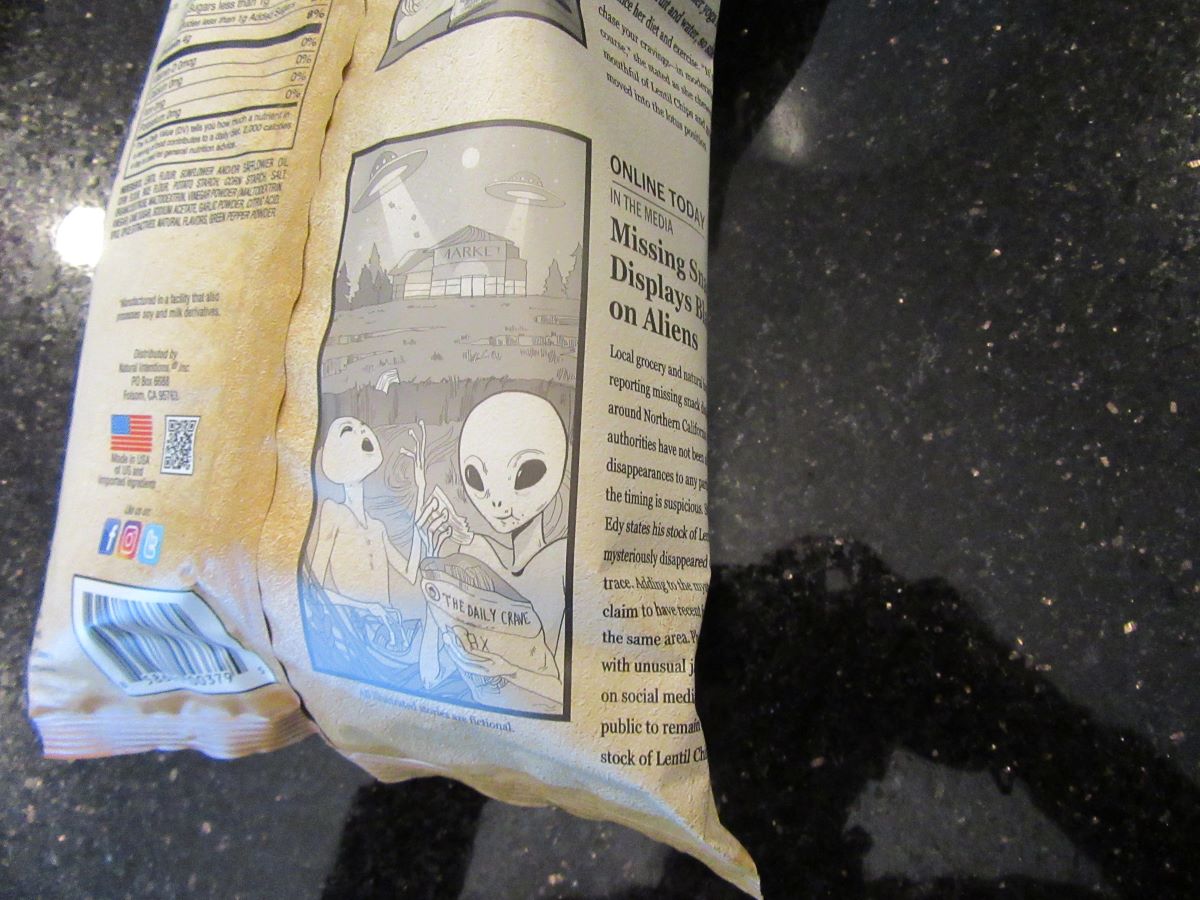
Another wild story on The Alaska Triangle is a circle of mutilated animals found far from any body of water. Why the connection to water? Because one of the animals was a whale. I guess the whale was in the middle of evolving and growing lungs. Sorry, actually it was accidentally dropped from a flying saucer driven by a distracted alien scrolling for barbecue blubber recipes on his cell phone.

I guess nobody’s heard of the Iowa corn mutilation phenomenon. Every year there are reports of several ears of corn completely denuded of kernels found near cornfields. Only the cobs are left. Weirdly, explorers and paranormal researchers often don’t find them in circles, but in terrifying little piles, not uncommonly surrounded by savagely ripped beef jerky wrappers and beer bottles completely drained of all liquid.

The Alaska Killer Bigfoot is even more mystifying—or stupefyingly felgercarbish. The explorers are investigating a place abandoned many decades ago because a special breed of Bigfoot monster called Nantinaq slaughtered people and knocked over the clothesline poles, making it impossible to dry overalls and flannel shirts.

The explorers on Alaska Killer Bigfoot occasionally barf for the pleasure of viewers. Maybe it’s the Nantinaq effect or spoiled beef jerky; it’s not clear which is more likely. It’ll have to await further study by various guest experts like spirit mediums and elderly Bigfoot experts.

Buoys somehow get into the tops of trees and holes mysteriously get dug where explorers find ancient coins, which they fail to clearly identify and maybe wonder if they can buy beer with them.

I wonder if Tony Harris, host of the show The Proof is Out There, will travel to Alaska and investigate Nantinaq or the inland whale circles. That show tends to retain some skepticism and usually errs on the side of saying something is unknown rather than saying thing like “Bigfoot has been proven to make infrasound” noises.

You know, so far nobody on the Alaska Killer Bigfoot took advantage of what might be a fact of infrasound, which is that it can nauseate people and possibly make them barf.

Oops, I just made a contribution to felgercarb.

Covid-19 Vaccine Immune Response to Omicron Wanes According to NIH

According to the National Institute of Health (NIH) the current Covid-19 vaccine booster elicits a robust immune response, it wanes quickly against the Omicron variant.

Exercise for Brain Health

University of Iowa research shows that exercise could help for protecting us against Alzheimer’s disease. After age 65, our risk for this category of dementia doubles every 5 years.

Even if scientists develop effective and safe senolytic compounds that could allow us to live to be 200 years old, that won’t be happening in the near future. There’s another way to help prevent Alzheimer’s disease.

Exercise can lower the risk for Alzheimer’s disease, especially some form of aerobic exercise.

When it comes to exercise, any exercise is better than none.

Hot Water Heater Out, Cold Showers In

Our hot water heater went kaput yesterday and I’ve now endured the only 2 cold showers I’ve ever taken in my life that I can recall.

Sena will be doing sponge baths, even though I’ve told her cold showers are great, easy, and healthy. Her hesitation might have something to do with my screams while I’m in the shower. The neighbors called emergency services yesterday, but now they probably know the story.

It’s strange how hot water heaters can just plain fail, especially on a Friday when the plumber is booked until late Monday afternoon. When I told the scheduler I would be more than happy to donate every single one of my cribbage awards to their company (which number exactly zero at last count), she just chuckled. When she told me our water heater was “out of warranty,” it didn’t surprise me and made me wonder if I would be taking daily cold showers until the day I die (meaning in about one week given my current level of recurrent hypothermia).

My cold shower method is the jump-in-yikes-out approach. Sena hauls me out in a wheelbarrow to unthaw me in the refrigerator—body part by body part.

In fact, there’s some evidence that cold showers are actually healthy for you, provided you don’t die of cold shock. Believe it or not, a cold shower drives blood flow from your skin to your internal organs. I don’t think that includes your brain, mainly because I don’t think you could pay me enough to stick my head into the freezing water which would turn me into a Jimbo-cickle.

On the other hand, there’s not a wealth of scientific evidence that cold showers are always good for you. On the other hand, it may be good for your immune system and circulation. Consult your doctor if you have cardiovascular disease. Cold showers can shrink your blood vessels. They can also shrink other parts of a guy’s anatomy, if you know what I mean.

Hey, did you know that Chuck Norris’ balls make cold water shrink? You get my drift.

This is not the first time we’ve had problems with a hot water heater. A few years ago, in a different house, the water heater developed a leak around the base. This is supposedly something the homeowner can deal with.

You get my drift. You might think you’re lucky this is the age of YouTube and you’d be partly right. However, I found a number of do-it-yourself videos in which different consultants had slightly nuanced approaches to checking and maintenance of hot water heaters. Watching several videos and getting the gist of the steps is what ordinary people probably do if they do this at all.

Is there only one way to check the Temperature Pressure Release (TPR) valve? Do you always have to shut off the gas line valve or can you get by with turning the thermostat knob to the pilot setting?

Should you really watch that MythBusters episode in which there is a very explosive example of how the wrong procedures in hot water heater maintenance can lead to very deadly consequences? No kidding; a couple of experts recommended it.

I gotta tell ya, I can do without the “guttural thud.”

Anyway, start to finish, the project of checking for leaks around the drain valve and the TPR valve, getting the garden hose and hooking it up to the drain valve after shutting off the cold-water valve, turning the thermostat to pilot, draining the 50 gallon tank (don’t forget to turn on your hot water faucets to help the process along!) to see tea-colored water briefly which cleared quickly, and reversing the steps, with a total time of about 2 hours including clean up and shazam—the leak was not fixed.

That’s why I call a plumber. And I’ll be keeping track of the number of cold showers I take.

Do You Get the Zoomies or the Zennies?

Does your pet dog, cat, or sloth ever get the zoomies? We don’t have pets; I just read about animals getting the zoomies the other day. It’s an interesting phenomenon. Right after a bath, a dog might race around the yard, getting all dirty again. They look like they’re having great fun and veterinarians say it’s harmless.

It would be great if we could catch a sloth with the zoomies. Not only would that be a first for zoology. Maybe it would outrun the fungus and other parasites growing on its hair, making it easier to gather by scientists. Some of that stuff might have potential for use in developing medicines for humans.

Other animals including those in the wild can get the zoomies, and some version of it might be done by Springbok antelope, although it’s called pronking. They just run around and leap, maybe for no apparent reason. Some claim that dogs occasionally pronk, but I wonder if it’s just a special case of the zoomies.

The veterinary term for zoomies or (and maybe pronking) is Frenetic Random Activity Periods (FRAP).

Technically, I don’t think humans get the zoomies although some would debate the issue.  Many of us try to do the opposite, especially nowadays. One example is mindfulness, which I’ve been doing for the last 8 years. It’s difficult for me to describe, but you’re really not trying to do anything, not even trying to relax, per se.

But I try to be still and notice whatever is unfolding, nonjudgmentally. It’s a little hard not to scratch that itch right next to my temple. I’ve seen on the web that some people call it the zennies—maybe we could call it Focused Regular Awareness Periods (FRAP).

I guess dogs and cats enjoy their brand of FRAP, or at least it looks that way. It’s really hard to tell what’s going on if you just watch people doing the human brand of FRAP. Sometimes they just look like they might be asleep—which occasionally happens.

Zoomies or zennies; could they be different paths to the same place?

FDA Advisory Committee Approves Adding Omicron component to the Next Covid-19 Vaccine

On June 28, 2022 the FDA Vaccine and Related Biological Products Advisory Committee came to a majority “yes” vote to the question:

“Does the committee recommend inclusion of a SARS-CoV-2 Omicron component for COVID-19 booster vaccines in the United States?”

The meeting was recorded and is available for review.