Here’s an update on front-yard and back-yard birds, doing what birds always do in the spring–nesting. There were still only two cardinal eggs in the nest as of last Wednesday. There are no robin eggs in the nest; they would be blue. The parents are still pretty fussy (click on the images to see them better).
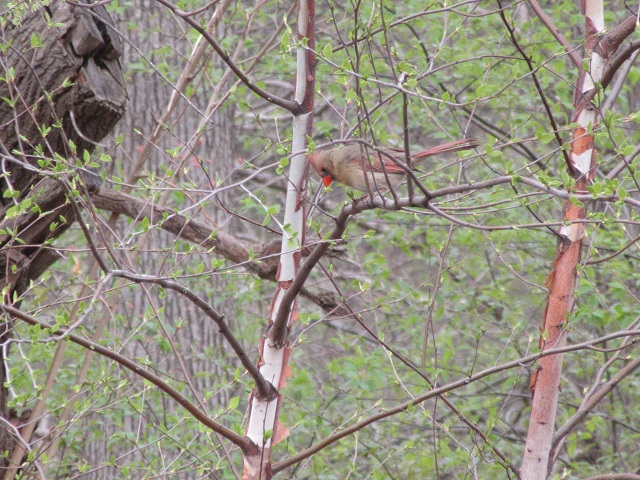
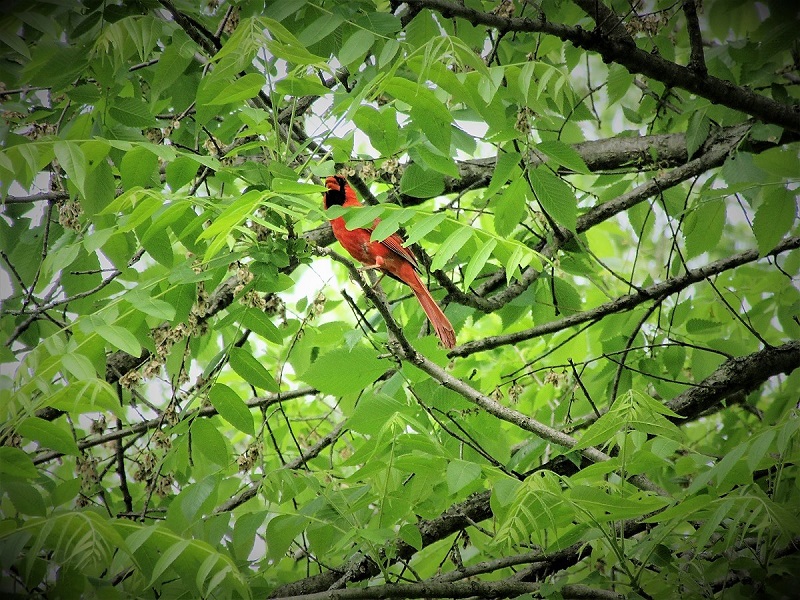
Mama Cardinal
Papa Cardinal
The front yard juniper (I guess it’s a juniper; it’s a skinny
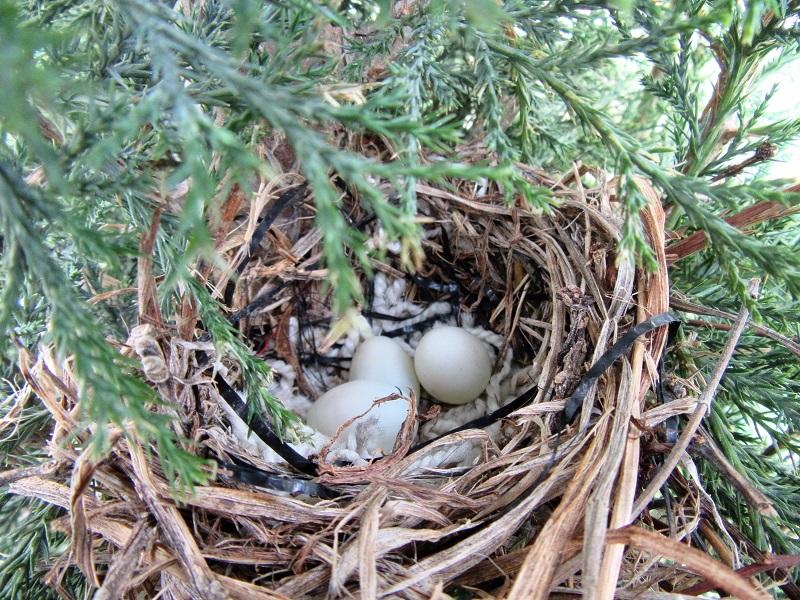
evergreen) has a Hoorah’s nest with 3 white eggs. The parentage of the eggs is
tough to figure out so far.
I’m not sure what’ll hatch out of those eggs. The nest itself is pretty messy for a chipping sparrow. It’s loosely woven and has bits of what looks like white textile fibers strewn around the nest and scattered on the tree branches just outside. It’s about 5 feet off the ground.
Mystery eggs
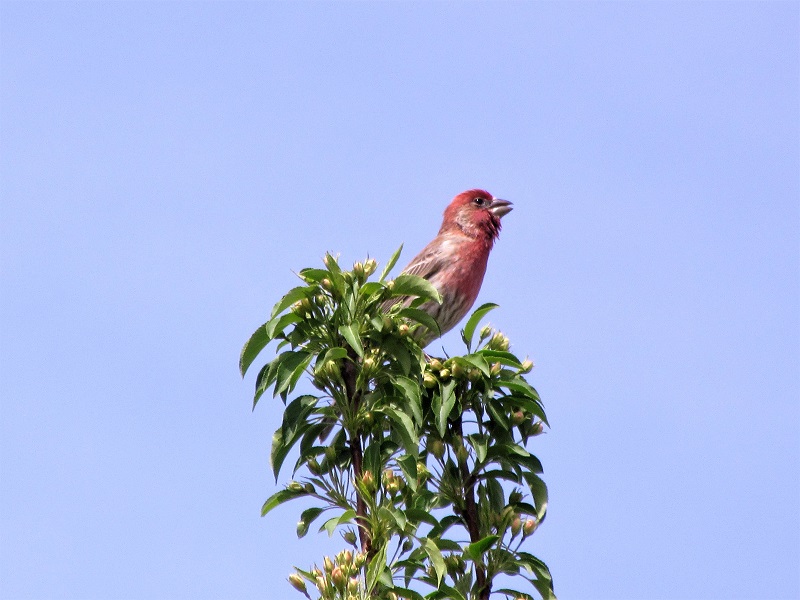
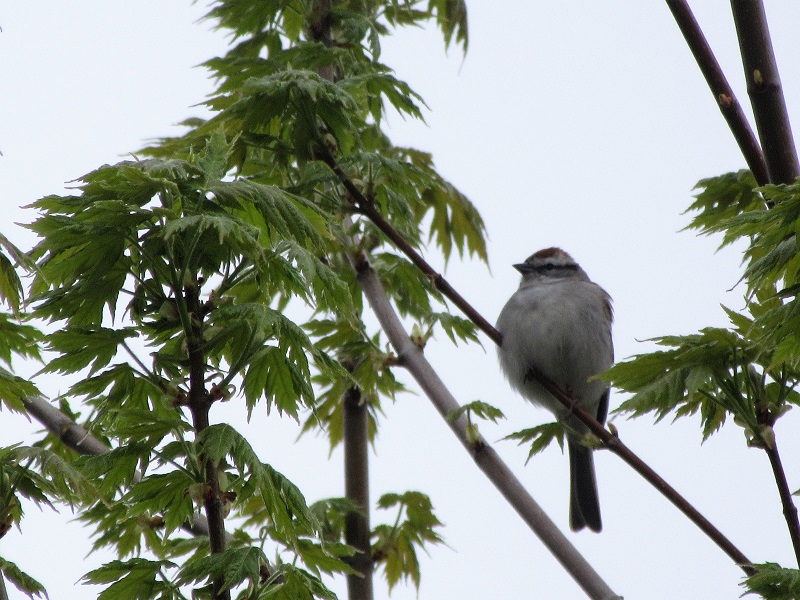
I’ve seen a male house finch and what looks like a female chipping sparrow hanging around the nest. They both look like they fly out of the juniper when I approach. I’m no expert but I doubt house finch males are that promiscuous. They both fuss at me, but from different trees.
House finch male
Chipping sparrow?
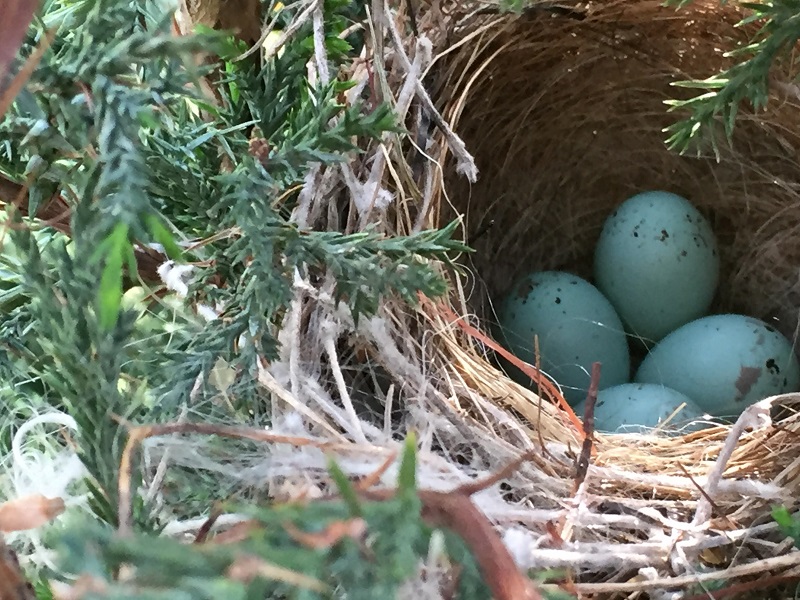
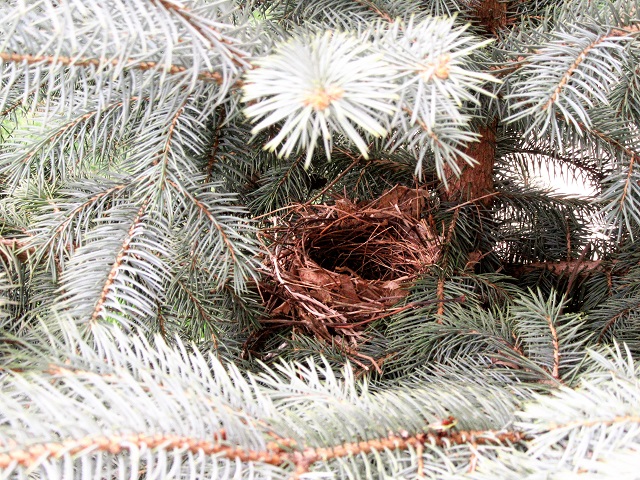
The eggs are non-descript. They don’t look like the chipping sparrow eggs we had in the spruce tree right next to the juniper about two years ago. Those eggs were definitely blue and the hatchlings were definitely sparrows. The only thing in that spruce now is what looks like it might be last year’s nest, from what I don’t know.
Chipping sparrow eggs
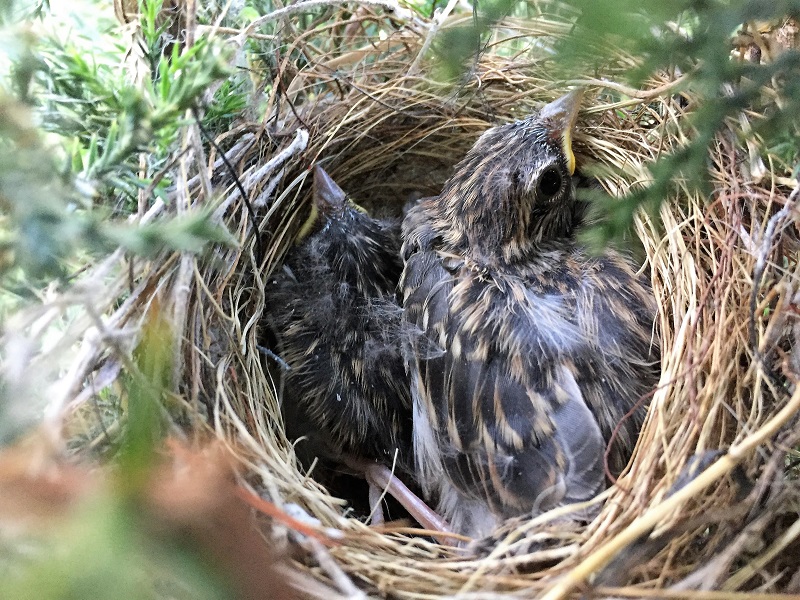
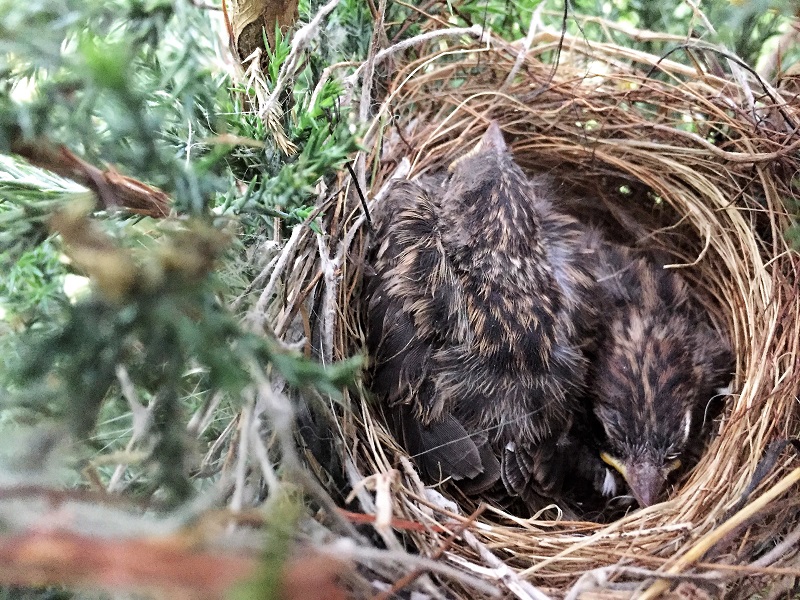
Chipping sparrow chicks
House finch eggs are usually “pale blue and lightly marked”,
according to my Birds of Iowa Field Guide by Stan Tekiela (2000). Lightly
marked with what? Don’t think about it.
I’m not sure what to think about our cardinals. We saw the egg cache go from two to three—than back to two in the same day. No kidding, the nest gained a third egg in the morning and lost it in the afternoon.
Three eggs…
And then there were two…
I looked all over the ground and couldn’t find it. Before
that, I was hunting around the web trying to learn more about cardinals and
discovered that robins and cardinals will sometimes lay their eggs in the same
nest. It’s not always clear why this happens, maybe competition or mutualism.
Maybe they’re just swingers.
There was an article published about nest-sharing between
cardinals and robins several years ago, published in The Wilson Journal of
Ornithology. The authors observed cardinals and robins sharing a nest with
mixed eggs in Polk County, Iowa of all places. Iowa is a happening place. Both species
incubated the eggs; however, only the robins fledged.
“Govoni, P. W., et al. (2009). Nest Sharing Between an American Robin and a Northern Cardinal, BIOONE.
Mixed-clutch nest sharing was observed between an American Robin (Turdus migratorius) and a Northern Cardinal (Cardinalis cardinalis) in Saylor Township, Polk County, Iowa in May 2007. The nest contained three American Robin eggs and two Northern Cardinal eggs, but only American Robin young were fledged successfully. This was not a case of brood parasitism, as both females were observed alternating incubation of the nest. Competition for desirable nest sites might be a possible cause for this type of interspecific behavior.”
Others speculate that robins will eat cardinal young. I’m not so sure about that. Based on what little I found on the web about it, it’s controversial whether robins actually raid cardinal nests to eat the eggs. They rarely will eat shrews and small snakes. Like me, they hate coconut. They eat a lot of chokecherries, often after they’ve fermented into wine, on which they get pretty drunk and could play pranks on cardinals (“Hey, let’s go cardinal-tipping and steal some eggs!”).They sure like worms and follow my wife around as she waters the lawn, snacking on them as they emerge from their flooded tunnels, gasping and frantically hunting for their flood insurance policies. They also ham it up for the camera.
Robin hamming it up and probably three sheets to the wind.
My wife has spied a robin or two flying around the back
yard. It raises questions about competition because robins nested and raised a
brood last year in the same tree and in the exact same spot where the cardinals
are settled this year.
It’s hardly prime real estate in my opinion. We’re always
out in the back yard, making noise and flinging water and grass clippings. And
we’re continually nosing around the nests, which makes the adult birds pretty nervous
and fussy, putting up Do Not Trespass signs and privacy fences.
If robins ate the third egg, they had excellent table
manners. There’s no trace of shell or yolk anywhere. I wondered if the cardinal
had carried off one of the eggs out of impatience with our continual spying on
their nest. But how? The eggs look too big for a bird’s beak. Can they carry it
in their feet? Or do they own luggage?
And where would they take it? I supposed it’s possible they
could be taking it to another nest they previously built—but it would be
occupied by a previous brood. Cardinals nest more than once a season; the male
feeds the young while the female builds another one, according to Birds of Iowa
Field Guide by Stan Tekiela (2000).
I have no idea what’s going on with these birds. I’ll keep
you posted as the situation develops.
Well, we missed Earth Day this year, which fell on April 22nd. The theme was to protect threatened and endangered species. One excuse is that we’ve been too focused on the cardinals building a nest in our back yard this spring. They are neither threatened nor endangered. I would call them fussy, especially when we get too close to the nest in our evergreen tree.
My other excuse is that April 22, 2019 was the day I had my
last official work-related CPR recertification. It’s valid for two years but I’ll
be retired next year. CPR is very important and I take the class seriously. I
always seem to have a problem getting the bag mask tight enough on the
mannequin’s face to get a good breath in.
This year there was an electronic device to monitor the
quality of your chest compressions. It lights up green to let you know when they’re
adequate. Orange lights means you have to fix your technique. That was new for
me and I was probably not letting up enough to let the heart fill. Imagine
that. I’ve probably had poor technique for years.
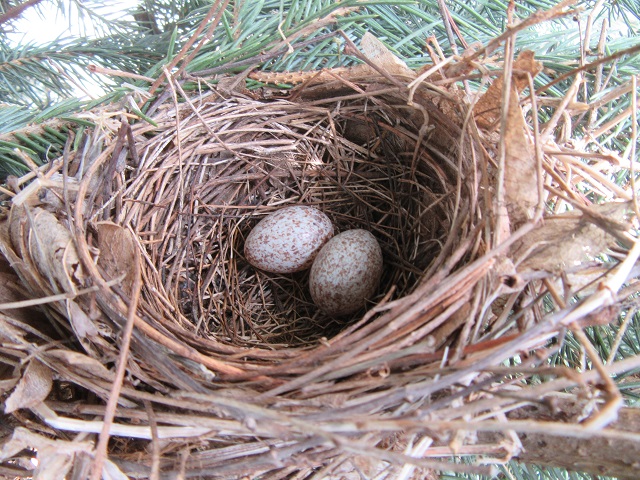
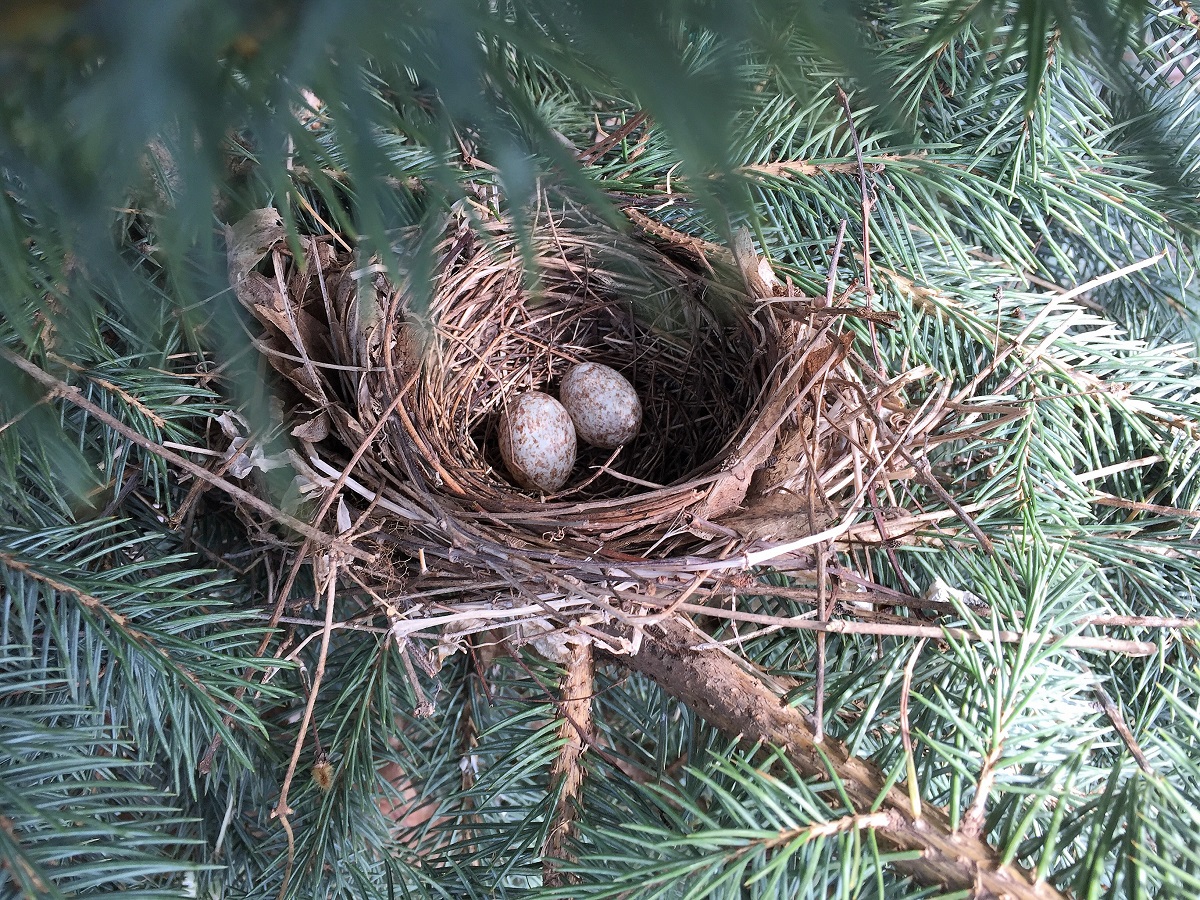
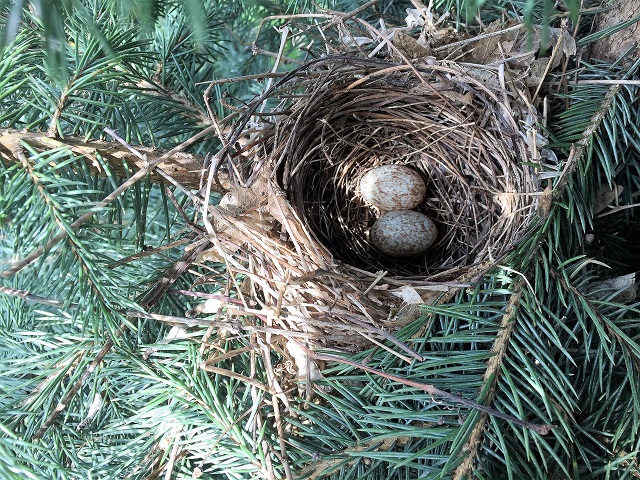
Getting back to the cardinals, we’ve noticed that there are two eggs, off white with brown speckles. We’ve never seen eggs like that and we can distinguish them from the eggs of robins and chipping sparrows. The cardinal parents chirp pretty loudly at us whenever we get too close to the tree.
Northern Cardinal eggs…we’re pretty sure.
Also, it’s Hosta planting time in the back-yard garden, a
job my wife does because my form with a shovel is just as bad as my chest
compressions and bag breathing on the CPR mannequin.
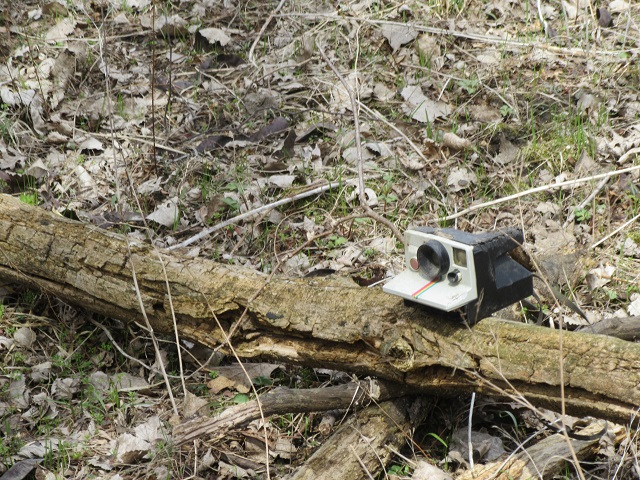
Last year, we got out for Earth Day and I found an old polaroid camera while we were out on the Clear Creek Trail. I’m not sure how harmful it was to the environment. Judging from its condition, the environment was more harmful to the polaroid.
Polaroid in good condition.
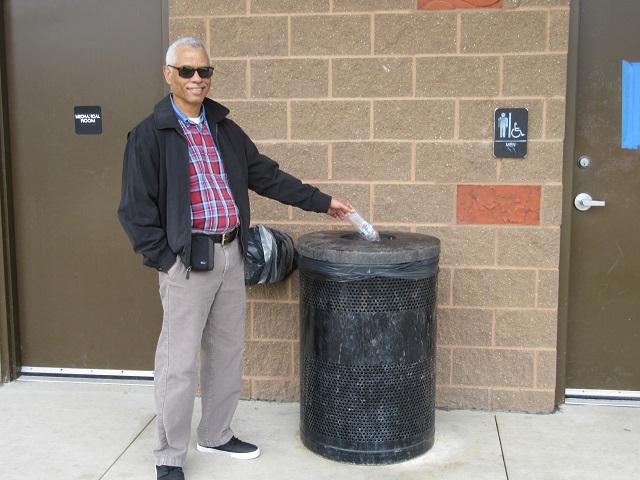
On the other hand, we did spot a plastic bottle, which is harmful to the environment. We did the appropriate thing by dropping it in the proper trash receptacle.
Plastic goes in the trash.
Today is National DNA Day, which celebrates the discovery
and understanding of DNA and the scientific advances that understanding has
made possible. About the only thing important to me about it is that there are a
few things that are definitely not in my DNA:
Cooking—unless it’s sticking a frozen pizza in the oven.
Planting Hostas.
Bag breathing the CPR mannequins.
Reading, listening to, or watching political news.
Eating shredded coconut.
Sitting in a psychiatry outpatient clinic, waiting for no-shows.
Waiting in airports.
Shopping for anything.
Removing or spreading mulch.
It’s an incomplete list, of course. Happy DNA Day!
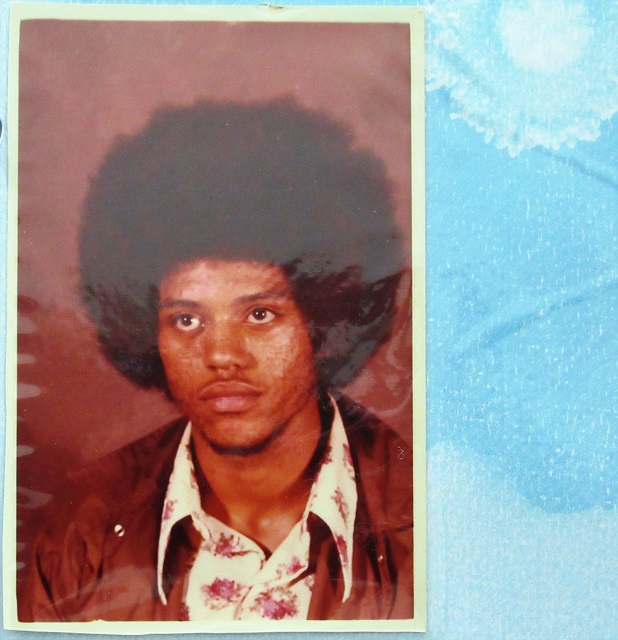
Sometimes I think about my brother Randy, who died 19 years ago. His last days were made immeasurably easier by the caring staff at Hospice of North Iowa. He worked at a local artificial ice company for many years. He died when he was 43 of cancer, before either of our parents died.
Jim Amos
Randy Amos
He will always be remembered for his generosity, kindness,
and infectious sense of humor. A sense of humor ran in the family, despite hardships.
He had a raw, honest, and often boisterous passion. We treasure everything he
gave us.
Even the courageous way he let go of his life was a gift. He
died as he lived, in the arms and in the hearts of the people who loved him.
I learned a valuable lesson about that. On his last day in
the hospice, I was determined to be with him up to the moment he died, staring
down death in his face. I’m still not sure why I wanted to do that.
Then a couple of his long-time friends stopped by to see
him. Death watch was interrupted as we visited in his room. I faced them, reluctantly
taking my eyes off him. They talked to me, sharing their memories of him while
he was alive. I soon became painfully aware that there were many who knew Randy
in ways that I did not know. He was a dear friend and even a surrogate father
to many.
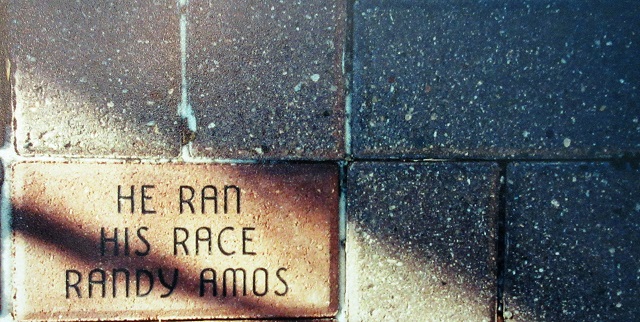
They talked; I listened and learned. I lost track of the time. When there was a break in their discourse, I quickly turned back to Randy. He was already gone. He had slipped away while his friends, his other family, were sharing something with me far more important than my death watch. I learned more about humility that day than I can recall learning ever since. There is a brick in the driveway of Hospice of North Iowa on which is etched the message, “He ran his race.”
Randy was a track man in school. He could outrun just about
anyone. He was also pretty fast on his gold flake Schwinn Stingray bicycle. I
notice there are vintage Stingrays going for thousands of dollars these days. He
could fishtail and wheelie like nobody’s business.
My father used to say that the only difference between me and Randy was that he could cook and I couldn’t. There were a few other differences.
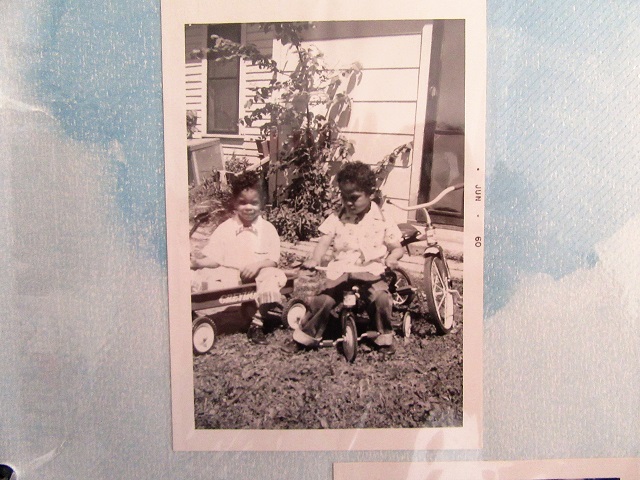
Jimmy and Randy (I’m in the wagon)
Through an unfortunate circumstance that I still don’t
understand, Randy was my patient on our Medical-Psychiatry Unit in the late
1990s, shortly after he was diagnosed with cancer. I would never have done this
by choice, but it seemed there was no one else to cover the unit at the time.
He was delirious, probably from an accidental overdose on
opioid pain medicines during a difficult stage in his cancer treatment. It’s
really not possible to describe the conflict I had about being both his brother
and his doctor. It should not have happened—but it did. He didn’t recognize me.
He mumbled. He twitched. He drifted in and out of awareness. I knew all the
signs; I saw delirium every day in the hospital.
But this was different because this patient was my brother.
I will never forget. After that, I had a much better understanding of what
families goes through when they witness delirium in a loved one. I will not
miss this part of my job when I retire.
Randy was my best man at my wedding in 1977. I bought him a nice
pocket watch, which was buried with him. I do not visit his grave not because I
don’t love him, but because I would rather remember him as he was.
My wife and I spent a few months living in Madison,
Wisconsin back in 2008. I had taken a new job as a psychiatrist there. It was
the second of two blunders moving from academic medicine to private practice,
the first being a move to Illinois, also very short-lived.
We really liked Madison and sometimes dream of moving back
there after I’ve retired. It’s an interesting city with many sights to see and
things to do.
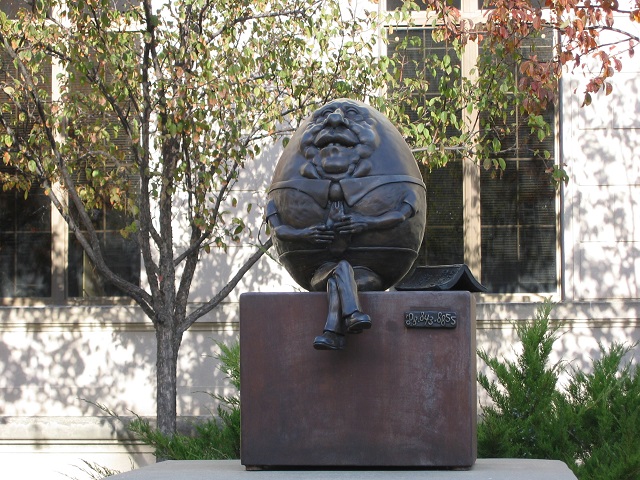
One of the interesting sights we saw was a mysterious bronze sculpture that I’ve only just today found the explanation for. It looks like Humpty Dumpty of the familiar nursery rhyme and riddle. I found out a lot more about Humpty Dumpty and his odd brother Harry Dumpty, who is actually the subject of the sculpture found in front of the Madison Municipal Building just south of the intersection of Martin Luther King Jr. Boulevard and East Doty Street.
Harry Dumpty
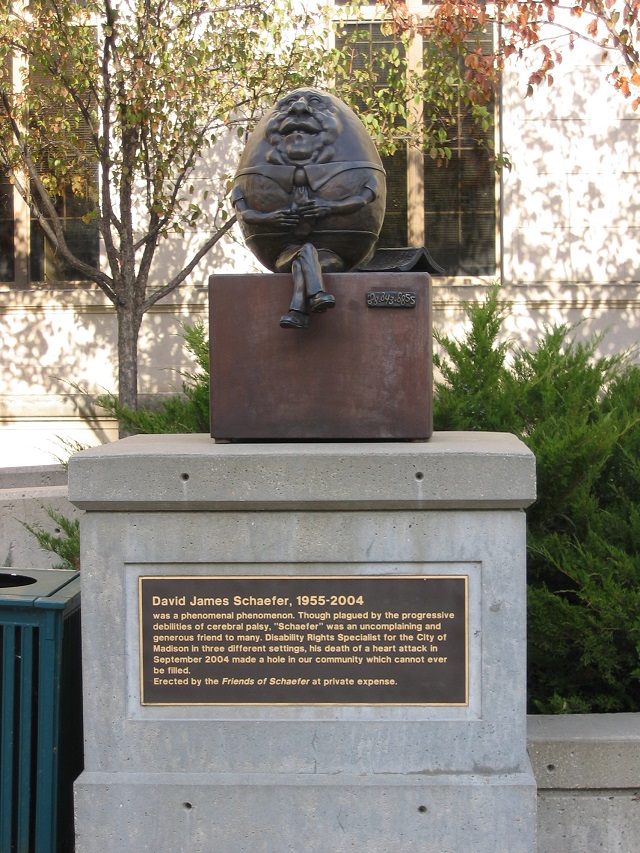
I never knew the sculpture was Harry Dumpty. It sat above a
large concrete wall with an inscription on it which I just assumed was
connected to the sculpture and probably still sits there although we couldn’t
find it in 2012 when we returned for a visit:
“David James
Schaefer, 1955-2004
was a phenomenal phenomenon. Though plagued by the
progressive debilities of cerebral palsy, “Schaefer” was an
uncomplaining and generous friend to many. Disability Rights Specialist for the
City of Madison in three different settings, his death of a heart attack in
September 2004 made a hole in our community which cannot ever be filled.
Erected by the Friends of Schaefer at private
expense.”
It turns out Harry Dumpty has no connection to David James Schaefer. In fact, Harry is one of several similar sculptures created by artist Brent George, who made him in 1997, saying he’s Humpty’s brother. If you look closely at the book sitting open next to Harry, it’s entitled “Harry Dumpty.” Brent George’s name is below it. Brent’s phone number is on the front of the wall. Evidently somebody called him and asked about the sculpture. Brent says there’s no connection between the sculpture and the inscription.
A copy of Harry Dumpty sits outside of the Dekalb Public Library in Dekalb, Illinois. Brent moved from there to Madison, Wisconsin. In the local online newspaper, the Daily Chronicle, news editor Jillian Duchnowski wrote a couple of stories about it in 2014 which eventually led to the proposal of a contest to find a rhyme for him similar to Humpty’s. I couldn’t find the results. One newspaper speculated that Harry is less well-known because he never fell off a wall.
In the online news website, Isthmus, a staff writer named David Medaris wrote a few paragraphs about Harry in 2008, which we somehow missed back when we were first learning about Madison. Medaris comments that this kind of irreverent art is common in Europe and is a marker for cities where “…people who have a sense of humor live with gusto.” He identifies Brent George as the artist but never mentions David James Schaefer.
There has been a lot of speculation about deep political and
scientific meanings for Humpty Dumpty, but it’s likely just a nursery rhyme and
riddle.
On the other hand, there’s very little written about Harry
Dumpty. If anyone knows the results of the Dekalb, Illinois poetry contest
mentioned above, please let me know.
I’m off service for a while, which means I have more time for birds. Right now, my wife and I are trying not to spook the cardinals. It looks like they’ve finished the nest and we’re waiting for the eggs.
This will be the first time we’ve seen cardinals nesting in our yard. It’s a little strange, because the cardinals chose the same evergreen tree as the robins did last year.
The robins built a pretty sturdy nest but the cardinals just threw one together. It looks pretty flimsy.
A couple of years ago, chipping sparrows raised chicks in one of our front yard evergreen trees. They were cute.
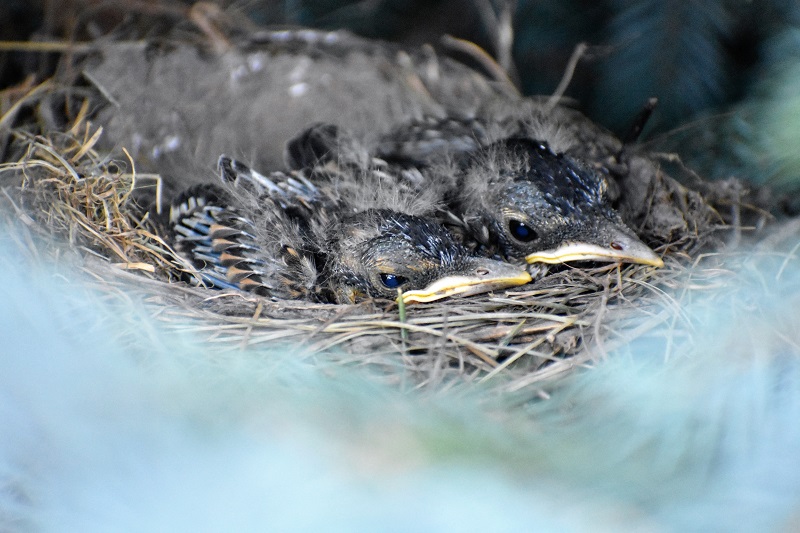
But the baby robins looked like little dinosaurs.
I imagine the new cardinals will look pretty scruffy.
The cardinal nest is pretty much done—no eggs yet, though. At least we think it’s a cardinal nest. It looks typical according to experts; loosely woven of twigs, leaves, stucco, and ponderosa pine accents. They’re pretty fussy about us snooping around the backyard evergreen tree they chose to build a home in.
Any day now, we’re hoping to see a clutch of eggs, bluish
white with brown markings. Or maybe pale green with brown-lilac spots. Or
possibly whitish to pale bluish or greenish white, marked with brown, purple,
and gray. Or Hawkeye black and gold. It all depends on which guidebook you read,
I guess.
I’m gradually getting back into bird watching and spending
less time with my head at the hospital (“Earth to Jim!”). Doctors learn to
spend all their time either on the wards or in the clinic. It reminds me of a
couple of scenes from Men in Black (MIB) II.
As Agent J walks into the MIB complex at Battery Park, the
elevator dude says “Don’t you ever go home? Agent J says “Nope.”
Later he drops into Zed’s office and asks, “What you got for
me?”
Zed replies, “Look. See those guys in black suits? They work
here. We got it covered.”
That’s how physicians can get after years of acculturation
into the driven doctor model. Often enough, I take most of the work away from
the trainees, when they’re not looking. And I take my work home—that’s called
pajama time.
Hey, those dudes work here too. I have a tendency to see
myself as almost indispensable, which makes it hard to envision retirement at
times.
I have to keep reminding myself that I’m not the only doc who can do my job. The next generation of doctors are eager and ready. They deserve a chance. But I sometimes catch myself telling old war stories about how hard it was when I was a resident or a junior attending.
“I remember when I had to walk 40 miles to work in the driving
blizzard alternating with blazing heat (it’s Iowa) to get to my 6 x10 foot
office in the basement to stoke the fire in the pot-bellied stove for coffee
and grits at 4:00 in the morning, before the damn birds even get up, milk a few
dozen cows in the atrium, chase the pigs out of the operating rooms and then go
see about a hundred or so consultations before 7:00 in the morning I tell you, then
write notes until midnight, be on call until 3:30 the next morning and do it
all over again. What do you guys know about work?”
I may exaggerate a little bit. Usually there weren’t that
many cows in the atrium.
It can be difficult to unwind from the physician’s
treadmill. But as time goes on, I look forward to seeing the birds build nests,
to see the brand-new eggs, the ugly chicks who look like little dinosaurs until
the feathers grow out. I can pay more attention to the world outside the
hospital, where the new doctors are stoking the fire.
I’m a big fan of the Men in Black movies. I’m not going to
tell you how many times I’ve watched them on TV (78 million and if that number
reminds you of a scene from Men in Black, you’re just as much a fan as I am, if
not worse). One of my favorite lines is when Zed says to Edwards, “Edwards.
Let’s put it on.” Edwards asks, “Put what on?” And Zed says, “The last suit
you’ll ever wear.”
Today, I asked my secretary to order some new white coats for me. I went down to the Uniform Shop and checked on it. All they need is the requisition and they’ll get it.
Since I’m retiring after this year, these are the last white coats I’ll ever wear. There’s no Zed to tell me that. The Uniform Shop staff person won’t know it when the coats arrive—unless I tell her, of course.
I found a very long, involved discussion on the web about the meaning of Zed’s “last suit you’ll ever wear” statement. All I got out of it was that some people take that movie way too seriously.
But for me the last white coat I’ll ever wear means exactly that. I’m going to wear the coat until I retire (in about 14 months according to the countdown)—and then I’m never going to wear white coats again.
I can almost hear certain persons snickering in the background. I suspect there may be a few bets about this retirement thing being another temporary leave-taking, like the times I left for private practice and came back, sort of like bringing Agent K back after neuralyzing him at his request. He really did retire—temporarily.
But nobody is going to neuralyze me. I’ll keep a lot of
memories about my time as a Consultation-liaison (C-L) Psychiatrist, even
though some of them are sort of like Agent K’s memories of being swallowed by a
giant interstellar cockroach.
However, that reminds me of a few thoughts I have about institutional memory. I’ve mentioned my concerns about being practically the only C-L Psychiatrist in a pretty big hospital and retiring. I’m a geezer, but I know a lot about the ins and outs and moving parts and what it means to be a one-man hit-and-run fireman psychiatric consultant in a large academic medical center.
Institutional memory…
Institutional memory has been defined as “the collective
knowledge and learned experiences of a group. As turnover occurs among group
members, these concepts must be transitioned. Knowledge management tools aim to
capture and preserve these memories.”
Institutional memory can also be characterized briefly as:
Accumulated knowledge, skills, “this is the way we do things”
Some of it gets hardened into policies and procedures
Much of it “…resides in the heads, hands, and hearts of individual managers and functional experts.”- “How to Preserve Institutional Knowledge” by Ron Ashkenas, Harvard Business Review, 2013
Too much of anything for too long can be bad, including institutional memory
The bullet point that Ron Ashkenas makes above is relevant
to employers of baby boomers like me who know informal procedures, and have the
skills (and they chose us so they recognized the skills, so don’t be calling us
sport, feisty, hon, sweetie, or anything like that) and knowledge that’s in our
heads but may not be stored anywhere else.
That makes the baby boomer retirement phenomenon a real challenge. About 10,000 boomers will reach the age of 65 every day for the next 15 years. And most of us aren’t kidding around. There’s no way to just deneuralyze us to make us come back. You can’t make it happ’n Cap’n.
There are ways to package institutional memory into handy
things like mentoring partnerships, knowledge wikis, snappy videos (just shoot
the damn thing!) and other media that are easily accessible and geared for the
adult learner.
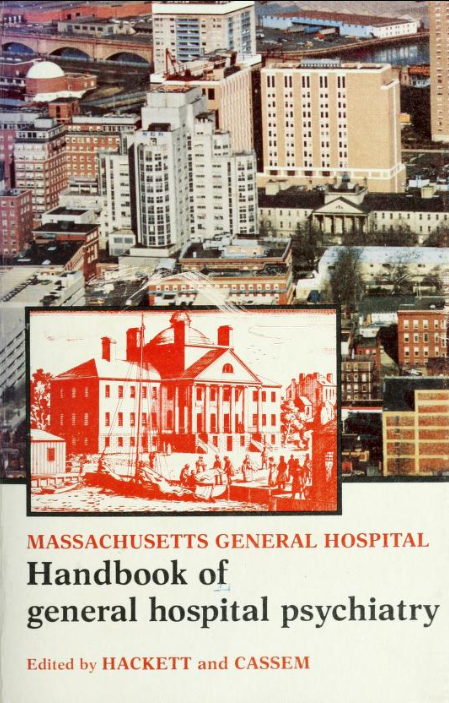
You can’t beat the Internet Archives for history. You can borrow and read the first edition of the Massachusetts General Hospital Handbook of general hospital psychiatry published in 1978, just like checking it out from a public library. Read the chapter, “Beginnings: liaison psychiatry in a general hospital.” You can learn from Dr. Thomas P. Hackett about the difference between a consultation service and a liaison service:
digital institutional memory
“A distinction must be made between a consultation service
and a consultation liaison service. A
consultation service is a rescue squad.
It responds to requests from other services for help with the diagnosis,
treatment, or disposition of perplexing patients. At worst, consultation work is nothing more
than a brief foray into the territory of another service, usually ending with a
note written in the chart outlining a plan of action. The actual intervention is left to the
consultee. Like a volunteer firefighter,
a consultant puts out the blaze and then returns home. Like a volunteer fire brigade, a consultation
service seldom has the time or manpower to set up fire prevention programs or
to educate the citizenry about fireproofing.
A consultation service is the most common type of psychiatric-medical
interface found in departments of psychiatry around the United States today.
A liaison service requires manpower, money, and
motivation. Sufficient personnel are
necessary to allow the psychiatric consultant time to perform services other
than simply interviewing troublesome patients in the area assigned. He must be able to attend rounds, discuss
patients individually with house officers, and hold teaching sessions for
nurses. Liaison work is further distinguished from consultation activity in
that patients are seen at the discretion of the psychiatric consultant as well
as the referring physician. Because the
consultant attends social service rounds with the house officers, he is able to
spot potential psychiatric problems.”—T. P. Hackett, MD.
By the way, have you seen my YouTube Channel? I’ve been beaming me up into educational videos for residents and medical students for a while now.
Next year I’ll be
doffing the white coat for good—but I’ll be on THIS planet.
Reference:
Hackett,
T. P., MD (1978). Beginnings: liaison psychiatry in a general hospital. Massachusetts
General Hospital: Handbook of general hospital psychiatry. T. P. Hackett, MD
and N. H. Cassem, MD. St. Louis, Missouri, The C.V. Mosby Company: 1-14.
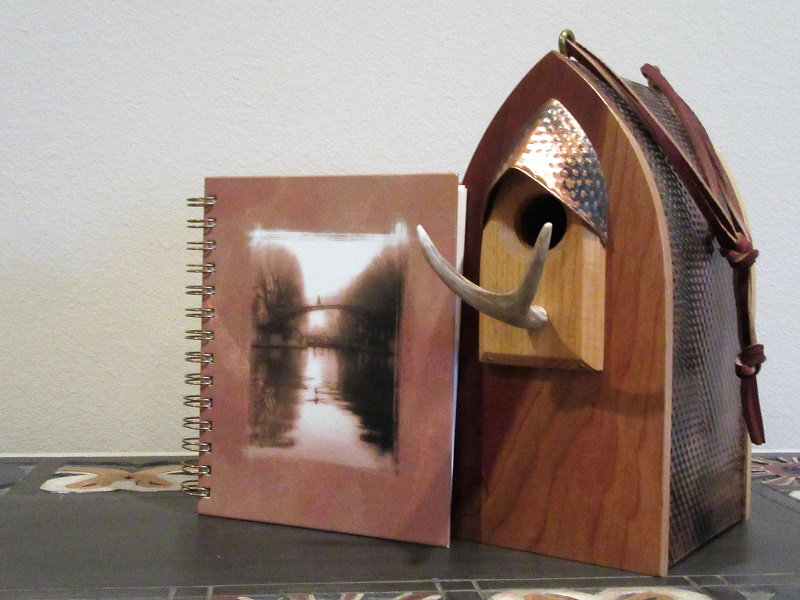
About 15 years ago, I left my position at the University of Iowa to work somewhere else. The spiral notebook with a picture of someone crossing a bridge and the fine birdhouse in the picture above were going away gifts.
There were many touching messages in the little book. Friends wished me well and reminded me to “Keep up on all the birds in your new neighborhood.” I was a birdwatcher then and I’m reaching back for that now.
One of them said, “I hope you find your new position to be everything you want it to be.”
I did not. I returned and everything I left was somehow changed. But I was the same old Jim. And later I left again–and again returned. And now the third leave-taking is approaching–retirement. I will not return. Maybe then my spirit will not be nostalgic.
OK, it was a long day on the general hospital psychiatry consultation service. This post is going to be short. I put 3.4 miles and 29 floors on my step counter today and I’m feeling every one of them right now. It’s almost 10:30 at night and I’m trying to find a way to end the evening on a high note before I hit the sack .
I found it by listening again to the University of Iowa Shortcoat Podcast (via Radio Public) interview with a former internal medicine resident I had the pleasure of working with, Dr. Keenan Laraway. He’s doing a Nephrology fellowship at the University of Pennsylvania.
The title of the podcast is “Night Float: Finding Mentors, Being a Mentor.” Although I’ve never thought of myself as a mentor, apparently Keenan thought I was one for him.
Dr. Keenan Laraway on mentorship.
Listen to the whole podcast, but just to feed my ego, won’t you please fast forward to about 10 minutes, 50 seconds and hear what Keenan has to say about Dr. Jim Amos?
It made my day. He gave me the highest compliment he can give anybody, which is that I think like an internist. He says that I taught him a whole lot about what it means to be a doctor.
That, more than anything, is going to be the hardest thing to leave when I retire.











 Go Retire Psychiatrist