An Auspicious Chair

I took the picture of the little chair one of the residents brought to the psychiatry consult office yesterday. I got a big charge out of it, especially because I’ve been using a version made of wood and leather for a few years now. I think it’s possible that it could be an auspicious chair.

The resident actually used his, too. It was a busy day; I put in about 4 miles and 40 floors on my step counter—which meant the residents did too. The chair is obviously useful to rest our feet, but I think Thomas P. Hackett summed up the best ever rationale for sitting with patients:

“As a matter of courtesy, I sit down when interviewing or visiting patients. Long accustomed to the ritual of making rounds, many physicians remain standing as a matter of course. Standing, physicians remind me of missiles about to be launched, poised to depart. Even if that is not necessarily true, they look the part. Patients sense this and it limits conversation. In addition, when standing, the physician necessarily looks down on the patient. This disparity in height is apt to encourage the attribution of arrogance. Looking down at a patient who is prone emphasizes the dependency of the position. Sitting at the bedside equalizes station. Sitting with a patient need not take longer than standing with him.”— Hackett, T. P., MD (1978). Beginnings: liaison psychiatry in a general hospital. Massachusetts General Hospital: Handbook of general hospital psychiatry. T. P. Hackett, MD and N. H. Cassem, MD. St. Louis, Missouri, The C.V. Mosby Company: 1-14.

I had a little fun with the chair in a YouTube video as well.

The chair I use now is a replacement for the first one I got as a sort of loaner from a colleague in Palliative Care Medicine. That one broke during a consultation visit with a patient and his family (circumstances disguised to protect confidentiality) in the emergency room in which we were asked to evaluate for catatonia. The patient was mute but there was little evidence otherwise for catatonia, one of the chief features of which is the inability to react to any stimulus in the environment. I was sitting on the chair explaining in detail the intravenous lorazepam challenge test for catatonia (which often interrupts the episode of muteness and immobility).

I was sitting in front of the patient but facing the family and the consult service trainees while expatiating on the topic. As I was droning on, I heard a sudden pop—and I fell unceremoniously on my rear end as the chair collapsed beneath me.

My audience exploded in loud laughter, of course, as you’d expect when a pompous ass falls on his ass. But they also pointed to the patient. When I turned to look at him, he was convulsed with apparent mirth although still unable to make a sound.

I considered this a novel test for catatonia, negative in this case. Of course, it would be impractical for regular use.

Where was I? Oh, the little chair the resident brought for consult rounds. I was honored by it. It seemed to show that I was leaving a legacy as I head for retirement in June.

Another sign of leaving a legacy was a New Year’s email message I got from a former resident, Dr. Paul Thisayakorn, MD, who has been making an auspicious beginning in the field of consultation-liaison psychiatry in Thailand. He’s working very hard and is an outstanding clinician, researcher, and teacher. He has a lovely family. He and I respect each other a great deal.

Speaking of auspicious, when Paul graduated from our psychiatry residency and before leaving for his Consultation-Liaison fellowship program, he gave me a necktie with white elephants printed on it. I still have it. I may not have the symbolic meaning of the white elephant exactly right, but I think the white elephant in Thai culture is called “chang samkhan,” or maybe “chang phueak” which means “auspicious elephant.” In general, I think the idea is they symbolize success or at least the promise of success. Paul’s gift showed his gratitude and respect for me because I was one of his teachers. I am still honored to have been a part of his education and his life. I will always treasure his gift of gratitude.

An auspicious tie

Paul is very hard-working and very successful.  And if the residents now start to use the little camp stools to sit with their patients, I would treasure that legacy as well.
New Cribbage Board Delivered Before Christmas–Barely

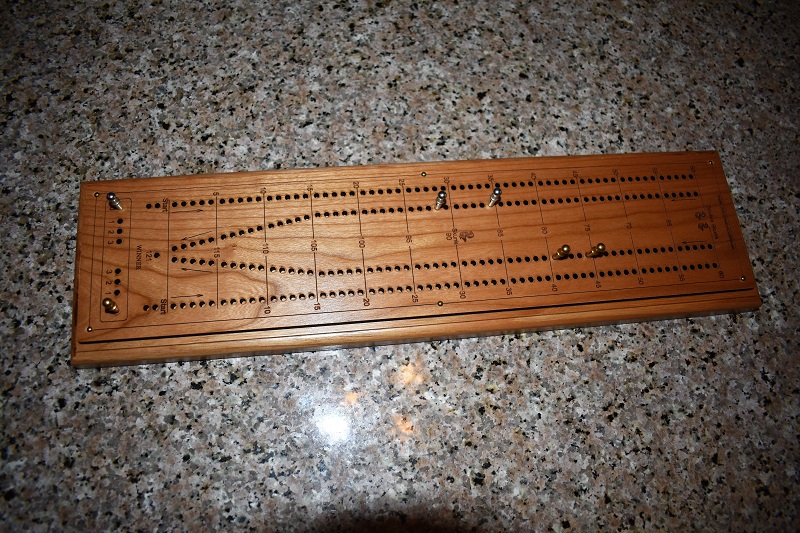
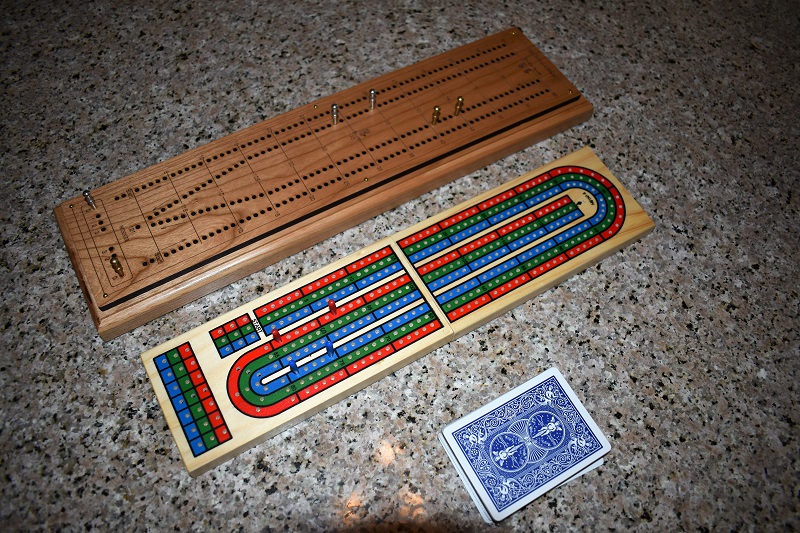
We got our new cribbage board today—after ordering it on December 15, 2019 by Priority Mail through the United States Postal Service (USPS). It’s a handsome Cherry on Hickory base V Tournament board, although we were puzzled by the label on the box which indicates that it was a Priority Mail 3-Day delivery when it was anything but.

In fact, my wife, Sena, took it down to the post office to ask a few questions about the meaning of Priority Mail. Our expected date of delivery was changed several times. Initially, it was December 18th or 19th. That morphed into December 21st, 22nd, and finally the 23rd. We got a couple of email notices saying it was to be delivered by 8:00 PM, even on a Saturday when we knew the Post Office was closed. A 3-day delivery turned into a week, which the USPS charges us a little over $13 and then says there’s no guarantee.

Sena found out that even if you order it delivered by First Class, depending on the weight, it gets bumped to Priority Mail. I’m guessing you pay more for First Class, but it sounds like you might not necessarily be any better off. Moreover, the multiple changes in expected delivery dates were called “unusual.” The worker was sympathetic, but sympathy was all Sena got. Sena was lucky she didn’t get the postal service worker working with another customer in the line next to her. All that worker said was, “There are no guarantees!”

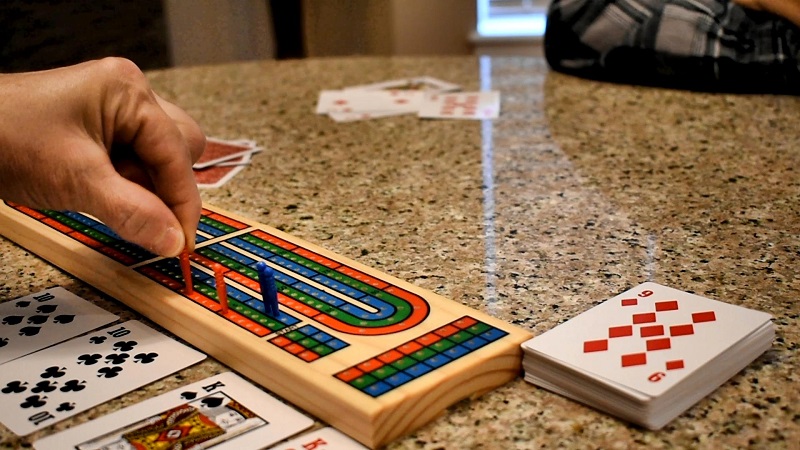
In fact, we interrupted a cribbage game today when we discovered the new board was delivered on our porch. I set up both boards to reflect the scores.

Cribbage game in progress…

I can see that it’s easier to play a two-handed game with fewer chances for mistakes in pegging on the new board. The tracks are further apart. Knocking over pegs was not uncommon on the old board—unintentional of course.

The metal pegs that came with the new board fit the holes perfectly and the stowaway hatch on the back for them were safe because of the snug fitting wooden cover.

As I’m finishing this post, our cribbage game which started this morning around 10:30 AM, sits on the dining room table unfinished on both boards. That’s because it’s close to 50 degrees outside and Sena is watering the lawn and the trees.

We might finish the game—but there are no guarantees. Have a Merry Christmas and a Happy New Year–that’s a priority!

Shopping for Cribbage Boards

As you know, Sena and I have been relearning how to play cribbage, a traditional card game using a special peg board for keeping score and about a million rules. They say cribbage is a game that takes 20 minutes to learn and 20 years to master.

We’re having a lot of fun learning. We bought a set for about ten bucks. It’s a folding board, a little over 14 inches long and 3 and a half inches wide. The pegs are plastic and can be stored in a shallow slot on the back of the board—not protected by the plastic sliding cover. We found that out one day; luckily the pegs weren’t lost. You can find these in most hobby and big box stores where you live. We’re shopping for a new cribbage board.

The cribbage set came with a simplified set of rules, which you can read with a standard magnifying glass. The peg board has 121 holes and you sort of race around the board to see who gets to 121 first, pegging your progress by scoring special combinations of cards from a standard 52 card deck like cards whose pip values add up to 15; pairs; 3 and 4 card runs like 6, 7, 8: flushes and so on. Then you score your hand and your crib (an extra hand that only the dealer gets and to which both the dealer and non-dealer contribute). Because there are so many opportunities to score during the game, it’s a lot easier to peg it out on the cribbage board. You can find all the rules on the American Cribbage Congress (ACC) website. The basic game is for two players although there are 3 and 4-handed versions.

Because our board is a little on the small side, we’d like something bigger and easier to read. I’m not a shopper by any means, but I’m learning about the variety of boards out there.

As usual you can find anything on Amazon, but what we’re looking for is something large and for that we have to look in other places. It turns out there are tournament boards that the ACC recommends and uses in the many tournaments around the country. You won’t find tournament boards just anywhere. You most likely won’t find them in any local store where you live.

There are tournament boards that have two straight rows that go for 60 holes up and back (to cut down on pegging errors) and a line across the board at the 90 mark, which is the skunk line. If you don’t make it past the skunk line, you have the right to be embarrassed. It means you will never be a cribbage player worth two cents, probably lose your job, your home, end up in the gutter, be kidnapped by aliens, taken to another planet in a distant galaxy and displayed in a zoo for the rest of your natural life, living on a diet of wild hickory nuts, which the aliens think all earthlings survive on.

That means you should study cribbage closely and for that you need the right kind of board. We like to have numbers printed on the board—but it turns out the official tournament boards don’t have them. When I think about it, I guess it makes sense. There are only two peg holes worth paying attention to and that’s the one where the skunk line is and the 120th.

But it just looks nicer to have the numbers on the board. We’ve shopped around a little. There is a tournament board that is a special V-type version. There are two rows but the 2nd row slants away from your opponent, making it even easier to peg.

There’s a guy in Florida who makes a V-type with all the numbers and even images of little skunks on it. It’s a little bigger than ours, made of hickory and comes with one of three top playing surfaces to choose from: Cherry, Maple, and interestingly, something called Beetle Kill Pine which is wood from thousands of acres of pine trees that have been killed by a beetle that injects it with a dye, giving a bluish cast to the grain. He doesn’t mention whether the boards are disinfected or not. The board runs about 75 dollars if you buy the cloth carry bag (65 dollars if not and that doesn’t count shipping). The maker is very honest and tells you that he can’t promise that the pegs he makes will fit the holes. Hmmmm.

There are mom and pop outfits in places like Canada and Rhode Island which specialize in hand-crafted game items and they make gorgeous cribbage boards, one of which will set you back over 100 dollars. It’s about 29 and a half inches long and about 8 inches wide and the pegs are 2 and a half inches long. It’s called the Imperial, and well it should at the price. The same outfit also has another model which I later learned is a Century model, a vintage board with a busy top surface along with the peg holes around the edges. There are several different peg holes that allow you to score other things like skunks, “legs” (which I think are different from games and matches, but I’m not sure, unless it’s for how many of your legs the aliens hack off for every skunk you lose by), hickory nut brownie recipes, and ways to score up to about 900 points, for what I don’t know. There’s so much stuff on the board it’ll make your head swim, but it’s the least pricey of the higher end bunch we’ve been looking at. It goes for 50 bucks. Part of the description of the company says the founders “…believed that quality materials and painstaking engineering were tantamount.” I think they meant “paramount”.

The place in Canada makes pretty boards out of Canadian Hard Maple. The largest one is about 27 inches long by 8 inches wide and has a stowaway slot for the metal pegs and a deck of cards. Most storage compartments on cribbage boards have the kind of slots we have on our cheapo board, with a little cover that slides over the slot, which falls off and allows the pegs to escape to their everlasting freedom down the floor heat register. The Canadian model (called the Jumbo) has an artsy carved wooden cap which is secured by “powerful rare earth magnets.” Have fun playing if you can get the cap off. It’s priced at 65 dollars and that’s with the storage bag.

You know, our little 10 dollar folding cribbage board does get the job done. Happy holidays!

Go Cribbage, Psychiatrist!

Sena and I started playing cribbage again yesterday after Thanksgiving dinner, for the first time in over 20 years. It was a great way to pass a little time; we hope you had as much fun in your own way.

 We’re rediscovering how fun it is to play cards. We’ve been brushing up on the many rules of cribbage. It was just a practice game—BUT I WON, YEAAHHH!

OK, technically the game was null and void because I screwed up on one of the several dozen conventions such as how to cut for the starter card. Actually, I forgot it completely during one hand.

Because scoring is pretty complicated and easy to screw up, I downloaded a simple and free smartphone app to check our addition, at least until we get more practice. We’re using it to help us check our math, just until we’re more confident.

In general, there two phases to the game, sometimes called the “play” and the “show.” In the play you try to earn points by making plays of scoring cards, such as 15s, pairs, runs, and so on. You keep a running tally of the cards by counting each card as it’s played. But you can’t go over 31. In the show, you score cards and the crib (a special hand that only the dealer scores) to which the two players each contribute two cards. Games usually go to 121 and you keep score on a cribbage board on which you “peg” your points as you make them. See the ACC for the full rules (see below).

And, it just so happens that today is the 29th of the month—which reminds us of the very rare but possible 29 score in cribbage (see below). We’ve not played in so long that we’re really green beginners, as you can tell in the video. Making the video was just as much fun as playing the game.

I’m sure anybody who is experienced will cringe as they watch us play. Probably even dead cribbage experts will turn in their graves. We think it’s a hoot. We made mistakes and Sena even got the giggles.

The biggest organization in the world for cribbage is the American Cribbage Congress (ACC), which was established in 1980. They have an annual Tournament of Champions in Reno, Nevada. You can find out anything you want to know about cribbage on their website.

There are many branch cribbage clubs located across North America, called ACC Grass Roots clubs. There’s even one in Ankeny, Iowa, called Club #17, Capital City. You play 9 games in an evening, rotating from table to table so you can play someone different each time. I notice that the club in Ankeny tells you not to worry if you have trouble moving through the rotation scheme, because they allow for stationary seats. There are awards given, such as for getting the extremely rare 29-point hand, which some say is as rare as a golfer getting a hole-in-one.

And I notice that photos of players on the ACC websites show mostly people my age—not implying anything at all. They say games usually take only 15 to 20 minutes. Sena and I took much longer than that today. I guess you could say that, as mentioned on the Capital City website, we play what they call “kitchen table cribbage.”

Go cribbage!

Back in the Saddle Again

This is just a short update on how phased retirement is going. I’m back in the saddle. Last Friday I went back on duty on the Consultation-Liaison Psychiatry service. I’m at 50% time. My step counter today shows about 2 miles and 17 floors—a slow day. That’s fine with me.

Colleagues pass me in the hall and say, “I thought you were retired.” They don’t look happy when I tell them I’ll be fully retired in June next year.

But I’m a little happier. It’s taking a long time to get used to not being a fireman, which is what it means around here to be a C-L psychiatrist.

How’s the cooking going? Miserable but getting better, in a way. I can deal with things like “Just Crack an Egg,” which my wife, Sena got for me, as a sort of sympathy gift, I guess. I can handle it. And I made an omelet the other day, my first ever. The kitchen was not filled with smoke and it was edible.

How’s the exercise routine going? I’m still at it, 20 minutes every day, along with my mindfulness practice.

As I was giving my usual orientation remarks to the new trainees coming on the service this morning, I caught myself saying “I do it for the juice” when telling them why I do this schtick. I’ve said that to a lot of residents and medical students over the years.

I guess I should rethink that remark and the mindset that makes me say it so often. Pretty soon, I won’t be chasing all over the hospital anymore— “for the juice.”

I’ve been trying hard to find something else for the juice. Sena and I’ve rediscovered card games we haven’t played in over 20 years: Pinochle and Gin Rummy. I lost track of time playing Gin yesterday, I had so much fun. We just celebrated our 42nd anniversary. It was magical.

I’m probably going to be OK.

Am I a Mover and a Shaker—or Just Shaky?

I sometimes wonder about whether I’m a mover and a shaker or just shaky. I think it’s the latter. I’ve known plenty of movers and shakers and they tend to be great planners. On the other hand, I tend to take the path of least resistance. Often, I don’t consider enough options and just settle for what’s expedient. That has not always turned out for the best. My wife, Sena, is more likely to shop around for things which cost the least and reward the most—although that process can seem very long to me.

Take the time I decided I wanted to try private practice. There were actually two times and neither worked out in the way I intended. I learned valuable lessons, one of which was that I was a better teacher than I gave myself credit for.

I guess if I had thought things through more back when I thought the grass was greener on the other side of the fence, I might have qualified for the early retirement benefit from the place I left—twice.

On the other hand, I’ve made what seemed like hasty decisions other times in my life and made out all right. One of them was marrying Sena.

I can’t recall what the other one was.

House Hunting Disorder

House Hunting Disorder might be my suggestion to add to the Diagnostic and Statistical Manual (DSM) of Mental Disorders, whenever the American Psychiatric Association gets around to updating.

Shopping is not one of my favorite things to do. Shopping for houses (especially a retirement home) is something I would suggest running away from if you have any choice—which you won’t, trust me. We’re not yet ready for the Vintage Cooperative, a condo-like setting for seniors. I’m almost ready to settle for an apartment.

I’m remembering our first “apartment” when we moved to Hawkeye Drive in Iowa City over 30 years ago. It was University of Iowa housing and my wife wept openly when she saw it. The moving van sat in the office parking lot for at least a couple of hours while the truth sunk in. The only other choice was Hawkeye Court, but that was not the one to which we were sentenced—I mean, which we, like a lot of other students, signed up for, sight unseen, when we moved here so I could start medical school. They were painted cinder block buildings described as resembling “minimum security prisons,” and had been around since the 1960s. They were all torn down to make way for new student housing around 5 or 6 years ago.

We were on the 3rd floor so we had to lug our furniture up to the top. I had problems with my knees then, which, miraculously, I don’t have now that I’m decades older. Over time, the place developed a constant buzzing noise from a vibration which I think began in the shared 1st floor laundry room where all the poltergeists lived. It drove me nuts—from which I obviously never fully recovered. I couldn’t convince the maintenance man that the noise even existed. He looked at me sort of wide-eyed and edged away from me as I placed his hand on the sofa to demonstrate how you could actually feel the vibration all over the apartment.

The neighborhood was a little scary occasionally. On one Halloween night, we got a visit from some very tall kids who were not wearing costumes, smelled of beer, and held out what looked like giant lawn and leaf bags. They said “Trick or Treat” in pretty deep voices for children. I probably shouldn’t have asked, “Aren’t you a little old for this?” as I dropped a few candies into the bags, which I could have stepped into and been completely concealed. When I closed the door, we could hear the candies shatter against it.

The next apartment we rented had a small blister in the ceiling which grew quickly over a day or so into a beach ball-sized bulge. It happened over a weekend and the manager claimed he couldn’t get anybody to fix it until Monday. We spent some tense moments just watching and waiting for the bleb to explode all over the living room.

OK, so maybe apartments are out. We’ve lived in a several houses here since then, which are really markers for my career in medicine as well as domiciles. Things have changed in the real estate market. Homeowners Associations (HOAs) are just one of the changes.

HOAs are something I would rather avoid but may not be able to escape. I could weep openly about them, but it won’t help. The explanation for them, which comes from developers most of the time, is that the Post Office doesn’t want to deliver mail to each and every house nowadays. This has led to the proliferation of mailbox clusters, which have to be maintained at HOA expense. Sometimes it amounts to scooping snow off the concrete pad on which the mailbox cluster sits.

HOA fees are a nuisance. They can run from a few dollars to a few hundred dollars a year, which I admit is better than association fees for condos, which can run into the thousands. What the fees cover is sometimes difficult to discern. A lot of developers and builders nowadays erect subdivisions in locations which I suspect would have been avoided in decades past. Some of these areas tend to be called “wetlands,” which are ponds surrounded by tall grasses and which foster the evolution of various life forms that sometimes crawl up on land to feed on small mammals.

Seen any small mammals?

You can sometimes escape the HOA madness by buying older homes in what are called “established neighborhoods” where the residents raise chickens, hunt for mastodons, and park RVs in their driveways that are bigger than their houses. There are unwritten rules which include but are not limited to animal sacrifice. But at least they don’t have covenants that require you to have an 8-foot-tall lamp post which must remain on 24/7; a stamped and gaily-painted driveway (multi-cultural themes only), stone columns quarried in Portugal, and a bat-infested entry and those bats better be neutered or spayed, vegan, rabies-free, defanged and declawed, and be multi-lingual.

HOAs require at least 4 officers (President, Treasurer, Secretary, Executioner), elected as soon as the last nail goes into the last house on the last empty lot in the subdivision. The President should carry personal liability insurance against the possibility the neighbors will file a lawsuit about the conservation areas being infested with non-native vegetation, such as lichen or cobwebs.

HOAs can’t protect you against builders, which are another hazard which you can’t avoid unless you are capable of building your own house, which you are not because, as you well know, there are only two kinds of people in the world—builders and victims of builders. You know who you are.

Nope

Speaking of building, what’s up with mud rooms being placed in the layout not where they make the most sense, which is immediately in from the garage door entry, but in what I think is called the Jack and Jill arrangement? This puts the mud room next to the laundry room next to the walk-in master closet which is off the master bathroom, which leads from the master bedroom, all in a straight line and all separated by the mandatory pocket doors which must be filthy and get stuck halfway out according to the building codes. Needless to say, the mud room need not be in close proximity to the garage entry and is often close enough to the front door that you have to track mud from there to the mud room—or across the front room to the kitchen, which makes about as much sense. The obvious conclusion here is that Jack and Jill were sadistic fiends called up using the Ouija board. At least that’s who the builders will tell you to blame.

I could go on but I’ve got other stuff to do today, like shop for houses. I know it’s a sickness and I should get some help—but there’s no treatment.

Over the Double Rainbow

We saw a double rainbow while out for a walk during a gentle rain. I know they’re not rare, they form because light bounces off raindrops, and all that. I’m not after the science angle here. I’m just hoping this was a sign of good luck to come. I’m pretty sure I’ve probably seen a double rainbow before. I just can’t remember when. And I doubt it was as striking as this beauty was.

Double rainbow!

These days I’m wondering what’s over the rainbow or the double rainbow. Going for a walk the other day helped me put things in perspective—at least for a while.

Out for a walk in the fall

My life is slower when I’m not on service in my role as a general hospital psychiatric consultant. And I’ll be fully retired in June. I just came off service earlier this week, when I was going at my usual fireman’s pace. Things seem to move so much faster nowadays.

I’m on service at 50% time now. That feels a lot different than the previous two years, when I was at 65% time. When I’m on, I’m going at a dead run. When I’m off, I just mosey along. It’s a little jarring to go from 0 to 90 and back again every so often—even though it’s less and less often.

I don’t mind telling you, I get a little bored sometimes. It helps to do something different every once in a while. I hadn’t made a pizza from scratch in over a year and a half. I guess it’s not completely from scratch. I’m still better at just sticking a frozen one in the oven.

Make that pizza!

A Beer Called Ruthie

Ruthie is a good name for a beer. It’s a craft brew made by Exile Brewing Company in Des Moines, Iowa. It was named the official craft beer of the Iowa State Fair this year.

Who needs a tray?

There’s a cute picture of Ruthie on the bottle pouring beer into a couple of glasses balanced on her bosom. Where else?

It turns out that Ruthie Bisignano was the owner of Ruthie’s Lounge in Des Moines, open from 1950-1970. She was nationally famous for this kind of serving style. She was married sixteen times to nine men, by her account, according to a Des Moines Register clipping from 1988. This was the year my wife, Sena, and I moved from Des Moines to Iowa City in a U-Haul truck so I could start medical school.

Exile was established in 2012 and they serve community healthy living awareness as well as beer and food. For example, they started the Ruthie Breast Cancer Campaign in 2018 and for every case of pink-labelled Ruthie beer sold, a dollar was donated to Susan G. Komen Greater Iowa. They have a well-balanced attitude toward health and life—sort of like the well-balanced way Ruthie served beer.

We noticed that one of the menu items was something called Mexican Rarebit.  It reminded me of a Gomer Pyle episode back in the 1960s. If you’re not a baby boomer, you might not know anything about this old TV comedy involving the stormy relationship between a naïve Marine private and his grumpy drill sergeant, Vince Carter. It ran for 5 seasons and, while it was one of the few programs my mother liked, Sena hated it mainly because of Gomer’s over-done North Carolina hick accent.

Anyway, one of the episodes was “Gomer the Welsh Rarebit Fiend.” In it, whenever Gomer or Carter ate what Gomer always sounded like he called “Welsh Rabbit,” they would sleepwalk and switch personalities. An article on the web about the episode showed many snapshots from it, one of them including a sign on which was printed “Psychiatric Unit.”

Of course, that piqued my interest since I’m a retiring psychiatrist. I didn’t remember that part of the episode. I searched the web and discovered that Welsh Rabbit was the original name of the dish, which is a simple dish of mainly melted cheddar cheese on toast. I admit I don’t understand the etymology of the name. Somebody either couldn’t catch rabbit or pronounce it.

However, it’s been associated with causing vivid nightmares, especially if you eat too much of it late at night. Maybe it’s the mustard.

In fact, there was an early 20th century comic strip called “Dreams of a Rarebit Fiend” by Winsor McKay. It was about spectacular dreams caused by eating Welsh Rarebit. The dreams often portrayed Freudian themes including phobias. Some speculated they might have inspired iconic movie creatures like King Kong.

Anyway, Exile’s Mexican Rarebit sandwich involves ground chuck in a spicy queso, bacon, and corn salsa. I wonder if the recipe calls for beer, which might be another way to enjoy the Ruthie. The web site doesn’t warn the diner to avoid eating it just before bedtime.

You can find a lot of different recipes for Welsh Rarebit, limited only by the cook’s imagination.

Sena just returned from the store and among the items was cheddar cheese and pumpernickel bread.

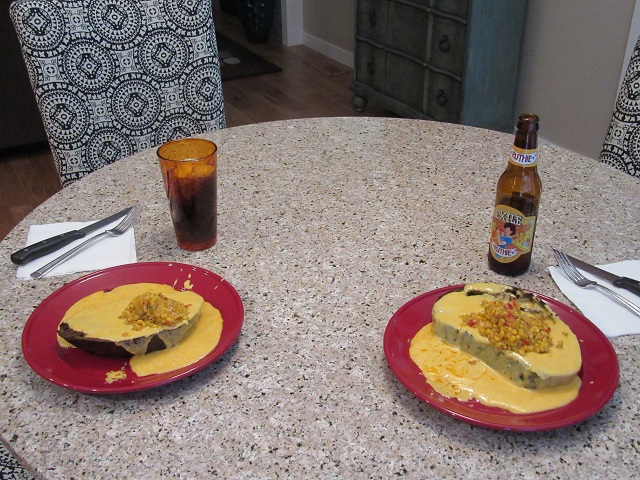
I made what we’ll call Ruthie Rarebit today—with a heck of a lot of coaching from Sena. The recipe was pretty traditional:

A stick of butter, about a tablespoon of flour; aged cheddar cheese, about one and a half cups, enough for both of us; a small carton of whipping cream; about a teaspoon of dry mustard, half of a 12 ounce bottle of Ruthie Gold Lager (could as well have used the whole thing); salt and pepper, a little paprika and cayenne pepper.

Toast a couple of big slices of bread (we used pumpernickel) with a little olive oil in a pan. Melt a stick of butter in a saucepan, add about a tablespoon of flour, a bottle of beer or ale, whipping cream, add the cheddar cheese, and keep stirring. Pour it over the toast and add whatever else you want on top.

Ruthie Rarebit

No Welsh Rarebit recipe calls for rabbit—that I’m aware of, anyhow. I’m not expecting any nightmares tonight. In fact, I think it might be as helpful for sleep as melatonin.

See how it’s done!

Let Happiness Leak

This is just a post to offset the grumpy one from a couple of days ago. Sena and I took a walk on the Clear Creek Trail and she broke me up with her shenanigans.

Along the way, we found a painted rock in a tree which had the word “corridor rocks” printed on it.

It looked like something you could google—which I did. It’s a cute story titled “The Corridor Rocks! —Brightening Days One Stone at a Time” by Sara C. Painting rocks, hiding them and giving people like us a fun time discovering them. Sara says it was a way to stop and smell the roses.

It’s one way to remember how happiness works. It leaks…sort of. We put the rock back where we found it. The only clue we’ll give you is that it’s somewhere out there on the Clear Creek Trail. Have fun!