Sena bought a yard ornament. No, it was not a pink flamingo. It’s a Fiery Metal Kinetic Dual Spinning Garden Stake (FMKDSGS). A name like that and right away you know it’s going to be one of those products requiring owner assembly and your skills and patience will be tested. Take my advice and get the pink flamingo.
Our skills were sorely tested, mainly because the product arrived with puzzling and missing instructions and what looked like extra parts. It’s from the Alpine Corporation, a wholesaler based in The City of Commerce, California although the box label clearly says the product was made in China. I usually have pretty good luck with products manufactured in China, but not this time.
The Owner’s Manual does not include a picture showing all the parts needed for assembly, for some reason. On page 2 there are pictures of the rear and front spinners, the stake parts, a connector, and a cap nut. However, there are no pictures for the two sets of nuts, what I think might be some kind of spacers or bearings, and covers that arrived with the product. There are no instructions for what to do with them. The post was crooked because the sections didn’t screw in straight.
I found a pdf of the Owner’s Manual on line, but it had all the same flaws as the original. I couldn’t find a YouTube video about assembly. I tried installing the nuts, bearings, and little covers where I thought they should go, but often the spinners refused to spin and the connector would come loose. It would only sort of work without wiggling apart when I put the spacer/bearing piece on the threaded top section of the pole or connector first, then slipped the cover over the spacer bearing, and twisted the nut over that.
At times, I half-expected little gray aliens would manifest from the spinners (could be some kind of vortex wormhole) and laugh at me.
The product is sold under slightly different names by on-line retailers. I could not find anything about FMKDSGS at the corporate Alpine web site. The Alpine contact form spelled one retailer’s name (Menards) wrong (“Mernards”). It’s not BBB accredited but there are a couple of complaints about customer service and work environment.
I tried different ways to connect the mystery parts to the two spinners. I got pretty frustrated, which was echoed by a couple of reviews by other Amazon customers who complained about missing instructions and being forced into trial and error problem-solving. We didn’t see those reviews before buying the product.
After a lot of trial and error, I thought I made the thing work. I still didn’t know if it was put together right, though. Both spinners spun although the front spinner often stalled. It didn’t immediately fall apart when it was stuck in the ground and took the breeze. However, we were not confident it wouldn’t collapse in the near future—so we returned it to the store.
Hey, how ‘bout them Nielsen’s surveys? I can’t remember getting any Nielsen media rating surveys before I retired and I’ve gotten two of them since then. They send you a crisp, new dollar bill in the mail to entice participation. More likely, it elicits guilt. You’d return the dollar bill but not in the mail, would you? Is this some kind of rite of passage or what?
Technically, you’re not supposed to talk about whether or not you participated in the survey, but I saw one blogger’s post about his radio diary survey. Is there a penalty for admitting you’re a part of “Nielsen Family”? Are there Nielsen Enforcers who come to your house and break your kneecaps while listening to the Godfather soundtrack through their earbuds if you don’t obey the rule?
One white commenter thought Nielsen just targets old white guys for some reason. Then a black commenter pointed out that Nielsen mails the surveys to old black guys too, so it didn’t have anything to do with skin color—and he did it with a sense of humor. He speculated that Nielsen might just target grouchy old retired guys with strong opinions because we remember what the value of a dollar bill was back in the day.
It reminded me of what I used to listen to on the radio in my younger days. Back then, the radio was what you had to use to listen to music. Well, there was a TV music show called American Bandstand, hosted by Dick Clark. The format was pretty much young couples dancing to the latest tunes while the camera panned over the dancers randomly. I remember watching it one day and noticing the camera was moving a lot less randomly and kept focusing on a young blonde woman in the crowd in the middle of the dance floor. That is, it did until she made a very lewd gesture which immediately led to a return to very random camera meandering—and possibly higher Nielsen ratings.
I listened to the radio a lot when I was a kid. One of the local radio stations was KRIB, which the announcer always pronounced “K-OW-I-B because he talked so fast. Many of the songs were bad, so bad that a humorist named Dave Barry published a book about it in 1997, Dave Barry’s Book of Bad Songs. He’s a Miami Herald newspaper columnist who has written a lot of funny books. I had nearly all of them at one time, including the bad songs book. I have only a few now, including an autographed copy of one about getting older, Lessons from Lucy (2019).
One of the worst songs in my opinion was a 1976 tune “Blinded by the Light” by Manfred Mann’s Earth Band. It’s actually a cover of a song by Bruce Springsteen. I kept hearing a lyric I definitely thought was “wrapped up like a douche,” which I swear I never shared with anybody nor looked up on the web (or as Dave Barry would say, “I swear I am not making this up.”) until just today to discover I’m far from the only person to hear that. I also found out that kind of error is called a “mondegreen” (a mishearing of a phrase in a way that gives it a new meaning). The actual lyric was “revved up like a deuce.” That was the kind of bad song Dave Barry wrote about—although I don’t remember that specific song being in his book.
Nowadays I listen to KCCK (88.3 FM) for blues and jazz. Years ago, I used to listen to Da Friday Blues show starting at 6:00 p.m. every Friday. It was hosted by John Heim, who is still doing the show, even after a devastating accidental neck injury which left him paralyzed from the neck down a few years ago. He was hospitalized at The University of Iowa and his family and friends donated a lot of money to help him get to a rehab center in Omaha, Nebraska. John actually retired from teaching in 2004, but has been a DJ at KCCK for years because music means so much to him. He’s a brilliant example to retirees everywhere.
There’s a lot more to radio than Nielsen ratings, no disrespect to Nielsen Families everywhere—and just a reminder, I have no kneecaps worth breaking.
I’m probably busy as a beaver, especially now that I’ve read a short description of how a beaver builds a dam. The article is short on references; in fact, there are none to back up the unidentified author’s remarks. In fact, I suspect the article is fact-free, the only apparent purpose to create test questions for grade-school children.
The author says that, while beavers are busy when engaged in tree felling and dam building, they are disorganized, poor at planning the activities and often mess them up—even accidentally getting killed by falling timber.
By analogy then, since I retired last year, I’ve been about as busy as a beaver. When my frame of reference was working at the hospital as a consulting psychiatrist, I was extremely busy. I put on 3 to 4 miles and about 30 floors a day chasing consults all over an 800-bed hospital with 8 floors.
Now my typical day is very different. Staying physically fit is challenging. I exercise daily, but it’s hardly as demanding as when I was working. I start off with floor yoga to warm up. I hop on the stationary bike, which is not a Peloton or anything like it. There’s nobody in the display exhorting me to crush that Peloton. The digital mileage counter display doesn’t even work.
Next, I do bodyweight squats. My ankle and knee joints crackle and pop loudly, but as long as they don’t hurt, I imagine I’m fine. Next, I do curl and press exercises with a pair of 10-pound dumbbells. Then I do planks. After 3 sets of squats, etc., I get back on the bike. Following the exercises, I sit for mindfulness meditation. That whole business takes about an hour.
As far as beaver busyness, the only time I felled any timber was last summer, when I flirted with danger using a power pole saw trying to clear dead tree limbs left over from the derecho. That actually was a poorly planned activity and was certainly dangerous. I guess I was busy as a beaver then.
Is there such as a thing as being mentally busy as a beaver? Apparently not. Sena and I play cribbage now and then. Other than that, there’s always TV. I listen to music on the Music Choice Channel on TV. I like the Easy Listening and Light Classical stations. Each musical artist featured has several short biographical notes appear while the music plays. I practice doing mental subtractions when the artist’s birthdate appears. It’s the old borrowing method of subtraction you learn in grade school—unless nobody teaches that anymore. There are usually several grammatical and usage problems (worse than mine) with the information about artists and I practice recasting sentences. Sometimes they’ll mention a musician’s nickname, such as BullyboysquatlowjoocedewdliosityBrahms. Several of the classical musicians composed symphonies before they were potty-trained.
On the practical side, I watch the Weather Channel, following which are shows like Highway Thru Hell and Heavy Rescue 401. Those guys are really busy, dragging semi-trucks out of ditches in snowstorms in British Columbia. They operate 75-ton wreckers with rotating booms and winches which regularly spit their cables at anyone nearby.
I alternate the heavy wrecker shows with the Men in Black (MIB) movies, which poke fun at the UFO and alien themes (a welcome counterpoint to Ancient Aliens which takes itself too seriously). I was sure I was watching MIB movies way too much until I found all of the fans’ contributions to websites which list the many errors in the movies. Just google “MIB goofs.” You’ll see the triumphant announcement from those who somehow know what color scheme New York City streets signs had in 1969 and point out how wrong the movie is. On the other hand, I know what kinds of pies young Agent K and Agent J had in MIB 3 (apple with a “nasty piece of cheddar” and strawberry rhubarb, respectively).
I’ve been reading the short story collection Hue and Cry by James Alan McPherson with the idea that the entire book was new to me. So, I was stunned when I remembered the story, “A Solo Song: For Doc.” It has more than one layer of meaning, but on one level it’s about a Black railroad train waiter named Doc Craft who is forced into retirement. The narrator tries to teach a young waiter he calls youngblood learning the ropes about how the old school waiters made their work not just a job but a way of life. I was surprised to learn there was a television adaptation of the story made in 1982.
I must have read it in an anthology when I was a youngblood myself. It’s about racism but it’s also about aging, retirement, and change itself. It makes sense that I would feel differently about the story now that I’m older and retired.
I’m about a year into my retirement now and it has not been easy to adjust. Boredom and the search for a new meaning and purpose in my life still challenge me. While racism did not play a part in my decision to leave my profession, there is no doubt that things changed over my three-year phased retirement starting in 2017, dramatically so since the COVID-19 pandemic in 2020.
I thought I was still maintaining my skills as a psychiatric consultant in the general hospital. I was physically fit, in many cases better able to run up and down the stairs for 8 flights than the youngbloods. When they asked me why I became a consulting psychiatrist, I often told them that I “did it for the juice.” I guess that’s why Doc Craft did it.
Maybe I retired because I didn’t want to be pushed out. Doc Craft didn’t retire because he just wasn’t made for it. Sometimes this doc wonders….
I’ve got one thing in common with a lot of people who say they’ve seen things like Bigfoot and UFOs. I’ve seen someone beat the Dollar Bill Jump Challenge but I can’t prove it.
I know there are a lot of people who say they’ve seen the Loch Ness Monster, ghosts, little gray aliens, Sasquatch, and who also claim to have eaten delicious fruitcake. That is to say I’ve seen a lot of blurry photographs, videos, and I’ve thrown out more than my fair share of fruitcake.
However, I also don’t have any video evidence for what I saw a guy at the YMCA do over 40 years ago, which was to jump forward over a broom handle while holding his toes. Don’t bother asking me why there was a broom in the weight room at the YMCA. Too many questions get in the way of a good story. This middle-aged jock was telling me and another youngster about this strong man stunt of jumping over a broom handle laying on the floor. He never mentioned a dollar bill, but it looks like this is usually part of the game.
He looked right at me and said, “You look like an athlete, let’s see if you can jump over a broomstick.” First of all, I was a skinny kid and didn’t look athletic—that’s why I was in the weight room in the first place. Furthermore, the guy had several conditions for jumping over a broomstick on the floor I didn’t know about before agreeing to try it.
You have to bend over in front of the broom handle (dollar bill) and grab your toes, keep your knees slightly bent, and then all you have to do is jump. Most of the time, the challenge is to jump over a dollar bill. I think you could injure your feet on a broom handle, so I advise against it.
There are variations on this game. It probably makes no difference if you lay the dollar crosswise or lengthwise. You always have to grab your toes, not let go when you jump, and land upright. There’s an ankle grabbing variation which I don’t think makes much difference, but the classic rule is you have to hang on to your toes.
The other kid and I tried to do this about a dozen times and we invariably let go of our toes or fell over or both. Then the middle-aged jock did it flawlessly. No, I didn’t have a camera. It’s too bad because a video would prove one way or another whether this stunt is possible.
On the other hand, I’ve seen a lot of videos and snapshots of Bigfoot on TV that are so terrible I can’t tell if I’m looking at a Bigfoot or a man in a monkey suit. I’ve never seen an alien, not even the corpse of one. I know, there are a lot of videos of UFOs, but they look like tic tacs and make me think of someone shaking a mini laser pointer in front of a cat to make it chase the light around. And I have not tried to eat fruitcake since I was little and my mom made me eat it because it was a Christmas gift from our church.
What would impress me is seeing a video of a Bigfoot ghost stepping out of a flying saucer while eating a big slice of fruitcake.
The one explanation I’ve found on line for why the dollar bill jump stunt is considered impossible is that your center of gravity has to move ahead of your base. The same article says you can jump backward easily because the support base moves first and the center of gravity stays in a balanced state. I can’t do that either. There are a couple of YouTubes that show a lot of people falling over. None of them tried it backward, although one guy tried it sideways and fell on his side.
For the record, my story of witnessing somebody beat the dollar bill jump is just that—a story. If you have a video of you or somebody beating the dollar bill jump challenge, let me know.
Over the Easter weekend, we drove by James Alan McPherson Park. A lot of people were having a great time. Because it was crowded, we went to Terry Trueblood Recreation Area, planning to return another day.
We just got our copy of McPherson’s Pulitzer Prize winning fiction anthology, Elbow Room. We’ve ordered his other collection of short fiction, Hue and Cry and it’s been shipped.
McPherson was impressed with the neighboring culture of Iowa City. He’s described as being kind and neighborly himself.
He was self-effacing, which probably seemed ironic to some people, given he was the first African American to win the Pulitzer Prize for fiction for Elbow Room. He was on faculty at the Iowa Writers’ Workshop for many years, won the inaugural Paul Engle award from the Iowa UNESCO City of Literature, graduated from Harvard Law School, recipient of a Guggenheim Fellowship, a MacArthur Fellowship, and was inducted into the American Academy of Arts and Sciences.
I’m struck by a few ironies. Our paths never crossed but that’s probably not surprising given our different professional trajectories. I graduated from medical school at Iowa and just retired last year from the University of Iowa Hospitals & Clinics (UIHC) Dept of Psychiatry where I was a Consultation-Liaison Psychiatrist.
However, McPherson in his essay, [Pursuit of the Pneuma, McPherson, J. (2011). Pursuit of the “Pneuma”. Daedalus, 140(1), 183-188]. described being treated by Iowa City psychiatrist, Dr. Dorothy “Jean” Arnold. And, ironically, Dr. Arnold was white (both she McPherson came from the racially polarized South) and originally graduated from the University of Alabama Medical School. She was also the first female psychiatrist to open a private practice in the state of Iowa in 1957. She taught at the University of Iowa Hospital, but I could not find her mentioned in the history of the UIHC Psychiatry Dept, although Dr. Peg Nopoulos, the first woman chair of the department, has her own chapter [Psychiatry at Iowa: The Shaping of a Discipline: A History of Service, Science, and Education, written by James Bass.]
I’m mentioned in Bass’s history, which is sort of ironic. The book is actually about scientists in the field of psychiatry, and I was anything but. I was a clinician. For comparison, if you ever watch the Weather Channel, I’m not a meteorologist. I’m more like the guys on Highway Thru Hell or Heavy Rescue 401, although I’m not practical in that sense. I am African American though, and it was a good idea for Bass to mention me, since I think I’m the only Black psychiatrist to have ever been hired by the department.
McPherson was impressed with the generous and receptive nature of Iowans, which he ascribed to a quality captured by the word “Pneuma,” a Greek word meaning “the vital spirit of life itself.”
There’s another irony in connection with one of my most influential teachers at Huston-Tillotson College, in Austin, Texas, one of the historically black colleges and universities (HBCU) in America. McPherson attended the HBCU at Morris Brown College in Atlanta, Georgia. Dr. Jenny Lind Porter-Scott, who recently died, was a white Professor of English at H-TC, writer and translator of poetry, teacher to thousands, and popular with students of all races, yet there is no tangible, permanent remembrance of her by Texans. To be sure, she is listed in the Texas Women’s Hall of Fame and in 1964, she was appointed Poet Laureate of Texas by Governor John Connally. Her house was demolished in 2016. In 2016, an architect sent me an email message describing a plan to build a mini-library of her published work in the neighborhood, and a house similar in style to the one demolished on the lot. Whenever I check on Google Maps, the lot remains empty and overgrown with weeds.
James Alan McPherson taught and formed close bonds with many students who came from different countries, ethnic, and racial backgrounds. Enjoy the park named for him in the “the vital spirit of life itself.”
I discovered recently from a news item that a local park (formerly Creekside Park) in Iowa City has been renamed James Alan McPherson Park. I realize it’s incredible, but I didn’t know who he was. How did he escape my notice? We’ve lived in the Iowa City and Coralville area for over 30 years and the African American Pulitzer Prize winning fiction writer and Iowa Writers’ Workshop professor had been here the whole time. McPherson died of pneumonia complications in 2016.
We moved in different circles. My wife, Sena, and I moved to Iowa City in 1988 so that I could attend the new summer enrichment medical school program for minority and disadvantaged students. The program owed its start to a leading African American University of Iowa professor, Philip Hubbard. I graduated in 1992, finished my psychiatry residency in 1996, and spent nearly my entire career working as a psychiatric consultant in the University of Iowa general hospital until my retirement last summer.
In contrast, McPherson spent his whole career as a fiction writer. He earned his Master of Fine Arts at the Iowa Writers’ Workshop in 1971. He returned in 1981 to become a faculty member there and lived in Iowa City until his death. He won both the Guggenheim and MacArthur fellowships. In fact, his fame as a writer was established before he ever got to Iowa. McPherson made a substantial contribution to the workshop’s reputation as one of the top creative writing programs in the world.
Last January when I wrote the post about the Iowa River Landing Sculpture Walk, we visited the Iowa Writers Library at the Coralville Marriott Hotel and Conference Center. I mentioned Margaret Walker, the first African American woman accepted to the Iowa Writers’ Workshop. I still think the IRL should have a sculpture honoring her.
But I can’t even recall seeing a book by an African American man in the lowa Writers Library. It’s maintained by the Coralville Public Library, whose website lists several of McPherson’s works, including Elbow Room (which won the Pulitzer in 1978), as being shelved there. I remember thinking that the collection was a bit disorganized and that some books seemed to be missing or shelved in the wrong places. But since I wasn’t even aware of McPherson, I can’t say his books weren’t there.
Even though I have a copy of the book Invisible Hawkeyes: African American at the University of Iowa during the Long Civil Rights Era, edited by Lena M. Hill and Michael D. Hill, I missed any mention of McPherson in the chapter, Obscured Traditions: Blacks at the Iowa Writers’ Workshop, 1940-1965. One reason might be the time frame, which preceded McPherson’s matriculation. However, that’s no excuse because the very last page of the chapter mentions him.
The conclusion chapter of Invisible Hawkeyes (An Indivisible Legacy: Iowa and the Conscience of Democracy by Michael D. Hill in Invisible Hawkeyes: African Americans at the University of Iowa during the Long Civil Rights Era, in Chapter Four: Obscured Traditions: Blacks at the Iowa Writers’ Workshop, 1940-1965, by Michael D. Hill, University of Iowa Press, 2016). does devote a lot of attention to McPherson’s role at the Iowa Writers’ Workshop. While Hill acknowledges that McPherson described his experience at Iowa as “humanizing,” this was in the context of the struggle against racism endured by most other African American students who preceded him decades before. Interestingly, Hill suggests that it’s ironic for an alumnus of a historically black college or university (HBCU), (which was Morris Brown College in Atlanta, Georgia) to express a fondness for Iowa, a place where racism was keenly felt by his predecessors and which Hill suspects McPherson might not have understood in detail and which he discussed only in the abstract with his mentor, Ralph Ellison (author of Invisible Man).
Well, I’m in way over my head there—and I think it’s better for Michael Hill himself to comment on how irony seemed a part of McPherson. He’s also in the best position to describe McPherson as a person as well as a writer. In the video, Hill’s initial comments are about McPherson’s reaction to being the recipient of the Pulitzer Price for Elbow Room, his book of short stories.
We just ordered a copy of Elbow Room. I read a few of the stories from it on the web. It’s funny how chapters from some books find their way out there, often through university web sites, it seems. He was a genius at storytelling. Just from a psychiatric clinician’s standpoint, “The Story of a Dead Man” is a perfect description of someone with Antisocial Personality Disorder, something a colleague wrote about: Bad Boys, Bad Men: Confronting Antisocial Personality Disorder (Sociopathy) by Donald W. Black, MD, 2013 Oxford University Press. It’s an autographed copy. Incidentally, whenever I google black psychiatrists in Iowa, Dr. Black’s always near the top of the page. His name is Black but black he is not.
Which brings up a sense of humor, something which many people say McPherson had. He used a sense of humor several times during a fascinating 1983 interview with Bob Shacochis for the Iowa Journal of Literary Studies. It seems to me that they got a bit annoyed with each other a few times. One of the more striking comments from McPherson was his quote of an old Negro saying, “You may be my color, but you ain’t my kind.” The context was a question from Shacochis about McPherson’s thoughts about the Third World. I was puzzled by his reply that he thought the Third World was a “fiction.” McPherson said if the Third World has any power, then it might be politically advantageous for African Americans to identify themselves with it. He wasn’t after power, he just wanted to find his kind—and that didn’t have anything to do with color.
McPherson was very evocative in his writing and his speech. That old Negro saying evoked a memory in me of my short time at Huston-Tillotson College (another HBCU, in Austin, Texas) in the mid-1970s. I had grown up in Iowa in what were basically all white schools where I was the only African American kid in the classroom. When I finally went to H-TC, I felt very out of place. Even my Northern accent got me into trouble. One student asked me, “Why do you talk so hard?” There was this one time when I tried to play in a pickup basketball game with a group of other students. I was a very clumsy player. For the briefest of moments while struggling underneath the basket, I got murmurs of encouragement from several of them, even members of the opposite team. I will never forget how good that made me feel, especially when I contrast it with a memory from my hometown when I tried to play with a bunch of white guys. When one of them called out, “Don’t worry about the nigger!” I went and sat down on the bench.
The point is that nobody at H-TC ever said to me “You may be my color, but you ain’t my kind.” I said that to myself. Now, somebody else sent me a similar message to me in Iowa, shortly before I left for H-TC. It was a white woman who thought she meant well; she knew I was going there. She showed me a picture of a young black woman with the clear intention of trying to get me interested in females closer to my own color. The message was more like “You may be in my back yard, but you ain’t my color.”
Speaking of back yards, when I was in elementary school, a couple of white bullies a few grades ahead of me found me at my house and started beating the crap out of me in my own back yard. Somehow, they knew that I wrote little stories and brought them to school to read. I began doing that for my mother at home. I promised them I would put them in my stories if they would quit beating on me. They believed me and stopped. It didn’t occur to me how dumb they were for a long time after.
Those little anecdotes are nothing like the jewels that McPherson fashioned. My stories here are true biography of pain. James Alan McPherson’s stories were true fiction, something magical and evocative enough to foster healing of pain. I hope he found his kind.
James Alan McPherson did more than enough to get his name on a sign and dedication plaque for a small park.
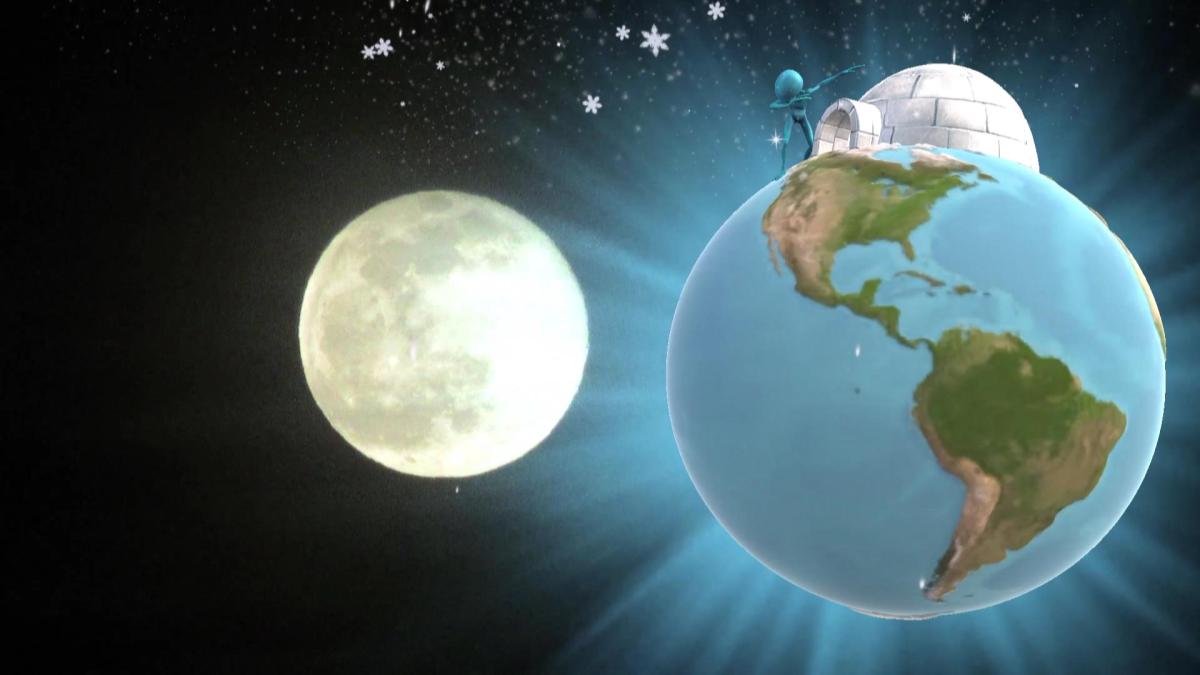
I’m having a little trouble keeping all of the different moon names straight. Last night was the Snow Moon. I managed to get a snapshot of it. It doesn’t look different from any other full moon. It’s called the Snow Moon mainly because February tends have the winter’s heaviest snow fall, according to the Old Farmer’s Almanac. It’s also known as the Hunger Moon or the Bony Moon, because this time of year could mean starvation for some back in the days when you had to hunt for your meals.
I got that mixed up somehow with the Wolf Moon—which was in January. I missed that one. On the other hand, you can think of being hungry as a wolf, or the wolf being at your door, meaning not having the means to fend off starvation. Anyhow, that’s my excuse for getting the Wolf Moon mixed up with the Snow Moon. However, according to the Old Farmer’s Almanac, some Native Americans actually called the January full moon the Snow Moon.
We did get a lot of snow in both January and February. We shoveled a lot of it. I guess there’s no official name for the problem I have flexing my stiff, sore left ring finger, which I’m pretty sure results from my grip on the snow shovel handle. I also occasionally get a stiff, sore left big toe, which I can’t flex. I believe this is from the way I tend to lean into my left instep when plunging the shovel into a big snowdrift.
Before you get after me with critiques about my body mechanics when snow shoveling, let me say this: I quit twisting my back and throwing the snow over my shoulder this season.
That said about the basic meaning of the Snow Moon according to the Old Farmer’s Almanac, there are other interpretations. This can be a time for reflection on transitions in one’s life.
There have been a lot of big and little changes in my life, the biggest one recently being retirement. It has been difficult to release my grip on my identity as a psychiatrist. I’ve been a doctor for a long time. It’s hard to remember what I was before I started medical school in the summer of 1988, which was a pivotal time for me. I joined several other students who were members of minority and disadvantaged groups, including but not limited to African Americans, in the summer enrichment medical school program. It has since developed into what is now the Summer Health Professions Education Program (SHPEP) at the University of Iowa.
In fact, it was a pivotal time for the University of Iowa College of Medicine. Leaders, including Philip G. Hubbard, were trying to navigate the controversy surrounding the concept of affirmative action. Not everyone accepted the idea with open arms at the time.
These days, I sometimes find myself remembering how I’ve changed over the past several decades. I recall the sometimes-awkward feeling of being a freshman at Huston-Tillotson College (now Huston-Tillotson University) in the mid-1970s. I had grown up in in a small town in Iowa, where I was often the only Black student in class.
When I was a child, I was lucky enough to have role models from both sides of the apparent racial divide. Although Paul ‘Blackie’ Espinosa was not African American, he took me and my younger brother to a Twins baseball game. While I don’t remember much about that day except that it was fiendishly hot—I remember how kind Blackie was to us.
I remember Al Martin, who was an African American artist in the community where I grew up. He took me to an art show where he displayed some of his paintings. Here again, while the Iowa weather was a small distraction (it was a very cold fall day), I looked up to Al as a leader.
I also remember a local pastor, Glen Bandel, who was white and who came to our house one terrible night when my mother was very sick. He stayed all night watching to make sure she didn’t need to go to the hospital. He slept sitting up in a rocking chair. I googled his name the other day. Much to my surprise, he’s still alive and is in his 90s. There was a news item announcing the celebration of his 90th birthday a couple of years ago.
As I try to stitch my past to my present, I keep finding that the strongest thread over the last 43 years has been my wife, Sena. I don’t know where I would be without her. I don’t like to contemplate it. I don’t know how I’ll navigate the changes that are surely happening even as I sit here and, in turn, dread or welcome them. Change will happen, no matter what the shape or tint of the moon, and whether I want it or not.
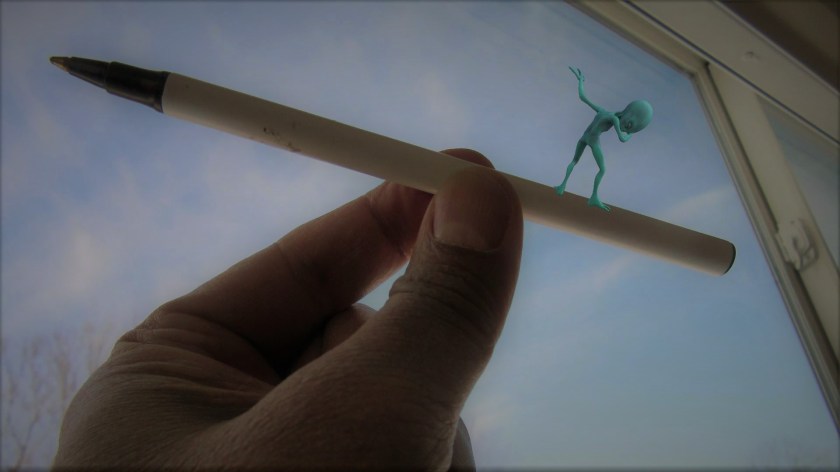
I’m sure you’ve already heard about the sighting of a UFO in the sky over New Mexico by an American Airlines pilot in the last few days. His recorded account sounds like he thought it might be some kind of long, cylindrical missile. It may or may not be the subject of an FBI investigation. I don’t know why the FBI should get involved. Heck, I have an unretouched snapshot of the darn thing by remote viewing via teleportation through a wormhole vortex. I’ve had lots of practice with this potentially dangerous maneuver, but you should not try this at home.
The original story I saw mentioned that the UFO was seen over a remote corner of New Mexico—close to a place called Des Moines. Don’t confuse that with Des Moines, Iowa. That doesn’t mean that UFOs never visit Iowa. It’s hard to know what to make of all those soybean mutilation reports.
There was a similar incident a couple of weeks ago. A UFO was reportedly spotted over Florida, although that one was said to be an actual missile. I got a shot of that one too, and I’m not so sure. Note the scorch marks on the fuselage.
It’s pretty frustrating that so few people get their cameras out when they see UFOs. You can claim that it’s adequate if we get recordings of pilots saying things like, “I’m seeing a UFO right now and it’s shaped kind of like a cross between a toaster oven and an Emu. I would say more but I’m being abducted as we speak. Can someone call my broker and tell her I want to buy more shares of crop circle futures?”
But a picture is worth a thousand words. How about those tic tac images? Has anyone contacted Ferrero Group to remind them that you need some kind of license to make UFOs? They’re too big to eat, by the way.
Some of you might remember the Public Broadcasting TV show Star Gazer hosted by Jack Horkheimer? He always closed the show by inviting viewers to “Keep looking up!”
That’s something we could all do more of. Keep looking up.
I was out shoveling snow this morning in the subzero temperatures. It’s getting down to 20 and 30 degrees below zero with the wind chills today and tomorrow—and likely beyond. Try to keep your buns warm in weather like that. Sena helped by making hot cocoa when I came in for a break. Little things like that make a big difference. Like many other people in the country, we’re getting out despite the wind chill warnings. There are a couple of reasons for that. None of us want our neighbors falling on our sidewalks. The other reason is that you look for just about any kind of a break from the indoor routine caused by the Covid-19 pandemic, part of which is the TV show lineup.
On the other hand, I get a kick out of the Ancient Aliens program. Last night, William Shatner, the Star Trek star who has his own show about the weird and wonderful, UnXplained. He sat at the head of a table lined by a group of Ancient Aliens heavy hitters, along with video guest stars including physicist Michio Kaku. I think Shatner was playing the role of devil’s advocate, apparently trying to argue against the idea that aliens are driving their UFOs recklessly around our planet while intoxicated on oregano, crashing them on the Weather Channel’s Highway 401 in British Columbia, forcing the Heavy Rescue crews to pull them out of ditches using 65-ton rotators (which look like they’re from another planet, by the way) and occasionally kidnapping various humans for the odd anal probing.
Anyway, I suspect Shatner was playfully provocative and this got the Ancient Alien crew to talking loudly and rapidly all at once, interrupting each other and challenging Shatner to a knife fight and whatnot. Just kidding; they were all very polite and respectful.
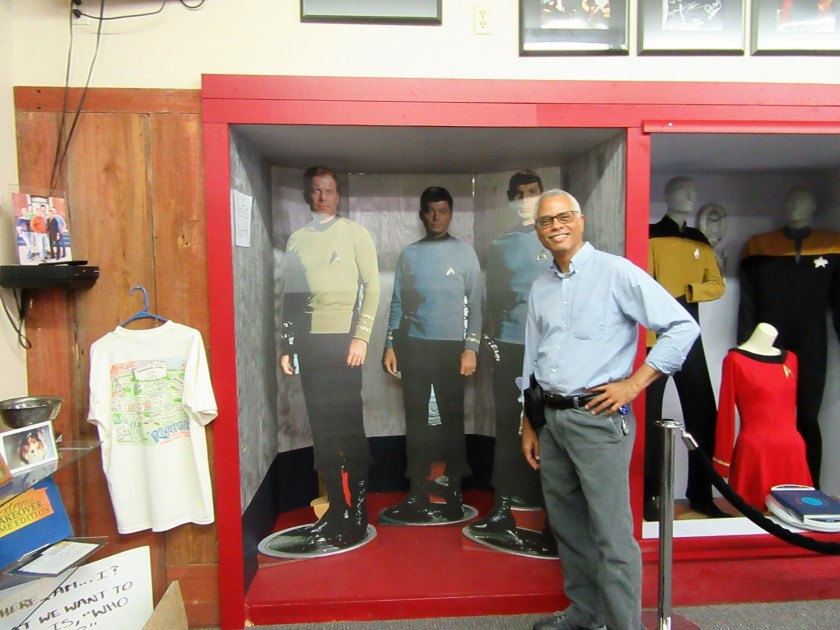
Me at the Star Trek Museum in Riverside, Iowa in 2016
I think it’s possible to take the Ancient Aliens show too seriously. I really wondered why Shatner was invited as a guest on Ancient Aliens. Maybe they don’t take themselves as seriously as some people think. Well, OK, they probably do.
In fact, I don’t think Shatner takes his own show, The UnXplained, seriously. I wonder if the title of the show is a sort of jab at the X-Files? Remember the 1999 episode, “The Unnatural”? Josh Exley (played by Jesse Martin) was an alien who took the form of an alien and was an excellent baseball player. He hid among an all-African American baseball team in Roswell in the 1940s but was executed by an alien bounty hunter who didn’t want him mixing with the human race. Think about that irony. The episode was warmly comical and at times, even poked fun at the preoccupation with alien invasions. I actually liked Jesse Martin’s version of the gospel song “Come and Go with Me to That Land.” There is no full version of it, but I also liked Sam Cooke’s rendition. Sena and I both really enjoyed watching the X-Files while eating popcorn. I treasure the memory.
Well, the sun is shining and it has finally almost stopped snowing. I have to go back out and finish shoveling.











 Go Retire Psychiatrist