COVID-19 Long Haul: Pizza in the Pan Again?

I remember a scene in the 1979 movie The Jerk, starring Steve Martin as Navin. He was telling Marie (played by Bernadette Peters) about pizza in a cup. They were both eating pizza in a cup. At the time, this was funny because it was ludicrous to think of pizza being served in a cup. It was almost unthinkable. Now you can find recipes for pizza in a cup all over the web. Things have changed.

But what does that have to do with COVID-19 Long Haul Syndrome? As a retired consultation-liaison psychiatrist, I can tell you that it’s beginning to look like things have not changed when it comes to doctors thinking somebody has a psychiatric syndrome if he presents with symptoms that can’t be medically explained. In other words, it’s easier to invent pizza in a cup then to rethink the mind-body dualism puzzle.

That seems to be happening with COVID-19 Long Haulers. I’m beginning to see the telltale signs of somatoform-type labels eventually getting applied to patients who get mild symptoms that sound like COVID-19 early on, but which often don’t get severe enough to require hospitalization. They tend to be younger, and develop long-term symptoms, some lasting for over a year, that sound a lot like what many doctors used to page me about—medically unexplained symptoms (MUS). They have fatigue, often have breathlessness, and pain for which medical tests often turn up negative results. When doctors substitute other words for MUS that they believe are less stigmatizing, there is a predictable backlash by patients who reject the new, softer label. Pizza in a pan.

Further, I noticed a study sponsored by Beth Israel Deaconess Medical Center listed on Clinical Trial dot gov called Mind Body Intervention for COVID-19 Long Haul Syndrome (first posted April 22, 2021). Participants will be assessed using the Somatic Symptom Scale-8 (SSS-8) which measures somatic symptom burden and was developed in the context of evaluating the DSM-5 somatic symptom disorder diagnosis. Pizza in a pan again.

I also found a comprehensive article on line, “The Medical System Should Have Been Prepared for Long COVID” by Alan Levinovitz, which presented a thorough description of the problem many patients have with physicians telling them their symptoms are “all in their heads.” Unfortunately, this now includes the symptoms of COVID-19 Long Haul Syndrome. In all fairness, I think most physicians try not to give patients that impression. For many years, I was often consulted to assist primary care and specialist physicians in “convincing” patients to think “both/and” about symptoms which could not be medically explained. In fact, that was part of my approach because, believe it or not, some patients were stuck in an “either/or” mindset about symptoms: physical vs psychological, body vs mind, eventually reaching invalidating conclusions like real vs not real. It’s not helpful, partly because physicians tend to get stuck in that mindset as well. We can’t seem to get the pizza out of the pan and into a cup.

Levinovitz mentions that some patients with COVID-19 Long Haul Syndrome have symptoms similar to another syndrome which had been linked to somatoform illness, Myalgic Encephalomyelitis/Chronic Fatigue Syndrome (ME/CFS). There is a great deal of information about it on the CDC website although the cause is still unknown. The CDC language treads very carefully on the issues of causation and treatment—and manage to draw a sort of dotted-line link between ME/CFS and COVID-19. It’s the same old pan.

Levinovitz also mentions Postural Orthostatic Tachycardia Syndrome (POTS), another poorly understood syndrome. I remember presenting a Grand Rounds about a patient with this POTS to my colleagues in the Psychiatry Department when I was an Assistant Professor. I invited the cardiologist who consulted me about the issue in one of his patients—who he suspected of having anxiety as the primary issue. Years later, I was consulted by another doctor about a different patient who definitely had abnormal test results (Tilt Table) consistent with POTS, did not suffer from anxiety, yet still thought psychiatry might have something to offer. The patient was puzzled but polite about why a psychiatrist was consulted. Pizza in the pan.

It’s very difficult for physicians to convey, in all humility, “I don’t know, but I still care.” The reasons why are complicated. The push for medical certainty, the packed medical clinic schedules, the limited time to spend with patients. It’s easy to say we must reimagine the way we practice medicine. It’s very hard to do. It’s a lot harder than reimagining the path from pizza in the traditional pan to pizza in a cup.

Hey, How About Them Nielsen Surveys?

Hey, how ‘bout them Nielsen’s surveys? I can’t remember getting any Nielsen media rating surveys before I retired and I’ve gotten two of them since then. They send you a crisp, new dollar bill in the mail to entice participation. More likely, it elicits guilt. You’d return the dollar bill but not in the mail, would you? Is this some kind of rite of passage or what?

Technically, you’re not supposed to talk about whether or not you participated in the survey, but I saw one blogger’s post about his radio diary survey. Is there a penalty for admitting you’re a part of “Nielsen Family”? Are there Nielsen Enforcers who come to your house and break your kneecaps while listening to the Godfather soundtrack through their earbuds if you don’t obey the rule?

One white commenter thought Nielsen just targets old white guys for some reason. Then a black commenter pointed out that Nielsen mails the surveys to old black guys too, so it didn’t have anything to do with skin color—and he did it with a sense of humor. He speculated that Nielsen might just target grouchy old retired guys with strong opinions because we remember what the value of a dollar bill was back in the day.

It reminded me of what I used to listen to on the radio in my younger days. Back then, the radio was what you had to use to listen to music. Well, there was a TV music show called American Bandstand, hosted by Dick Clark. The format was pretty much young couples dancing to the latest tunes while the camera panned over the dancers randomly. I remember watching it one day and noticing the camera was moving a lot less randomly and kept focusing on a young blonde woman in the crowd in the middle of the dance floor. That is, it did until she made a very lewd gesture which immediately led to a return to very random camera meandering—and possibly higher Nielsen ratings.

 I listened to the radio a lot when I was a kid. One of the local radio stations was KRIB, which the announcer always pronounced “K-OW-I-B because he talked so fast. Many of the songs were bad, so bad that a humorist named Dave Barry published a book about it in 1997, Dave Barry’s Book of Bad Songs. He’s a Miami Herald newspaper columnist who has written a lot of funny books. I had nearly all of them at one time, including the bad songs book. I have only a few now, including an autographed copy of one about getting older, Lessons from Lucy (2019).

One of the worst songs in my opinion was a 1976 tune “Blinded by the Light” by Manfred Mann’s Earth Band. It’s actually a cover of a song by Bruce Springsteen. I kept hearing a lyric I definitely thought was “wrapped up like a douche,” which I swear I never shared with anybody nor looked up on the web (or as Dave Barry would say, “I swear I am not making this up.”) until just today to discover I’m far from the only person to hear that. I also found out that kind of error is called a “mondegreen” (a mishearing of a phrase in a way that gives it a new meaning). The actual lyric was “revved up like a deuce.” That was the kind of bad song Dave Barry wrote about—although I don’t remember that specific song being in his book.

Nowadays I listen to KCCK (88.3 FM) for blues and jazz. Years ago, I used to listen to Da Friday Blues show starting at 6:00 p.m. every Friday. It was hosted by John Heim, who is still doing the show, even after a devastating accidental neck injury which left him paralyzed from the neck down a few years ago. He was hospitalized at The University of Iowa and his family and friends donated a lot of money to help him get to a rehab center in Omaha, Nebraska. John actually retired from teaching in 2004, but has been a DJ at KCCK for years because music means so much to him. He’s a brilliant example to retirees everywhere.

There’s a lot more to radio than Nielsen ratings, no disrespect to Nielsen Families everywhere—and just a reminder, I have no kneecaps worth breaking.

Busy as a Beaver

I’m probably busy as a beaver, especially now that I’ve read a short description of how a beaver builds a dam. The article is short on references; in fact, there are none to back up the unidentified author’s remarks. In fact, I suspect the article is fact-free, the only apparent purpose to create test questions for grade-school children.

The author says that, while beavers are busy when engaged in tree felling and dam building, they are disorganized, poor at planning the activities and often mess them up—even accidentally getting killed by falling timber.

By analogy then, since I retired last year, I’ve been about as busy as a beaver. When my frame of reference was working at the hospital as a consulting psychiatrist, I was extremely busy. I put on 3 to 4 miles and about 30 floors a day chasing consults all over an 800-bed hospital with 8 floors.

Now my typical day is very different. Staying physically fit is challenging. I exercise daily, but it’s hardly as demanding as when I was working. I start off with floor yoga to warm up. I hop on the stationary bike, which is not a Peloton or anything like it. There’s nobody in the display exhorting me to crush that Peloton. The digital mileage counter display doesn’t even work.

Next, I do bodyweight squats. My ankle and knee joints crackle and pop loudly, but as long as they don’t hurt, I imagine I’m fine. Next, I do curl and press exercises with a pair of 10-pound dumbbells. Then I do planks. After 3 sets of squats, etc., I get back on the bike. Following the exercises, I sit for mindfulness meditation. That whole business takes about an hour.

As far as beaver busyness, the only time I felled any timber was last summer, when I flirted with danger using a power pole saw trying to clear dead tree limbs left over from the derecho. That actually was a poorly planned activity and was certainly dangerous. I guess I was busy as a beaver then.

Is there such as a thing as being mentally busy as a beaver? Apparently not. Sena and I play cribbage now and then. Other than that, there’s always TV. I listen to music on the Music Choice Channel on TV. I like the Easy Listening and Light Classical stations. Each musical artist featured has several short biographical notes appear while the music plays. I practice doing mental subtractions when the artist’s birthdate appears. It’s the old borrowing method of subtraction you learn in grade school—unless nobody teaches that anymore. There are usually several grammatical and usage problems (worse than mine) with the information about artists and I practice recasting sentences. Sometimes they’ll mention a musician’s nickname, such as BullyboysquatlowjoocedewdliosityBrahms. Several of the classical musicians composed symphonies before they were potty-trained.

On the practical side, I watch the Weather Channel, following which are shows like Highway Thru Hell and Heavy Rescue 401. Those guys are really busy, dragging semi-trucks out of ditches in snowstorms in British Columbia. They operate 75-ton wreckers with rotating booms and winches which regularly spit their cables at anyone nearby.

I alternate the heavy wrecker shows with the Men in Black (MIB) movies, which poke fun at the UFO and alien themes (a welcome counterpoint to Ancient Aliens which takes itself too seriously). I was sure I was watching MIB movies way too much until I found all of the fans’ contributions to websites which list the many errors in the movies. Just google “MIB goofs.” You’ll see the triumphant announcement from those who somehow know what color scheme New York City streets signs had in 1969 and point out how wrong the movie is. On the other hand, I know what kinds of pies young Agent K and Agent J had in MIB 3 (apple with a “nasty piece of cheddar” and strawberry rhubarb, respectively).

I guess all this makes me busy as a beaver.

Reflection on James Alan McPherson’s “A Solo Song: For Doc”

I’ve been reading the short story collection Hue and Cry by James Alan McPherson with the idea that the entire book was new to me. So, I was stunned when I remembered the story, “A Solo Song: For Doc.” It has more than one layer of meaning, but on one level it’s about a Black railroad train waiter named Doc Craft who is forced into retirement. The narrator tries to teach a young waiter he calls youngblood learning the ropes about how the old school waiters made their work not just a job but a way of life.  I was surprised to learn there was a television adaptation of the story made in 1982.

I must have read it in an anthology when I was a youngblood myself. It’s about racism but it’s also about aging, retirement, and change itself. It makes sense that I would feel differently about the story now that I’m older and retired.

I’m about a year into my retirement now and it has not been easy to adjust. Boredom and the search for a new meaning and purpose in my life still challenge me. While racism did not play a part in my decision to leave my profession, there is no doubt that things changed over my three-year phased retirement starting in 2017, dramatically so since the COVID-19 pandemic in 2020.

I thought I was still maintaining my skills as a psychiatric consultant in the general hospital. I was physically fit, in many cases better able to run up and down the stairs for 8 flights than the youngbloods. When they asked me why I became a consulting psychiatrist, I often told them that I “did it for the juice.” I guess that’s why Doc Craft did it.

Maybe I retired because I didn’t want to be pushed out. Doc Craft didn’t retire because he just wasn’t made for it. Sometimes this doc wonders….

Imagination Lives in Oakland Cemetery

We don’t usually make trips to Oakland Cemetery (or any cemetery for that matter), but today we made an exception to find the grave of James Alan McPherson, the first African American to win a Pulitzer Prize for fiction and longtime Iowa Writers’ Workshop faculty who died in 2016 and for whom an Iowa City park was renamed a month ago.

We never met McPherson, although we are reading a couple of his books (Elbow Room, the Pulitzer Park winning work, and Hue and Cry) and just visited the James Alan McPherson Park on Monday this week.

This trip brought back happy memories right away. It’s not the first time we’ve been to Oakland Cemetery. In 2015 and 2016 we took the same route, parking at Happy Hollow Park on Brown Street and walking east to find the Black Angel. The main reason for going to Happy Hollow Park back then was not so much to see the Black Angel, but for two Psychiatry Department Faculty vs Resident Matball games at Happy Hollow Park. Matball is an imaginative combination of kickball and baseball using large mats for bases and a kickball for pitching, which the hitter actually kicks and runs the bases.

I was on faculty but didn’t play, which I thought would help them win. It was very hot both years. Faculty lost both years. There was another match in 2017 which I didn’t attend, and which I think faculty also lost.

But it was great fun. I don’t remember who put the 2015 trophy won by the residents in a bowl of red (possibly strawberry, I didn’t eat any) Jell-O. That took imagination. It was a stroke of genius, but was not repeated after the following two losses. There have been no Matball games since then.

Anyway, we visited the Black Angel. I think I left some loose change at the foot of the sculpture, which is traditional I think, for good luck. The Black Angel has a very complicated story, which is in many cases, fueled by superhuman imagination. The stories get more complicated every year and the legends have been developing since the 9-foot statue with 4-foot pedestal was created in 1912.

Actually, the Black Angel is often used as a point of reference for the rest of the cemetery. That’s how we used it today to find McPherson’s grave, which is said to be in a place called the poets’ corner where many other artists, including Writers’ Workshop faculty, are buried.

The easiest way to find the Black Angel is probably to approach the cemetery from the west and head east to the intersection of Brown and Governor Streets, where there’s a big sign for Oakland Cemetery. There’s a map next to the cemetery office. We could not find any place marked “poets’ corner.” But the Black Angel is clearly marked.

You’ll notice you can drive through the cemetery, but the paved road is about the width of a car. It’s actually more like a service road, just right for riding mowers, but a little narrow for cars. There is no parking lot we could find, which is why we parked at Happy Hollow Park.

As you reach the Black Angel, you’ll notice one of her wings is raised at a right angle from her body. It points roughly North. You need to go in the opposite direction to find poets’ corner. As you pass the Black Angel, take the second path to the right and simply follow it around, moving south past the University of Iowa Deeded Body Program monument to a section marked with a narrow post labeled “Oak Green.” That’s where you’ll find McPherson’s headstone.

The headstone is easy to pick out; it’s an imaginative work of art. The black rectangular stone is decorated with clever sculptures including his signature car cap, two roses, and even a cigarette in an ashtray. He was a smoker. I don’t know what the characters on the pedestal mean.

On the back of the stone are many carved envelopes indicating McPherson’s mail correspondence with many loving friends and family—and beyond. There is a sense of humor and imagination here too. One of the envelopes is from “Publisher’s Clearinghouse” and the recipient section says “ATTENTION: You may have already won $1,000,000!” I can just picture Ed McMahon! Another is from “Fabian’s Seafood Truck” to “Our Loyal Customer.” I didn’t realize it while we were there, but when we got home, it occurred to me that as we were driving home from James Alan McPherson Park, we saw a big refrigerated truck where seafood was being sold; it was next to the Dairy Queen on Riverside Street. I searched Fabian Seafood on the web and found a picture that exactly matched what we saw.

Around the edge of the headstone was an inscription that to read in its entirety you have to walk all the way around the monument because the words are carved in the front, sides and back:

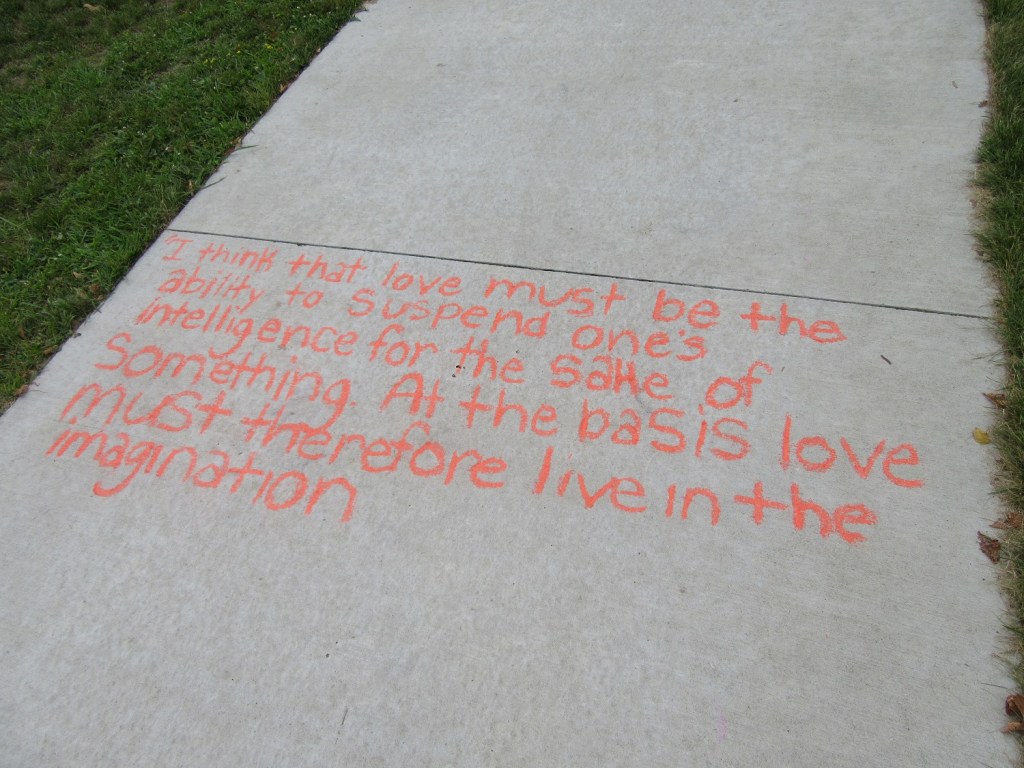
“I think love must be the ability to suspend one’s intelligence for the sake of something. At the basis of love therefore must live imagination.” This is a quote from McPherson. He also wrote in his essay “Pursuit of the Pneuma” about “an ancient bit of spiritual wisdom” which denies that God rested on the seventh day after creating all existence. Instead, God created imagination and gave this gift to his human creations, enabling us to wield an integrative kind of power—which is what love can do.

Imagination therefore lives in Oakland Cemetery.

Walk the James Alan McPherson Park

Yesterday, Sena and I visited the James Alan McPherson Park. The Iowa City Council renamed it in his honor last month; it was formerly called Creekside Park. There were compelling reasons for the name change. He was the first African American to win a Pulitzer Prize for fiction for his collection of short stories, Elbow Room in 1978, graduated from Harvard Law School in 1968, was inducted into the American Academy of Arts and Sciences in 1995, and was a permanent faculty member for thirty years at the Iowa Writers’ Workshop at the University of Iowa, among other notable career achievements. He was 72 when he died in 2016 of complications of pneumonia.

McPherson was a longtime resident of Iowa City and was revered by his students. Colleagues described him as the “moral center of the Iowa Writers’ Workshop” and even the “moral center of the world.” Despite his stunning achievements, he was shy and often barely spoke above a whisper in the classroom. He lived in the general neighborhood where the park is located. We never got a chance to meet him.

We are reading his books, though.

The park is located at 1878 Seventh Ave Ct and sits on a little over 2 acres. It was empty except for the occasional walker on the trail. People were friendly. It seems hardly distinguishable from the neighborhood surrounding it and blends into the homes, hugs the meandering creek and adjoining trail, and seems held in a protective embrace by the homes bordering it. A new park sign and a memorial plaque will be installed later this summer.

We saw a rich variety of birds, in fact more than we’ve seen in a while.

We get a sense that everyone is welcome there. There are 6 parking spaces. You can imagine that limited parking makes the place a treasured possession of the immediate neighborhood. But people we encounter there make us feel that it belongs to all of us. Even a sign leaning against a house alongside the trail made that clear. We’ll be back.

Bigfoot, UFOs, and the Dollar Bill Jump Challenge

I’ve got one thing in common with a lot of people who say they’ve seen things like Bigfoot and UFOs. I’ve seen someone beat the Dollar Bill Jump Challenge but I can’t prove it.

I know there are a lot of people who say they’ve seen the Loch Ness Monster, ghosts, little gray aliens, Sasquatch, and who also claim to have eaten delicious fruitcake. That is to say I’ve seen a lot of blurry photographs, videos, and I’ve thrown out more than my fair share of fruitcake.

However, I also don’t have any video evidence for what I saw a guy at the YMCA do over 40 years ago, which was to jump forward over a broom handle while holding his toes. Don’t bother asking me why there was a broom in the weight room at the YMCA. Too many questions get in the way of a good story. This middle-aged jock was telling me and another youngster about this strong man stunt of jumping over a broom handle laying on the floor. He never mentioned a dollar bill, but it looks like this is usually part of the game.

He looked right at me and said, “You look like an athlete, let’s see if you can jump over a broomstick.” First of all, I was a skinny kid and didn’t look athletic—that’s why I was in the weight room in the first place. Furthermore, the guy had several conditions for jumping over a broomstick on the floor I didn’t know about before agreeing to try it.

You have to bend over in front of the broom handle (dollar bill) and grab your toes, keep your knees slightly bent, and then all you have to do is jump. Most of the time, the challenge is to jump over a dollar bill. I think you could injure your feet on a broom handle, so I advise against it.

There are variations on this game. It probably makes no difference if you lay the dollar crosswise or lengthwise. You always have to grab your toes, not let go when you jump, and land upright. There’s an ankle grabbing variation which I don’t think makes much difference, but the classic rule is you have to hang on to your toes.

The other kid and I tried to do this about a dozen times and we invariably let go of our toes or fell over or both. Then the middle-aged jock did it flawlessly. No, I didn’t have a camera. It’s too bad because a video would prove one way or another whether this stunt is possible.

On the other hand, I’ve seen a lot of videos and snapshots of Bigfoot on TV that are so terrible I can’t tell if I’m looking at a Bigfoot or a man in a monkey suit. I’ve never seen an alien, not even the corpse of one. I know, there are a lot of videos of UFOs, but they look like tic tacs and make me think of someone shaking a mini laser pointer in front of a cat to make it chase the light around. And I have not tried to eat fruitcake since I was little and my mom made me eat it because it was a Christmas gift from our church.

What would impress me is seeing a video of a Bigfoot ghost stepping out of a flying saucer while eating a big slice of fruitcake.

The one explanation I’ve found on line for why the dollar bill jump stunt is considered impossible is that your center of gravity has to move ahead of your base. The same article says you can jump backward easily because the support base moves first and the center of gravity stays in a balanced state. I can’t do that either. There are a couple of YouTubes that show a lot of people falling over. None of them tried it backward, although one guy tried it sideways and fell on his side.

For the record, my story of witnessing somebody beat the dollar bill jump is just that—a story. If you have a video of you or somebody beating the dollar bill jump challenge, let me know.

Reflecting on Ironies

Over the Easter weekend, we drove by James Alan McPherson Park. A lot of people were having a great time. Because it was crowded, we went to Terry Trueblood Recreation Area, planning to return another day.

We just got our copy of McPherson’s Pulitzer Prize winning fiction anthology, Elbow Room. We’ve ordered his other collection of short fiction, Hue and Cry and it’s been shipped.

McPherson was impressed with the neighboring culture of Iowa City. He’s described as being kind and neighborly himself.

He was self-effacing, which probably seemed ironic to some people, given he was the first African American to win the Pulitzer Prize for fiction for Elbow Room. He was on faculty at the Iowa Writers’ Workshop for many years, won the inaugural Paul Engle award from the Iowa UNESCO City of Literature, graduated from Harvard Law School, recipient of a Guggenheim Fellowship, a MacArthur Fellowship, and was inducted into the American Academy of Arts and Sciences.

I’m struck by a few ironies. Our paths never crossed but that’s probably not surprising given our different professional trajectories. I graduated from medical school at Iowa and just retired last year from the University of Iowa Hospitals & Clinics (UIHC) Dept of Psychiatry where I was a Consultation-Liaison Psychiatrist.

However, McPherson in his essay, [Pursuit of the Pneuma, McPherson, J. (2011). Pursuit of the “Pneuma”. Daedalus, 140(1), 183-188]. described being treated by Iowa City psychiatrist, Dr. Dorothy “Jean” Arnold. And, ironically, Dr. Arnold was white (both she McPherson came from the racially polarized South) and originally graduated from the University of Alabama Medical School. She was also the first female psychiatrist to open a private practice in the state of Iowa in 1957. She taught at the University of Iowa Hospital, but I could not find her mentioned in the history of the UIHC Psychiatry Dept, although Dr. Peg Nopoulos, the first woman chair of the department, has her own chapter [Psychiatry at Iowa: The Shaping of a Discipline: A History of Service, Science, and Education, written by James Bass.]

I’m mentioned in Bass’s history, which is sort of ironic. The book is actually about scientists in the field of psychiatry, and I was anything but. I was a clinician. For comparison, if you ever watch the Weather Channel, I’m not a meteorologist. I’m more like the guys on Highway Thru Hell or Heavy Rescue 401, although I’m not practical in that sense. I am African American though, and it was a good idea for Bass to mention me, since I think I’m the only Black psychiatrist to have ever been hired by the department.

McPherson was impressed with the generous and receptive nature of Iowans, which he ascribed to a quality captured by the word “Pneuma,” a Greek word meaning “the vital spirit of life itself.”

There’s another irony in connection with one of my most influential teachers at Huston-Tillotson College, in Austin, Texas, one of the historically black colleges and universities (HBCU) in America. McPherson attended the HBCU at Morris Brown College in Atlanta, Georgia. Dr. Jenny Lind Porter-Scott, who recently died, was a white Professor of English at H-TC, writer and translator of poetry, teacher to thousands, and popular with students of all races, yet there is no tangible, permanent remembrance of her by Texans. To be sure, she is listed in the Texas Women’s Hall of Fame and in 1964, she was appointed Poet Laureate of Texas by Governor John Connally. Her house was demolished in 2016. In 2016, an architect sent me an email message describing a plan to build a mini-library of her published work in the neighborhood, and a house similar in style to the one demolished on the lot. Whenever I check on Google Maps, the lot remains empty and overgrown with weeds. 

James Alan McPherson taught and formed close bonds with many students who came from different countries, ethnic, and racial backgrounds. Enjoy the park named for him in the “the vital spirit of life itself.”

Worm Moon for March 2021

The full moon for this month on March 28, 2021 is called the Worm Moon. According to the Old Farmer’s Almanac, it’s “spectacularly bright.” It is indeed. I took the picture below around 8:30 PM.

Worm Moon March 28, 2021

It’s also known by other names including the Eagle Moon and the Crow Comes Back Moon, Wind Strong Moon among others. By the way we had a Fire Weather Warning around here for today and tomorrow advising against outdoor burning because of elevated grassland fire risk due to windiness.

It’s not clear what kind of worm is connected with this moon. It could be a beetle larva or an earthworm. Maybe the earthworm is connected with the return of robins, who eat the earthworms. Which makes me wonder what earthworms eat. They commonly eat parasites so you don’t want to snack on any raw earthworms.

Yes, in fact you can eat earthworms. You can but I won’t. I’m a finicky eater and I’ve been called the slowest eater in the world. I prefer to call my pace mindful eating. It becomes slower (I mean more mindful) when I encounter stuff like shredded coconut, which I chew forever because somehow, I can barely bring myself to swallow it. It has the consistency of cellophane, to which I have a personal policy against eating. I’m not sure you could eat earthworms mindfully, but I bet you couldn’t get your mind off what you’re eating.

Mindful eating was something I learned about when I took the Mindfulness Based Stress Reduction (MBSR) course several years ago. Mindful eating guidelines include keeping the different tastes: salt, sweet, sour, bitter in mind, so to speak. In addition to those there’s another taste called umami (pronounced oo mommy). I think it’s close to savory, not to be confused with Smack Ya Mama, a Cajun seasoning, which you might use in gumbo.

Gumbo comes from a West African word for okra, another thing I would rather not eat because it’s slimy (sort of reminds me of earthworms). Mindful eating could include setting down your utensils or food in between bites. I could easily set down my utensils and okra—but I probably wouldn’t pick them up again.

There is no connection I know of between the Men in Black (MIB) Worm Guys and the moon. They don’t come from the moon but they’re definitely not from this galaxy. I don’t know what they eat but they like gourmet coffee and cigarettes. You can cut them in half and it doesn’t kill them; they just pull themselves together. If you cut an earthworm in the right place, behind the half that contains the head, several hearts, etc., it grows a new hind end.

The moon is a fascinating thing. It stabilizes the earth, keeping it from wobbling on its axis so that our seasons and temperatures don’t change wildly. It’s slowly moving away from us, according to scientists. But it’s a very long goodbye. It will be many Worm Moons before the moon goes. And by then, there won’t be anyone to notice.

James Alan McPherson Park

I discovered recently from a news item that a local park (formerly Creekside Park) in Iowa City has been renamed James Alan McPherson Park. I realize it’s incredible, but I didn’t know who he was. How did he escape my notice? We’ve lived in the Iowa City and Coralville area for over 30 years and the African American Pulitzer Prize winning fiction writer and Iowa Writers’ Workshop professor had been here the whole time. McPherson died of pneumonia complications in 2016.

We moved in different circles. My wife, Sena, and I moved to Iowa City in 1988 so that I could attend the new summer enrichment medical school program for minority and disadvantaged students. The program owed its start to a leading African American University of Iowa professor, Philip Hubbard. I graduated in 1992, finished my psychiatry residency in 1996, and spent nearly my entire career working as a psychiatric consultant in the University of Iowa general hospital until my retirement last summer.

In contrast, McPherson spent his whole career as a fiction writer. He earned his Master of Fine Arts at the Iowa Writers’ Workshop in 1971. He returned in 1981 to become a faculty member there and lived in Iowa City until his death. He won both the Guggenheim and MacArthur fellowships. In fact, his fame as a writer was established before he ever got to Iowa. McPherson made a substantial contribution to the workshop’s reputation as one of the top creative writing programs in the world.

Last January when I wrote the post about the Iowa River Landing Sculpture Walk, we visited the Iowa Writers Library at the Coralville Marriott Hotel and Conference Center. I mentioned Margaret Walker, the first African American woman accepted to the Iowa Writers’ Workshop. I still think the IRL should have a sculpture honoring her.

But I can’t even recall seeing a book by an African American man in the lowa Writers Library. It’s maintained by the Coralville Public Library, whose website lists several of McPherson’s works, including Elbow Room (which won the Pulitzer in 1978), as being shelved there. I remember thinking that the collection was a bit disorganized and that some books seemed to be missing or shelved in the wrong places. But since I wasn’t even aware of McPherson, I can’t say his books weren’t there.

Even though I have a copy of the book Invisible Hawkeyes: African American at the University of Iowa during the Long Civil Rights Era, edited by Lena M. Hill and Michael D. Hill, I missed any mention of McPherson in the chapter, Obscured Traditions: Blacks at the Iowa Writers’ Workshop, 1940-1965. One reason might be the time frame, which preceded McPherson’s matriculation. However, that’s no excuse because the very last page of the chapter mentions him.

The conclusion chapter of Invisible Hawkeyes (An Indivisible Legacy: Iowa and the Conscience of Democracy by Michael D. Hill in Invisible Hawkeyes: African Americans at the University of Iowa during the Long Civil Rights Era, in Chapter Four: Obscured Traditions: Blacks at the Iowa Writers’ Workshop, 1940-1965, by Michael D. Hill, University of Iowa Press, 2016). does devote a lot of attention to McPherson’s role at the Iowa Writers’ Workshop. While Hill acknowledges that McPherson described his experience at Iowa as “humanizing,” this was in the context of the struggle against racism endured by most other African American students who preceded him decades before. Interestingly, Hill suggests that it’s ironic for an alumnus of a historically black college or university (HBCU), (which was Morris Brown College in Atlanta, Georgia) to express a fondness for Iowa, a place where racism was keenly felt by his predecessors and which Hill suspects McPherson might not have understood in detail and which he discussed only in the abstract with his mentor, Ralph Ellison (author of Invisible Man).

Well, I’m in way over my head there—and I think it’s better for Michael Hill himself to comment on how irony seemed a part of McPherson. He’s also in the best position to describe McPherson as a person as well as a writer. In the video, Hill’s initial comments are about McPherson’s reaction to being the recipient of the Pulitzer Price for Elbow Room, his book of short stories.

We just ordered a copy of Elbow Room. I read a few of the stories from it on the web. It’s funny how chapters from some books find their way out there, often through university web sites, it seems. He was a genius at storytelling. Just from a psychiatric clinician’s standpoint, “The Story of a Dead Man” is a perfect description of someone with Antisocial Personality Disorder, something a colleague wrote about: Bad Boys, Bad Men: Confronting Antisocial Personality Disorder (Sociopathy) by Donald W. Black, MD, 2013 Oxford University Press. It’s an autographed copy. Incidentally, whenever I google black psychiatrists in Iowa, Dr. Black’s always near the top of the page. His name is Black but black he is not.

Which brings up a sense of humor, something which many people say McPherson had. He used a sense of humor several times during a fascinating 1983 interview with Bob Shacochis for the Iowa Journal of Literary Studies. It seems to me that they got a bit annoyed with each other a few times. One of the more striking comments from McPherson was his quote of an old Negro saying, “You may be my color, but you ain’t my kind.” The context was a question from Shacochis about McPherson’s thoughts about the Third World. I was puzzled by his reply that he thought the Third World was a “fiction.” McPherson said if the Third World has any power, then it might be politically advantageous for African Americans to identify themselves with it. He wasn’t after power, he just wanted to find his kind—and that didn’t have anything to do with color.

McPherson was very evocative in his writing and his speech. That old Negro saying evoked a memory in me of my short time at Huston-Tillotson College (another HBCU, in Austin, Texas) in the mid-1970s. I had grown up in Iowa in what were basically all white schools where I was the only African American kid in the classroom. When I finally went to H-TC, I felt very out of place. Even my Northern accent got me into trouble. One student asked me, “Why do you talk so hard?” There was this one time when I tried to play in a pickup basketball game with a group of other students. I was a very clumsy player. For the briefest of moments while struggling underneath the basket, I got murmurs of encouragement from several of them, even members of the opposite team. I will never forget how good that made me feel, especially when I contrast it with a memory from my hometown when I tried to play with a bunch of white guys. When one of them called out, “Don’t worry about the nigger!” I went and sat down on the bench.

The point is that nobody at H-TC ever said to me “You may be my color, but you ain’t my kind.” I said that to myself. Now, somebody else sent me a similar message to me in Iowa, shortly before I left for H-TC. It was a white woman who thought she meant well; she knew I was going there. She showed me a picture of a young black woman with the clear intention of trying to get me interested in females closer to my own color. The message was more like “You may be in my back yard, but you ain’t my color.”

Speaking of back yards, when I was in elementary school, a couple of white bullies a few grades ahead of me found me at my house and started beating the crap out of me in my own back yard. Somehow, they knew that I wrote little stories and brought them to school to read. I began doing that for my mother at home. I promised them I would put them in my stories if they would quit beating on me. They believed me and stopped. It didn’t occur to me how dumb they were for a long time after.

Those little anecdotes are nothing like the jewels that McPherson fashioned. My stories here are true biography of pain. James Alan McPherson’s stories were true fiction, something magical and evocative enough to foster healing of pain. I hope he found his kind.

James Alan McPherson did more than enough to get his name on a sign and dedication plaque for a small park.