CDC ACIP Highlights on Covid 19 Vaccine

There was a lot to digest in today’s CDC ACIP meeting on Covid-19 vaccines. I missed the morning sessions but managed to see a few of the afternoon presentations.

The presentation by Dr. Retsef Levi, PhD, MIT, ACIP Work Group Chair, the Covid -19 Vaccine Discussion Framing Work Group (WG) was basically pretty critical of the Covid-19 vaccines in general.

The opposing reply to this (favorable to vaccines) was put together by University of Iowa’s Dr. Stanley Perlman, Dr. H. Bernstein, and Dr. M. Miglis, Additional Workgroup Considerations in Covid-19 Vaccination Policy and Practice.

For a change, I listened to the Public Comment section. I usually have not paid attention to them because most of the speakers were opposed to vaccines. Today was different. All of them were strongly supportive of vaccines.

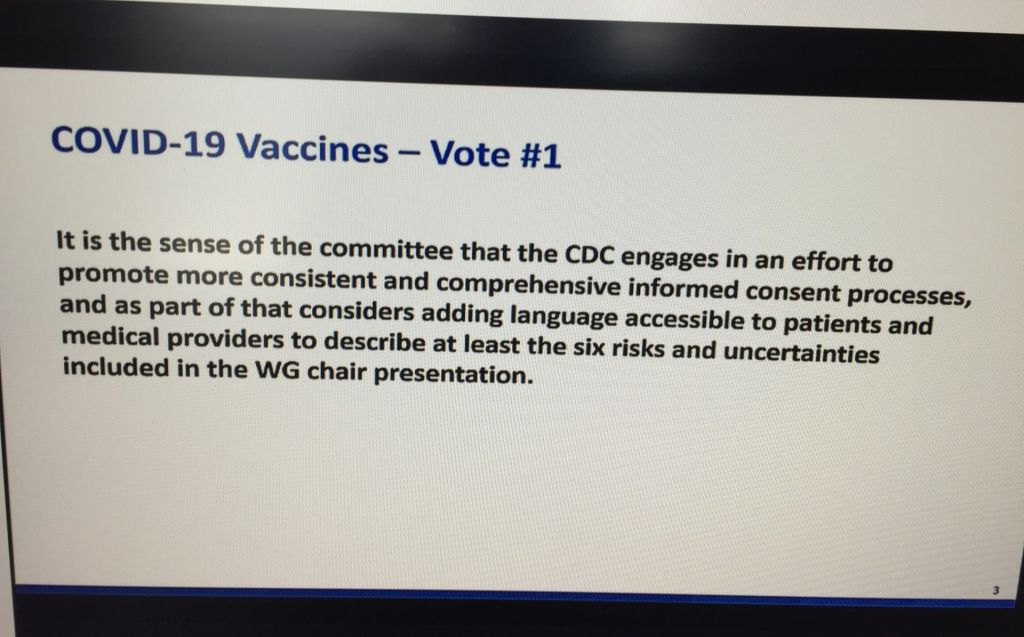
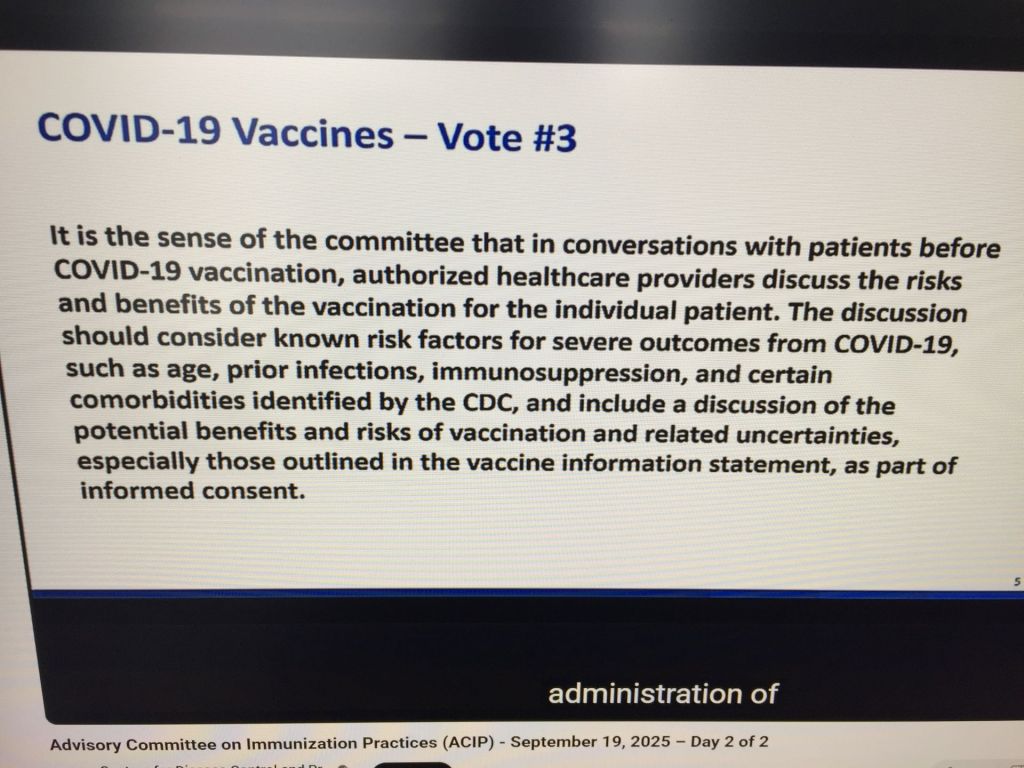
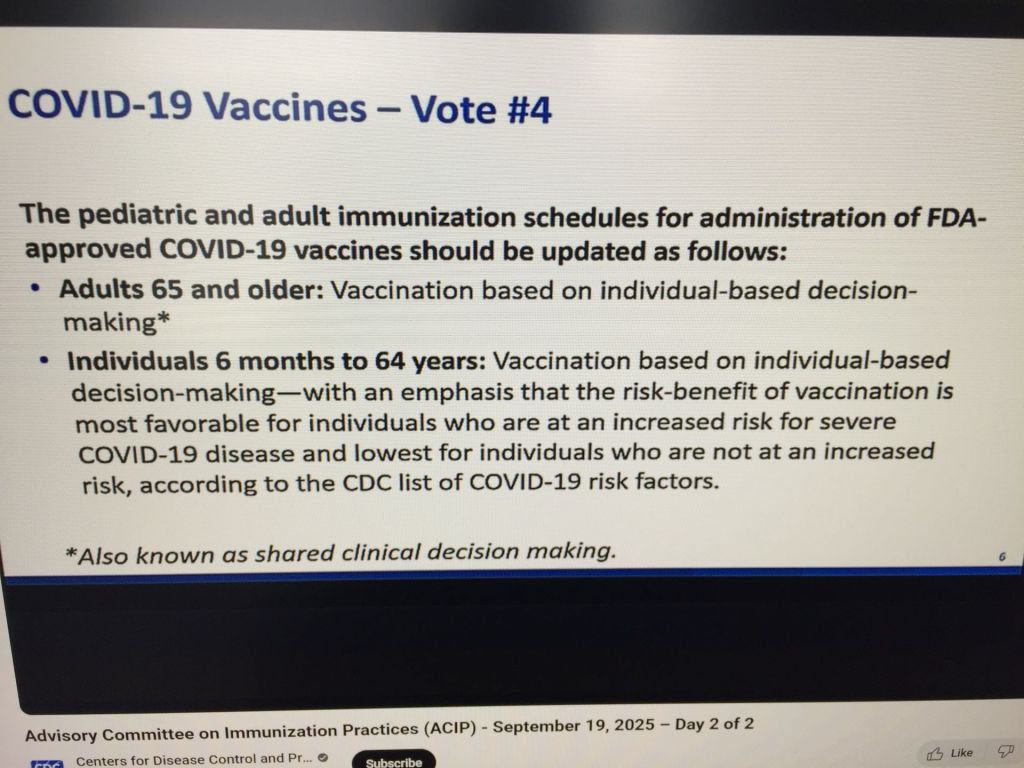
There is a bottom line to this. I watched the voting session, which was very interesting. There were 4 voting questions. I had to take pictures of them because they were not included in the on-line schedule. It was easily the most interesting session of the afternoon, at least for me.

Voting question 1: all but one member voted “yes,” the committee chair Kulldorff voted “no.”

Voting question 2: one member suggested striking this one, but they voted anyway. What’s worrisome is that it was split between the yes and no votes; only the chair, Kulldorff, could break it and he voted “no.” Looks like common sense won; otherwise it would have made access very difficult.

Voting question 3: The video lost audio for a long time, but eventually it turned out that the votes were “yes” unanimously on the assumption that pharmacists counted as “health care providers.”

Voting question 4: The votes were all “yes,” mainly because they decided that pharmacists could make this work. One member questioned the wording which suggested that you needed to talk to your doctor about getting the vaccine because of the wording “shared clinical decision-making.” They glossed over it.

It looks like access to the Covid-19 vaccine will remain mostly open for now.

Public Comments on Upcoming CDC ACIP Meeting Posted

I have just noticed that there are over 5,000 comments posted on the comments section of regulations.gov in the section entitled Meeting of the Advisory Committee on Immunization Practices-September 2025.

The link to the comment section is on the CDC ACIP meeting announcement web page, “Written Public Comments.”

This is the first time I’ve seen a written comment section like this for the meetings. I think it gives people a sense of what health care professionals and others think about how things are going with the current approach to preventive medicine at the CDC.

Upcoming CDC ACIP September Meeting on MMVR & Covid-19 Vaccines

The upcoming meeting on the MMVR and Covid-19 vaccines will include voting on the MMVR and Covid-19 vaccines. Usually, the committee posts the actual voting questions, which so far I have not seen on the meeting agenda. I’ll be looking for them in the next couple of days.

Here is the link to the Center for Infectious Disease and Policy (CIDRAP) at the University of Minnesota article which bears directly on the meeting topics.

CDC ACIP Meeting Agenda Posted

I just noticed that the CDC ACIP draft agenda for upcoming meeting on September 18th and 19th has been posted. There will be votes on the MMRV, Hepatitis B, and Covid-19 vaccines.

Got Vaccines Today!

Sena and I got our latest updated seasonal Covid-19 and flu vaccines today. Manpower was low at Walgreens so we ended up sitting for about an hour, but otherwise this was a routine trip. We’re thankful.

We noticed there were a few people waiting—mostly our age. No word up yet on the CDC ACIP site about the Sept. 18-19 meeting as far as an agenda, speakers, or slides.

Upcoming CDC Advisory Committee Meeting in September 2025-Or Not?

I’ve been checking the Centers for Advisory Committee schedule on their website for weeks and the only way I found out there is an upcoming meeting is on the Federal Register schedule. Sena found it in a news outlet story. As of this morning around 9 a.m., there was no announcement on the CDC website yet. That may change later today.

According to the Federal Register, the CDC ACIP will hold a meeting on September 18, 2025, from 10 a.m. to 5 p.m., EDT, and September 19, 2025, from 8 a.m. to 4 p.m., EDT.

Under Supplementary Information:

“The agenda will include discussions on COVID-19 vaccines; Hepatitis B vaccine; measles, mumps, rubella, varicella (MMRV) vaccine; and Respiratory Syncytial Virus (RSV). The agenda will include updates on ACIP Workgroups. Recommendation votes may be scheduled for COVID-19 vaccines, Hepatitis B vaccine, MMRV vaccine, and RSV. Vaccines for Children (VFC) may be scheduled for COVID-19 vaccines, Hepatitis B vaccine, MMRV vaccine, and RSV. Agenda items are subject to change as priorities dictate. For more information on the meeting agenda, visit https://www.cdc.gov/​acip/​meetings/​index.html.”

However, I also noticed a news article posted by the Center for Infectious Disease Research and Policy (CIDRAP) indicating that the meeting might be postponed because of the recent upheaval around vaccine policy and personnel.

This meeting’s actual timing and schedule items could be moving targets.

Thoughts on Long Covid

I read Dr. Ron Pies, MD’s essay today, “What Long COVID Can Teach Psychiatry—and Its Critics.” As usual, he made thought- provoking points about the disease concept in psychiatry. What I also found interesting was the connection he made with Long Covid, a debilitating illness. He cited someone else I know who was involved with a group assigned to create a working definition for it—Dr. E. Wes Ely, an intensive care unit physician at Vanderbilt University in Nashville, Tennessee.

I remember when I first encountered Dr. Ely, way back in 2011 when I was a consulting psychiatrist in the University of Iowa Health Care general hospital. I was blogging back then and mentioned a book he and Valerie Page and written, Delirium in Critical Care. Back then I sometimes read parts of it to trainees because I thought they were amusing:

“…there is a clearly expressed opinion about the role of psychiatrists. It’s in a section titled “Psychiatrists and delirium” in Chapter 9 and begins with the sentence, “Should we, or should we not, call the psychiatrist?” The authors ask the question “Can we replace them with a screening tool, and then use haloperidol freely?” The context for the following remarks is that Chapter 9 is about drug treatment of the symptoms and behaviors commonly associated with delirium.”

I would point out that the authors say, while acknowledging that the opinions of psychiatrists and intensivists might differ, “…we would advocate that a psychiatrist should be consulted for patients already under the care of a psychiatrist or on antipsychotic medications”. Usually, in most medical centers in the U.S.A. a general hospital consultation-liaison psychiatrist sees the delirious inpatient rather than the patient’s outpatient psychiatrist. And many delirious patients don’t have a previous formal history of psychiatric illness and so would not have been seeing an outpatient psychiatrist in the first place.” (Page, V. and E.W. Ely, Delirium in Critical Care: Core Critical Care. Core Critical Care, ed. A. Vuylsteke 2011, New York: Cambridge University Press).

I’m pretty sure I got an email from Wes shortly after I posted that, with his suggestion that I write more about the delirium research he was doing. He sent me several references. I met him in person at a meeting of the American Delirium Society later on and attended an internal medicine grand rounds he presented at UIHC in 2019, “A New Frontier in Critical Care Medicine: Saving the Injured Brain.” He’s also written a great book, “Every Deep-Drawn Breath.”

Anyway, Dr. Ely and others were tasked by the Administration for Strategic Preparedness and Response and the Office of the Assistant Secretary of Health in the Department of Health and Human Services tasked the National Academies of Sciences, Engineering, and Medicine (NASEM) with developing an improved definition for long Covid.

At first, I was puzzled by the creation of criteria that essentially defined Long Covid as a disease state which didn’t even necessitate a positive test for Covid in the history of patients who developed Long Covid. I then read the full essay by Family Medicine physician, Dr. Kirsti Malterud, MD, PhD, “Diagnosis—A Tool for Rational Action? A Critical View from Family Medicine.”

I was hung up on the dichotomy between physical illness and somatization and thought the Long Covid definition posed a dilemma because it purposely omits any need for an “objective” test to verify previous Covid infection, making the Long Covid diagnosis based completely on clinical grounds. The section on persistent oppositions (dichotomies) was helpful, especially the 2nd point on the dichotomy of the question of whether an illness is physical or psychological (p.28).

The point on how to transcend the dichotomy was well made. I guess it’s easy to forget how the body and mind are related when a consultation-liaison psychiatrist is called to evaluate somebody for “somatization.” Often that was the default question before I ever got to see the patient.

Still, the person suffering from Long Covid often doesn’t seem to have a consistently effective treatment and may stay unwell or even disabled for months or years. Social Security criteria for disability look well-established.

I can imagine that many persons with Long Covid might object to have their care transferred to psychiatric services alone. I can see why there are Long Covid clinics in several states. It’s difficult to tell how many and which ones have psychiatrists on staff. The University of Iowa calls its service the Post Covid Clinic and can refer to mental health and neuropsychology services. On the other hand, a recent study of how many Long Covid clinics are available and what they do for people showed it was difficult to ascertain what services they actually offered, concluding:

“We find that services offered at long COVID clinics at top hospitals in the US often include meeting with a team member and referrals to a wide range of specialists. The diversity in long COVID services offered parallels the diversity in long COVID symptoms, suggesting a need for better consensus in developing and delivering treatment.” (Haslam A, Prasad V. Long COVID clinics and services offered by top US hospitals: an empirical analysis of clinical options as of May 2023. BMC Health Serv Res. 2024 May 30;24(1):684. doi: 10.1186/s12913-024-11071-3. PMID: 38816726; PMCID: PMC11138016.)

I’m interested in seeing how and whether the new Long Covid definition will be widely adopted.

CDC ACIP Meeting Today on Covid-19 Vaccine

We watched the Covid-19 vaccine part of today’s meeting this morning. I thought it got off to sort of a rough start, mainly with technical difficulties. I can’t recall any other meetings in which the camera flipped back and forth oddly between speakers and their slides. I thought that was distracting.

The question-and-answer periods ran too long which put them behind schedule. One member of the original 8 committee members, Dr. Michael Ross, was missing from the CDC roster. There were news articles about his withdrawing after a review of financial holdings.

While most of the Covid-19 presentation was review, I thought it was too bad that ACIP Chair Dr. Martin Kulldorff announced there would be no vote on the Covid-19 vaccine today. He also said that the ACIP committee would look forward to the missing Evidence to Recommendations (EtR) material in the fall. Dr. Adam MacNeil, the presenter of the Covid-19 vaccine review, admitted that the EtR was not finished. I was not clear on why.

I didn’t really see the point of Dr. Kulldorff’s giving a rather long speech about why he was fired from Harvard after he refused to get the Covid-19 vaccine. I would much rather have heard him give details about his emphasis on the importance of conducting controlled trials (I think he meant placebo-controlled?) and posing this as a question to Dr. MacNeil. I think this is what led to Dr. MacNeil’s response which implied that they would take too long to produce actionable results (I might be putting words in his mouth but that’s my interpretation)—which could lead to saving more lives. It looked like a rather awkward moment.

Dr. MacNeil reviewed the FDA approval of using a JN.1 lineage vaccine at the VRBPAC meeting in May and also mentioned the FDA leadership preference for the LP.8.1 variant. I noticed the CDC variant genomic tracker today shows that the new kid on the block, NB.1.8.1, is now just as prevalent or more prevalent as LP.8.1. They’re both from the JN.1 lineage.

Some of the questions from the newly appointed committee members were over my head. But in all fairness, one of the members asked a question which not only I didn’t get but that Dr. MacNeil said he didn’t quite understand either.

So far, we’re planning to watch the influenza vaccine presentation tomorrow morning. I’m not sure why there’s a vote on thimerosal in the flu vaccine tomorrow but there was no vote on the Covid-19 vaccine today.

CDC Advisory Committee Meeting on Vaccines Starts Tomorrow

The CDC ADVISORY COMMITTEE ON IMMUNIZATION PRACTICES (ACIP) is scheduled to begin their meeting tomorrow at 10:00 AM ET despite US Senator Bill Cassidy’s recommendation that it be postponed due to concerns about the lack of experience of the committee members and because there is not yet confirmation of a new CDC Director.

In fact, the CDC Director nominee, Dr. Susan Monarez, of Wisconsin, is scheduled for her confirmation hearing at the same time as the start of the CDC ACIP meeting tomorrow morning at 10:00 AM ET. Dr. Monarez would be the first CDC director “…in decades…” (according to a report posted in The Hill in May) who has neither previously worked at the CDC “…nor obtained a Doctor of Medicine degree…”

As of this morning around 10:00 AM, the meeting agenda has not yet been finalized. So far, it looks like there will be no vote on the Covid-19 vaccine update, although there will be a vote on Thimerosal in flu vaccines about which the FDA has previously published an extensive summary.  

University of Minnesota CIDRAP Story on CDC ACIP Meeting Next Week

The University of Minnesota Center for Infectious Disease Research and Policy (CIDRAP) posted a news report about the upcoming CDC ACIP meeting next Wednesday. Apparently, so far the new advisory committee draft agenda does not include a vote on the Covid-19 vaccine.