
There’s a couple of reasons for this odd post. There are two reasons for writing it. One is a belated respect for copyright law and the other is a selfish one-my eye is on the WordPress prize for editing a post more than 6 years old. The latter will no doubt be disqualified because the blog the post originally appeared in, I canceled several years ago. This is fun to write anyway.
But the first reason is the best one. The post was in a former blog of mine called The Practical Psychosomaticist and it’s in honor of my favorite teacher at Huston-Tillotson College (now Huston-Tillotson University), Dr. Jenny Lind Porter. This was way back in the 1970s. She taught English literature and sponsored the college’s poetry contest and the book, Habari Gani, in which the winning poems were published. The post, entitled “Reaching the Turrets” is below. My edit is removing the text of Dr. Porter’s poem, which was in the original post.

Bog Post January 7, 2011 in The Practical Psychosomaticist (although I wrote it in December 2010): Reaching the Turrets:
“I just received my copy of The Lantern of Diogenes and Other Poems, a book of poetry published in 1954 by Jenny Lind Porter, my favorite teacher at Huston Tillotson University in Austin, Texas. It was sent from Austin along with a very friendly handwritten letter from the merchant. He remarked,
It’s rare to find a book of this age that when you open the pages it creaks like it is unread. I guess someone like the way it looked on their bookshelf!
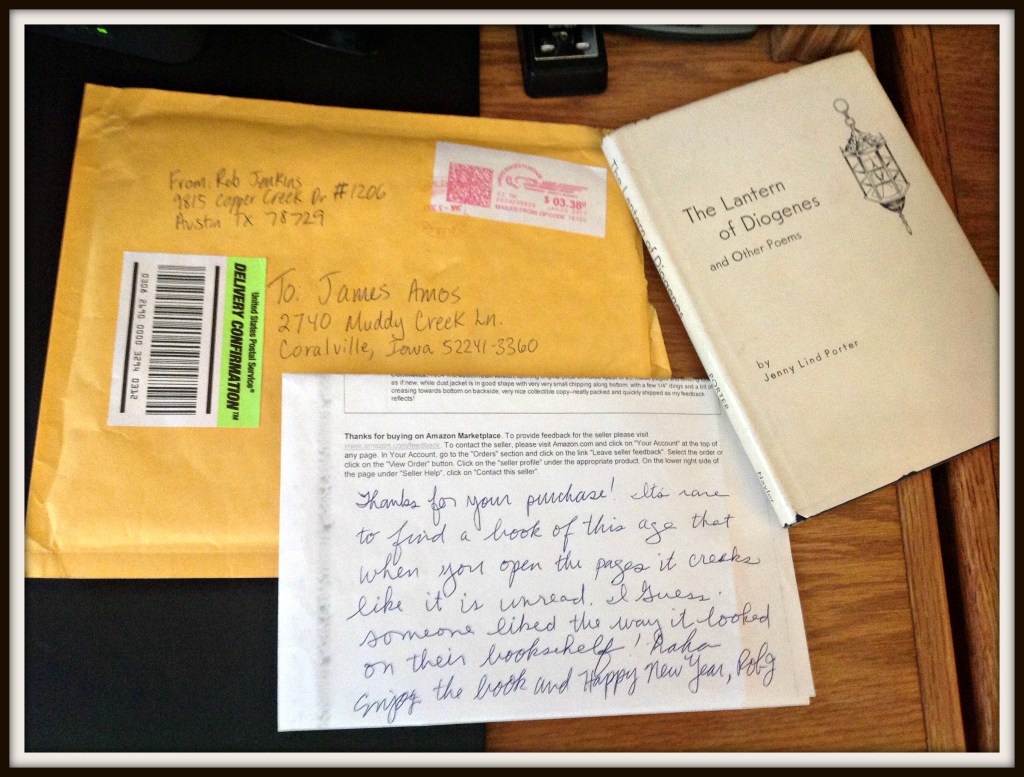
I’ve never heard of a book that creaked. But I think he’s right. I cannot imagine how one could leave a book by her unread. She was appointed Poet Laureate of Texas in 1964 and is listed in the Texas Women’s Hall of Fame. She won international recognition for this small creaky volume and many other works. She was named for the Swedish opera singer, Jenny Lind, often called the “Swedish Nightingale”, one of the most popular singers of the 19th century.
And of course the title is taken from Diogenes of Sinope, the Greek philosopher of the Cynic school who walked throughout Athens carrying a lantern in daylight, searching for an honest man. He never found one. He believed that virtue was best revealed in action than in theory.
Jenny Lind Porter was very much an action-oriented person, despite (or maybe because of) her education in the classics, philosophy, and poetry. She was very practical. A rarified jewel of a poem like The Turrets of the Mind, even if the language is archaic, has earthy implications[1]. Unfortunately, I can’t publish the poem here becasue the book is copyrighted (published in 1954), but I can at least talk about my impressions of it.
It could be about not reaching our potential, not doing what we’re born to do like searching and asking questions, wondering, and not achieving what we are designed to achieve. We are capable of such magnificent accomplishments yet so many of us forego the fig and settle for the thistle. We often prefer the darkness because there are so many dangers out there in the light.
Is there any way to connect this seeming relic to the modern world? In medicine, there is a struggle to fathom the scourge of a specific from of brain illness called delirium, or acute confusion caused by medical conditions and which mimics many forms of psychiatric illness. On one side of the struggle is the search for a drug that will prevent it, especially in those who are at high risk, the cognitively impaired elderly. There are a small number of studies that seek evidence for the effectiveness of antipsychotic medications to prevent delirium[2]. They can sometimes reduce mental suffering and some studies suggest they might prevent delirium. And on the other side are studies which seem to show that these same medications can cause sudden death in some adults[3].
So, are we to accept the thistle and the fig, the rose with the thorn? And how are we to know unless we emerge from behind the arras of one small room and explore the larger possibilities even though we may be wounded on the jutting rocks? Maybe the challenge is not to be fooled by what might be false choices, to cultivate our collective imagination, to keep looking for other solutions, and to keep climbing up to the turrets so we may get a clearer view of our choices for healing ourselves and those we love.
And we should not let good books get creaky. Some of them are gifts from extraordinary people whose greatest gift to us may be adding a deeper color and a richer texture to our lives.
1. Porter, J.L., The Lantern of Diogenes and other Poems. 1954: The Naylor Company.
2. Larsen, K.A., et al., Administration of Olanzapine to Prevent Postoperative Delirium in Elderly Joint-Replacement Patients: A Randomized, Controlled Trial. Psychosomatics, 2010. 51(5): p. 409-418.
3. Ray, W.A., et al., Atypical Antipsychotic Drugs and the Risk of Sudden Cardiac Death. New England Journal of Medicine, 2009. 360(3): p. 225-235.”







Leave a Reply