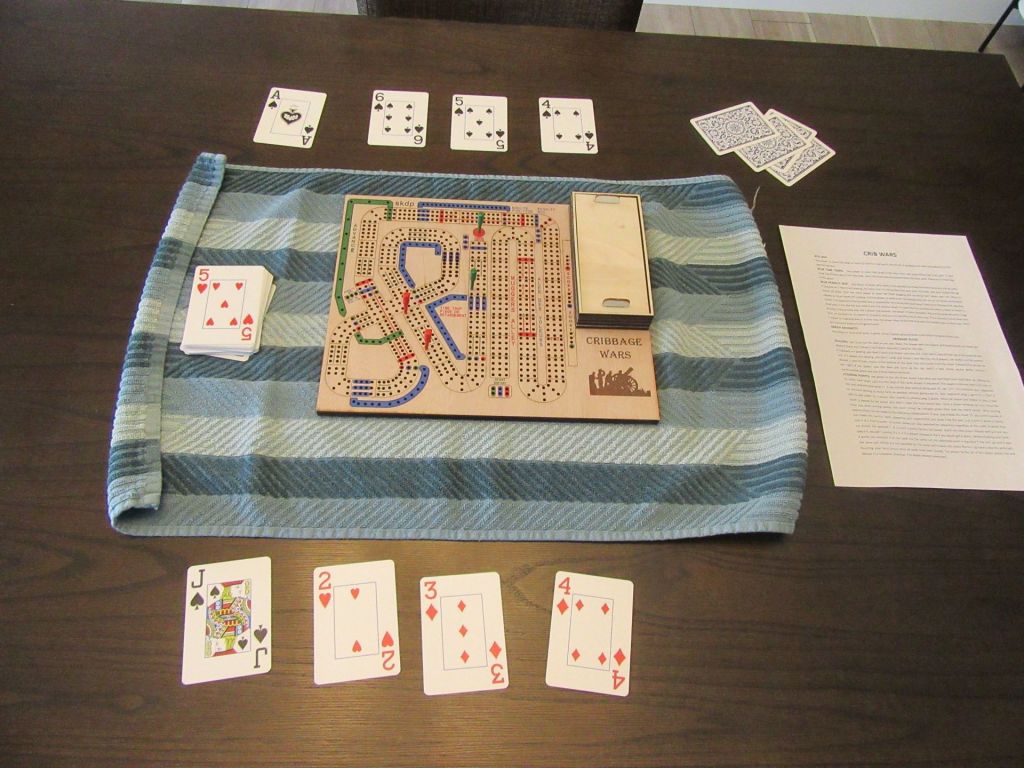
Hey, we played our first Crib Wars game today and, wouldn’t you know it, Sena won! We played six card cribbage. We ignored Muggers Alley.
I spent a fair amount of time in two of the Blue Time Traps. She got caught in a couple of cycles around the last Blue Time Trap, but scored big coming out of it. I had red pegs and she had the green. I think we spent about 2 hours playing.
Playing the low cards usually was the big reason why we got caught in the time traps. And despite Sena landing in the Blue Penalty Box at the beginning, she ended up winning! The Red Skip areas helped us both make better progress than we would have otherwise. The Green Advance zone helped Sena. I had to take the main track route and ended up in the Blue Time Trap in the left lower quadrant.
Maybe next time we’ll see if 7-card cribbage makes the game go faster.
We just got two new cribbage games: Crib Wars and Wicked Cribbage. We’ve been looking over the rules for both. We haven’t played either yet. I’ll talk about Crib Wars here.
Crib Wars is the most challenging to tackle, mainly because the rules and the board are open to interpretation.
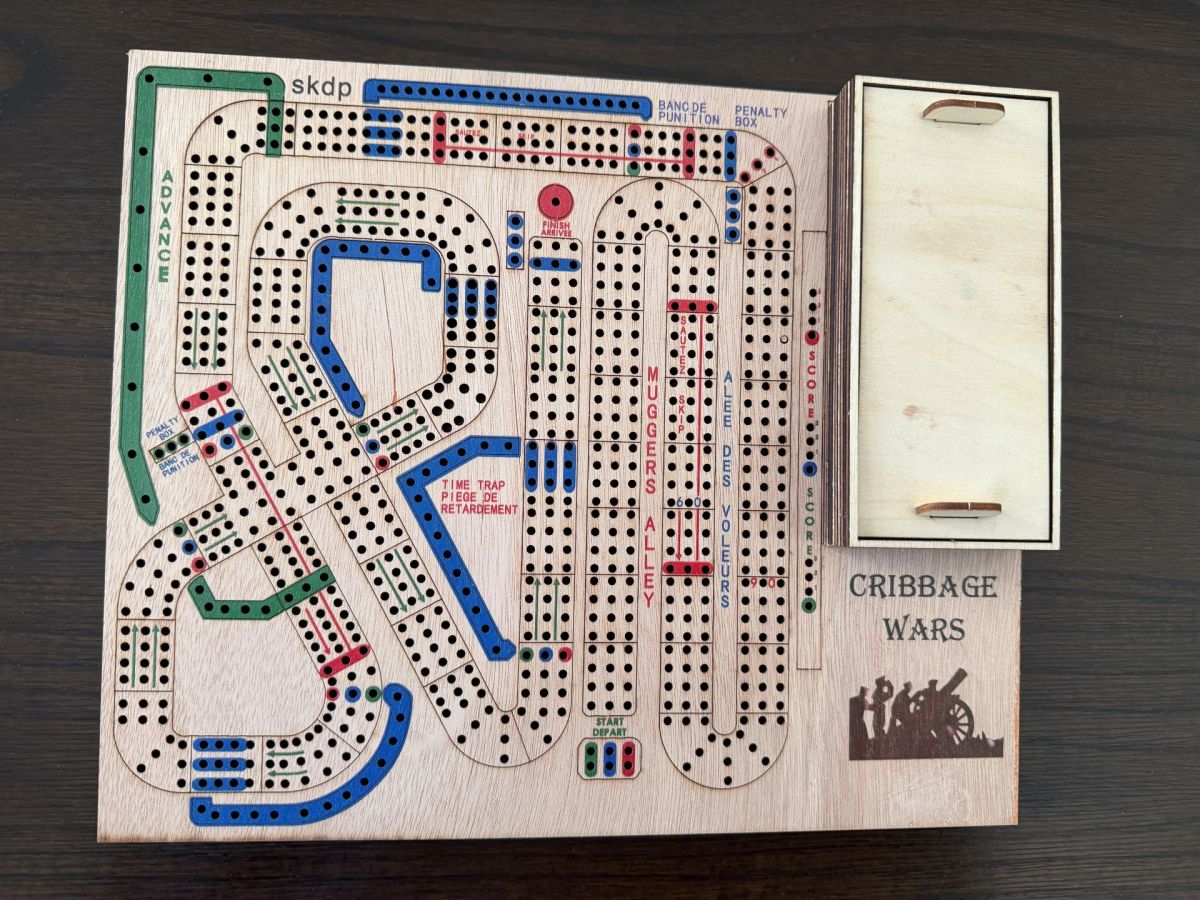
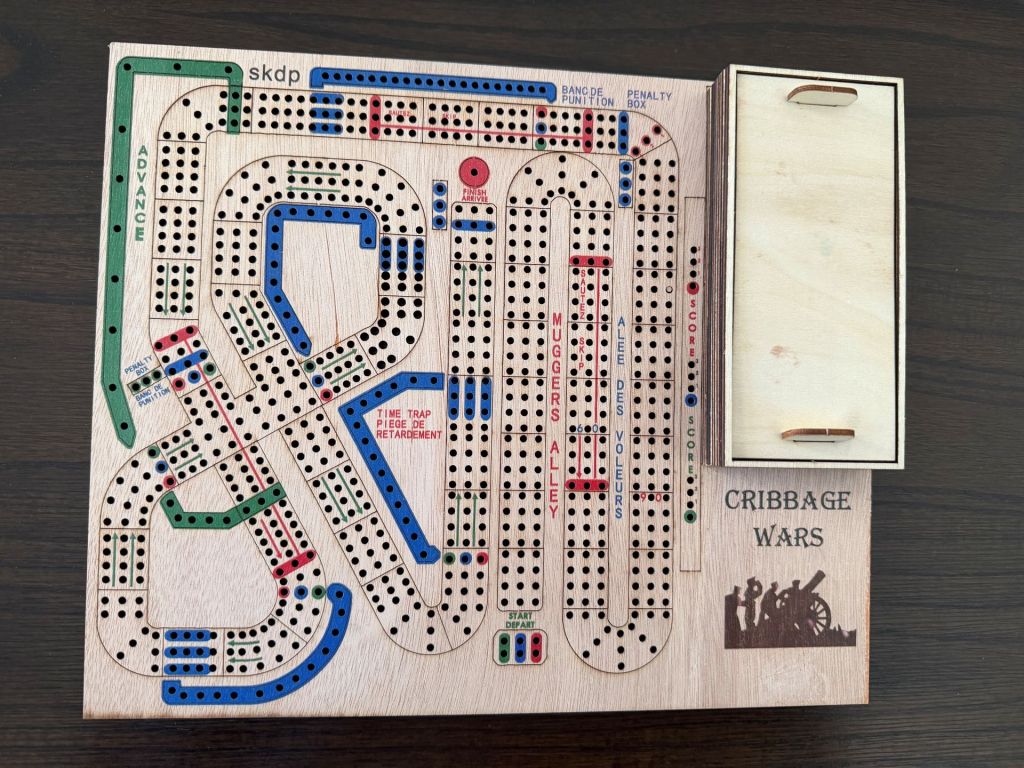
Crib Wars came with a 363-hole board and a set of rules. It was made in China and I have no idea what “skdp” means but it’s stamped on the board at the top. I haven’t seen this on any other similar-looking Crib Wars boards. The first 121 holes is the regular number of holes you’d play in the usual game of cribbage. There is a Muggers Alley in which you can play the Muggins Rule against your opponent. In general, if your opponent miscounts a score, you can call Muggins and take the points they missed. Does that mean we have to play Muggins Rule in that part of the board? I’m not sure how to get around this since you can’t just omit any other part of the game—can you? Judges are not involved. What if you and your opponent don’t agree? Do you play Rock Paper Scissors (you can do that in Wicked Cribbage, by the way, just not for Muggins Rule!). If I can say the quiet part out loud here, Sena and I tried to play Muggins rule once, messed it up and haven’t played since.
The American Cribbage Congress (ACC) rulebook has rules for Muggins Rule:
“Rule 10. Muggins 10.1. When in Effect a. Muggins is the only optional rule (see definition in rule 1.6). b. Officials in charge of tournaments, Grass Roots, or other forms of organized play must announce in their flyers and prior to beginning of play that muggins is in effect. c. When muggins is in effect, pegging out (reaching the game hole) is mandatory. d. When muggins is in effect, it cannot be optional between two players. It is played by all players. 10.2. Situations That Apply Except for the situations listed in rule 10.3, muggins is applied to the underpegging of the full value of any points during the play or scoring of the points in the hand or crib.
10.3. Situations That Do Not Apply a. The omission or underpegging of a penalty. b. The omission or underpegging of a muggins score. c. The dealer’s failure to peg two points for turning a Jack as a starter card. d. Points lost by a player by pegging backward.
10.4. Calling Muggins a. The caller shall state, “Muggins for X points.” During the play of the cards, the score(s) not pegged or underpegged shall be identified. Muggins may not be pegged until both players agree. If the opponent does not agree, judges shall be summoned. If the judges determine that the play was not a muggins, the opponent will be awarded the points taken as a penalty. If the true amount of underpegging is determined to be other than the amount originally claimed, the caller is entitled only to the lesser of the claimed or true amounts. In no case shall the amount of points awarded for muggins exceed the actual number of holes that could have been pegged had the scoring been correctly done. The muggins points shall be scored after the judges render a decision. b. For points missed during the play of the cards, a muggins call must be made: (1) After the player finishes underpegging the score or, if no score is pegged, after the player forfeits the score (see rule 7.2).
(2) Before the scoring player pegs a subsequent score or the pone’s hand is pegged. c. For points missed in a hand or crib: (1) The dealer must call muggins after the pone finishes pegging the score or states there is no score and before the pone’s hand is mixed with other cards or the total count of the dealer’s hand is announced. (2) The pone must call muggins after the dealer completes pegging the hand (or crib) score or states there is no score and before the pone mixes the hand (or crib) with other cards. d. The zero-count hand or crib: once a player claims no count in a hand or crib, muggins may be called immediately. After the player’s opponent says the word “muggins,” the player may not correct his or her count.”—American Cribbage Congress Cribbage Tournament Rules 2025 edition, Rule 10 Muggins Sec 10.1-10.4, pp 44-46 https://www.cribbage.org/NewSite/rules/rulebook_2025.pdf
There are other versions of the boards:
Michaud Toys makes a game called Cribbage Rumble. They called it Cribbage Wars about 7 months ago in a Facebook post. It looks different mainly because the design of the track and other markings are on an elongated board typical for most cribbage boards. That’s to make it easier for two players to see because they usually sit opposite each other with the board in between them. Despite the distortion, the design is very similar to the Crib Wars board that typically is made on a rectangular board. There is no Muggers Alley. The Crib Wars game we got was shipped with a one-page sheet with description and rules. I don’t know if Michaud Toys includes the rules. For U.S. customers, it costs $89.95 plus a 35% tariff and an extra $25 UPS brokerage fee paid before delivery.
Ebonwood is a company located in Appleton Wisconsin and they make a variety of wood objects including cribbage boards including a Cribbage Wars game. It’s rectangular and similar to what we got. However, it lacks directional arrows on the track in the lower left quadrant. There is no Muggers Alley. The rules for Cribbage Wars are on the Ebonwood web site. I don’t know if the board ships with rules. Ebonwood charges $210 for it.
If you already know how to play basic cribbage, you can ignore most of what’s on the rules sheet because there’s only a short section for the Crib Wars rules. It describes the colored areas and what the players are supposed to do with them. There are only a couple of YouTube videos demonstrating how to play the game and I’ve not been able to sit through them because they’re both over an hour and half long. There’s a shorter separate video of an explanation of just the rules as they pertain to the colored areas. It’s mostly helpful, although I think there’s room for interpretation.
I have just a few comments and questions so far about our Crib Wars board:
Red Skips: There are 3 of these. The rule says if you land on the first red box you should “slide” to the next red box which gets you 20 holes further along the board. The red box just means the set of 3 holes highlighted with a red color. You get from the first one to the next one by just moving it 20 holes. You’ll land in the 2nd set of holes marked in red. This is a boon in the first Red Skip area. However, if you pay attention to the directional arrows (two skinny green arrows in the middle of the track) guiding you, it looks like they accelerate you toward two of the Blue Time Traps.
Blue Time Traps: There are 4 of these and there will be three blue lines, meaning the blue color covers all three holes and all three peg tracks (3 holes along the track and 3 holes across the track). If you land in a set of three holes highlighted in blue, you end up moving to a blue area of holes that actually set you behind several holes. You have to play your way out of them. Players note that you can end up in repetitious cycling back to the traps largely because of how often you can get one or two points at a time while scoring. In fact, some say that if their opponent gets close to a Blue Time Trap they may purposely lead with a five card (something you would rarely if ever do in a standard cribbage game). That could trap the opponent into playing a ten card or a 5 card, which might risk them moving only a couple of holes right back into the Blue Time Trap. The same thing could happen with falling into the Blue Penalty Boxes.
Blue Penalty Boxes: There are three of them. This one is also open to interpretation. You fall into one of these by moving your peg into one of the single blue hole lines, meaning one blue track across the three peg tracks. This is a disaster because you immediately have to fold your hand and your crib while your opponent plays through, so to speak. And the one who pegs into the Blue Penalty Box has to move back 20 holes while the opponent pegs forward by 20 holes. But the other thing is that the person who incurs the penalty also has to “sit in the box.” There are 3 holes next to the track and this is where you put your peg. At first, I didn’t understand the need for a box to sit in if you’re also supposed to move backwards 20 holes. After I thought about it, it made sense that while you’re sitting out the hand, you have to wait for your opponent to play their hand and crib first and move forward. After that is done is when the respective 20-point loss and gain are taken. Anyway, that’s why you sit in the box.
Green Advances: There are two of them. I think they’re tricky. If you land in a green hole, you take a short cut path. The long one ends in what looks to me like an arrow pointing at the hole you should go to next on the main track. That puts you on the track which allows you to avoid the lower left quadrant Blue Time Trap. You don’t avoid the potential other trap above. If you take the normal track instead you end up moving toward the lower left quadrant Blue Time Trap—but you have a chance at getting into the short Green Advance track before you get there which loops back away from it and you end up going in the direction of the upper Blue Time Trap. Fun, huh?
You think you’re in the clear after that? You’re not because there is a sadistically placed Blue Penalty Box in the next to the last hole before the Finish Line!
Now I see why there are so few YouTube videos. Incidentally, Crib Wars came with a small yellow packet with Chinese lettering on it and the name Osmanthus printed on it. I found out that Osmanthus is a flower and it can have a variety of meanings including love, prosperity, optimism, luck, or good fortune. Sena cut the packet open because she thought it might contain flower seeds (she’s a gardener) but it just contained a square piece of white felt.
I wonder about trying to play a mashup of 7-card cribbage on the Crib Wars board. That might be the ultimate Calvinball cribbage game.





 Go Retire Psychiatrist