CDC ACIP Highlights on Covid 19 Vaccine

There was a lot to digest in today’s CDC ACIP meeting on Covid-19 vaccines. I missed the morning sessions but managed to see a few of the afternoon presentations.

The presentation by Dr. Retsef Levi, PhD, MIT, ACIP Work Group Chair, the Covid -19 Vaccine Discussion Framing Work Group (WG) was basically pretty critical of the Covid-19 vaccines in general.

The opposing reply to this (favorable to vaccines) was put together by University of Iowa’s Dr. Stanley Perlman, Dr. H. Bernstein, and Dr. M. Miglis, Additional Workgroup Considerations in Covid-19 Vaccination Policy and Practice.

For a change, I listened to the Public Comment section. I usually have not paid attention to them because most of the speakers were opposed to vaccines. Today was different. All of them were strongly supportive of vaccines.

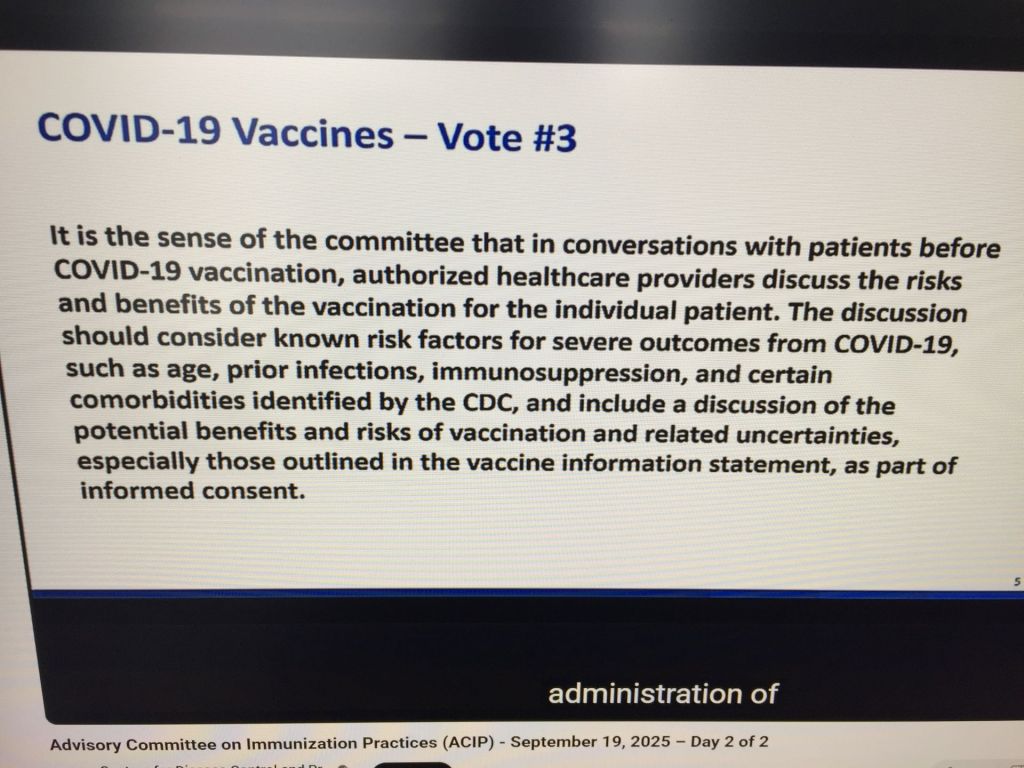
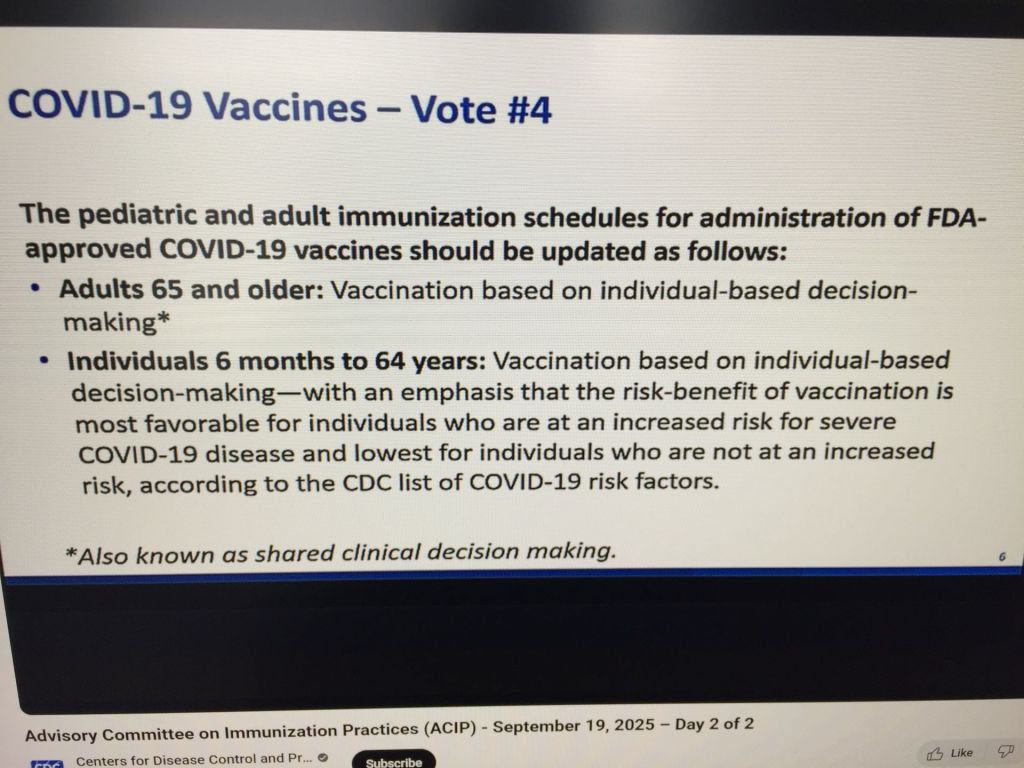
There is a bottom line to this. I watched the voting session, which was very interesting. There were 4 voting questions. I had to take pictures of them because they were not included in the on-line schedule. It was easily the most interesting session of the afternoon, at least for me.
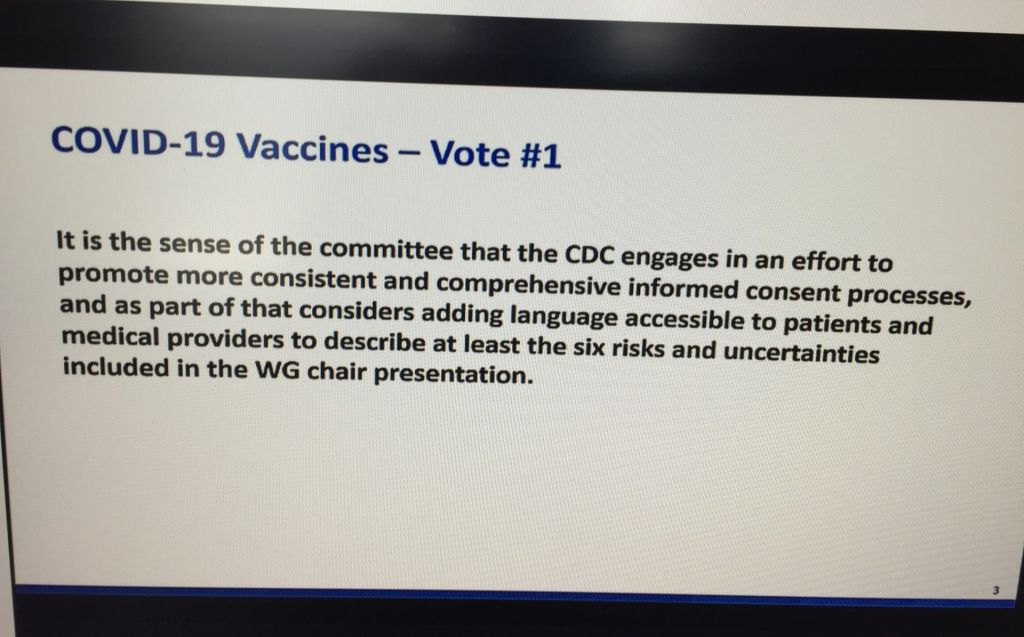
Voting question 1: all but one member voted “yes,” the committee chair Kulldorff voted “no.”

Voting question 2: one member suggested striking this one, but they voted anyway. What’s worrisome is that it was split between the yes and no votes; only the chair, Kulldorff, could break it and he voted “no.” Looks like common sense won; otherwise it would have made access very difficult.

Voting question 3: The video lost audio for a long time, but eventually it turned out that the votes were “yes” unanimously on the assumption that pharmacists counted as “health care providers.”

Voting question 4: The votes were all “yes,” mainly because they decided that pharmacists could make this work. One member questioned the wording which suggested that you needed to talk to your doctor about getting the vaccine because of the wording “shared clinical decision-making.” They glossed over it.

It looks like access to the Covid-19 vaccine will remain mostly open for now.

Unknown's avatar

Author: James Amos

I'm a retired consult-liaison psychiatrist. I navigated the path in a phased retirement program through the hospital where I was employed. I was fully retired as of June 30, 2020. This blog chronicles my journey.

2 thoughts on “CDC ACIP Highlights on Covid 19 Vaccine”

  1. From what I have seen and heard – these hearings were a mess compared with the usual science based hearings. Some of the people in the room apparently have no science or medicine background at all. The requirement to have a “discussion” about vaccine side effects or “get a prescription” basically seem like a way to erect obstacles to vaccination.

    I had 9 Moderna immunizations and for every one I had to sign off on the fact that I had read about all of the rare side effects possible for vaccinations – even though I obviously did not have any. Nine personal conversations with a physician or pharmacist adds nothing to that.

    A lot of hoop jumping for the antivaxx ideology.

    Liked by 1 person

    1. I agree that the meeting was a hot mess. There were petty arguments about definitions and quibbling over statistics. The voting questions were obviously attempts to advance anti-vaccine ideology. On the other hand, I have to say that the ACIP chair, Martin Kulldorff, did vote “no” on the “need a prescription to get a vaccine” vote, although he broke a tie. Even if the motion had passed, I think rational people would have found a way around this obvious obstacle to access. Kulldorff was also the only “no” vote on the first measure, although it did pass. The “six risks and uncertainties” are obviously part of antivaxx ideology that either doctors (or pharmacists?) are to discuss with patients presented by Retsef Levi. They include controversial topics that are designed to scare patients:

      “Current assessments regarding the protection provided by COVID-19
      vaccines and especially seasonal COVID-19 boosters against severe
      outcomes (e.g., death, hospitalization and long COVID) are of low
      quality. At best, the additional protection provided by a seasonal
      booster is moderate and of short duration.”

      “There is evidence that repeated seasonal mRNA boosters cause
      acquired changes in the immune system and may be associated with
      increased vulnerability to future infections, including SARS-CoV-2 and
      other respiratory viruses. These risks, as well as potential risks of
      autoimmunity, chronic inflammation, immune tolerance and impaired
      immune surveillance including immune fatigue or suppression, are
      currently not well understood.”

      “There are documented deaths from symptomatic and subclinical
      myocarditis, pericarditis and potentially other cardiovascular conditions
      post COVID-19 vaccination, including of healthy children, with probable
      causal relationship to the mRNA vaccines. This risk is likely relatively
      small but currently not well understood.”

      “Clinical reports demonstrate that in some cases COVID-19 vaccines can
      cause prolonged and debilitating post vaccine syndrome (PVS). The injuries
      associated with PVS involve diverse symptoms and conditions, many
      overlapping with long COVID injuries. Some of the observed symptoms and
      conditions may include insomnia, chronic pain and fatigue, dysautonomia
      (e.g., POTS), immune dysregulation and deficiency, autoimmune disorders,
      severe neuropathy and other neurodegenerative conditions, cardiovascular
      and neurovascular injuries, and severe clotting. The frequency of PVS and
      related risk factors are currently not well understood.”

      “There is evidence that in some individuals vaccinated with mRNA COVID-19
      vaccines, the resulting spike protein, the mRNA and the nano-lipids
      formulation components persist in different body organs, including lymph
      nodes and the heart, for a prolonged period of months and possibly years in
      some patients. Prolonged and persistent exposure to spike, mRNA and
      nano-lipids particles is associated with post-vaccine syndrome (PVS) injuries
      as well as potentially other side effects that are currently only partially understood.”

      “The safety and the efficacy of COVID-19 vaccination during pregnancy have
      never been tested in appropriately powered randomized clinical trials. In
      one randomized trial there was observed numerical imbalance of higher
      number of babies with congenital malformation among those born to vaccinated women.”

      That Kuldorff was the only person on the ACIP committee to vote “no” on this measure is concerning, yet it does lead me to consider that he was trying to bend the arc of this meeting toward reason.

      Liked by 1 person

Leave a comment

This site uses Akismet to reduce spam. Learn how your comment data is processed.