

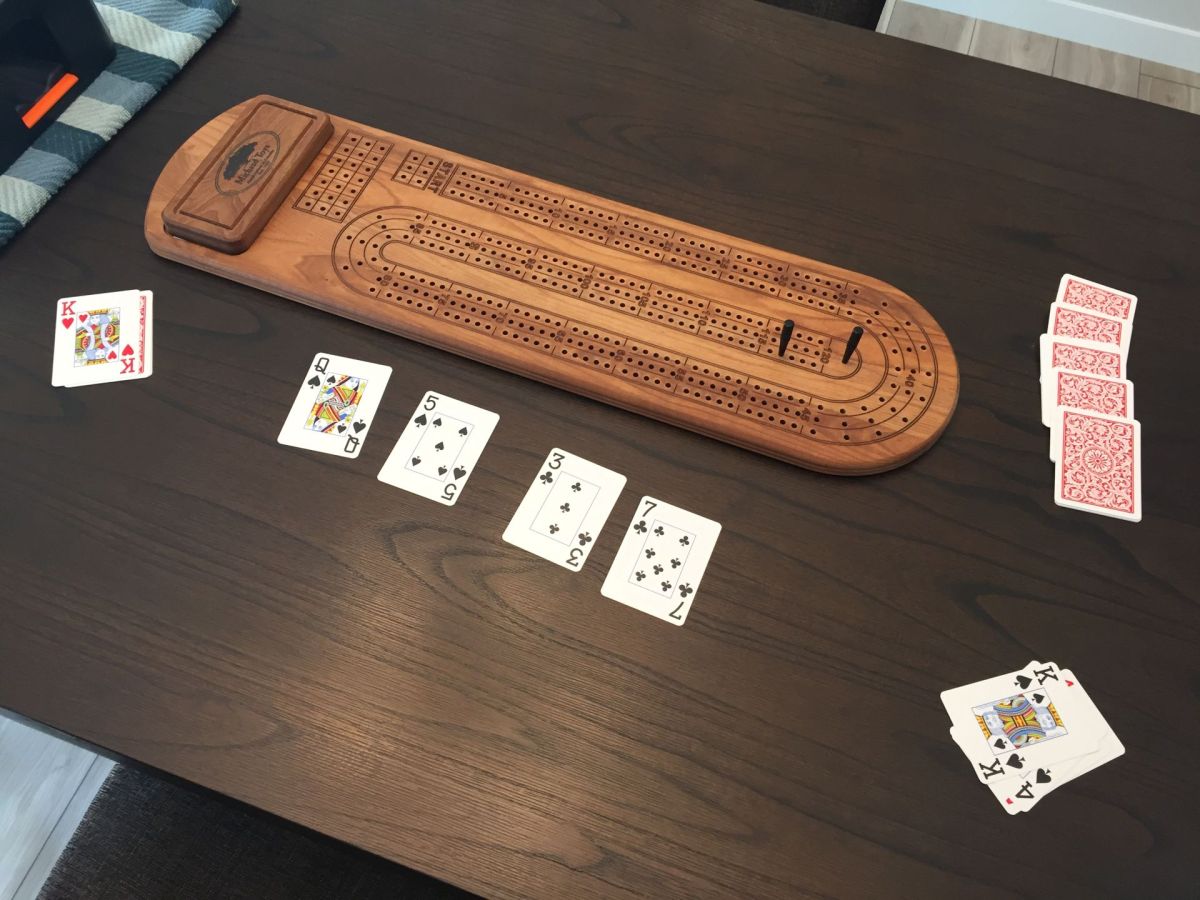
I got lucky and won my first game of cribbage solitaire today! I got to 121 in six deals. I probably should have videotaped the game, but since you never know if you’re going to win, you’d probably waste a lot of time filming. Sena watched me do it and I wonder when she’s going to give it a try. What you see in the picture are the 4 crib cards spaced out, the deck with starter card, the hand cards face up in a pile on the right, and the 5 other deals in piles face down on the left.
According to DeLynn Colvert in his book “Play Winning Cribbage” 5th Edition, published in 2015 in the appendix, “This game is simple, fast, and difficult to win…but it can be done.” You have to average 20 points per deal to win the 121-point game. See my YouTube video below for a quick demo.

Rules summarized:
Cribbage solitaire has six hands and six cribs and you peg your six hands.
Start by dealing two cards down to form part of your hand, then one down to form part of the crib. Deal two more to your hand, one more to the crib, and finally two more to your hand (which now has six cards and the crib has two.
Discard two of the six cards to form a four-card crib. Then flip the top card of the deck for the starter card.
Then peg your hand for maximum count, which would not always be the way you’d peg in a game with an opponent. Colbert’s example paraphrased: if you hold 5-10-10-jack. Play the 5 first, then a 10 for “15-2,” then the other 10 for “25, a pair for two and a go.” The remaining jack also scores a “go” for one point. Your peg is six points total.
After scoring the peg, count your hand, then your crib.
Then start the second deal by using the first-hand starter card, which becomes one of the first six cards for your hand. Again, deal the crib two cards. Repeat this process until you complete the game with the sixth deal (the deck will have four cards after six deals). (Colvert, 2015).
Reference
Colvert, D. (2015). Play Winning Cribbage 5th ed. Missoula, Montana: Starr Studios.




 Go Retire Psychiatrist