

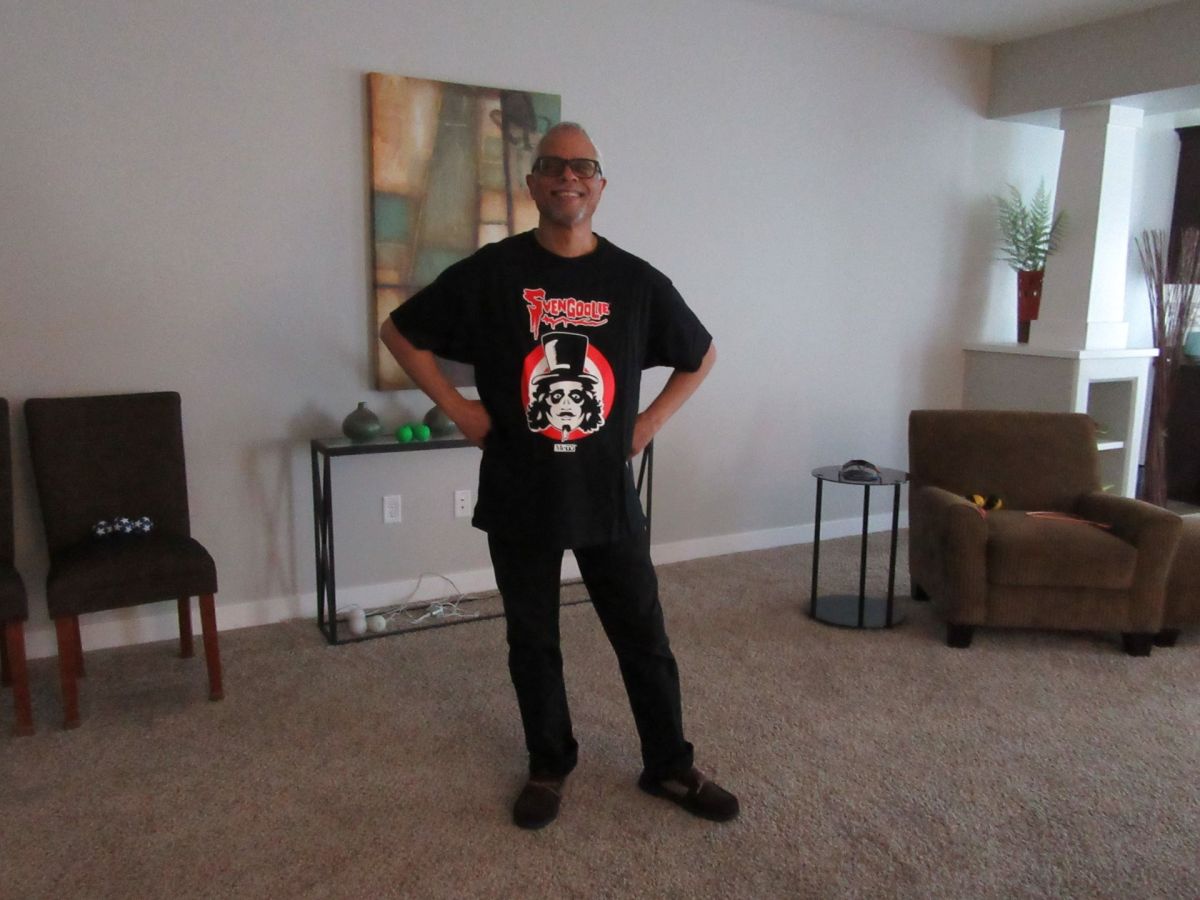
On Saturday night we watched the sequel to “The Abominable Dr. Phibes” movie, which is “Dr. Phibes Rises Again.” It was released in 1972. We also discovered that Turner Classic Movies (TCM) has shown the film. The TCM link has what I think is the best plot summary.
It makes us wonder what qualifies for classic status if TCM has this movie in its library. Incidentally, TCM also shows the other Svengoolie movie we saw recently, “Invaders from Mars.” I’m pretty sure I saw this on TV when I was a little kid. I have a vivid memory of the stocky green Martian stooges running stiff-legged through tunnels.
Anyway, I couldn’t find a clear definition of what a classic is. I think it depends on the category, in this case for shlock movies. Even Roger Ebert was all over the map about it (about films in general, not schlock horror films).
Anyway, TCM seemed to echo what Svengoolie and company speculated about as far as the last names of a few of the characters (in the trivia section, although I’m not so sure about the reference to jazz trumpeters). Svengoolie also mentioned the connection. Four of them happened to have last names that a few famous musicians had:
Darius Biederbeck: I start with that one because the jazz musician Bix Beiderbecke (note the spelling difference) has an Iowa connection. He was born in Davenport, Iowa.
Harry Ambrose: There might be a connection to Benjamin Baruch Ambrose, known professionally as Ambrose, who was a violinist and bandleader.
Hackett: Bobby Hackett was a famous jazz trumpet and cornet player. Just an aside, I usually mistakenly come up with the name Buddy Hackett when I try to remember Bobby Hackett. That might still be an interesting connection because Buddy Hackett played Marcellus Washburn in “The Music Man” film adaptation in 1962. Of course, this also has an obvious Iowa Connection. I found a reference which says that Marcellus had a song and dance routine in the “The Music Man.” I’m from Mason City (River City in the musical) and I’ve never seen the play or the movie.
Lombardo: Guy Lombardo was a violinist and bandleader who had a jazz style.
What makes the connection important and whether it figures into whether the movie is a classic or not is beyond me. However, music is an important feature in “Dr. Phibes Rises Again” as it was in the first film, “The Abominable Dr. Phibes.” Phibes is frequently playing an organ and waving his arms around like a drunken bandleader.
And then there is the mechanical band. It’s probably not a real mechanical band, but actors who try to mimic the movements of robotic musicians. I found a comment about this in a web article in which the commenter thought he saw one of the robots moving a little too smoothly.
Humor is a feature in “Dr. Phibes Rises Again” as it was in the first film. The clownish and incompetent police officers, Inspector Trout and Superintendent Waverley reappear. This comedy relief may be an attempt to offset some of the more vividly horrifying murder scenes. Trout makes a jarring joke about one of the characters who was crushed in one of Phibes’ diabolical torture machine- “Baker had a bad night.”
This reminds me of what I appreciate about Svengoolie, who always warns the TV audience when grisly scenes that might be too intense are coming up. If you decide to see the film, you might want to skip the scorpion scene.

 Go Retire Psychiatrist