The Visible Flame

I began rereading the book Invisible Man by Ralph Ellison today, which is Leap Day. Given what little I know about Leap Day and Leap Year in general, there isn’t a connection.

I first read Invisible Man well over 40 years ago. It was a paperback and I took it with me to Huston-Tillotson College in Austin, Texas (now Huston-Tillotson University), one of the historically black colleges and universities (HBCUs) in the United States.

It was very hot in Austin in my freshman year and the students didn’t have air-conditioned dormitories in those days. It must have been over 90 degrees. The glue melted on most of my paperback books, including Invisible Man. I suppose that’s why I eventually threw the book away, because it was falling apart.

After all these years, I bought a hardcover edition. We have air-conditioning now. I was motivated to read it again after I read Invisible Hawkeyes: African Americans at the University of Iowa during the Long Civil Rights Era, edited by Lena M. Hill and Michael D. Hill. See my blog posts, Milestones, and The Iowa River Landing Sculpture Walk, for background.

When I was a young man, I identified with the protagonist in Invisible Man. The Prologue still strikes a chord.

On the other hand, I googled my name today and found a few links that made me feel less invisible. Probably the most surprising link was to an interview with me entitled “James Amos, MD,” which you can read here. The piece evoked memories of a past version of me—which has not changed much since then. It mentions my former blog The Practical Psychosomaticist which I later renamed The Practical C-L Psychiatrist (C-L stands for Consultation-Liaison) after the flagship organization, the Academy of Psychosomatic Medicine changed its name to the Academy of C-L Psychiatry in response to a poll of its membership asking whether the name should be changed.

This biography makes me more visible, at least on the web. On the other hand, the blog no longer exists, due in part from my concerns about the General Data Protection Regulation (GDPR), which was enforced in 2018. I posted a lot of educational material about C-L Psychiatry on the blog along with pictures and presentations of my trainees. In a way, I did not protect their privacy and I was uncomfortable about that.

Other web pages surfaced during my self-googling. They included my article on delirium, “Psychiatrists Can Help Prevent Delirium,” posted on Psychiatric Times in 2011.

I also found my blog post on physician burnout, “How I left the walking dead for the walking dead meditation,” published on the Gold Foundation web site in 2014.

And there was my other Gold Foundation post about rude doctors, “Are doctors rude? An insider’s view,” posted in 2013.

There are a couple of petitions left over from years ago as well, about the controversial Maintenance of Certification (MOC) and the closure of state mental hospitals in Iowa several years ago.

I also found my review of Dr. Jenny Lind Porter’s book, The Lantern of Diogenes and Other Poems (published 1954).

The book seller’s note to me when Porter’s book was delivered in 2011 read as follows:

“Thanks for your purchase! It’s rare to find a book of this age that when you open the pages, it creaks like it is unread. I guess someone liked the way it looked on their bookshelf! Haha! Enjoy the book and Happy New Year, Rob J.”

An unread author is an invisible author. The first poem in the book is below:

The Lantern of Diogenes

by Jenny Lind Porter

All maturation has a root in quest.

How long thy wick has burned, Diogenes!

I see thy lantern bobbing in unrest

When others sit with babes upon their knees

Unconscious of the twilight or the storm,

Along the streets of Athens, glimmering strange,

Thine eyes upon the one thing keeps thee warm

In all this world of tempest and of change.

Along the pavestones of Florentian town

I see the shadows cower at thy flare,

In Rome and Paris; in an Oxford gown,

Men’s laughter could not shake the anxious care

Which had preserved thy lantern. May it be

That something of thy spirit burns in me!

Dr. Porter’s house in Austin, Texas was demolished a few years ago. There were plans to build a house there reminiscent of the architectural style of her original home and also a remembrance of her published work. I just noticed a satellite image of the property. There is no visible evidence that anything of that nature was ever built. Dr. Porter is, in a sense, invisible although her lantern still burns.

Visibility is a relative term. My advancing age and approaching retirement sometimes lead me to feel like I’m becoming invisible, gradually vanishing from the landscape of consultation-liaison psychiatry and general medicine.

Ralph Ellison’s book Invisible Man is a visible legacy. My legacy is small—yet the flame flickers, visible after all.
Facial Hair and the Masked Worker

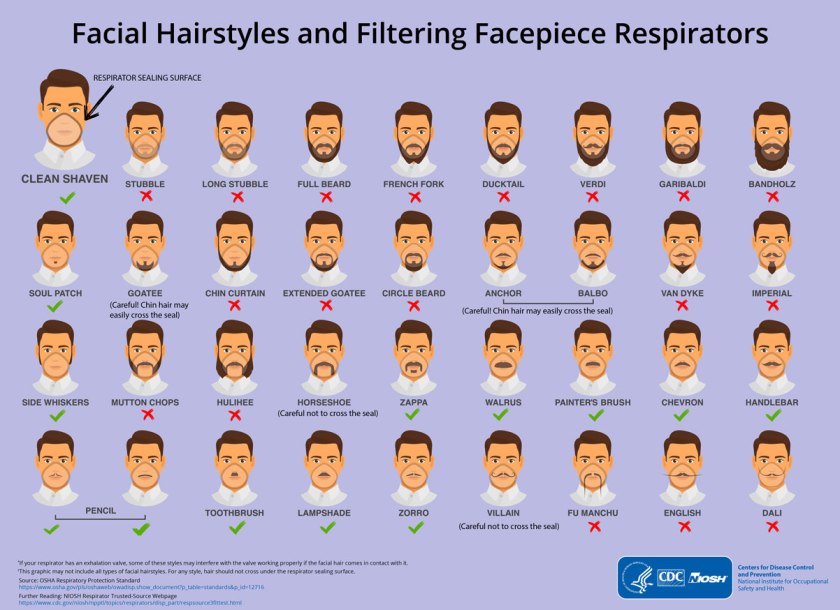
I’ve seen the news warning us about how facial hair can interfere with the N95 respirator mask seal. It’s connected with the concerns about the novel coronavirus which you no doubt have heard unless you live under a rock. The Centers for Disease Control (CDC) reiterated their warning about how certain beard and mustache styles can interfere with the recommended mask for helping protect you from infection.

As a health care worker, I’m required to be fit tested annually for the N95 respirator mask. “Fit” is not an acronym, by the way; it just refers to how well the mask fits. It’s a twenty-minute test in which a technician or nurse uses a special machine to check for how tight the seal is around the mask in order to ensure protection from airborne particles, including viruses.

I passed my fit test.

I saw the graphic yesterday of all the different facial hair styles that pass muster—most of them don’t. I’ve never heard of half of them. Believe it or not, I didn’t know that little tuft of hair under my lower lip is called a “soul patch.” I guess maybe I’m the one who’s been living under a rock.

I’ve read that some experts think that any facial hair is bad and recommend that you have to be clean shaven. I think some places won’t even allow fit testing on anyone who has facial hair.

However, I found a PubMed study published in the latter part of 2018 which showed that you can pass a fit test “even with substantial facial hair in the face seal area;” the abstract is below:

Floyd, E. L., et al. (2018). “Influence of facial hair length, coarseness, and areal density on seal leakage of a tight-fitting half-face respirator.” J Occup Environ Hyg 15(4): 334-340.

                BACKGROUND: OSHA regulations state that an employer shall not permit tight-fitting respirators to be worn by employees who have facial hair that comes between the skin and facepiece seal. Studies have shown that facial hair in the face seal zone can increase penetration and decrease the fit factor (FF), although the relationship between the amount and characteristics of facial hair and the increase in penetration is not well quantified. This article examines the influence of facial hair length, areal density, and coarseness on FF for one model of half-face elastomeric negative-pressure air purifying respirator. APPROACH: Quantitative fit tests (QNFT) were performed on 19 subjects with beards initially 0.500-in long and subsequently trimmed to 0.250, 0.125, and 0.063 in, then after a razor shave. Three fit tests were performed at each of the 5 lengths, for 285 total tests. The average diameter and areal density of cheek and chin hair were measured. Penetration was modeled as a function of hair length category, beard areal density, and hair coarseness. RESULTS: FF decreased with beard length, especially beyond 0.125 in. However, passing FF scores were achieved on all tests by all subjects at the smooth shave and 0.063 in conditions, and 98% of tests were passed at 0.125 in; seven subjects passed all tests at all conditions. Chin and cheek areal densities were significantly different and were only weakly correlated. Beard hair diameters were normally distributed across subjects (mean 76 microm, standard deviation 7.4 microm). Beard length and areal density, but not coarseness, were statistically significant predictors of fit using an arcsine transformed penetration model. FF decreased with increasing beard length, especially beyond 0.125 in, although FF with a “stubble” beard did not differ significantly from a smooth shave. FF also decreased with increasing areal beard hair density. CONCLUSION: Beard length and areal density negatively influence FF. However, tight-fitting half-face negative-pressure respirator fit tests can achieve adequate fit factor scores even with substantial facial hair in the face seal area.

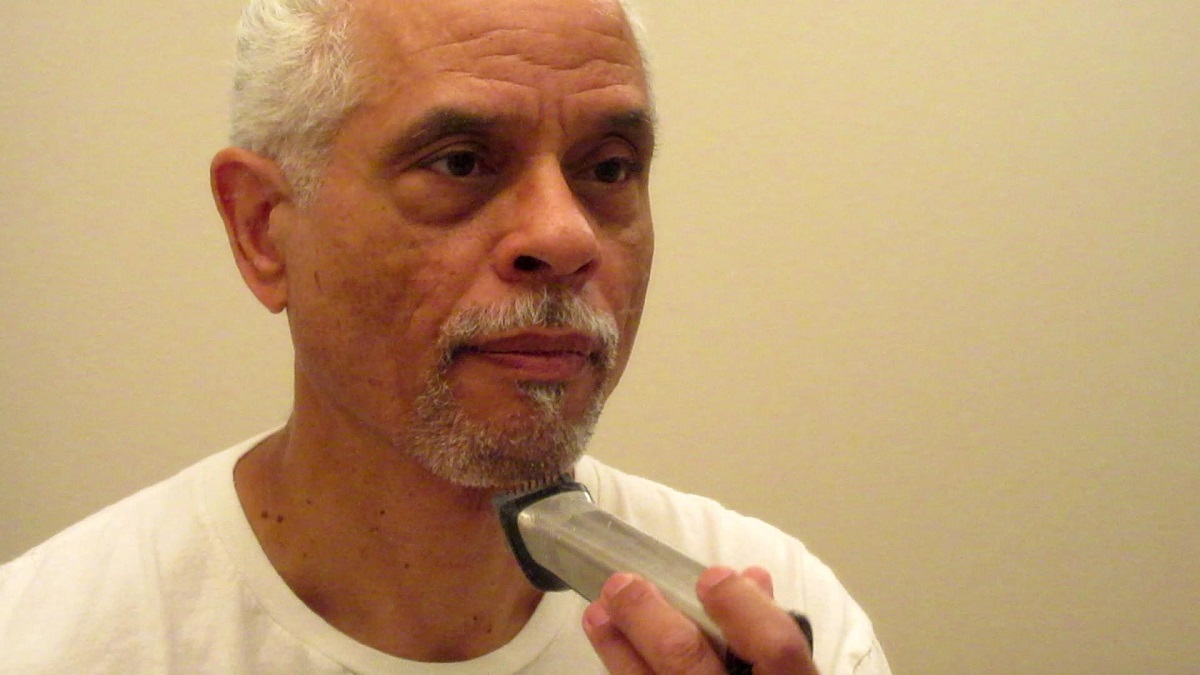
I generally have a stubble circle beard. When I don’t use the stubble guard on my trimmer for a while, I supposed my chin whiskers could lead to what some have called the “goatee leak.”

The CDC web site posted a funny article in 2017 on their web site entitled, “To Beard or not to Beard? That’s a good Question!” That facial hair chart is in the article. They also remind you check your mask seal every time you use it, no matter what your facial hair status is.

There’s a pretty funny YouTube video about this issue. The title is “The Bearded Guide to N95 Respirator Fit Testing.” My video is below.

Jumbo Cribbage Board Antics

Well, Sena and I played the official inaugural cribbage game on our new Jumbo Crib board from Ontario. That was a belated Valentine Day’s gift for us which Sena is only too happy to remind me about; but that’s OK, I deserve a little ribbing. You can get a sample of that from watching the video.

We have to stretch a bit more to reach across the table and the 8-inch-wide board. That’s good exercise. The 2-inch-tall pegs have a pleasing heft to them.

Making the video for our cribbage games is a big challenge. I think one of the best reasons for doing it is that we learn from our mistakes by watching them. We’re still rookies. It took us all day just to shoot a decent video—although it was fun to play. I’m pretty sure players out there will spot errors. Let us know what they are!

I just happened to come across an old newspaper article about a guy named Frank Lake who was a Grand Champion level player years ago. When the journalist interviewed him, he was around 83 years old—that was in 2005. Frank said that cribbage is “85% luck and 15% smarts.”

We think there has got to be more skill involved than that. Somebody once said that cribbage is a game which takes a few minutes to learn but a lifetime to master. At my rate, it’ll take more years than I have left in my lifetime just to learn.

Each game is different. In a two-hander, each player gets only 6 cards. The non-dealer ends up with only 4 after dropping two into the dealer’s crib. We take about 30 minutes to play a game, which is about half the time we took when we first started playing. I’ve read that you really can’t expect to play at the tournament level unless you can finish a game in 15 minutes. I doubt we’ll ever get there.

The Jumbo is the fourth cribbage board in our small collection. Frank Lake accumulated quite a few cribbage boards in his career, some of them trophies. I think he owned a collection of around twenty of them. One of them was in the shape of the state of Oregon. Hmmm…

The Geezer is Redeemed

Well, as far as this tardy Valentine’s Day gift is concerned, the Geezer is redeemed. The answer to the riddle in the 2/18/2020 post “I’m Late for Valentine’s Day” is a new Jumbo cribbage board (the Jumbo Crib).

This is the gift I forgot to order for our Valentine’s Day, which was a Canadian Hard Maple cribbage board. It arrived today from Ontario. It was shipped only this past Tuesday, so we were pleasantly surprised (almost shocked) that it arrived so quickly. It’s really big compared to our other cribbage boards.

The clues in the post a couple of days included a picture of us in rain gear at Niagara Falls, taken about 5 years ago. The picture of a bed of flowers in the shape of a Maple leaf with a bunch of falling Maple leaves was taken in Canada, just across the border.

Sena keeps telling me that she told me to order the board, but I honestly don’t remember her telling me that.

The board is made by Michaud Toys, a small, family-owned craft shop in Ontario not that far from the Niagara area. They are well-known for making excellent wooden toys, games, and puzzle boxes. They believe in family game night, which for me and Sena is almost every night.

I ordered it on Valentine’s Day, which was just last Friday. It shipped the very next Tuesday and we got it this morning.

It came with a nice storage bag, some metal pegs (2 inches long), a deck of cards, and a set of very accurate rules. It’s 27 ½” long and 8” wide. It’s great fun to play on.

Wow!

It has a handy little cubby on the board which can hold the card deck, pegs, and rule booklet. This is covered by a cap which fits snugly over the hole and is secured by “powerful rare earth magnets.” They work. I can turn the board upside down and shake it—nothing pops out.

Jumbo Crib stuff

The rare earth magnets remind me of the 1970s soul music band, Rare Earth. I went to one of their concerts when I was a teenager and it was so loud that I think I suffered some mild but permanent hearing loss.

Maybe that’s why I didn’t hear Sena when she told me to order the cribbage board. Anyway, we’re celebrating!

I’m Late for Valentine’s Day

I’m a little late for Valentine’s Day, but you could give me a break because I’ve been a little busy being retired. Don’t throw things at me because I’m getting too old to duck. And I did get my wife a card, flowers, and some candy on time.

It was something else I forgot. It’ll take a few days before I can tell you what it was.

We made a Valentine’s Day wish by breaking a chicken wishbone the other day. I believe that was before Valentine’s Day. In fact, it was about a week prior.

I don’t know if there are any rules about how to you’re supposed to hold the wishbone. Some will probably say our technique was poor when they see the video.

I think if you talk about what you wish for, you’re liable to break the spell and you won’t get what you wish for. I believe you’re allowed to hint, though. Pay close attention to the video.

Happy late Valentine’s Day!

Milestones

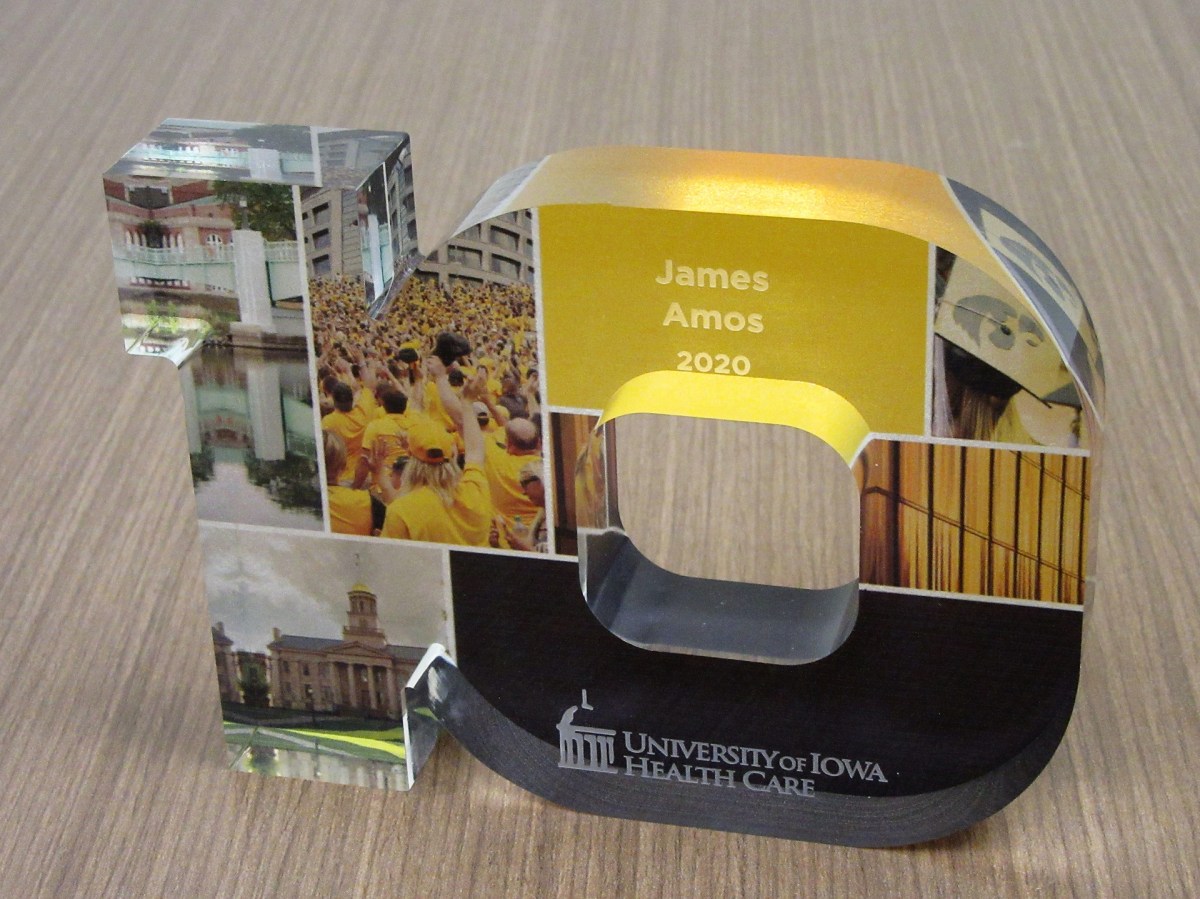
I got a nice, if puzzling surprise today. At a faculty meeting I was recognized for my 10-year anniversary of service at our hospital. It’s an important milestone, even if it is wrong. They scheduled this small event a couple of months ago, but I was too busy on the psychiatry consult service to break away. I also usually carry the pager for the trainees during the noon hour when the faculty meetings are held.

The 10-year anniversary recognition was very kind—except that I’ve been here for twenty odd years, not counting residency and medical school.

In all fairness, my department knows that and we shared a few jokes about it. I guess I should clarify that I have left the university for private practice a couple of times, which interrupts the years of service recognition timelines.

I was gone both times for a total of less than 12 months—just sayin’. I returned for a few reasons, although mainly because I missed teaching.

Anyway, I showed up at the faculty meeting, albeit a little guilty looking because I’m usually too busy to attend. My department chair arrived and said that she had to run back to get my “statue.”

That jarred me. Several years ago, when I had my first blog, The Practical Consultation-Liaison (C-L) Psychiatrist, I used to kid my readers that someday a statue of me would be erected in the university Quad. It would be made of Play-Doh.

And that’s why I asked her as she turned to leave, “Is it made of Play-Doh?” She looked puzzled and I didn’t really think I could explain in a way that wouldn’t make me look like I’d been smoking something illegal.

The “statue” is a handsome little sculpture of the number 10, standing for 10 years of service. It has color photos embedded in it of various aspects of academic life at the University of Iowa, many of which I’ve had the privilege of enjoying in the 30 odd years my wife, Sena, and I have been in Iowa City.

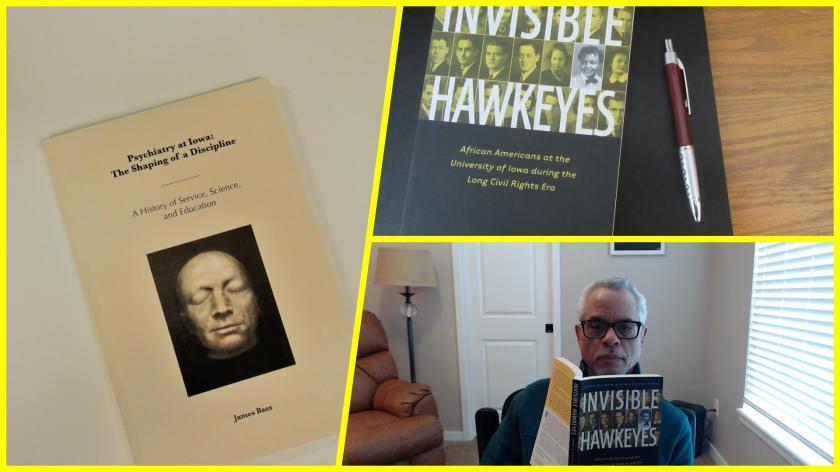
Just before the meeting, I had walked up to the 8th floor (I always take the stairs) to the psychiatry department offices to see if I could get a copy of the recently published history of the department, Psychiatry at Iowa: The Shaping of a Discipline: A History of Service, Science, and Education, written by James Bass.

Mr. Bass interviewed many people in the department, including me. I didn’t expect that my perspective on the consultation service, the clinical track, or my race would even get mentioned. However, 2 out of 3 made it into print.

It didn’t really surprise me that my being African American was not mentioned. I think I’m probably the only African American faculty member of the department in its 100-year history, at least until very recently.

It reminded me of another book that I just acquired, Invisible Hawkeyes: African Americans at the University of Iowa during the Long Civil Rights Era, edited by Lena M. Hill and Michael D. Hill.

In a small way, I’m making the invisible visible.

Making the invisible visible

And also, because it’s great for my ego, I’m going to quote what Bass wrote about me in Chapter 5, The New Path of George Winokur, 1971-1990:

“If in Iowa’s Department of Psychiatry there is an essential example of the consultation-liaison psychiatrist, it would be Dr. James Amos. A true in-the-trenches clinician and teacher, Amos’s potential was first spotted by George Winokur and then cultivated by Winokur’s successor, Bob Robinson. Robinson initially sought a research gene in Amos, but, as Amos would be the first to state, clinical work—not research—would be Amos’s true calling. With Russell Noyes, before Noyes’ retirement in 2002, Amos ran the UIHC psychiatry consultation service and then continued on, heroically serving an 811-bed hospital. In 2010 he would edit a book with Robinson entitled Psychosomatic Medicine: An Introduction to Consultation-Liaison Psychiatry.” (Bass, J. (2019). Psychiatry at Iowa: A History of Service, Science, and Education. Iowa City, Iowa, The University of Iowa Department of Psychiatry).

In chapter 6 (Robert G. Robinson and the Widening of Basic Science, 1990-2011), he mentions my name in the context of being one of the first clinical track faculty in the department. In some ways, breaking ground as a clinical track faculty was probably harder than being the only African American faculty member in the department.

As retirement approaches this coming June, I look back at what others and I worked together to accomplish within consultation-liaison psychiatry. The challenges were best described by a former President of the Academy of Consultation-Liaison Psychiatry, Thomas Hackett (this quote I helped find for James Bass and anyone can view it on the Internet Archive):

“A distinction must be made between a consultation service and a consultation liaison service.  A consultation service is a rescue squad.  It responds to requests from other services for help with the diagnosis, treatment, or disposition of perplexing patients.  At worst, consultation work is nothing more than a brief foray into the territory of another service, usually ending with a note written in the chart outlining a plan of action.  The actual intervention is left to the consultee.  Like a volunteer firefighter, a consultant puts out the blaze and then returns home.  Like a volunteer fire brigade, a consultation service seldom has the time or manpower to set up fire prevention programs or to educate the citizenry about fireproofing.  A consultation service is the most common type of psychiatric-medical interface found in departments of psychiatry around the United States today.

A liaison service requires manpower, money, and motivation.  Sufficient personnel are necessary to allow the psychiatric consultant time to perform services other than simply interviewing troublesome patients in the area assigned.  He must be able to attend rounds, discuss patients individually with house officers, and hold teaching sessions for nurses. Liaison work is further distinguished from consultation activity in that patients are seen at the discretion of the psychiatric consultant as well as the referring physician.  Because the consultant attends social service rounds with the house officers, he is able to spot potential psychiatric problems.”— Hackett, T. P., MD (1978). Beginnings: liaison psychiatry in a general hospital. Massachusetts General Hospital: Handbook of general hospital psychiatry. T. P. Hackett, MD and N. H. Cassem, MD. St. Louis, Missouri, The C.V. Mosby Company: 1-14.

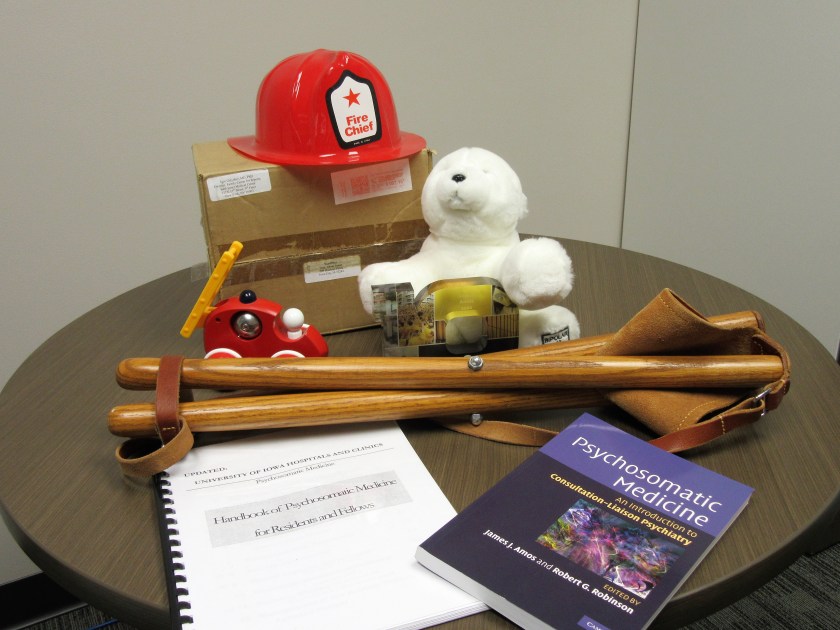
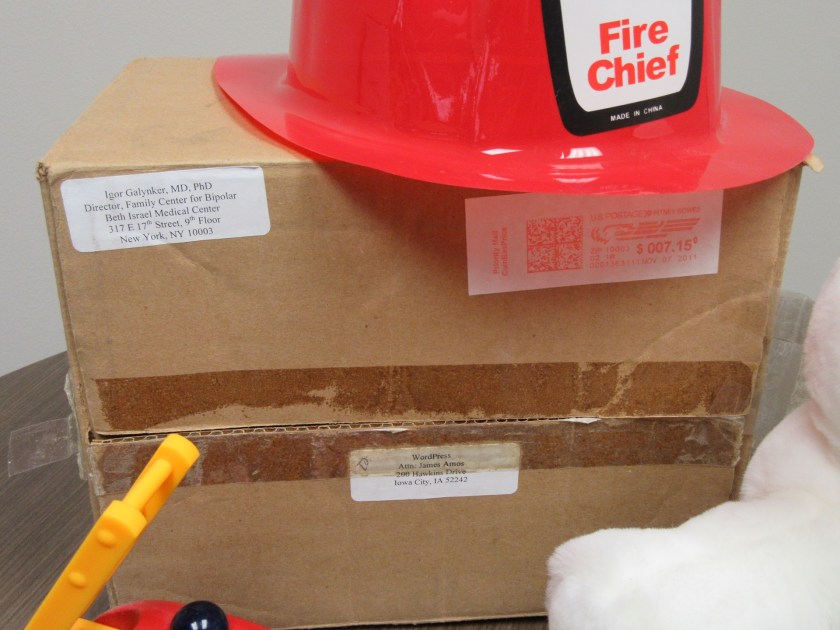
I have what seems like precious few mementos of my sojourn here in the department and, indeed, on this earth. I have a toy fireman’s helmet I found hanging in a plastic sack on my office doorknob one day. It was a gift from a Family Medicine resident who rotated on the consult service and who learned why I called it a fire brigade.

For the same reason, I have a toy fire truck, sent to me by a New York psychoanalyst who was also a blogger.

I have Bumpy the Bipolar Bear, believe or not, sent to me by psychiatrist, Dr. Igor Galynker, about whose emergency room suicide risk assessment method I had blogged about several years ago. C-L psychiatrists do a lot of suicide risk assessments in the hospital and the clinics. I still have the box with the address to me:

WordPress

Attn: James Amos

200 Hawkins Drive

Iowa City, IA 52242

I have my first homemade handbook for C-L Psychiatry and the published handbook that eventually replaced it. Thank goodness the leaders of the Academy of Consultation-Liaison Psychiatry listened to the membership and changed the name from Psychosomatic Medicine to C-L Psychiatry.

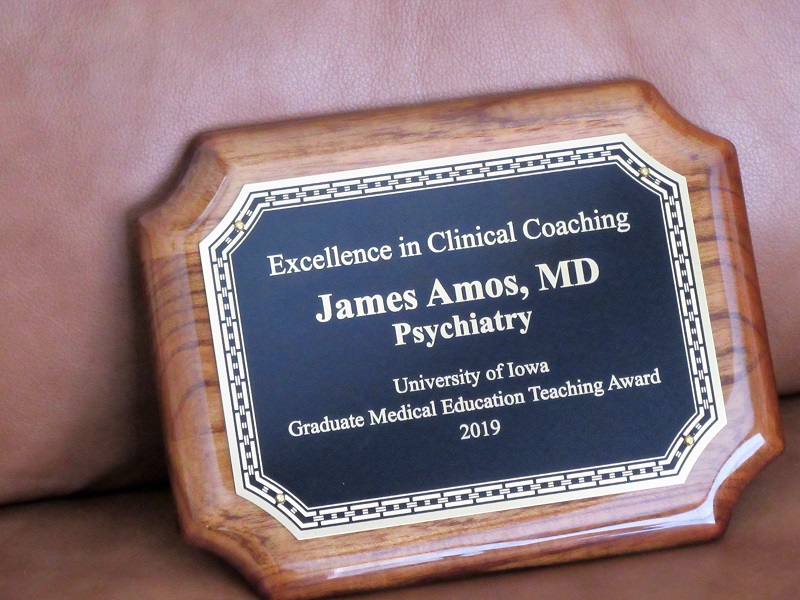
I have an award for being an excellent clinical coach.

And I have my little camp stool, which a colleague who is a surgeon and emergency medicine physician gave me and which allows me to sit with my patients anywhere in the hospital, so that I don’t have to stand over them.

It will all fit in a cardboard box on my last day—the next milestone.

29 Cribbage Board Antics

After a lot of encouragement from Sena, we got the 29-cribbage board. It’s a novelty board shaped like the very rare perfect 29 cribbage hand. You’re more likely to spot aliens in your back yard than to get a 29 hand—the odds are 1 in 216,580. See our 29 cribbage board antics in our YouTube video.

This is a follow up cribbage post, the most recent one being “Kitchen Table Cribbage” featuring our other new board, which was a v-tournament model.

We have a lot of fun playing cribbage and making the videos are a challenge, given that we’re still learning how to play. If we wait for the perfect video (meaning one without mistakes), it would be similar to waiting for the perfect 29 hand to show up.

On the cribbagecorner web site, there are interesting facts about the 29 hand probabilities. According to them, given the assumption that there’s a cribbage tournament somewhere in the United States almost daily, you should expect to see one 29 hand a year during tournament play.

One the other hand, there are many cribbage games, including kitchen table versions, occurring daily between commoners like us. Who knows how many 29 hands show up in all those unofficial competitions?

We’re not shy about comments from cribbage players helping us develop our skills. I suppose another way to do that would be to join a cribbage club. The American Cribbage Congress (ACC) sponsors the ACC Grass Roots organizations which has about 200 such clubs across North America.

Players in the ACC Grass Roots clubs compete to earn points for awards including being crowned champion and for getting 29 hand. There is one ACC Grass Roots club in Iowa and it’s in Ankeny. It’s called the Capital City 9-game club (given that most club members get together to play 9 games about once a week or so).

Just for the record, the capital city of Iowa is Des Moines. Ankeny is about 13 miles north of there. If we were to join the Capital City club, that would mean about a 2-hour drive from Iowa City. Since the season runs from September to May, we’d be driving in winter weather conditions sometimes.

If you earn enough lifetime milestone points in the ACC Grass Roots club, you can earn a trip to big tournaments such as the annual ACC Tournament of Champions, usually held in Reno, Nevada. However, the ACC announcement says the 2020 Grand National tournament XXXIX will be in Sacramento from September 22-27, 2020. The first-place trophy is a gold pan. The last time anybody from Iowa won it was in 1990. He was from Des Moines.

The obvious question is why isn’t there an ACC Grass Roots club in Iowa City? I don’t know if there is enough interest, frankly. I did see a small 29 cribbage board at a local hobby shop here. It fit in the palm of my hand. The one we just got works out better for us.

I just found out that National Cribbage Day is celebrated annually on February 10, which is just around the corner! February 10 happens to be the birthday of Sir John Suckling, the creator of cribbage in the early 17th century. He was also a poet. According to the Poetry Foundation web page for him, his poetry showed him to be a cynical party animal, womanizer, and gambler. He invented cribbage from an earlier game called Noddy and it was gambling game. I gather it’s still the only game that can be play in an English pub for money. Cribbage came to American with the first English settlers.

Can you tell we really like playing cribbage? Please, no wagering.