Do Barbers Still Exist?

About once or twice a year, I consider going DIY on getting my hair cut. My wife has been doing it for decades and cutting mine as well. Do barbers still exist? Or are we now calling them stylists? I grew up in the era when males usually sat in dim waiting rooms with a few rickety chairs around a beat-up table gaily decorated with coffee cup ring stains, cigarette burns, and old sports magazines dated from the Eisenhower administration. You waited for your favorite barber as the one you were leery of from past bloody buzzcuts loudly snaps an apron over his empty chair, staring at you.

Anyway, I usually go through about a half dozen on-line instructions in text and videos. The gist of most of them is usually polarized between two main viewpoints.

Writers on one side command you to never go DIY on anything as crucial as getting the right haircut because that’s why hair stylists (they almost never call them barbers) go through years of training. The message is that if you try to cut your own hair, you’ll be shamed for the rest of your natural life because you’ll certainly goof it up, wind up in the gutter and eventually have to move to Antarctica where you can at least hide your head in an oversized hooded parka, not that the seals and penguins care much about your hairstyle.

The other side generally says anyone with a kindergarten level education and a pair of garden shears can and should cut his own hair and do it right now for the sake of our economy. The instructions usually contain about a dozen or so steps and several disclaimers which sound like empty reassurances (“Remember, it’s just hair; it’ll grow back!”).  If you see an article in which the expert doesn’t know the difference between “perpendicular” and “parallel,” regarding cutting with a pair of scissors, you should probably just ignore it.

There is a third approach, which might fit an old guy nervous about hitting the barber scene after so many years. It’s advice about how to talk to your barber about what kind of haircut you want. I used to ask for a knuckle cut, which I think means different things to different barbers. I found one YouTube video about not cutting past the second knuckle which likely explains why some barbers gave me a funny look whenever I asked for a knuckle cut. It’s just a general principle about how to cut using a pair of scissors, not a specific cut per se.

So, talking to your barber would involve knowing the language of the art. The minute you get in the chair, you should confidently state, “Los libros están en la biblioteca.”

Seriously, there are a number of terms out there on the web about haircuts that barbers suggest you not use if you don’t know what you’re talking about—like the “fade.” The definition according to one author is that your hair is cut all the way down to the skin at your hairline. Most writers recommend readers not ask for it because they probably don’t want it. OK, I don’t want it.

Another cut I don’t want is a buzzcut, something I mentioned that old timer barbers used to give me when I was a kid. That was my first ever haircut at the barbershop. I remember it because he tied a piece of paper around my neck which I was really nervous about because it was tight. In fact, there are on line DIY suggestions that you can use a belt for the same purpose—which I think is just to mark the boundary of your neck hairline and which sounds a little creepy. Interestingly, the buzzcut is what some writers recommend for DIY beginners to haircutting. Just for the record, I’m opposed to cuts that involve chainsaws. I’m also not too keen on seeing what my scalp looks like after all these years.

I see the difference between the block and tapered nape cuts, the latter being preferable since the blending with the natural hairline makes for a longer-lasting neat look as the hair grows out.

I’m not as sure about the other kind of taper which is more technical and involves tapering the hair length gradually from the top of your head down to the neck. If I want my hair about the same length all the way around, I probably don’t want a taper—right?

I don’t know how to talk about texture with a barber. “Please cut my hair so the texture is like, you know, hairy.” But there are terms for texture, such as “razored” which some experts swear gives you a “badass” look, I think because the barber uses a straight razor. The associations elicited using words like “badass” and “straight razor” in the same paragraph tend to make me a little edgy.

I don’t know how that would even look, but that reminds me of another suggestion for how to talk with your barber about what you want which doesn’t involve words but pictures. You should bring a photo of your favorite movie star sporting the cut you want.

“To look like Yoda, you want?”

I think I’m on safe ground if I tell my barber I would like my arches natural, referring to the hairline around my ears. If you ask for high arches, you might risk getting the loving cup look. I can handle my own sideburns, thanks. I have a trimmer for that, but if you have to mess with them, just trim them a little.

For now, all I can say for sure is that I’m not going DIY on my haircuts as a New Year’s resolution. Merry Christmas and Happy New Year!
New Cribbage Board Delivered Before Christmas–Barely

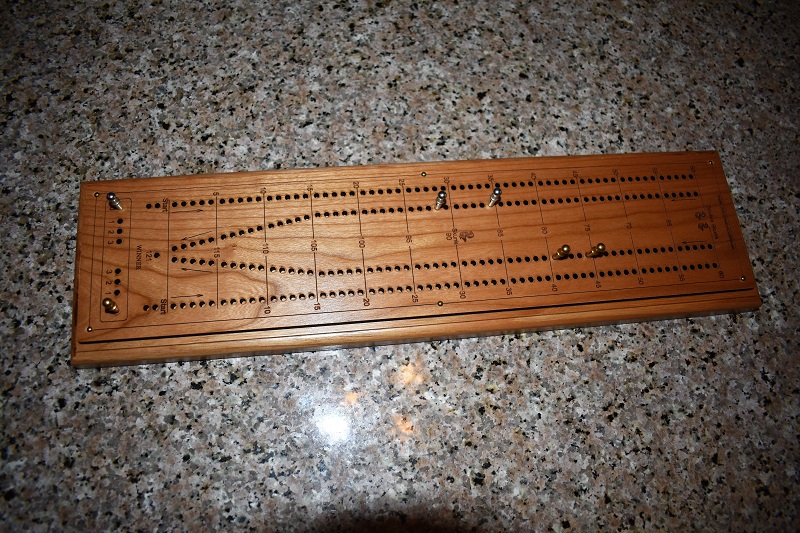
We got our new cribbage board today—after ordering it on December 15, 2019 by Priority Mail through the United States Postal Service (USPS). It’s a handsome Cherry on Hickory base V Tournament board, although we were puzzled by the label on the box which indicates that it was a Priority Mail 3-Day delivery when it was anything but.

In fact, my wife, Sena, took it down to the post office to ask a few questions about the meaning of Priority Mail. Our expected date of delivery was changed several times. Initially, it was December 18th or 19th. That morphed into December 21st, 22nd, and finally the 23rd. We got a couple of email notices saying it was to be delivered by 8:00 PM, even on a Saturday when we knew the Post Office was closed. A 3-day delivery turned into a week, which the USPS charges us a little over $13 and then says there’s no guarantee.

Sena found out that even if you order it delivered by First Class, depending on the weight, it gets bumped to Priority Mail. I’m guessing you pay more for First Class, but it sounds like you might not necessarily be any better off. Moreover, the multiple changes in expected delivery dates were called “unusual.” The worker was sympathetic, but sympathy was all Sena got. Sena was lucky she didn’t get the postal service worker working with another customer in the line next to her. All that worker said was, “There are no guarantees!”

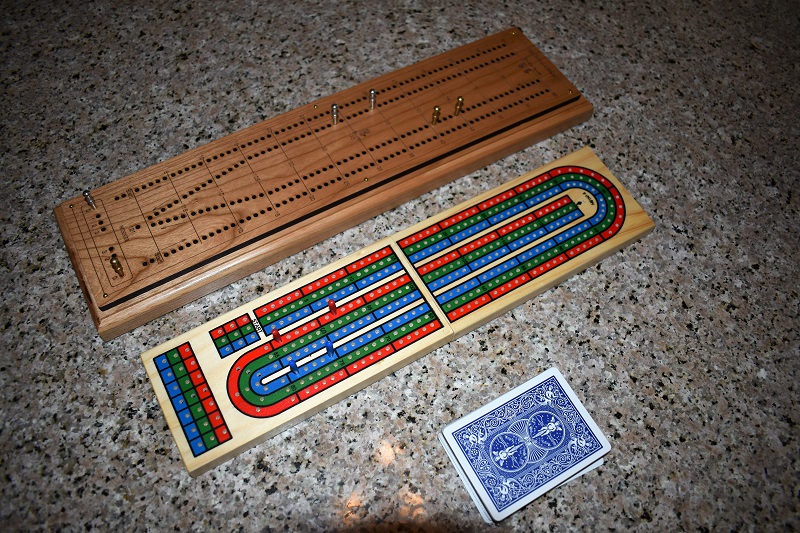
In fact, we interrupted a cribbage game today when we discovered the new board was delivered on our porch. I set up both boards to reflect the scores.

Cribbage game in progress…

I can see that it’s easier to play a two-handed game with fewer chances for mistakes in pegging on the new board. The tracks are further apart. Knocking over pegs was not uncommon on the old board—unintentional of course.

The metal pegs that came with the new board fit the holes perfectly and the stowaway hatch on the back for them were safe because of the snug fitting wooden cover.

As I’m finishing this post, our cribbage game which started this morning around 10:30 AM, sits on the dining room table unfinished on both boards. That’s because it’s close to 50 degrees outside and Sena is watering the lawn and the trees.

We might finish the game—but there are no guarantees. Have a Merry Christmas and a Happy New Year–that’s a priority!

Shopping for Cribbage Boards

As you know, Sena and I have been relearning how to play cribbage, a traditional card game using a special peg board for keeping score and about a million rules. They say cribbage is a game that takes 20 minutes to learn and 20 years to master.

We’re having a lot of fun learning. We bought a set for about ten bucks. It’s a folding board, a little over 14 inches long and 3 and a half inches wide. The pegs are plastic and can be stored in a shallow slot on the back of the board—not protected by the plastic sliding cover. We found that out one day; luckily the pegs weren’t lost. You can find these in most hobby and big box stores where you live. We’re shopping for a new cribbage board.

The cribbage set came with a simplified set of rules, which you can read with a standard magnifying glass. The peg board has 121 holes and you sort of race around the board to see who gets to 121 first, pegging your progress by scoring special combinations of cards from a standard 52 card deck like cards whose pip values add up to 15; pairs; 3 and 4 card runs like 6, 7, 8: flushes and so on. Then you score your hand and your crib (an extra hand that only the dealer gets and to which both the dealer and non-dealer contribute). Because there are so many opportunities to score during the game, it’s a lot easier to peg it out on the cribbage board. You can find all the rules on the American Cribbage Congress (ACC) website. The basic game is for two players although there are 3 and 4-handed versions.

Because our board is a little on the small side, we’d like something bigger and easier to read. I’m not a shopper by any means, but I’m learning about the variety of boards out there.

As usual you can find anything on Amazon, but what we’re looking for is something large and for that we have to look in other places. It turns out there are tournament boards that the ACC recommends and uses in the many tournaments around the country. You won’t find tournament boards just anywhere. You most likely won’t find them in any local store where you live.

There are tournament boards that have two straight rows that go for 60 holes up and back (to cut down on pegging errors) and a line across the board at the 90 mark, which is the skunk line. If you don’t make it past the skunk line, you have the right to be embarrassed. It means you will never be a cribbage player worth two cents, probably lose your job, your home, end up in the gutter, be kidnapped by aliens, taken to another planet in a distant galaxy and displayed in a zoo for the rest of your natural life, living on a diet of wild hickory nuts, which the aliens think all earthlings survive on.

That means you should study cribbage closely and for that you need the right kind of board. We like to have numbers printed on the board—but it turns out the official tournament boards don’t have them. When I think about it, I guess it makes sense. There are only two peg holes worth paying attention to and that’s the one where the skunk line is and the 120th.

But it just looks nicer to have the numbers on the board. We’ve shopped around a little. There is a tournament board that is a special V-type version. There are two rows but the 2nd row slants away from your opponent, making it even easier to peg.

There’s a guy in Florida who makes a V-type with all the numbers and even images of little skunks on it. It’s a little bigger than ours, made of hickory and comes with one of three top playing surfaces to choose from: Cherry, Maple, and interestingly, something called Beetle Kill Pine which is wood from thousands of acres of pine trees that have been killed by a beetle that injects it with a dye, giving a bluish cast to the grain. He doesn’t mention whether the boards are disinfected or not. The board runs about 75 dollars if you buy the cloth carry bag (65 dollars if not and that doesn’t count shipping). The maker is very honest and tells you that he can’t promise that the pegs he makes will fit the holes. Hmmmm.

There are mom and pop outfits in places like Canada and Rhode Island which specialize in hand-crafted game items and they make gorgeous cribbage boards, one of which will set you back over 100 dollars. It’s about 29 and a half inches long and about 8 inches wide and the pegs are 2 and a half inches long. It’s called the Imperial, and well it should at the price. The same outfit also has another model which I later learned is a Century model, a vintage board with a busy top surface along with the peg holes around the edges. There are several different peg holes that allow you to score other things like skunks, “legs” (which I think are different from games and matches, but I’m not sure, unless it’s for how many of your legs the aliens hack off for every skunk you lose by), hickory nut brownie recipes, and ways to score up to about 900 points, for what I don’t know. There’s so much stuff on the board it’ll make your head swim, but it’s the least pricey of the higher end bunch we’ve been looking at. It goes for 50 bucks. Part of the description of the company says the founders “…believed that quality materials and painstaking engineering were tantamount.” I think they meant “paramount”.

The place in Canada makes pretty boards out of Canadian Hard Maple. The largest one is about 27 inches long by 8 inches wide and has a stowaway slot for the metal pegs and a deck of cards. Most storage compartments on cribbage boards have the kind of slots we have on our cheapo board, with a little cover that slides over the slot, which falls off and allows the pegs to escape to their everlasting freedom down the floor heat register. The Canadian model (called the Jumbo) has an artsy carved wooden cap which is secured by “powerful rare earth magnets.” Have fun playing if you can get the cap off. It’s priced at 65 dollars and that’s with the storage bag.

You know, our little 10 dollar folding cribbage board does get the job done. Happy holidays!