Delirium and Catatonia: Medical Emergencies

It was a very busy day on the consultation psychiatry service today. Besides that, I gave a lecture about delirium and dementia to the medical students. The talk is similar to the one below:

As a reminder, Dr. Wes Ely, MD will be in Iowa City at the University of Iowa Hospitals and Clinics to talk about delirium, “A New Frontier in Critical Care: Saving the Injured Brain.” It will be at noon.

I’m urging medical students and residents to attend. Unfortunately, I’ll probably be too busy in the hospital to go.

I sometimes see what is called a catatonic variant of delirium in patients who are medically very sick.

A condition called catatonia can occur in the setting of delirium. Most commonly, patients with this condition are mute and immobile. They may have a fever and muscular rigidity that leads to the release of an enzyme associated with muscle tissue breakdown called creatine kinase (CK). The level of CK can be elevated and detectable on a lab test.

Many patients will have a fast heart rate and fluctuating blood pressure. They may sweat profusely which can lead to a sort of greasy facial appearance. They may have a reduced eye blink rate or seem not to blink at all. They may display facial grimacing.

The patient may exhibit the “psychological pillow” (some call this the “pillow sign”). While lying in bed, the patient holds his head off the pillow with the neck flexed at what looks like an extremely uncomfortable angle. The position, like other odd, awkward postures can be held for hours.

Catatonia can be caused by both psychiatric and medical disorders. It tends to be more common in bipolar disorder than in schizophrenia even though catatonia has historically been associated with schizophrenia as a subtype. You can also see it in encephalitis, liver failure, and in some forms of epilepsy and other medical conditions.

The patient may perseverate or repeat certain words no matter what questions you ask. He may simply echo what you say to him and that’s called “echolalia”.

Although catatonic stupor is what you usually see, less commonly you can see catatonic excitement, which is constant or intermittent purposeless motor activity.

The usual way to assess catatonic stupor in order to distinguish it from hypoactive delirium is to administer Lorazepam intravenously, usually 1 to 2 milligrams. A positive test for catatonic stupor is a quick and sometimes miraculous awakening as the patient returns to more normal animation. The reaction is usually not sustained and the treatment of choice is electroconvulsive therapy (ECT), which can be life-saving because the consequence of untreated catatonia can be death due to such causes as dehydration and pulmonary emboli.

Another less invasive test that doesn’t use medicine is the “telephone effect” described in the 1980s by a neurologist, C. Miller Fisher. It was used to temporarily reverse abulia, which in a subset of cases of stupor is probably the neurologist’s word for catatonia. Sometimes the mute patient suffering from abulia can be tricked into talking by calling him on the telephone. It’s pretty impressive when a patient who is mute in person answers questions by cell phone. I have never tried texting.

The goal is to identify any medical condition left undiscovered and treat it. Both delirium and catatonia should be thought of as ominous indicators of a medical emergency.


Patience is a Virtue Redux

This transition to retirement has me looking back at times to an earlier transition in my life—college. I wrote a blog post 8 years or so ago about a few of my experiences at Huston-Tillotson College (now Huston-Tillotson University, a private, historically African American school) in Austin, Texas. We called it H-T for short. The post was entitled “Patience is a Virtue.”

You have to remember, this was in the ‘70s. A lot has changed, including me. The blog post is going to be different now.

I’m not what you’d call a patient person by nature although I’m much older and patience comes easier nowadays. Patience is arguably the physician’s most valuable asset, so it was worthwhile for me to work at cultivating it. We’ve all heard that doctors start yapping almost before patients are through talking.

I’m still learning to be patient. I think I first realized that people thought I was impatient when I was a freshman at H-T. They were right; I just didn’t know it then.

I remember a day when I was pretty annoyed about some remarks a peer made during a class in Black History (we were still “black” in those days). After class, I vented about it with the teacher, Dr. Lamar Kirven, who was also a Major in the military. We called him Major Kirven.

We loved Major Kirven. He had a wonderful sense of humor and laughed along with us when we had to tell him we just could not read his indecipherable scrawls on the blackboard. We didn’t have PowerPoint—and I don’t think it would have helped him.

Anyway, Major Kirven listened without saying a word during my long diatribe. I’ll never remember what that nonsense was all about; it doesn’t matter now.

He listened deeply and, at the time it didn’t occur to me to be surprised about that. I was too busy liking the sound of my own opinions. Several times he could have interrupted and justifiably corrected me.

He didn’t. He waited until I was finished.

And then, very gently he said, “Brother Amos, patience is a virtue”.  It suddenly struck me that he had been very patiently listening to a very impatient young man’s philippic about the shortcomings of everyone but himself for almost a half hour before he made that brief observation.

I’ve been trying to be more patient. Along the way, I’ve discovered and rediscovered the truth of a statement that has often been attributed to Stephen Covey,

“With people, if you want to save time, don’t be efficient. Slow is fast and fast is slow.”

Stephen Covey

There’s a lot that goes into being an effective psychiatric consultant, not the least of which is the skill of transforming “That’s all I can do” into “I will do all I can.” That’s usually a lot easier if I listen patiently to what my colleagues, my trainees, and my patients want.

Meaning and Purpose in Retirement

As you know, I’m back in the saddle at work, according to the terms of my phased retirement contract. When I’m off service, I feel less pressured. However, when I’m on service, I’m like a fireman, thriving on pressure. I’ve done Consultation-Liaison (C-L) Psychiatry for so many years that, when I stop to think about it, I realize I get a good deal of my sense of meaning and purpose through my job.

I sometimes tell residents and medical students that I “do it for the juice.” That means I work for the adrenaline: rushing to emergencies, making quick decisions (some of them far from perfect), teaching on the run, telling funny stories about how my work as evolved over the years.

When I spent less time on the job during the first two years of phased retirement, I felt lost. There’s no better word for it. That’s not as much of a challenge now, but meaning and purpose in retirement can be difficult for a fireman to define.

I had a blog called The Practical C-L Psychiatrist until I dropped it last year. There were a couple of reasons. One of them was the expectation that bloggers write their own Privacy Policies in response to the European Union’s General Data Protection Regulation (GDPR) going into effect. I rebelled against it.

Please read my Privacy Policy on this blog. I worked pretty hard at it. I asked a few attorneys for guidance and only one of them got back to me, humbly admitting he didn’t know anything about it really, but had a helpful suggestion nonetheless.

The other reason I dropped The Practical C-L Psychiatrist was that it was less relevant to my stage of life in that I’m not racing all over the hospital nearly as much nowadays. I don’t have as much to write about that life anymore.

But I still love to write and so I swallowed my pride, wrote the Privacy Policy and decided on making a chronicle of my transition into retirement, which is this new blog, Go Retire Psychiatry. So far, I’ve more or less just made jokes about it. I realize that’s a defense. I need to move on and confront the search for meaning and purpose in retirement.

I’ve done a lot of fun things on the job over the years. I used to have mascots for the C-L service, like the one below. You can tell that it was from some time ago. The mascots were usually inflatable animals I bought from the hospital gift shop. The residents, medical students and I gave them silly names. The trouble was that the mascots, being balloons, were always running out of gas.

Winston googling neuroscience.

And that meant that somebody had to take the mascot for a walk all the way across the hospital back to the gift shop to get a healing shot of helium—and walk all the way back. The volunteers there got a big kick out of an old geezer doctor walking the mascot. It was an exercise in humility, which I admit I often needed.

And I took group pictures of trainees and me at the end of rotations by using an app on my old iPad. It’s called CamMe. The way it worked was that I set the iPad up on a stack of books or something; then we all stood for the shot. I would hold up my hand and make a fist to start a 3-2-1 countdown, which gave you just enough time to make a big smile for the automatic group selfies. Everybody got a kick out of it.

I was so proud of those pictures I thought nothing of posting them on my blog, with nary a thought about their privacy. All of them thought they were fun.

That’s about enough on meaning and purpose for today.

Fine Weather for Ducks

Today we had fine weather for ducks—who waddled across our front yard lawn and across the street. They sampled the worms the robins evidently wouldn’t eat. They didn’t like them much either.

I wonder what kind of romance life ducks have—probably about the same as humans.

That reminds me; my wife made another Hoorah’s Nest under her dining room chair this afternoon. She told me I could show you this.

Fine weather for ducks today

Who’s a Hoorah’s Nest?

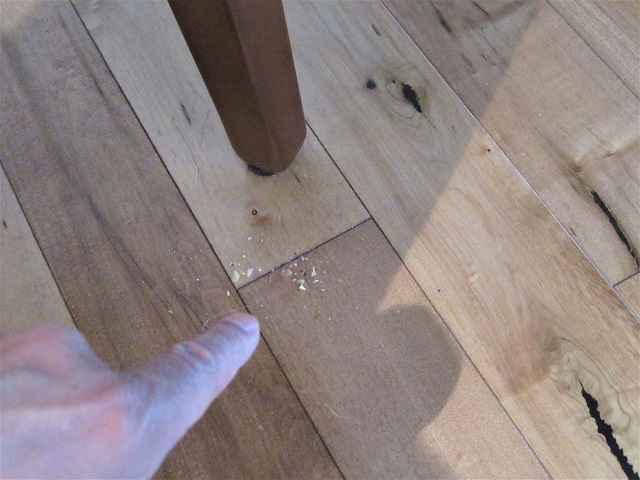
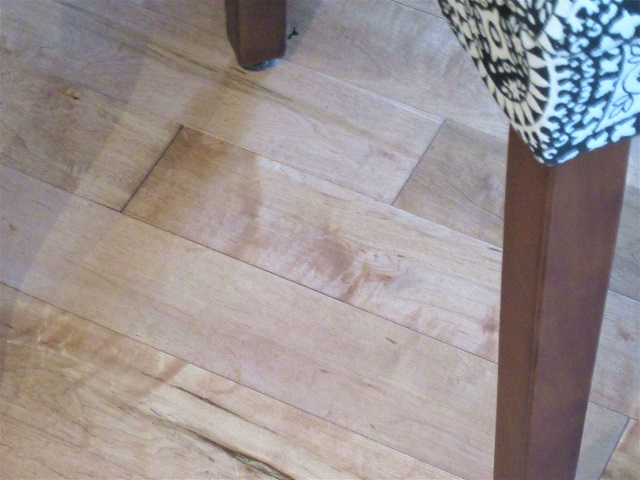
I asked my wife this morning if she ever got any food in her mouth, pointing to the floor under her dining room chair—where there was a small pile of crumbs and whatnot.

It was a regular Hoorah’s Nest (also known as Hurrah’s Nest). That’s just about anything (hairstyle, person, place, situation, my so-called cooking) that’s a big, disorganized mess. Don’t worry, she gave me permission to blab about this. I still have a place to live. You can send cash donations to my GoFundMe campaign if you want, though. I’ve got renovations planned.

My side of the floor is immaculate, of course. No Hoorah’s Nest on me.

You can look on the web for definitions of Hoorah’s Nest and the origin of the term, which includes speculations about a cryptid bird called a Hoorah. It doesn’t excite cryptozoologists as much as Bigfoot does.

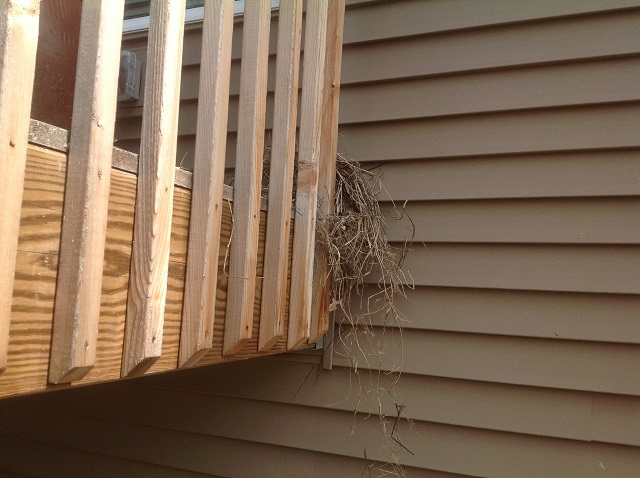
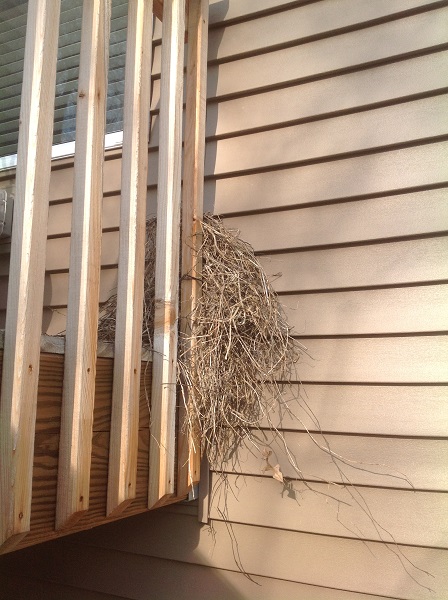
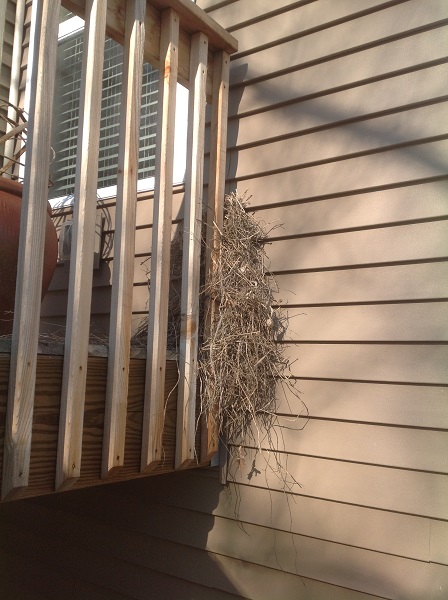
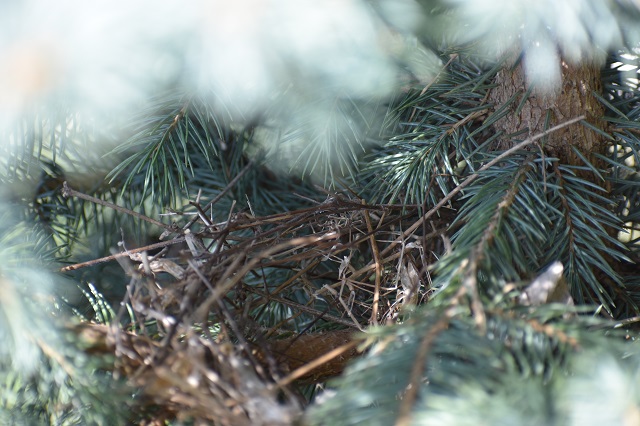
On the other hand, we think we saw the Hoorah about three years ago. I have several snapshots of its nest—which was a certified mess and a sign the bird needed professional help.

We tried to assist this Hoorah. Every time it started to go wrong in the construction of the nest (which was immediately), we tried removing the mess from the spot it chose to erect it.

The site was between our house and the back porch rail. Apparently, it was unfamiliar with trees.

It might have been high on drugs. On the other hand, the only bird I know of who has a substance abuse problem is the Cedar Waxwing. It overeats fermented berries and gets so drunk it can’t find its way home, much less build one.

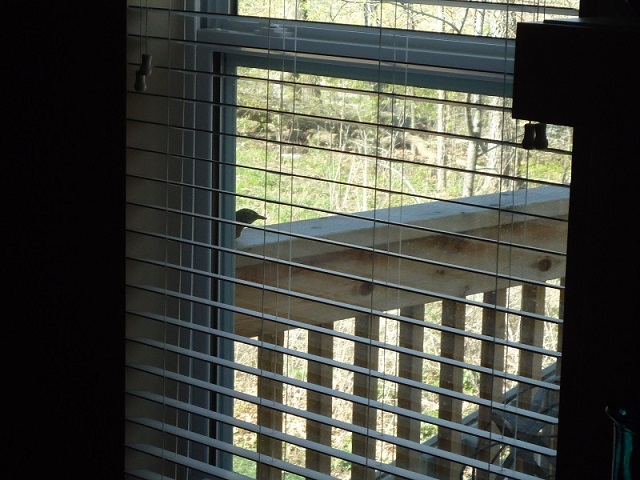
But this bird might have been from another planet—a world where trees don’t exist and nest-building skills are optional. I could get only one picture of the Hoorah—also known as a Robin. Their nests get the big Hoorah.

The shy and rarely seen Hoorah…otherwise known as a robin.

Other birds make really messy nests, though: Mourning Doves, even the Cardinals (on the right) who we might have already scared away just by staring at them through our window.

Holler if you see a Hoorah.

Start My Engine!

Good Gahd Amighty, it was busy today! I really had to start my engine. It felt like I logged a lot more than 2.6 miles and 21 floors on the step counter. It’s days like this one that I’m not going to miss when I retire.

I don’t think I could exercise enough to withstand too many hectic days. I need to be a transformer of some kind.

I could use a break, so it’s a good thing I got the weekend off. I think I can feel my age.

The only time I want a wild ride like that is if I’m at an amusement park.

In fact, my wife and I had a great time at the Mall of America in Minnesota a few years ago. See for yourself.

Remembering My Calling

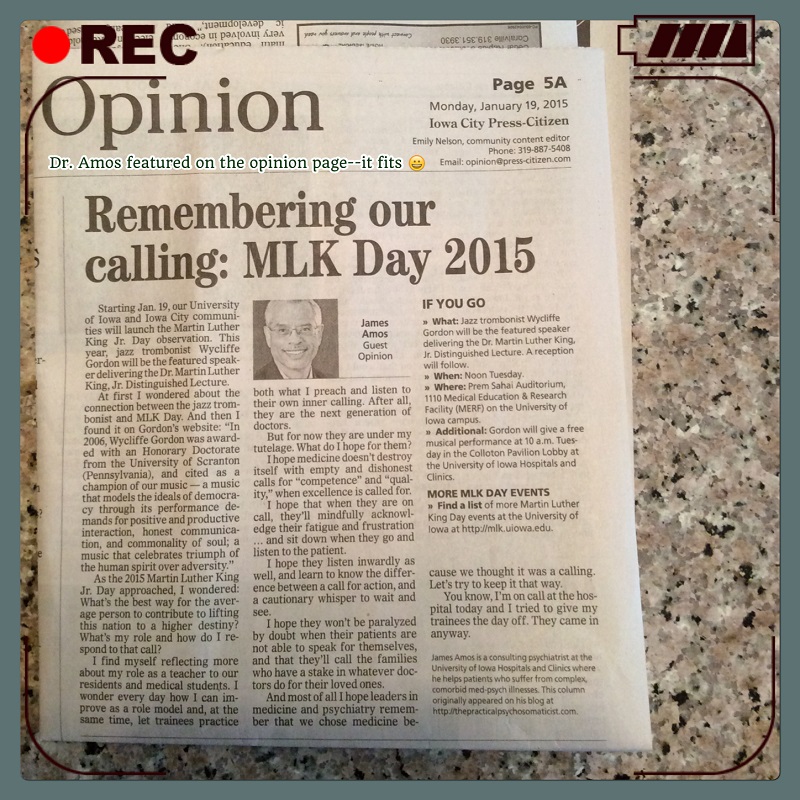
Back when I had the blog The Practical C-L Psychiatrist, I wrote a post about the Martin Luther King Jr. Day observation in 2015. It was published in the Iowa City Press-Citizen on January 19, 2015 under the title “Remembering our calling: MLK Day 2015.” 

I have a small legacy as a teacher. As I approach retirement next year, I reflect on that. When I entered medical school, I had no idea what I was in for. I struggled, lost faith–almost quit. I’m glad I didn’t because I’ve been privileged to learn from the next generation of doctors.

“Faith is taking the first step, even when you don’t see the whole staircase.”

Martin Luther King, Jr.

As the 2015 Martin Luther King Jr. Day approached, I wondered: What’s the best way for the average person to contribute to lifting this nation to a higher destiny? What’s my role and how do I respond to that call?

I find myself reflecting more about my role as a teacher to our residents and medical students. I wonder every day how I can improve as a role model and, at the same time, let trainees practice both what I preach and listen to their own inner calling. After all, they are the next generation of doctors.

But for now they are under my tutelage. What do I hope for them?

I hope medicine doesn’t destroy itself with empty and dishonest calls for “competence” and “quality,” when excellence is called for.

I hope that when they are on call, they’ll mindfully acknowledge their fatigue and frustration…and sit down when they go and listen to the patient.

I hope they listen inwardly as well, and learn to know the difference between a call for action, and a cautionary whisper to wait and see.

I hope they won’t be paralyzed by doubt when their patients are not able to speak for themselves, and that they’ll call the families who have a stake in whatever doctors do for their loved ones.

And most of all I hope leaders in medicine and psychiatry remember that we chose medicine because we thought it was a calling. Let’s try to keep it that way.

You know, I’m on call at the hospital today and I tried to give my trainees the day off. They came in anyway.

I’ll Have to Make Time

I suppose you’re wondering why I’ve been saying that my wife has got me this or that item, like the pink dumbbells and whatnot. She also got me an extra yoga mat.

Part of the explanation is that I’ve recently had a birthday, which reminds me of the importance of time in my life–mainly because I have a shrinking supply of it. After all, I’m heading into the sunset of my journey on Earth.

Sunset

Occasionally, I wonder what I ought to be trying to accomplish, if anything.

To achieve great things, two things are needed:

A plan and not quite enough time.

Leonard Bernstein

Bernstein’s quote is encouraging in a way. Hey, I’ve already got half of it–I don’t have enough time. Now all I have to do is achieve some great things.

I could go on the road to promote my idea for a hit song, “Put your hand in the hand of the man with a plan to get a tan, lead a band, roam the land, avoid the bladder scan, zippity do dah shazam.”

All I have to do is come up with lyrics…and a melody…and an agent…and a band…and a voice coach…and some talent.

Now, if I’m going to accomplish something great, it would make sense to keep working on building a more harmonious balance in my everyday life. I’m doing some of that, including regular exercise, mindfulness practice, and healthy eating.

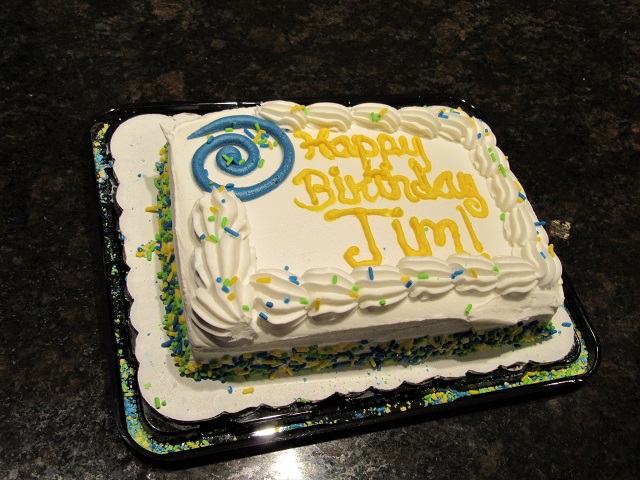
That reminds me, the birthday cake was excellent, especially topped with white chocolate vanilla ice cream.

Every so often, my former mindfulness teacher sends out an email message about the upcoming mindfulness classes. She always includes an inspirational quote, like the one below:

Be a person here. Stand by the river, invoke
the owls. Invoke winter, then spring.
Let any season that wants to come here make its own
call. After that sound goes away, wait.

A slow bubble rises through the earth
and begins to include sky, stars, all space,
Even the outracing, expanding thought.
Come back and hear the little sound again.

Suddenly this dream you are having matches
everyone’s dream, and the result is the world.
If a different call came there wouldn’t be any
world, or you, or the river, or the owls calling.

How you stand here is important. How you
listen for the next things to happen. How you breathe.

William Stafford – “Being a Person”

There was also a couple of suggestions for yoga and meditation techniques specifically to help you sleep. I recognized one of them as the body scan. The body scan is one of the first things they teach you in Mindfulness Based Stress Reduction (MBSR).

The body scan invariably put me to sleep, which made me feel like I wasn’t doing it right. Early on in the course, that was not exactly the “goal” of the body scan. Except mindfulness is not exactly a goal-oriented activity.

That’s hard to conceptualize. And so, the other class that is offered to those who make mindfulness practice a regular part of their lives are follow-up groups. It helps reaffirm the regular commitment to practice mindfulness.

I noticed one of the follow-up groups is entitled “Embracing the Paradoxes of Mindfulness.” The description of the course makes the point that mindfulness really isn’t about reaching a goal or achieving great things. It’s about being rather than doing. It’s hard for me to get my head around that after getting into and through medical school, residency, and practicing psychiatry for umpteen years. And now I’m making a transition to retirement.

One of my biggest fears about making and sticking to a mindfulness practice was that I often didn’t think I would have enough time for it. My teacher just advised me that I would simply have to make time.

Maybe I could accept the time I do have left and just be the geezer I am.

OK, OK, it’s not about relaxing…

Talk About Change

Let’s talk about change. I’ve had a couple of brand-new tie bars (gifts from my wife) in my dresser drawer for a couple of months now. I’d forgotten them until last night. I used to wear a tie bar many years ago. I’m discovering that I probably wore it wrong, according to fashion experts who know a lot about these things.

I never knew you were supposed to wear a tie bar between the 3rd and 4th button of your shirt (counting from the neck). I guess I always wore it too low. It was always coming loose from the shirt, and that’s why I quit wearing it for years. It’s long gone. I think I probably just threw it away, or maybe it got lost in one of our many moves. And I never knew that the part of the shirt you attach the tie bar to is called a “placket.”

There are different kinds of tie bars. Most of them are made with what resembles an alligator clip. I guess you’re supposed to call that a slide clasp. Another kind of bar is difficult to manage without wrinkling your tie. It’s an awful lot like a cotter pin, but you’re supposed to call it a pinch clasp—I think.  I have one of each. Pictures don’t always seem to match up with the names.

Look close to see the tie bar; it’s there. It’s just not in the right spot according to GQ.

I also used to wear bow ties. You don’t need a tie bar for those. They were very colorful. They’re long gone.

I also used to wear the old-style suspenders and even had buttons on the inside of my trousers to secure them. They’re long gone, maybe because I felt insecure without a belt. That was back before I got a paunch—which is now starting to shrink, probably because I’m exercising daily.

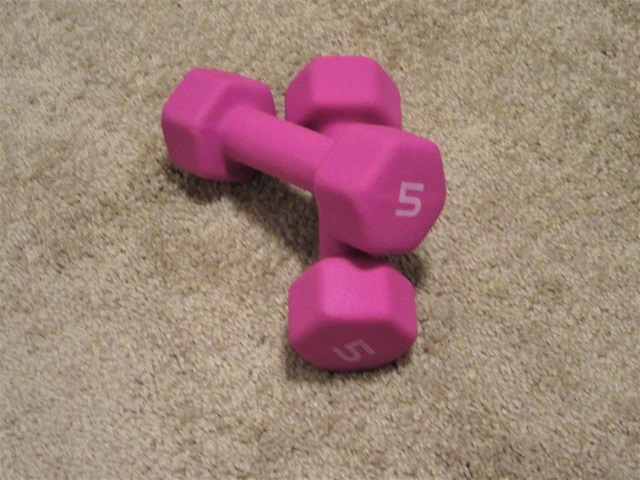
And speaking of daily exercise, my wife got me a pair of 5-pound dumbbells. She says pink was the only color left. Anyway, I began using them this evening. I’m not sure, but I may need some liniment.

I used to wear a heavy pair of wingtip Oxford brogues. Believe it or not I would tramp all over the hospital in those shoes. I still thought they looked sharp, but they also looked dated—kind of like me. I used to keep the old-fashioned cedar shoe trees in them, just to keep the creases out of the instep.  They’re long gone. Now I wear lighter shoes. When I exercise, I wear Velcro tennis shoes.

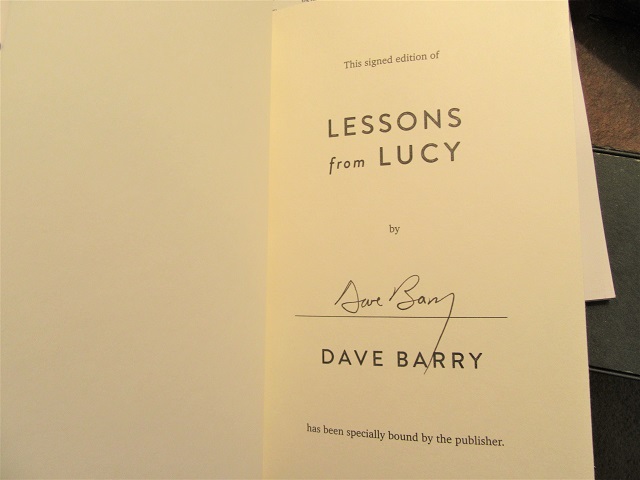
My wife also got me an autographed copy of  Dave Barry’s new book, Lessons from Lucy: The Simple Joys of an Old, Happy Dog. I’ve always been partial to his sophisticated humor—classic booger joke style.

However, I think Barry’s new book is more about how he’s changing as he ages. I haven’t had chance to read it yet except just enough from the jacket to suspect that the booger joke style will be there, but there’ll be something beyond that. He’s 70 years old and likely reflecting—about the mechanism of action of booger jokes. I used to have nearly all of his books, but they’re long gone. Just like the tie bar, I lost most of them in the many moves we’ve made.

The point is I’m changing in a lot of little ways. The big change coming up is, of course, retirement. I’m changing from a physician to a retiring physician—a retiring psychiatrist. Not all of the changes are to my liking, either about myself or my path.

“A flower falls even though we love it; and a weed grows even though we do not love it.”

Dogen

Change is not always comfortable. I have not stayed the same across the decades. Some changes have been painful. Others have been so much fun that I wouldn’t mind reliving them. They’re all long gone. We’ll just have to make new ones.

Darn Weird Socks

Today, a colleague and I compared socks. I noticed he was wearing a pair of Go Iowa Hawkeye-type socks. They looked pretty good—and then I showed him my brand-new Taco Avocado Alien socks. He was pretty impressed. They are the Darn Weird socks of America.

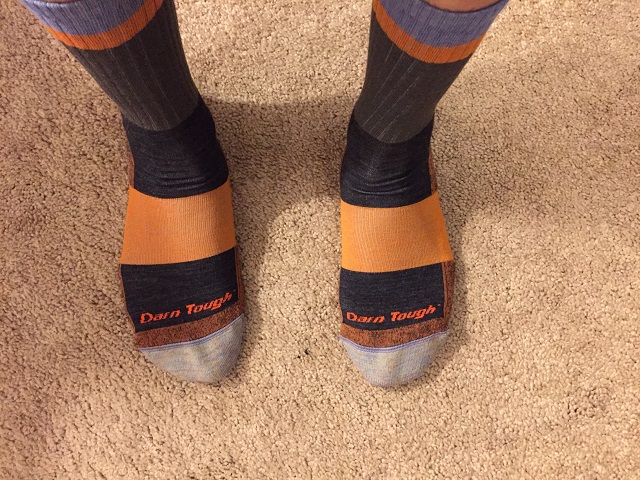
On the other hand, around 3 years ago, I found out about Darn Tough socks and got a couple pairs. They’re still tough, no matter how many stairs I climb.

Darn Tough socks have an unconditional lifetime replacement guarantee. They’re made in Vermont. They’re not cheap. But hey, if they’re good enough for dairy farmers in Wisconsin, they got to be good enough for me.

I’m not sure how long my Taco Avocado Alien socks are going to last. I usually get about 2-3 miles and 20 floors and more logged on my step counter as I hoof it around the hospital in my job as a Consultation-Liaison Psychiatrist. Today I logged 2.9 miles and 27 floors. And when I got home, I exercised in them. I wore my geezer Velcro tennis shoes, of course.

That kind of punishment often leads to my wearing out socks in a few weeks. Usually the toes go quick. Maybe my Darn Weird socks won’t last. I Like the Taco Avocado Alien theme anyway. I still haven’t figured out what the connection is between aliens, tacos, and avocados. Sure, you make guacamole from avocado for tacos and so they’re all green. Maybe that’s all there is to it.

Then again, we have to ask ourselves, do aliens like tacos with guacamole? I guess you’d have to ask the guys on the Ancient Aliens TV show (it’s on the History Channel), which I watch every Friday. It’s relaxing and often puts me to sleep. Does Giorgio A. Tsoukalos, a.k.a. the hair guy, wear Taco Avocado Alien socks? There are so many memes out there about him, it wouldn’t surprise me if you could find a picture of him wearing them—photo-shopped, of course.