
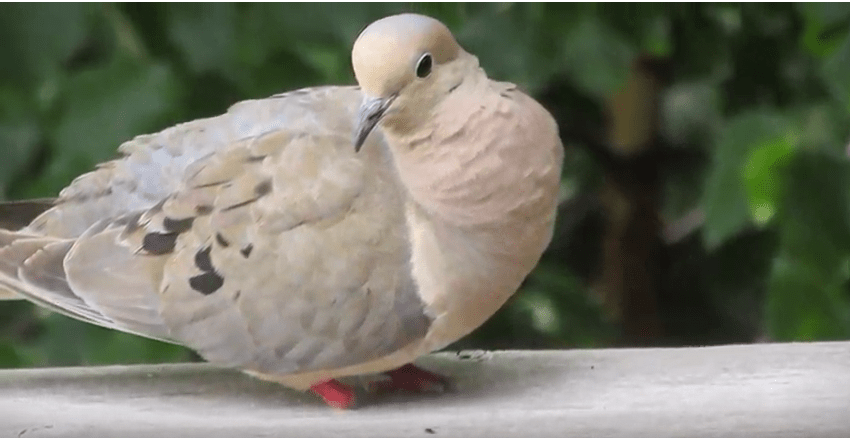
Mourning Dove Toe Deformities Revisited

I recently got my first and only comment on a blog post I posted on March 30, 2019 about toeless mourning doves which were visiting our backyard deck of a house in which we lived previously. I also found an article published about the issue later that year in December of 2019, which is about pigeons losing toes. Pigeons and mourning doves are not exactly the same (although they are relatives within the same family), but apparently pigeons are thought by the authors of the article to lose their toes because of urban pollution.

The commenter is from West Texas who has seen toe deformities, notes that it’s a new problem to him (never saw it prior to this year), remarks that the toe deformities were visible in newly hatched birds and further suspects the problem is more complicated than exposure to stringfeet or frostbite injury.

When I searched the web for more information, what appeared is my 2019 blog post at or near the top of the page and little else. There was one news item about the issue published in 2021 suggesting the problem of missing toes in doves at that time was probably due to frostbite from a winter storm in North Texas.

We haven’t seen any mourning doves lately. They don’t frequent our new property, which is actually close to the same neighborhood where we observed the toeless birds several years ago.

So, the mystery deepens. If anyone has new information, let me know.

New reference:

Frédéric Jiguet, Linda Sunnen, Anne-Caroline Prévot, Karine Princé,

Urban pigeons losing toes due to human activities,

Biological Conservation,

Volume 240,

2019,

108241,

ISSN 0006-3207,

(https://www.sciencedirect.com/science/article/pii/S0006320719306901)

Abstract: Measuring the impacts of urban pollution on biodiversity is important to identify potential adaptations and mitigations needed for preserving wildlife even in city centers. Foot deformities are ubiquitous in urban pigeons. The reasons for these mutilations have been debated, as caused by frequenting a highly zoonotic environment, by chemical or mechanistic pigeon deterrents, or by necrosis following stringfeet. The latter would mean that pigeons frequenting pavements with more strings and hairs would be more exposed so subject to mutilations. We tested these hypotheses in Paris city (France), by recording the occurrence and extent of toe mutilations on samples of urban pigeons at 46 sites. We hypothesized that mutilations would be predicted by local overall environmental conditions, potentially related to local organic, noise or air pollutions, so gathered such environmental predictors of urban pollutions. We showed that mutilations do not concern recently fledged pigeons, and that their occurrence and frequency are not related to plumage darkness, a proxy of a pigeon’s sensitivity to infectious diseases. Toe mutilation was more frequent in city blocks with a higher degree of air and noise pollution, while it tended to increase with the density of hairdressers. In addition, the number of mutilation on injured pigeons was higher in more populated blocks, and tended to decrease with increasing greenspace density, and to increase with air pollution. Pollution and land cover changes thus seem to impact pigeon health through toe deformities, and increasing green spaces might benefit bird health in cities.

One sentence summary

Toe mutilation in urban pigeons is linked to human-induced pollution.

Keywords: Columba livia; Feral pigeon; Toe mutilation; Stringfeet; Urban pollution

Iowa City Nature Challenge Begins!

The Iowa City Nature Challenge began on April 29, 2022. It’s sponsored by the University of Iowa Office of Sustainability and the Environment. According to their web site:

“From April 29th to May 2nd, find and photograph plants and animals in your backyard, in parks, along city streets, on school grounds—anywhere you find nature in Iowa City. Then, simply use the iNaturalist app to upload your photos and add them to the Iowa City project!”

It sounds fun. Read all the instructions carefully. This reminded me of my own amateur naturalist post back in 2019 about a toeless Mourning Dove.

Video Description from my YouTube post:

This is a rather sad little video about a Mourning Dove without toes who visited our back porch in early August 2018. The first slide is of a bird with normal feet, followed by several shots of the bird with abnormal feet.

There’s a slide with a bird seemingly sitting in its own poop, which is said by some to cause the problem–which is doubtful.

The last shot is that of a pair of doves trying to nest in our window box, which was full of sharp, plastic artificial plants, which was painful to watch and I wonder if their hazardous habits could lead to injuring their feet.

Speculation about the causes of these injuries range from something called string foot (string or human hair used to build nests getting wrapped around toes leading to amputation), sitting in poop leading to infections, and frostbite.

I think frostbite is plausible, and so did a birdwatcher named Nickell, who published an article about it over a half century ago; Nickell, W. P. (1964). “The Effects of Probable Frostbite on the Feet of Mourning Doves Wintering in Southern Michigan.” The Wilson Bulletin 76(1): 94-95, complete with hand-drawn illustrations that look exactly like the one in the video.

String foot is also plausible, but I’m reminded of an essay by E.B. White, Mr. Forbush’s Friends, White, E. B. (1966). “Annals of birdwatching: Mr. Forbush’s friends.” New Yorker. 42(1) or in White, E. B. (1999). Essays of E.B. White. New York, Harper Perennial, in which White recounts the book, Birds of Massachusetts and Other New England States by Edward Howe Forbush, in which you can read one of the many anecdotes from amateur ornithologists about bird behavior that Forbush collected for his book, which was published circa 1929:

“Mrs. Olive Thorne Miller. Reported case of female tufted titmouse stealing hair from gentleman in Ohio for use in nest building. Bird lit on gentleman’s head, seized a beakful, braced itself, jerked lock out, flew away, came back for more. Gentleman a bird lover, consented to give hair again. No date.”– Forbush, Edward Howe, 1858-1929. Birds of Massachusetts and Other New England States. [Norwood, Mass.: Printed by Berwick and Smith Company], 192529. I wonder why a bird would risk string foot by using hair in nests?

Toeless Mourning Doves

I’m an amateur bird watcher. Last August, I saw a toeless Mourning Dove with what some people would call String Foot, a foot deforming condition that might be caused by a variety of injuries. I had never seen anything like it.

Toeless Mourning Dove

In the slide show you can see a bird seemingly sitting in its own poop, which is said by some to cause the problem—which I suspect is doubtful. The last shot is that of a pair of doves trying to nest in our window box, which was full of sharp, plastic artificial plants. It was painful to watch and I wonder if their hazardous habits could lead to injuring their feet.

Mourning Doves nesting on a speaker

I’ve seen Mourning Doves do strange things, mainly nesting in areas that don’t make much sense. Years ago, we could not dissuade a pair of them from building a home on top of one of the audio speakers mounted outside on our deck. Cranking up the volume didn’t work.

I clicked around the web trying to find out about the problem. Speculation about the causes of these injuries range from something called String Foot (string or human hair used to build nests getting wrapped around toes leading to amputation), sitting in poop leading to infections, and frostbite.

I think frostbite is plausible, and so did a birdwatcher named Nickell, who published an article about it over a half century ago; Nickell, W. P. (1964). “The Effects of Probable Frostbite on the Feet of Mourning Doves Wintering in Southern Michigan.” The Wilson Bulletin 76(1): 94-95, complete with hand-drawn illustrations that look exactly like the one in the slide show.

In the book, Birds of Massachusetts and Other New England States by Edward Howe Forbush, you can read one of the many anecdotes from amateur ornithologists about bird behavior that Forbush collected for his book, which was published circa 1929 (I actually plucked it from one of E.B. White’s essays):

“Mrs. Olive Thorne Miller. Reported case of female tufted titmouse stealing hair from gentleman in Ohio for use in nest building. Bird lit on gentleman’s head, seized a beakful, braced itself, jerked lock out, flew away, came back for more. Gentleman a bird lover, consented to give hair again. No date.”– Forbush, Edward Howe, 1858-1929. Birds of Massachusetts And Other New England States. [Norwood, Mass.: Printed by Berwick and Smith Company], 192529.

I wonder why a bird would risk String Foot by using hair in nests?