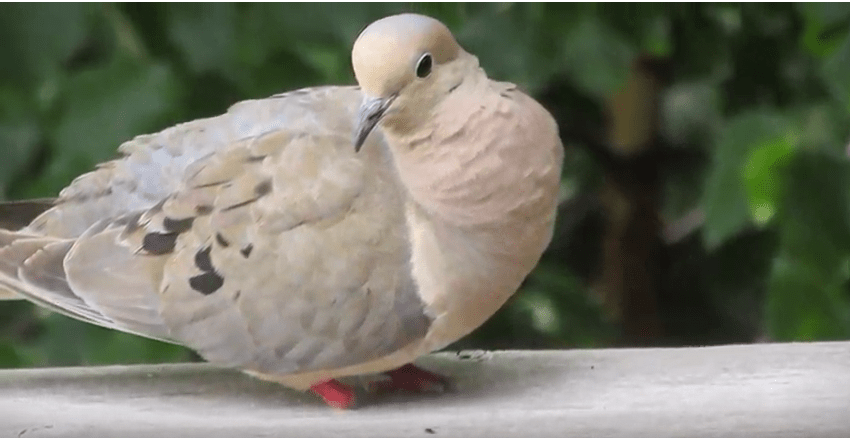
I’m an amateur bird watcher. Last August, I saw a toeless Mourning Dove with what some people would call String Foot, a foot deforming condition that might be caused by a variety of injuries. I had never seen anything like it.
In the slide show you can see a bird seemingly sitting in its own poop, which is said by some to cause the problem—which I suspect is doubtful. The last shot is that of a pair of doves trying to nest in our window box, which was full of sharp, plastic artificial plants. It was painful to watch and I wonder if their hazardous habits could lead to injuring their feet.

I’ve seen Mourning Doves do strange things, mainly nesting in areas that don’t make much sense. Years ago, we could not dissuade a pair of them from building a home on top of one of the audio speakers mounted outside on our deck. Cranking up the volume didn’t work.
I clicked around the web trying to find out about the problem. Speculation about the causes of these injuries range from something called String Foot (string or human hair used to build nests getting wrapped around toes leading to amputation), sitting in poop leading to infections, and frostbite.
I think frostbite is plausible, and so did a birdwatcher named Nickell, who published an article about it over a half century ago; Nickell, W. P. (1964). “The Effects of Probable Frostbite on the Feet of Mourning Doves Wintering in Southern Michigan.” The Wilson Bulletin 76(1): 94-95, complete with hand-drawn illustrations that look exactly like the one in the slide show.
In the book, Birds of Massachusetts and Other New England States by Edward Howe Forbush, you can read one of the many anecdotes from amateur ornithologists about bird behavior that Forbush collected for his book, which was published circa 1929 (I actually plucked it from one of E.B. White’s essays):
“Mrs. Olive Thorne Miller. Reported case of female tufted titmouse stealing hair from gentleman in Ohio for use in nest building. Bird lit on gentleman’s head, seized a beakful, braced itself, jerked lock out, flew away, came back for more. Gentleman a bird lover, consented to give hair again. No date.”– Forbush, Edward Howe, 1858-1929. Birds of Massachusetts And Other New England States. [Norwood, Mass.: Printed by Berwick and Smith Company], 192529.
I wonder why a bird would risk String Foot by using hair in nests?


 Go Retire Psychiatrist