
A few days ago, I noticed a very interesting dragonfly resting on the sidewalk in front of a neighbor’s house as I went out for my morning walk. I approached it and could have stepped on it I got so close—but it didn’t move. I wondered if it were dead.
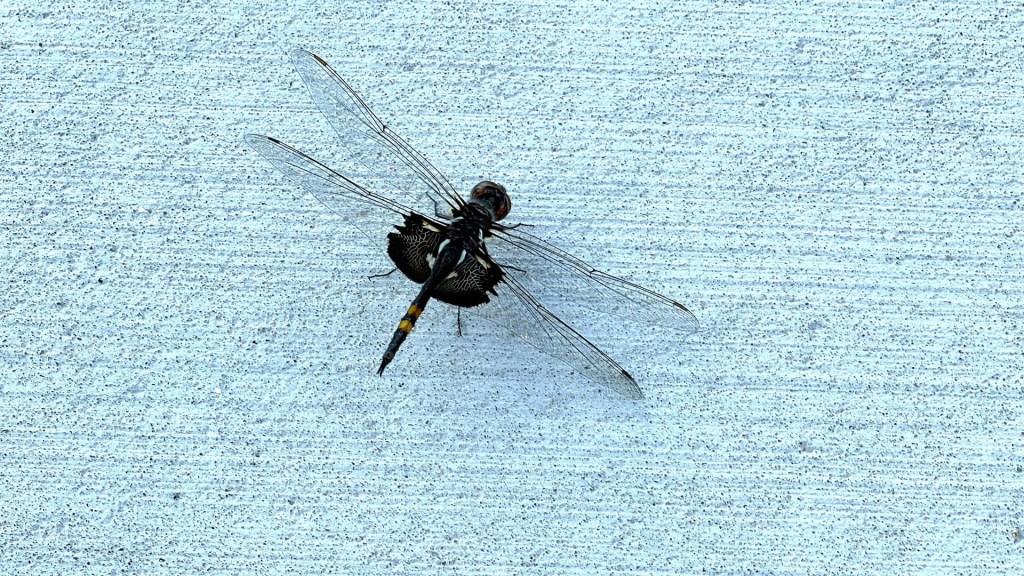
I got my iPhone out of my holster and expected the dragonfly to zoom away. It sat very still. It was not like most skimmer dragonflies I’ve seen before. It allowed me to stand right over the top of it and I took a picture of it.
The wings had black patches on them. Its body had two yellow bands around it. I searched the web to identify it and it was surprisingly easy to do so. It’s a Black Saddlebags dragonfly. It’s not unusual and it’s been spotted all over North America. I notice that observers in Iowa have described them on social media.
It’s simple to find a few facts about it. In many ways, it’s typical of nearly all other dragonflies. They eat mosquito larvae and mosquitos, which is a good thing. They probably migrate a long way south in winter. The irregular black wing patches resemble saddlebags.
The most interesting article I found was written by a Native American member of the Kawaiisu people, an ancient people native to southern California and live in the Tehachapi Valley and Tehachapi Mountains. They’ve been there for over 3,000 years.
The article was posted by Jon Hammond in 2011 and updated in 2016 in a local newspaper, The Tehachapi News. The title is “Black Saddlebags Dragonflies: Ancient and fascinating mosquito catchers.” He gives an exquisitely detailed description of the insect, a few times almost lyrical. Jon writes:
“Dragonflies, known in our local Nuwa (Kawaiisu) Indian language as kaza-bi-NO-zi, are one of the winged joys of summer. Enjoy these flying relics wherever you see them.”
I guess I was very lucky that day to get a picture. By the time I returned by the same path to my neighbor’s sidewalk, the Black Saddelbags dragonfly was gone.







Leave a Reply