
Reflecting on Ironies

Over the Easter weekend, we drove by James Alan McPherson Park. A lot of people were having a great time. Because it was crowded, we went to Terry Trueblood Recreation Area, planning to return another day.

We just got our copy of McPherson’s Pulitzer Prize winning fiction anthology, Elbow Room. We’ve ordered his other collection of short fiction, Hue and Cry and it’s been shipped.

McPherson was impressed with the neighboring culture of Iowa City. He’s described as being kind and neighborly himself.

He was self-effacing, which probably seemed ironic to some people, given he was the first African American to win the Pulitzer Prize for fiction for Elbow Room. He was on faculty at the Iowa Writers’ Workshop for many years, won the inaugural Paul Engle award from the Iowa UNESCO City of Literature, graduated from Harvard Law School, recipient of a Guggenheim Fellowship, a MacArthur Fellowship, and was inducted into the American Academy of Arts and Sciences.

I’m struck by a few ironies. Our paths never crossed but that’s probably not surprising given our different professional trajectories. I graduated from medical school at Iowa and just retired last year from the University of Iowa Hospitals & Clinics (UIHC) Dept of Psychiatry where I was a Consultation-Liaison Psychiatrist.

However, McPherson in his essay, [Pursuit of the Pneuma, McPherson, J. (2011). Pursuit of the “Pneuma”. Daedalus, 140(1), 183-188]. described being treated by Iowa City psychiatrist, Dr. Dorothy “Jean” Arnold. And, ironically, Dr. Arnold was white (both she McPherson came from the racially polarized South) and originally graduated from the University of Alabama Medical School. She was also the first female psychiatrist to open a private practice in the state of Iowa in 1957. She taught at the University of Iowa Hospital, but I could not find her mentioned in the history of the UIHC Psychiatry Dept, although Dr. Peg Nopoulos, the first woman chair of the department, has her own chapter [Psychiatry at Iowa: The Shaping of a Discipline: A History of Service, Science, and Education, written by James Bass.]

I’m mentioned in Bass’s history, which is sort of ironic. The book is actually about scientists in the field of psychiatry, and I was anything but. I was a clinician. For comparison, if you ever watch the Weather Channel, I’m not a meteorologist. I’m more like the guys on Highway Thru Hell or Heavy Rescue 401, although I’m not practical in that sense. I am African American though, and it was a good idea for Bass to mention me, since I think I’m the only Black psychiatrist to have ever been hired by the department.

McPherson was impressed with the generous and receptive nature of Iowans, which he ascribed to a quality captured by the word “Pneuma,” a Greek word meaning “the vital spirit of life itself.”

There’s another irony in connection with one of my most influential teachers at Huston-Tillotson College, in Austin, Texas, one of the historically black colleges and universities (HBCU) in America. McPherson attended the HBCU at Morris Brown College in Atlanta, Georgia. Dr. Jenny Lind Porter-Scott, who recently died, was a white Professor of English at H-TC, writer and translator of poetry, teacher to thousands, and popular with students of all races, yet there is no tangible, permanent remembrance of her by Texans. To be sure, she is listed in the Texas Women’s Hall of Fame and in 1964, she was appointed Poet Laureate of Texas by Governor John Connally. Her house was demolished in 2016. In 2016, an architect sent me an email message describing a plan to build a mini-library of her published work in the neighborhood, and a house similar in style to the one demolished on the lot. Whenever I check on Google Maps, the lot remains empty and overgrown with weeds. 

James Alan McPherson taught and formed close bonds with many students who came from different countries, ethnic, and racial backgrounds. Enjoy the park named for him in the “the vital spirit of life itself.”

Shine Your Light

It has been a couple of days since my second COVID-19 vaccine shot a couple of days ago. Consistent with what is known about the side effect profile of the second jab, I had one day of the well-described generalized aches and fatigue besides the sore arm, which didn’t limit my activities. It’s working.

I want to thank the University of Iowa Health Care Support Services Building (HSSB) personnel for a kind, well-organized approach to the vaccine administration process for so many people. This was a way for HSSB to shine a light. It was also an opportunity for many to shine their lights—protecting others as well as themselves.

Dr. Patricia Winokur, MD, Executive Dean and Infectious Diseases specialist at the University of Iowa Hospitals and Clinics, deserves special mention for her superb educational video presentations on the COVID-19 vaccines. Now there’s a big light—more like a beacon.

Her father was George Winokur, MD, who was a very influential psychiatrist and a past chairman of the University of Iowa Department of Psychiatry. He had a great sense of humor and was fond of reminding trainees that we had a lot to learn. He came up with a set of 10 commandments for residents:

Winokur’s 10 Commandments

  1. Thou shalt not sleep with any UI Psychiatry Hospital patient unless it be thy spouse.
  2. Thou shalt not accept recompense for patient care in this center outside thy salary.
  3. Thou shalt be on time for conferences and meetings.
  4. Thou shalt act toward the staff attending with courtesy.
  5. Thou shalt write progress notes even if no progress has been made.
  6. Thou shalt be prompt and on time with thy letters, admissions and discharge notes.
  7. Thou shalt not moonlight without permission under threat of excommunication.
  8. Data is thy God. No graven images will be accepted in its place.
  9. Thou shalt speak thy mind.
  10. Thou shalt comport thyself with modesty, not omniscience.

I got a shout-out to the University on Match Day today. A special congratulations to the Psychiatry Department and the new incoming first year residents. I know they’re going to let their lights shine, especially if they commit Winokur’s 10 Commandments to memory.

I’m reminded of Dr. Joan Y. Reede, MD, MPH, MS, MBA, who delivered the Martin Luther King, Jr. Distinguished Lecture in January. Her light glowed. By the way, she delivered the 2018 Harvard Deans Community Service Awards to medical students whose lights shone brightly.  

I also remember my former English Literature professor at Huston-Tillotson College in Austin, Texas ages ago, Dr. Jenny Lind Porter-Scott, who carried her lantern high. I have a copy of one of her books of poetry, The Lantern of Diogenes and Other Poems. The lead poem fits the theme today:

The Lantern of Diogenes

by Jenny Lind Porter

All maturation has a root in quest.

How long thy wick has burned, Diogenes!

I see thy lantern bobbing in unrest

When others sit with babes upon their knees

Unconscious of the twilight or the storm,

Along the streets of Athens, glimmering strange,

Thine eyes upon the one thing keeps thee warm

In all this world of tempest and of change.

Along the pavestones of Florentian town

I see the shadows cower at thy flare,

In Rome and Paris; in an Oxford gown,

Men’s laughter could not shake the anxious care

Which had preserved thy lantern. May it be

That something of thy spirit burns in me!

The Most Constructive Force in the Universe

As I struggle to remember to write and say the year “2021” I noticed the University of Iowa Health Care quotation selection by Dr. Martin Luther King, Jr this month pertinent to the upcoming MLK Human Rights Week, starting January 18, 2021:

“Love is the only force capable of transforming an enemy into a friend.”

It’s funny because, as usual, the way my sense of humor works, I also recall quotes from the movie Men in Black 3. Agent K asks Agent J, “Do you know the most destructive force in the universe?” Agent J answers with a wisecrack, “Sugar?” Agent K replies, “Regret.”

Then what is the most constructive force in the universe? Dr. King thought it was love.

Since my retirement in July of last year, I’ve had a lot of time on my hands. It leaves me with too much time to reflect on my current life as a retired psychiatrist—and my past life as a consulting psychiatrist. As my thin veneer of authority, responsibility, and other lies I tell myself drop away, I become more aware of my flaws in both roles. I find deep holes in my identity as a person as my identity as a doctor fades. Just being a person who has a lot to learn about life despite being a psychiatrist—is hard. I have regrets and remorse. My sense of humor sometimes helps me get by.

Dr. Martin Luther King, Jr and me in Vegas.

Regret can indeed be a destructive force. Though it’s similar to regret and painful, remorse could help me be a better person. It becomes more and more important that I find something constructive, both to do and to be.

 Maybe love is the most constructive force in the universe. Because quotes are sometimes misquoted and inaccurately attributed, I googled the quote “Love is the only force capable of transforming an enemy into a friend.” I found the sermon from which I think the quote is derived on a Stanford University web site. It’s called the “Loving Your Enemies” sermon and it’s published in the book, A knock at midnight: inspiration from the great sermons of Reverend Martin Luther King, Jr.

There are YouTube and Vimeo videos of an audio recording of the sermon as well. The internet being what it is, you apply hyperlinks to these and other works at the risk of the links being broken at some point, which I have found and which might be due to uncertainty about whether the text of the sermon is in the public domain.

As an aside, I’m reminded of a quote variously attributed to Charles Schulz, creator of the Peanuts comic strip, Fyodor Dostoyevsky, and others: “I love mankind; it’s people I can’t stand.” This probably betrays my skepticism about the ability to love your enemies.

You know, it’s funny. I didn’t find the Dr. King quote, word for word, the first couple of times I scanned it in the Stanford University transcript. What I did was the thing most junior medical students do when they discover the vast load of information they have to memorize and digest. I scanned the sermon for the key words and didn’t see them.

Nor did I find it on the third read, in which I finally abandoned the scanning method and actually read the sermon. But I got the point.

If the Stanford version and my reading are accurate, what I found were probably the main ideas I needed to make sense of the sermon. King said that I have to look deep within myself first before attempting to understand anyone else, much less to love my enemies. I also would do well to look for the good in people who I judge are bad. Moreover, I gain nothing by trying to defeat my enemies. He even mentions the theories of psychologists and psychiatrists to support his profound conclusions. As I read them, I was acutely reminded of my shortcomings as a psychiatrist. You would think a psychiatrist would know how to analyze himself (and psychoanalysts do undergo analysis in training). I am not a psychoanalyst. But I am capable of reflection.

The exact quote might not be discoverable (at least to me) in King’s sermon. Nevertheless, the transformative and redemptive power of love is clearly expressed. The quote is distilled from the text of the sermon. That doesn’t mean that there might not be a different version of the sermon which could have contained each and every word. According to one writer, that may be the case. Perhaps it’s in the book, A Knock at Midnight: Inspiration from the Great Sermons of Martin Luther King, Jr.

What is more important for me at this time of my life is to accept that my search for the most constructive force in the universe will proceed in baby steps.

What I need to do is reflect on my own shortcomings and find ways to improve while avoiding making excuses. Stephen Covey said that we often blame our parents or our grandparents for our flaws. This was part of his three theories of determinism to explain man’s nature. Genetic determinism says I inherited my flaws from my grandparents (whom I never met), which implied my mistakes were encoded in my DNA. Psychic determinism supposedly explains what I got from my parents because of their mistakes in rearing me. Hmmm, I was exposed to fruitcake at Christmas. Environmental determinism implicates says that other people in my workplace, my school, my neighborhood or my country (politicians perhaps?) caused my flaws.

Covey disputed these ideas by the example of Viktor Frankl’s personal triumph over his experience as a prisoner in a Nazi death camp. His captors controlled his liberty to move about his environment. They could not control his freedom to choose what he thought and felt. He controlled his self-awareness, imagination, conscience, and independent will to draw meaning from his experience [The Seven Habits of Highly Effective People: By Stephen R. Covey. New York: Simon and Schuster, 1989].

How can I see the good in my enemies, despite their obvious flaws in comparison to my own angelic perfection? And how to avoid acting on the urge to defeat them, despite the reality that there have to be winners and losers at all levels in society, including elections, sports, cribbage (at which my wife regularly beats me)? Something tells me I’m getting off to a shaky start here.

I have to crawl before I can walk; I have to walk before I can run—before I fall flat on my face for the umpteenth time. Now more than any other time in my life, I must keep trying. I must get up and try again.

ADDENDUM January 11, 2021: I tried to access the King Library and Archives (KLA) today at The King Center website. There is a message indicating the KLA page is down indefinitely and redirects the reader to the Stanford University site noted above.

Wild, Flying Tree Warriors

A couple of days ago, Country Arborists cleaned up the debris left behind in our back yard from the derecho that smacked Iowa in August 2020. They are wild, flying tree warriors. That was a scary storm and if the straight-line winds had blown in a slightly different direction, our house would have been all but demolished.

Like a lot of other people in the state, we’ve been clearing tree limbs. But the massive oak was beyond any tool we owned.

The view from our window was a constant reminder of the derecho. The fallen oak was broken but not separated high up and we had to leave that kind of work for the professionals. Many of the tree removal pros have been extremely busy. Some are scheduling out to a couple of years from now. Country Arborists are just as busy, but made time for us anyway.

We had no idea what was involved in tree removal jobs of this magnitude. When they arrived last Friday, one of the first things they noticed about our back-yard trees was one which they identified as possibly a Native American Trail Marker Tree. This summer, Sena noticed this odd, old tree which was bent at right angles.

Native American Trail Marker Tree

Anyway, I filmed the work they did, which was spectacular. They rigged a rope system which allowed one of them to cut the trees at the top, above the difficult terrain. He was like a trapeze artist, swinging from the branches. He carried all the tools he needed on his belt, leg holster, and harness as he flipped his little chain saw (which didn’t look big enough to cut the biggest tree but did) behind his back from hand to hand as needed to get the best angle of attack.

It was cold outside and I had trouble keeping the video camera still because I was shivering. I missed the shots of the biggest trees as they were in the act of falling because of that and a flashing red light on the viewfinder, which I was afraid was signaling either low battery or nearly full memory card. This is something Sena will be reminding me of for years to come.

I will never forget my dismay at missing the moment when the airborne arborist finished off the huge broken oak by kicking it, sending it to the ground with a biblical crash. I had to contain my urge to shout, “Hey, can we get another take on that?”

The big job is done—sort of. A wooded lot is a mixed blessing. Parts of the back yard are almost mesmerizing when the foliage is thick and the birds are flying all over the place. The forest is alive, but it doesn’t live forever. We have to learn how to live together somehow.

Retirement and Loss of the Crusade

I recently read an article about Maintenance of Psychiatry (MOC) written by Dr. Henry A. Nasrallah, MD and published this month in Current Psychiatry. The title is “Revamp the maintenance of certification program.” It brought back memories of my crusade to do the same thing in past years.

I lost my connection to that crusade when I was in my last year of my phased retirement contract. In a way, though I don’t miss MOC itself, I miss the sense of meaning and purpose I had while I opposed MOC through working with the Iowa Medical Society, through a petition to oppose Maintenance of Licensure (MOL, a state based version of MOC), and through writing articles and blogging about why I think psychiatrists and physicians in general don’t need these expensive, time-consuming activities which have led to anti-trust lawsuits being filed against certification boards.

In his article, Dr. Nasrallah criticizes the MOC as a monopoly perpetrated by the American Board of Psychiatry and Neurology (ABPN) and cites his own informal survey of 319 Current Psychiatry readers. He found that 86.5% of them recommended abolishing MOC. He tends to agree there should be an alternative to it. He recommends bringing back the oral exam.

I think it’s an interesting suggestion and I respect Dr. Nasrallah’s effort to not just oppose MOC, but to come up with another way for Psychiatry diplomates to keep their knowledge and skills up to date.

I remember my own oral board certification exam. It was very anxiety provoking, but I passed on the first try. There are reasons in addition to the anxiety they caused for why the oral boards were phased out after 2008. You can find them on the first page of a very entertaining post by Dr. Maria Yang. It’s a very long article, but the gist of the reasons for abolishing the oral boards is outlined on the first page. It was almost impossible to eliminate the wide variability of the live patient interview experience for diplomates while not being a guaranteed method for assessing a candidate’s knowledge and skills.

Dr. Yang lists several horror stories that make up the unverifiable yet terrifying lore about the process.

Even Dr. Nasrallah admits that the usual way the oral exams were conducted back in the day was almost unbelievably complicated logistically and also extremely expensive. He suggests that conducting them by videoconferencing could cut down on the costs, which is plausible. The justification for reinstating oral board exams is that it provided examiners a method for assessing a candidate’s interview skills and ability to collect and synthesize history and observation into a thorough diagnostic assessment and comprehensive treatment plan.

In fact, the academic medical center where I taught held what are sometimes called mock oral board exams regularly, which produced a tolerable mimic of the oral board experience in a less anxiety-provoking environment.

 Making the oral exam, even in virtual format, the alternative to MOC would probably still make candidates nervous. It could also by logistically challenging as well. Would they be vulnerable to some sort of hack, such as Zoom bombing?

I spent a lot of time opposing MOC while I was working. It was frustrating. On the other hand, I thought it was important for me to let trainees know that life after residency would include challenges in addition to patient care and teaching, and that lifelong learning activities they engaged in might cost them a lot of money and personal time that they might find burdensome. I thought of myself as an example of a responsible protester in basic agreement with the principle of lifelong learning and improvement, although objecting to the certification boards’ methods.

The anti-MOC movement was a crusade that gave me a sense of purpose. I’m retired now. I salute Dr. Nasrallah.

The Firefighter Retires

I’m writing this post today because this firefighter retires tomorrow—and I’ll probably be very busy and too weary at the end of my last day on the psychiatry consult service to write. In fact, I’ve been too busy and tired to post for the last several weeks because we’ve been in the process of moving. Does that ever really end?

I can tell that what will really end at around 5:00 PM tomorrow is my career as a general hospital psychiatric consultant. It has been a long time coming. I’ve been on a 3-year phased retirement contract and going back and forth between wishing for it to end sooner and being scared to death as the final day approaches.

There are those last things: handing in the keys, the white coats, the parking hang tag and the like. I’ve cleaned out my office and somebody already wants it. I’m surprised that I’m just the tiniest bit territorial about the place, which is strange. I never spent much time in it because I was always chasing consults around the hospital.

I’ve never retired before. I wonder what the rules are. I still don’t know how to answer everybody’s question: “What are you going to do?”

There is the “new” house. It’s actually an older home, which fits my status as an older person, I guess.

The floors squeak and creak, a lot like my joints. There are little jobs and slightly bigger jobs to do for which I’m painfully aware of the need to develop a whole new skill set—or at least relearn them.

It’s about new noises and new animals. A fox trots across our yard occasionally. I’m used to deer, but we’ve never spotted a fox on our lawn. It has a rusty coat streaked with a lot of gray. It looks old. But it’s a good hunter and more than once we’ve seen it carrying a big mouthful of something that might have put up a pretty good fight.

I’m touched by the well-wishers, and those who say thanks for the memories. Just about every day of the last week, I’ve seen and done something at the hospital which makes me say, “That is what I’ll miss.”

One day to go.

Kudos to the Goodenough Psychiatrist for Blog Post “The Perfect Balance”

I almost never write more than one post a day, but I’m pretty impressed with the blog post “The Perfect Balance” by The Goodenough Psychiatrist. It was very thought-provoking and the Stuart Ablon Ted Talk on Collaborative Problem Solving was refreshing.

A little over 3 ½ minutes into the video, Ablon says something interesting about conventional wisdom which helps cast doubt on blindly trusting it. When he remarks that conventional wisdom commonly fosters misconceptions including teaching that the earth was flat, it reminded me of a scene from Men in Black (I confess, one of my favorite movies). Agent K says, “A person is smart. People are dumb, panicky dangerous animals and you know it. Fifteen hundred years ago everybody knew the Earth was the center of the universe. Five hundred years ago, everybody knew the Earth was flat, and fifteen minutes ago, you knew that people were alone on this planet. Imagine what you’ll know tomorrow.”

His remarks highlight the challenge to those who break with conventional wisdom, which can sometimes be isolation.

It takes courage.

First Day Back in the Saddle

Today was my first day back on the hospital consultation-liaison service and I’m a little tired. I put about 2 miles and 22 floors on my step counter, which was a nice pace for starters. It’ll get busier as the COVID-19 surge develops over the next couple of weeks.

Being in phased retirement means I’m away for weeks, sometimes more than that. The pandemic changed many processes and policies while I was gone.

I think the biggest challenge I had this morning was just getting used to donning and doffing the face shield. I passed many people in the halls who are wearing them. My clumsiness was a little embarrassing. It took me a while just to figure out how to adjust the head band. But those who recommend them are right–they keep you from touching your face, which the masks don’t do.

You may have seen my YouTube video and the post on how to trim beards so they don’t interfere with the seal of the N95 masks. I even shaved mine off. Come to find out, I’ll probably never have to wear one given the shortages of masks generally.

I’m learning a lot of things on the fly and that includes how to use electronic gadgets to facilitate remote interviewing in order to cut down on spread of the virus.

I saw a lot more people in the stairwells and elevators were much less crowded.

It’s a different world.

The Visible Flame

I began rereading the book Invisible Man by Ralph Ellison today, which is Leap Day. Given what little I know about Leap Day and Leap Year in general, there isn’t a connection.

I first read Invisible Man well over 40 years ago. It was a paperback and I took it with me to Huston-Tillotson College in Austin, Texas (now Huston-Tillotson University), one of the historically black colleges and universities (HBCUs) in the United States.

It was very hot in Austin in my freshman year and the students didn’t have air-conditioned dormitories in those days. It must have been over 90 degrees. The glue melted on most of my paperback books, including Invisible Man. I suppose that’s why I eventually threw the book away, because it was falling apart.

After all these years, I bought a hardcover edition. We have air-conditioning now. I was motivated to read it again after I read Invisible Hawkeyes: African Americans at the University of Iowa during the Long Civil Rights Era, edited by Lena M. Hill and Michael D. Hill. See my blog posts, Milestones, and The Iowa River Landing Sculpture Walk, for background.

When I was a young man, I identified with the protagonist in Invisible Man. The Prologue still strikes a chord.

On the other hand, I googled my name today and found a few links that made me feel less invisible. Probably the most surprising link was to an interview with me entitled “James Amos, MD,” which you can read here. The piece evoked memories of a past version of me—which has not changed much since then. It mentions my former blog The Practical Psychosomaticist which I later renamed The Practical C-L Psychiatrist (C-L stands for Consultation-Liaison) after the flagship organization, the Academy of Psychosomatic Medicine changed its name to the Academy of C-L Psychiatry in response to a poll of its membership asking whether the name should be changed.

This biography makes me more visible, at least on the web. On the other hand, the blog no longer exists, due in part from my concerns about the General Data Protection Regulation (GDPR), which was enforced in 2018. I posted a lot of educational material about C-L Psychiatry on the blog along with pictures and presentations of my trainees. In a way, I did not protect their privacy and I was uncomfortable about that.

Other web pages surfaced during my self-googling. They included my article on delirium, “Psychiatrists Can Help Prevent Delirium,” posted on Psychiatric Times in 2011.

I also found my blog post on physician burnout, “How I left the walking dead for the walking dead meditation,” published on the Gold Foundation web site in 2014.

And there was my other Gold Foundation post about rude doctors, “Are doctors rude? An insider’s view,” posted in 2013.

There are a couple of petitions left over from years ago as well, about the controversial Maintenance of Certification (MOC) and the closure of state mental hospitals in Iowa several years ago.

I also found my review of Dr. Jenny Lind Porter’s book, The Lantern of Diogenes and Other Poems (published 1954).

The book seller’s note to me when Porter’s book was delivered in 2011 read as follows:

“Thanks for your purchase! It’s rare to find a book of this age that when you open the pages, it creaks like it is unread. I guess someone liked the way it looked on their bookshelf! Haha! Enjoy the book and Happy New Year, Rob J.”

An unread author is an invisible author. The first poem in the book is below:

The Lantern of Diogenes

by Jenny Lind Porter

All maturation has a root in quest.

How long thy wick has burned, Diogenes!

I see thy lantern bobbing in unrest

When others sit with babes upon their knees

Unconscious of the twilight or the storm,

Along the streets of Athens, glimmering strange,

Thine eyes upon the one thing keeps thee warm

In all this world of tempest and of change.

Along the pavestones of Florentian town

I see the shadows cower at thy flare,

In Rome and Paris; in an Oxford gown,

Men’s laughter could not shake the anxious care

Which had preserved thy lantern. May it be

That something of thy spirit burns in me!

Dr. Porter’s house in Austin, Texas was demolished a few years ago. There were plans to build a house there reminiscent of the architectural style of her original home and also a remembrance of her published work. I just noticed a satellite image of the property. There is no visible evidence that anything of that nature was ever built. Dr. Porter is, in a sense, invisible although her lantern still burns.

Visibility is a relative term. My advancing age and approaching retirement sometimes lead me to feel like I’m becoming invisible, gradually vanishing from the landscape of consultation-liaison psychiatry and general medicine.

Ralph Ellison’s book Invisible Man is a visible legacy. My legacy is small—yet the flame flickers, visible after all.

Milestones

I got a nice, if puzzling surprise today. At a faculty meeting I was recognized for my 10-year anniversary of service at our hospital. It’s an important milestone, even if it is wrong. They scheduled this small event a couple of months ago, but I was too busy on the psychiatry consult service to break away. I also usually carry the pager for the trainees during the noon hour when the faculty meetings are held.

The 10-year anniversary recognition was very kind—except that I’ve been here for twenty odd years, not counting residency and medical school.

In all fairness, my department knows that and we shared a few jokes about it. I guess I should clarify that I have left the university for private practice a couple of times, which interrupts the years of service recognition timelines.

I was gone both times for a total of less than 12 months—just sayin’. I returned for a few reasons, although mainly because I missed teaching.

Anyway, I showed up at the faculty meeting, albeit a little guilty looking because I’m usually too busy to attend. My department chair arrived and said that she had to run back to get my “statue.”

That jarred me. Several years ago, when I had my first blog, The Practical Consultation-Liaison (C-L) Psychiatrist, I used to kid my readers that someday a statue of me would be erected in the university Quad. It would be made of Play-Doh.

And that’s why I asked her as she turned to leave, “Is it made of Play-Doh?” She looked puzzled and I didn’t really think I could explain in a way that wouldn’t make me look like I’d been smoking something illegal.

The “statue” is a handsome little sculpture of the number 10, standing for 10 years of service. It has color photos embedded in it of various aspects of academic life at the University of Iowa, many of which I’ve had the privilege of enjoying in the 30 odd years my wife, Sena, and I have been in Iowa City.

Just before the meeting, I had walked up to the 8th floor (I always take the stairs) to the psychiatry department offices to see if I could get a copy of the recently published history of the department, Psychiatry at Iowa: The Shaping of a Discipline: A History of Service, Science, and Education, written by James Bass.

Mr. Bass interviewed many people in the department, including me. I didn’t expect that my perspective on the consultation service, the clinical track, or my race would even get mentioned. However, 2 out of 3 made it into print.

It didn’t really surprise me that my being African American was not mentioned. I think I’m probably the only African American faculty member of the department in its 100-year history, at least until very recently.

It reminded me of another book that I just acquired, Invisible Hawkeyes: African Americans at the University of Iowa during the Long Civil Rights Era, edited by Lena M. Hill and Michael D. Hill.

In a small way, I’m making the invisible visible.

Making the invisible visible

And also, because it’s great for my ego, I’m going to quote what Bass wrote about me in Chapter 5, The New Path of George Winokur, 1971-1990:

“If in Iowa’s Department of Psychiatry there is an essential example of the consultation-liaison psychiatrist, it would be Dr. James Amos. A true in-the-trenches clinician and teacher, Amos’s potential was first spotted by George Winokur and then cultivated by Winokur’s successor, Bob Robinson. Robinson initially sought a research gene in Amos, but, as Amos would be the first to state, clinical work—not research—would be Amos’s true calling. With Russell Noyes, before Noyes’ retirement in 2002, Amos ran the UIHC psychiatry consultation service and then continued on, heroically serving an 811-bed hospital. In 2010 he would edit a book with Robinson entitled Psychosomatic Medicine: An Introduction to Consultation-Liaison Psychiatry.” (Bass, J. (2019). Psychiatry at Iowa: A History of Service, Science, and Education. Iowa City, Iowa, The University of Iowa Department of Psychiatry).

In chapter 6 (Robert G. Robinson and the Widening of Basic Science, 1990-2011), he mentions my name in the context of being one of the first clinical track faculty in the department. In some ways, breaking ground as a clinical track faculty was probably harder than being the only African American faculty member in the department.

As retirement approaches this coming June, I look back at what others and I worked together to accomplish within consultation-liaison psychiatry. The challenges were best described by a former President of the Academy of Consultation-Liaison Psychiatry, Thomas Hackett (this quote I helped find for James Bass and anyone can view it on the Internet Archive):

“A distinction must be made between a consultation service and a consultation liaison service.  A consultation service is a rescue squad.  It responds to requests from other services for help with the diagnosis, treatment, or disposition of perplexing patients.  At worst, consultation work is nothing more than a brief foray into the territory of another service, usually ending with a note written in the chart outlining a plan of action.  The actual intervention is left to the consultee.  Like a volunteer firefighter, a consultant puts out the blaze and then returns home.  Like a volunteer fire brigade, a consultation service seldom has the time or manpower to set up fire prevention programs or to educate the citizenry about fireproofing.  A consultation service is the most common type of psychiatric-medical interface found in departments of psychiatry around the United States today.

A liaison service requires manpower, money, and motivation.  Sufficient personnel are necessary to allow the psychiatric consultant time to perform services other than simply interviewing troublesome patients in the area assigned.  He must be able to attend rounds, discuss patients individually with house officers, and hold teaching sessions for nurses. Liaison work is further distinguished from consultation activity in that patients are seen at the discretion of the psychiatric consultant as well as the referring physician.  Because the consultant attends social service rounds with the house officers, he is able to spot potential psychiatric problems.”— Hackett, T. P., MD (1978). Beginnings: liaison psychiatry in a general hospital. Massachusetts General Hospital: Handbook of general hospital psychiatry. T. P. Hackett, MD and N. H. Cassem, MD. St. Louis, Missouri, The C.V. Mosby Company: 1-14.

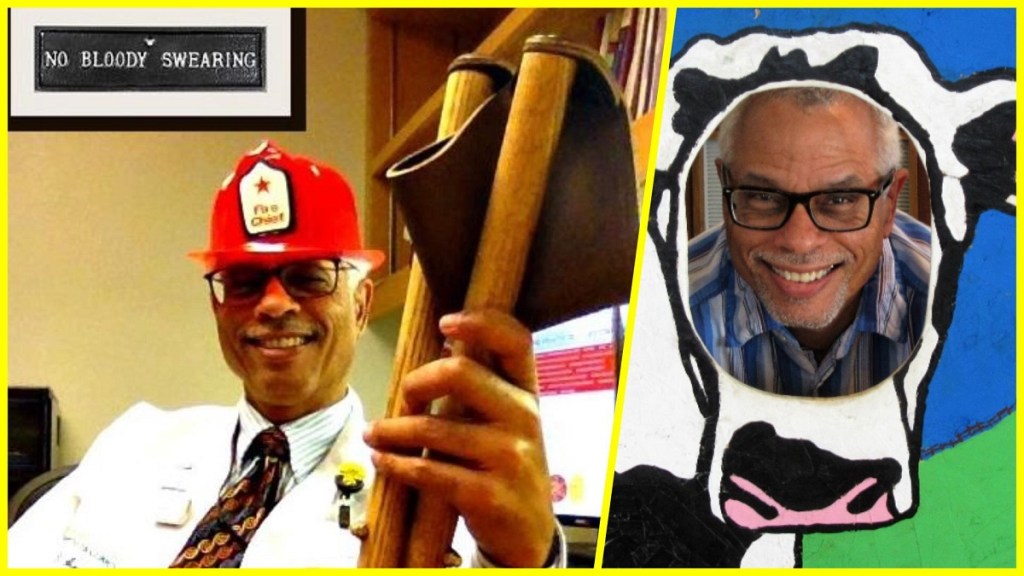
I have what seems like precious few mementos of my sojourn here in the department and, indeed, on this earth. I have a toy fireman’s helmet I found hanging in a plastic sack on my office doorknob one day. It was a gift from a Family Medicine resident who rotated on the consult service and who learned why I called it a fire brigade.

For the same reason, I have a toy fire truck, sent to me by a New York psychoanalyst who was also a blogger.

I have Bumpy the Bipolar Bear, believe or not, sent to me by psychiatrist, Dr. Igor Galynker, about whose emergency room suicide risk assessment method I had blogged about several years ago. C-L psychiatrists do a lot of suicide risk assessments in the hospital and the clinics. I still have the box with the address to me:

WordPress

Attn: James Amos

200 Hawkins Drive

Iowa City, IA 52242

I have my first homemade handbook for C-L Psychiatry and the published handbook that eventually replaced it. Thank goodness the leaders of the Academy of Consultation-Liaison Psychiatry listened to the membership and changed the name from Psychosomatic Medicine to C-L Psychiatry.

I have an award for being an excellent clinical coach.

And I have my little camp stool, which a colleague who is a surgeon and emergency medicine physician gave me and which allows me to sit with my patients anywhere in the hospital, so that I don’t have to stand over them.

It will all fit in a cardboard box on my last day—the next milestone.